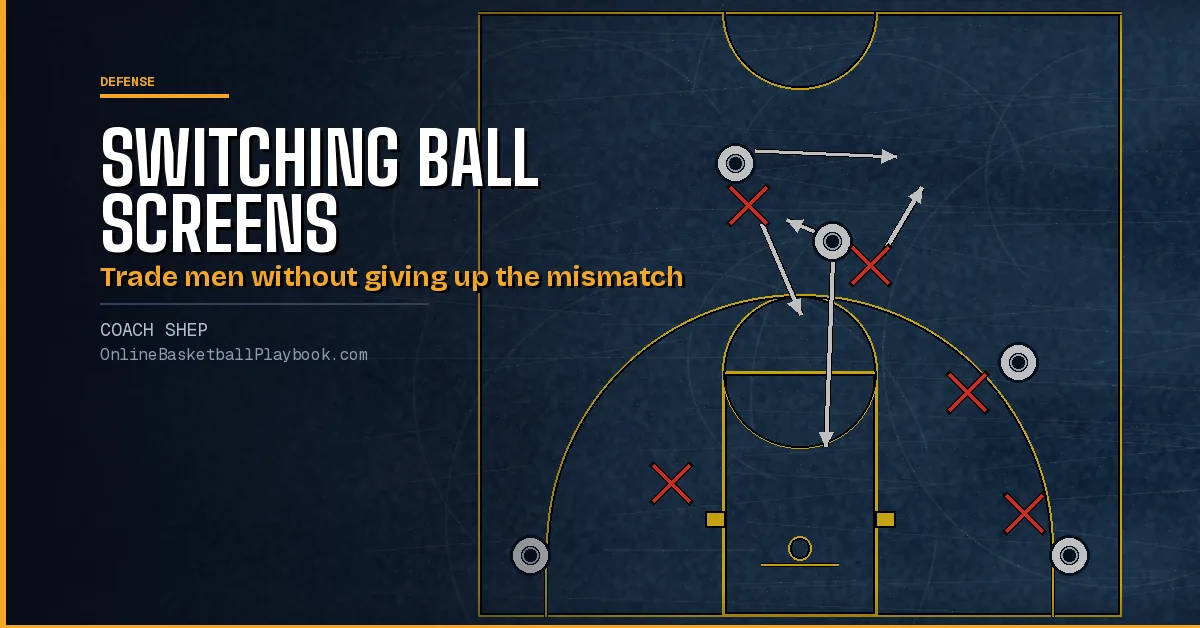
Switching defense in basketball means the two defenders in a screen trade men. On a ball screen, the screener's defender takes the handler and the on-ball defender takes the screener. The switch removes the chase and the hesitation, and it hands the offense a possible mismatch.
Coaches split widely on how much to switch, so this page lays out each option: when teams switch, how much they switch, who calls it, the jump switch, the late switch, how to repair the mismatch, the offense's seal counter and the drills that install it. The other coverages are on the pick and roll defense hub.
Switching Defense: Why Teams Switch Ball Screens
The case for and against:
- The case for. Switching disrupts motion and continuity offenses built on screens, helps contain the ball, and leans less on help-side rotation, because the ball is always guarded directly.
- The case against. It creates mismatches, guard on post or post on guard. It needs high basketball IQ and constant talk. It can leave a guard boxing out a big on a rebound.
- Switch on contact. Automatic contact switching beats show and recover, for five reasons: better pass denial, no hesitation, a broken screening rhythm, fewer fouls, and turnovers that feed the break.
- Switch when your team needs it. Three more reasons to switch: the team is poor at defending the pick and roll, the offense has no real post threat, and switching freezes ball movement, because most teams isolate instead of moving to find the mismatch.
Three triggers start a switch:
- Any screen. The defenders call it out and decide on it.
- A mismatch already on the floor. Such as a small guard on a big forward.
- The high ball screen. A switch denies the driving lane or the open shot.
Know your reason for switching before you ask the team to do it.

How Much to Switch
Coaches split on how much to switch. Think of it as three levels of commitment: positionless switching, 1 through 4 switching where the center never switches, and situational switching, for example only after a timeout or only at the end of the shot clock. The options in use:
| Approach | What it switches |
|---|---|
| Switch everything | Every ball screen by default, with jam and under, or a flat show on a shooting guard, as the fallback |
| Switch equals | Guard on guard and post on post, never a guard and a post |
| Switch by size pairs | The 1 and the 2, and the 4 and the 5. Messina also usually switches the side pick and roll in transition |
| Switch the perimeter only | Ball screens for the 1s, 2s and 3s, and never an off-ball screen |
| Switch by the clock | Everything late in the shot clock, whatever the size |
| Switch by matchup | Only a scouted pair, such as the two bigs when the 4 is a skilled shooter |
| Never switch | No ball screen switch at all |
USA Basketball says switching works best when the defenders match in size and quickness. An NBA coach's test for any of it is whether his team can switch without a clear mismatch and stay home. NBA teams usually avoid switching a big onto a small on a high screen, because the screener slides down and posts the small defender, and they show and recover there instead. Switching at the end of games is on late game situations.
When the clock starts. Do not switch too early, which gives the offense time to hunt the post mismatch. Off a miss, pick up high, about two steps above the arc, go under the first screen, and switch on the ball reversal, once the clock is on the defense's side. Off a make, a shadow press steals seconds so the first ball screen comes later in the possession. Decide how much you switch in the preseason and hold to it.
Who Calls the Switch
Messina has the screener's defender call it, then jump the passing lane. He calls switching an aggressive weapon. Other calls:
- Talk, touch, switch. Run it in that order.
- Screen, over, switch. Have the screener's defender call the screen and hedge one stride into the path, then the two trade.
- The word list. Use "switch," "stay" for no switch, "ball," "switch left" or "switch right," and "help," all called loud and before the screen arrives.
- Words and hands. Pair call words such as "Switch!" and "Screen right!" with hand signals for gyms where a shout will not carry.
More on building the talk is on defensive communication. Call it early and call it loud.
The Switch and the Jump Switch
The switch comes in several forms.
- The jump switch. The screener's defender jumps low into the dribbler's path for a steal, a travel or a charge. The read for the call is a shaky handler, or a screener who is a real threat. The same jump switch can be called "screen, screen, screen."
- Under with a jump switch. The screened defender goes under the screen while the post defender sprints above it to pressure the ball. It accepts a size mismatch to stop the outside shot.
- Jump switch, retreat, resist. Switch under rather than over, because over opens the short roll. The switch takes away the most dangerous pass, from the handler straight to the roller. The big resists the roll, with his body between the roller and the rim.
- Contact switch to a checkpoint. Above the free-throw line, bump and hedge, contact switch to a sideline checkpoint, then smother the ball while the other defender fronts the roller. The full system is on SOS pressure defense.
Pick the form that fits your personnel and drill it.
The Late Switch
A late switch comes after the screen has done some damage. Four ways to do it:
- Downhill or a shooting screener. An NBA staff uses a late switch when the guard attacks downhill or when the screener is a great shooter.
- The peel. A late switch back onto a screener who pops.
- Switch on the tight turn. A college staff does not show at all, and switches late if the handler turns hard and tight off the screen into the big, with set switch defenders for certain matchups.
- Switch, then double. Call switch, switch under, escort the big now guarding the star toward his teammates while the star dribbles two or three times, then send a double. It ends in the same picture as a blitz with three or four more seconds off the clock (see blitz and trap ball screens).

Get the next coaching guide in your inbox
One email when a new guide or diagram set goes up. Free.
Repairing the Mismatch
Every switch can leave a small defender on a big or a big on a guard. Repair it one of these ways.
- Scram. A big takes the post mismatch and the small defender is sent out to the big's man.
- Switch back. Switch back at the first chance when a switch on a back screen leaves a size mismatch.
- Zone the post. Front the post mismatch with the big while the ball is in the air, and the other defenders zone it with their arms spread and pressure the passer. Trap the small or release him by personnel.
- Close out after the rotation. The defender sent out by a scram still has to close out. Teach two closeouts. The short one comes off a stunt and is played as one on one. The long one, called bluff, comes off a skip or an X-out and runs the shooter off the line into the next rotation. The technique is on closeout and recover.
- Load to the isolation. Load to the isolation if a big has switched onto a small.
- Never triple-switch from one side. It leaves the shooter in the corner for a three. Also use open denial, an open stance off the ball, in every switch situation.

Post defense after a switch is covered in more detail on post defense. Have the repair ready before the switch happens.
The Offense's Counter
The offense hunts the mismatch the switch leaves. In the Gortat counter, the screener, now guarded by the smaller defender, seals the help defender so the handler's drive lane stays open. Other counters:
- Flash high. The screener, now guarded by a small, flashes to the high post while his defender is helping, then shoots, passes, drives or seals. If the flash is covered, he screens the helper.
- Arc below the block. The screener keeps the switched defender on his back, the ball reverses to post him, and a lob is there if the defense helps.
- Retreat and dive. The guard retreat dribbles while the post dives to the block against a big-little switch.

The handler's full set of reads against a switch is on pick and roll reads. Expect the offense to hunt the mismatch and plan for it.
Switching Drills
Build it small.
- Footwork apart from live play. Drill switching footwork apart from live play, then run a switching drill on screens with live defense and a full-court switching drill that adds the change from offense to defense under fatigue.
- Rep the coverages. A 2-on-2 series reps four ball screen coverages in turn, the switch among them.
- Climb the ladder. 1-on-1, then 2-on-2 ball screens, 3-on-3 screens, shell 4-on-4, shell 5-on-5 and 5-on-5.
- Install in order. Drop, then switch, then blitz.
More set-ups are on drills to teach ball screen defense.
Then test it under pressure. Competitive formats:
- Perfection Cut Throat. Three teams. The defense needs three stops in a row to win. The coach calls one defensive action for the possession, such as jump to the ball, and if any defender fails it, the stop does not count.
- Stop-Score-Stop. Messina's 5-on-5 does not end until one team chains a stop, a score and another stop.
- Defensive Validation. Messina's format counts a score only if the scoring team gets a stop on the next possession, played to 5 or 7.
- The 24-second drill. The offense has 24 seconds to score. A stop takes the clock down for the next possession, and an offensive rebound resets it to a full 24.
More competitive formats are on competitive defense drills. Two mistakes to coach against: miscommunication, and over-committing to the switch, which opens the driving lane the switch was meant to close. Build it small, then test it under pressure.
Questions Coaches Ask About Switching Defense
What is switching in basketball defense?
The two defenders in a screen trade men. On a ball screen, the screener's defender takes the handler and the on-ball defender takes the screener.
Should you switch every ball screen?
Coaches split between switching everything, switching only equals or the perimeter players, switching only late in the shot clock, and never switching a ball screen.
Who calls the switch?
The screener's defender calls it, early and loud, before the screen arrives.
What is a jump switch?
The screener's defender jumps into the dribbler's path as he comes off the screen, looking for a steal, a travel or a charge, while the on-ball defender takes the screener.
How do you defend a mismatch after a switch?
Scram with a big onto the post, switch back at the first chance, front the post and zone behind it, or load to the isolation.
Want the printable playbook packs?
OBP Pro members get the premium playbook packs: the zone attack, out of bounds and practice plan PDFs, plus each new pack as it is finished. The membership page lists what is in each one. Or draw your own version free in PlayDraw.
See what OBP Pro includesMore Coaching Guides From This Batch
- Drop Coverage Basketball: How the Big Plays the Ball Screen
- Hedge Basketball: Hard Hedge, Flat Hedge and the Recovery
- Ice Basketball Defense: Push the Side Pick and Roll Down
- Blitz Pick and Roll Defense: How to Trap a Ball Screen
Back to Pick and Roll Defense and every Defense page.
Keep Building
Related breakdowns
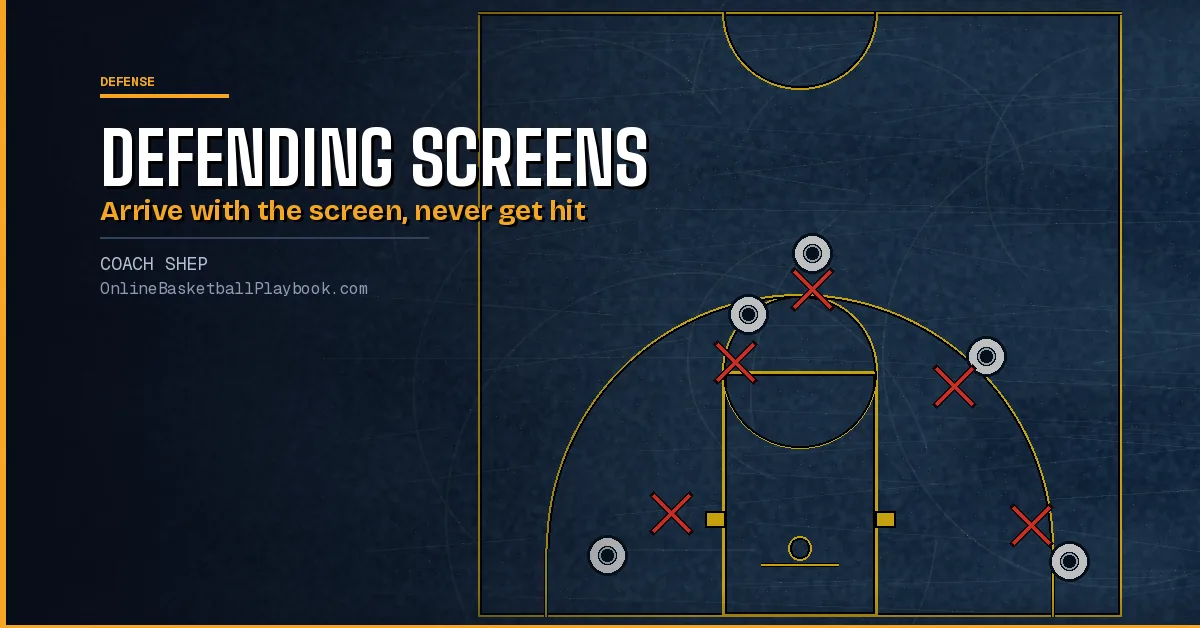
Defending Screens in Basketball: 5 Keys for Every Coverage
Defending screens in basketball comes down to five keys that hold under any coverage, for ball and off-ball screens, with the mistakes that cost baskets and drills.
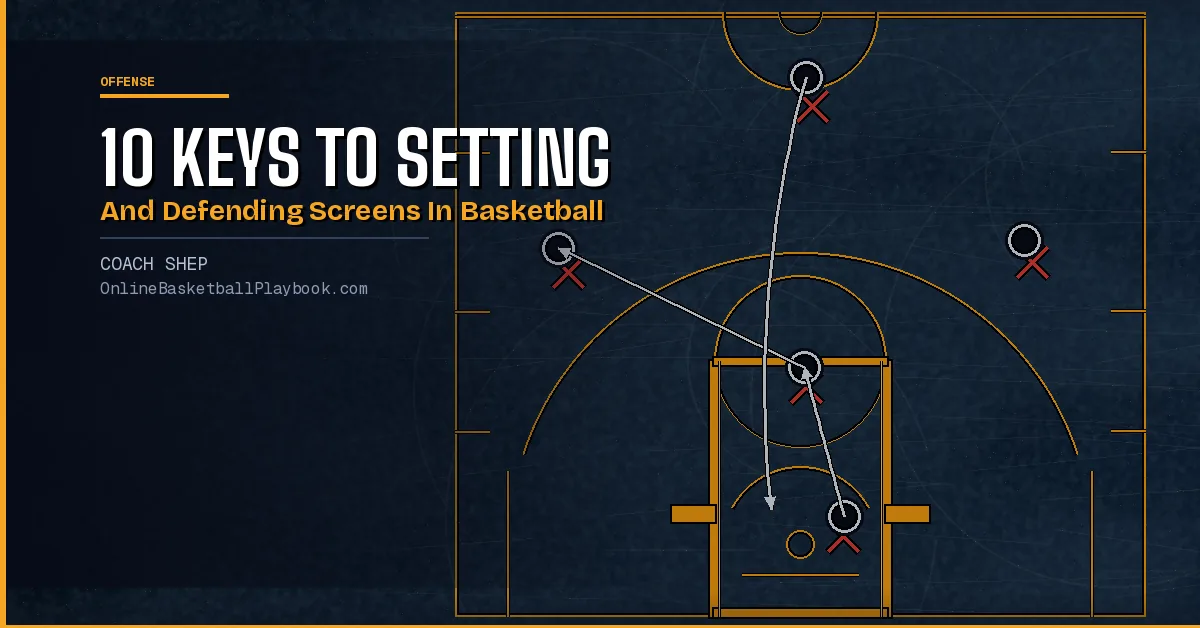
10 Keys to Setting and Defending Screens in Basketball
10 Keys to Setting and Defending Screens in Basketball
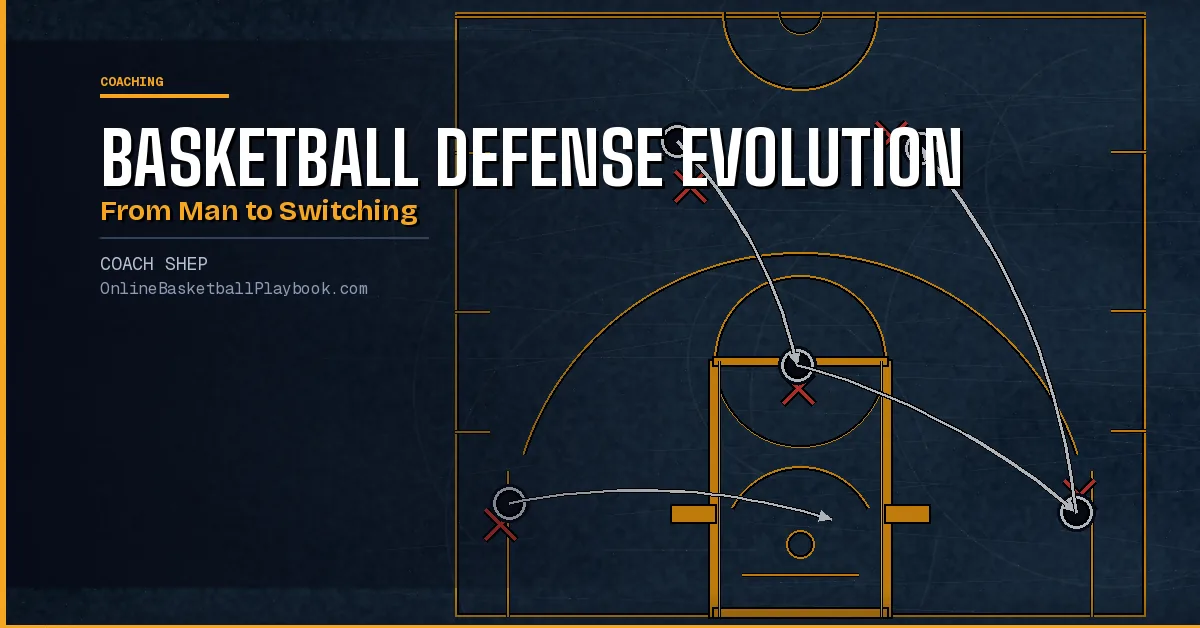
Basketball Defense Evolution: From Man to Switching
Basketball Defense Evolution: From Man to Switching