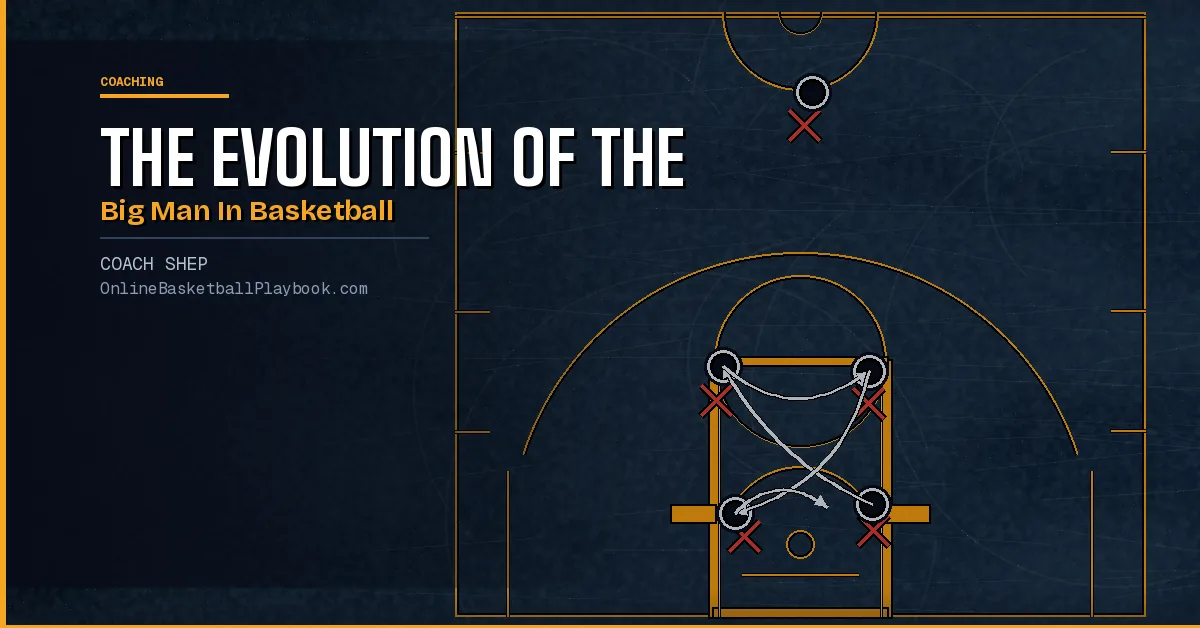
The center position has transformed more than any other spot on the floor. What used to be a back-to-basket power role is now a multidimensional job requiring shooting range, screening craft, and the ability to read advantage in real time.
The Original Big Man: Post Dominance Era
For most of basketball's first century, the center's job description was simple: get to the block, catch the ball with your back to the basket, and score over or through the defender. Players like Wilt Chamberlain, Bill Russell, Kareem Abdul-Jabbar, and later Shaquille O'Neal defined the position through raw size, strength, and footwork in the post. Offenses were designed around them. Everyone else cleared out and watched.
This model worked because defenses had no answer. A 7-foot center catching the ball in the low post with a smaller defender behind him was statistically one of the highest-percentage shots in basketball. Coaches called plays to enter the ball to the post and trusted their center to make the right move from there: a drop step baseline, a hook over the left shoulder, or a face-up jumper if the defense crowded.
The post-up was not just a play; it was the organizing principle of half-court offense. Everything else (ball reversal, cuts, screens) existed to create clean post entries. Teams without a dominant big were considered offensively limited by design. Having a legitimate center was a structural advantage that no amount of perimeter skill could fully offset.
Defensively, the era matched that philosophy. Big men anchored zone defenses and patrolled the paint, blocking shots and altering drives. Their job was to protect the rim and rebound, period. Mobility was not prized. Range beyond eight feet was irrelevant. A center who could run in transition was a bonus, not a requirement.
Stretch Bigs and the Three-Point Revolution
The shift began slowly. As three-point shooting became a more prominent offensive weapon in the late 1990s and through the 2000s, defenses started collapsing harder into the paint to prevent dribble penetration and easy layups. The logic was sound: concede a three rather than a two. But this created a new problem. If the center cannot shoot from distance, he actively clogs the lane and makes drives harder for his own team.
Coaches and front offices noticed that traditional post-up bigs occupied real estate the offense actually needed empty. When a non-shooting center stationed himself in the paint, he eliminated the driving lane and gave the defense a free help body. You could not drive and kick effectively because the center's defender did not have to guard the arc. The math turned against the old model gradually, then all at once.
The "stretch four" concept emerged, a power forward who could step outside and shoot the three, pulling his defender away from the basket and reopening the paint. Dirk Nowitzki was its most complete expression. His ability to shoot off the dribble from anywhere on the floor meant his defender could not sag, which meant the driving lanes stayed open for teammates. The floor-spacing big was not a luxury anymore; it was becoming a structural requirement.
Centers followed the same path. By the 2010s, teams were actively seeking bigs who could step to the elbow or the arc and shoot with credibility. The five-out spacing concept (all five players able to play outside the paint) began entering coaching vocabulary at every level. The post-up did not disappear entirely, but it was no longer the organizing principle. It became one of five weapons rather than the one weapon everything else served.
The Modern Big as Screener and Playmaker
As floor spacing became the baseline expectation, the modern center's value proposition shifted again. Shooting was necessary but no longer sufficient. The most valuable bigs in contemporary basketball are those who function as offensive engines through screening, roll reads, and short-roll playmaking.
Pick-and-roll offense became the dominant half-court action in the NBA and cascaded down to every level of the game. The center's role in that action is more complex than it appears. Setting a hard screen is only the first step. After the screen, the big must read the defense: hedge or drop coverage means the roll is open, switch coverage means a mismatch opportunity, ice coverage means the guard needs help and the big must pop or relocate. A center who can make only one read after the screen is easily scouted and defended. A center who processes two or three reads and responds correctly is extremely difficult to guard.
Short-roll playmaking added another dimension. As defenders began doubling the roll-man to prevent easy finishes at the rim, the smartest centers learned to catch the short roll, face up, and make a pass to the open shooter or cutter. Bigs like Nikola Jokic took this to a different level entirely, catching at the elbow and becoming the primary decision-maker in the offense, essentially running the team's half-court attack from the high post. The center as point guard was no longer a novelty concept; it became a legitimate offensive system.
Spacing, Cutting, and the Big's New Role in Man Offense
The principle the quote describes (five distinct paths, sequenced to exhaust the defense) reframes how coaches should think about their big man's contribution to man-to-man offense. In the old model, the center's job was Path 5 (post-up) almost exclusively. In the modern model, a complete big executes all five paths depending on what the defense gives.
Path 1 (penetration) now involves the big either as a pick-and-roll screener who opens the driving lane, or as a cutter to the rim who clears the way for a guard's drive. The center who sprints to the rim on any unguarded step, rather than waiting at the elbow, forces a coverage decision the defense cannot always win. If the defense ignores the cut, it is a layup. If the defense accounts for it, a perimeter player is open. The center as an active cutter creates pressure the old post-standing big never generated.
Path 3 (cutting) is where the modern big who can play away from the block creates the most damage. A center who takes a defender into the short corner and cuts back to the high post, or who V-cuts from the dunker spot to the elbow, manipulates spacing in ways guards cannot. His defender must follow. If the defender cheats to guard the paint, the big flashes open on the wing for a mid-range catch-and-shoot. The defense cannot have it both ways.
Path 4 (mismatch exploitation) remains the big man's most direct offensive path, but accessing the mismatch now requires more sophistication. In modern offense, the mismatch is created through action (a dribble hand-off, a ball screen, a slip) rather than called in advance. The most effective approach is to flow into the mismatch naturally through continuous offense rather than calling a timeout. A timeout gives the defense time to hide the smaller, slower, or weaker defender. The mismatch exploited in live action, within the flow of the offense, is far harder to counter.
How to Coach the Modern Big Man
Coaching bigs in today's game requires teaching layers that did not exist in the traditional post-dominant era. The first layer is technical: footwork, finishing with both hands, screening angles, and roll-to-rim timing. These fundamentals have not changed. A big who cannot finish at the rim or set a legal, hard screen is still limited regardless of what era he plays in.
The second layer is conceptual: the big must understand the action-to-advantage loop. Every screen he sets creates a defensive decision. Every cut he makes forces a help rotation. Every time he catches at the short roll, the defense has already made a commitment somewhere. His job is to read that commitment and attack the correct response: score, pass, or reset. This cannot be taught by calling plays. It must be taught by training the read.
The third layer is competitive disposition. Big men who evolved the position (from Hakeem Olajuwon's footwork in the post, to Tim Duncan's mid-range mastery and passing, to Jokic's full-court orchestration) all shared one trait: they wanted the ball in difficult situations and they processed information faster than the defense could act. Coaches who develop this disposition in their bigs, rather than protecting them from reads by calling simpler plays, produce players who can function without a set.
At the youth and high school level, the evolution demands a different kind of patience. Coaches must resist the temptation to park a tall, physical player in the post and feed him the ball. That approach might win games early, but it stunts the player's development and leaves him unprepared for higher levels where his size advantage narrows and his skill must carry more weight. Teaching the modern big the five paths, in order, produces a more complete player and a more versatile offensive system.
When developing bigs, drill the short-roll read before drilling the post-up. Most high school centers never practice catching at the elbow in live traffic, reading a collapsing defense, and making the skip pass to a corner shooter. That read is what separates an effective modern big from a liability in spread pick-and-roll offense, and it is entirely coachable with deliberate repetition.
What the Next Evolution Looks Like
The trajectory of the position suggests the next phase of the big man's evolution is already underway. Centers are increasingly expected to function as primary ball-handlers in short stretches, initiate offense from the top of the key, and execute actions historically reserved for guards: cross-court skip passes, step-back mid-range jumpers, and on-ball pick-and-roll reads as the handler rather than the screener.
At the NBA level, teams are already deploying lineups with no traditional center at all: five players who can all shoot, handle, and switch defensively. The "positionless" concept has been discussed for two decades, but it is arriving in earnest now. This does not mean centers are disappearing. It means the definition of what a center must do to stay on the floor has expanded so significantly that it now overlaps heavily with what forwards and guards have always done.
For youth and high school coaches, the message is practical: start teaching your tallest players guard skills earlier, not later. Ball-handling, shooting off movement, reading pick-and-roll coverages as the handler. These are not finishing touches for elite prospects. They are baseline skills that any serious big should be developing by age 14 or 15. The window to build these skills is not as large as coaches have historically assumed, and the programs that start this developmental work early will produce bigs who remain on the floor as the game continues to evolve.
The big man is not obsolete. Size, strength, and the ability to play at the rim still matter. What has changed is the context: those physical gifts now need to be paired with reads, range, and the ability to operate within a system designed around spacing and action rather than isolation and entry passes. The centers who thrive in the next decade will be those who mastered both worlds: the old footwork and the new reads, the paint and the perimeter, the finish and the pass.
- Teach the five offensive paths by name: Penetration, screening, cutting, mismatch exploitation, and post-up. Your big should know which path he is running on every possession and why.
- Drill the short-roll read weekly: Catch at the free-throw line or elbow, face up, and pass to the open shooter or cutter before the defense recovers. This single read makes your pick-and-roll system far harder to guard.
- Sprint-to-rim rule for all cuts: If your big is unguarded for even one step on any cut or screen-clear, he attacks the basket immediately (no pause, no look-around) because hesitation gives defenders time to recover and erase the advantage.
- No spacing, no action: before running any half-court set, confirm all five players are in their spacing spots; a non-shooting big parked in the paint eliminates the driving lane and gives the defense a free help body.
- Develop perimeter shooting early: Bigs who can step to the elbow or the arc force their defender to leave the paint, which opens every drive-and-kick action your guards run. This skill compounds over time and should start at the youth level, not in college.
Want more basketball coaching strategies and drills?
Join the Online Basketball Playbook newsletter →
Draw this play free in the play drawer →
Membership: the full library, playbook packs, and Pro drawing tools →
Keep Building
Related breakdowns
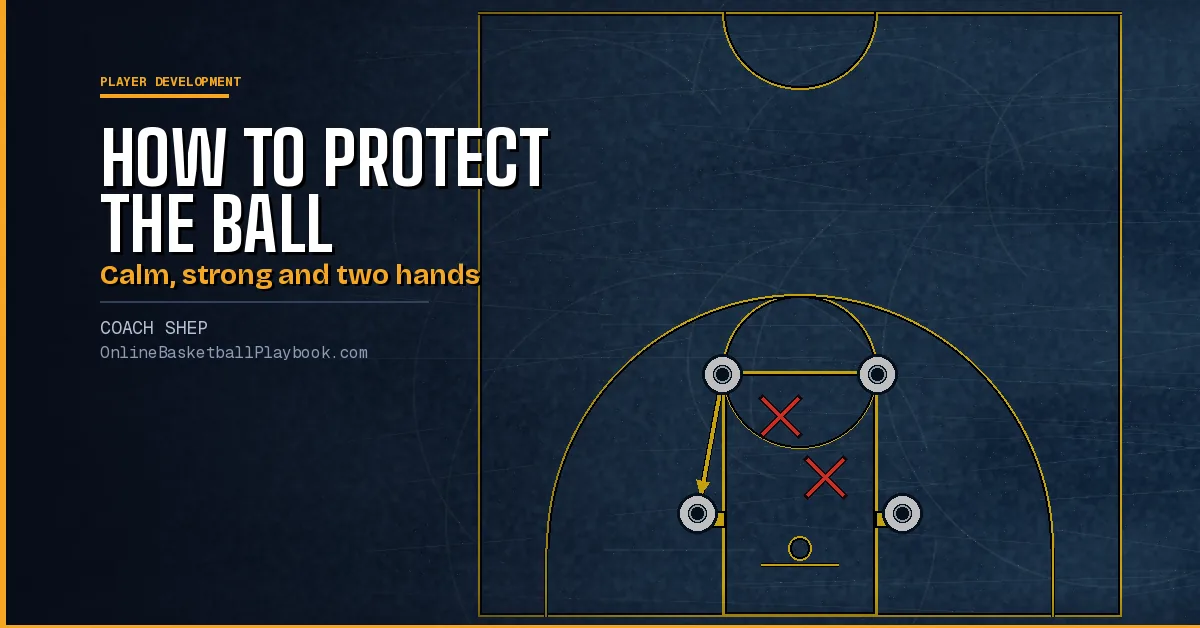
How to Protect the Ball: Ball Security and Fewer Turnovers
How to protect the ball in basketball: where turnovers come from, ripping and catching, the sure pass, beating a trap, ball security drills and pricing turnovers.
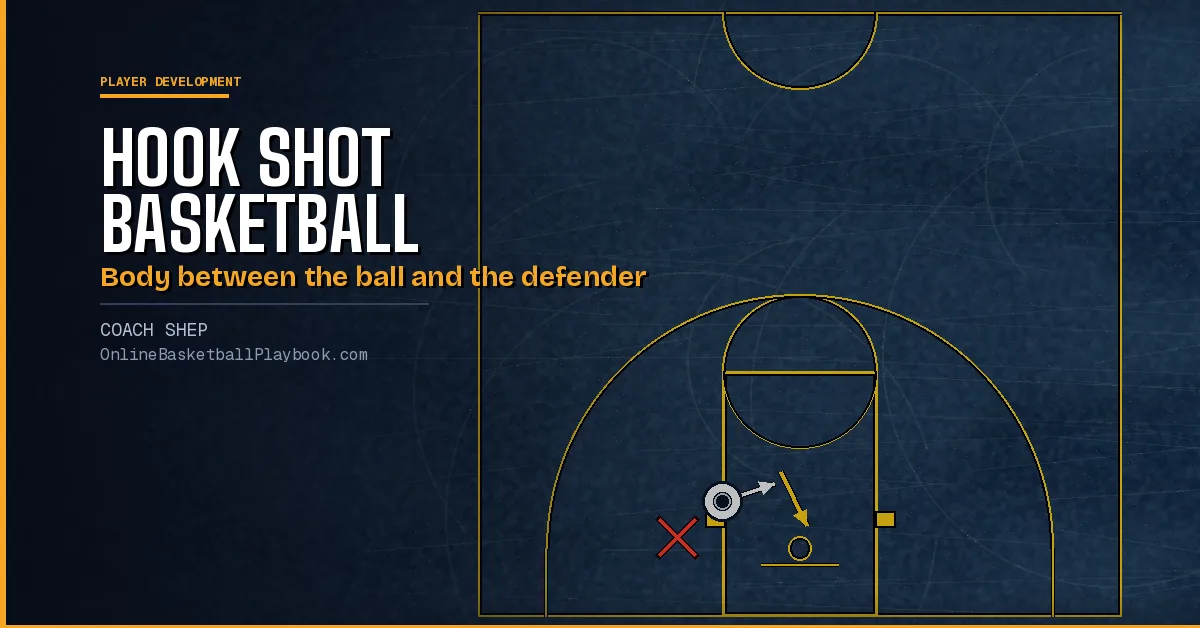
Hook Shot Basketball: How to Do It and How to Teach It
Hook shot basketball for post players and coaches: the classic hook, sky hook and jump hook, the footwork steps, when to use it, the pivot foot rules and drills.
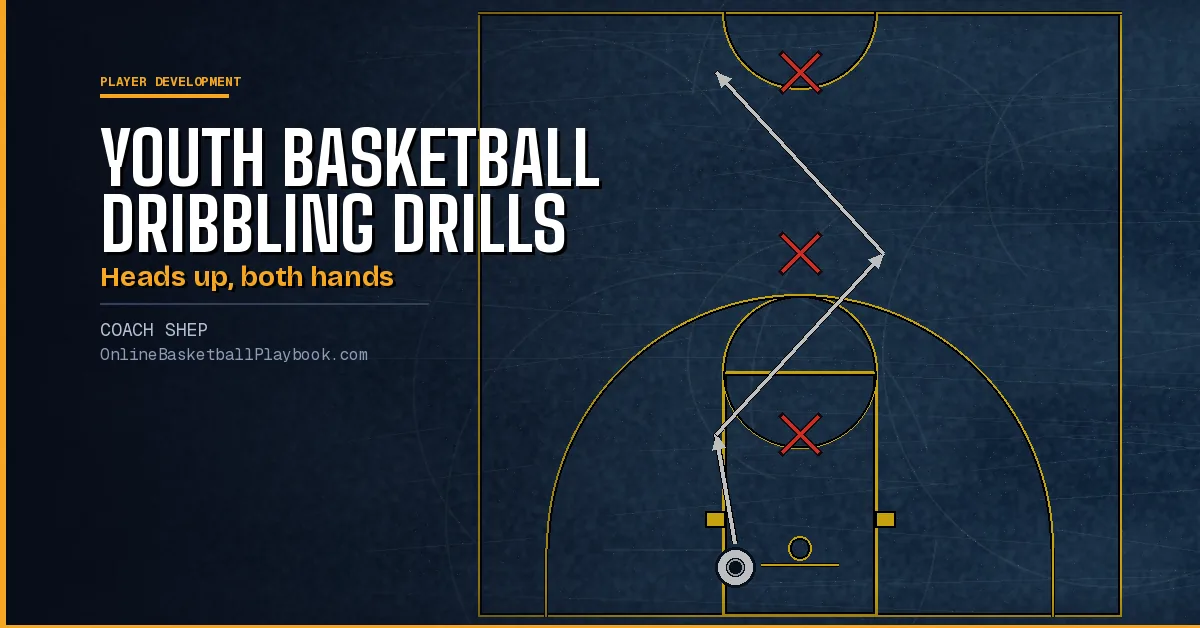
Youth Basketball Dribbling Drills: Cone Drills and Games by Age
Youth basketball dribbling drills for kids: finger-pad work, eyes-up games, cone dribbling drills, line drills and harder drills by age.