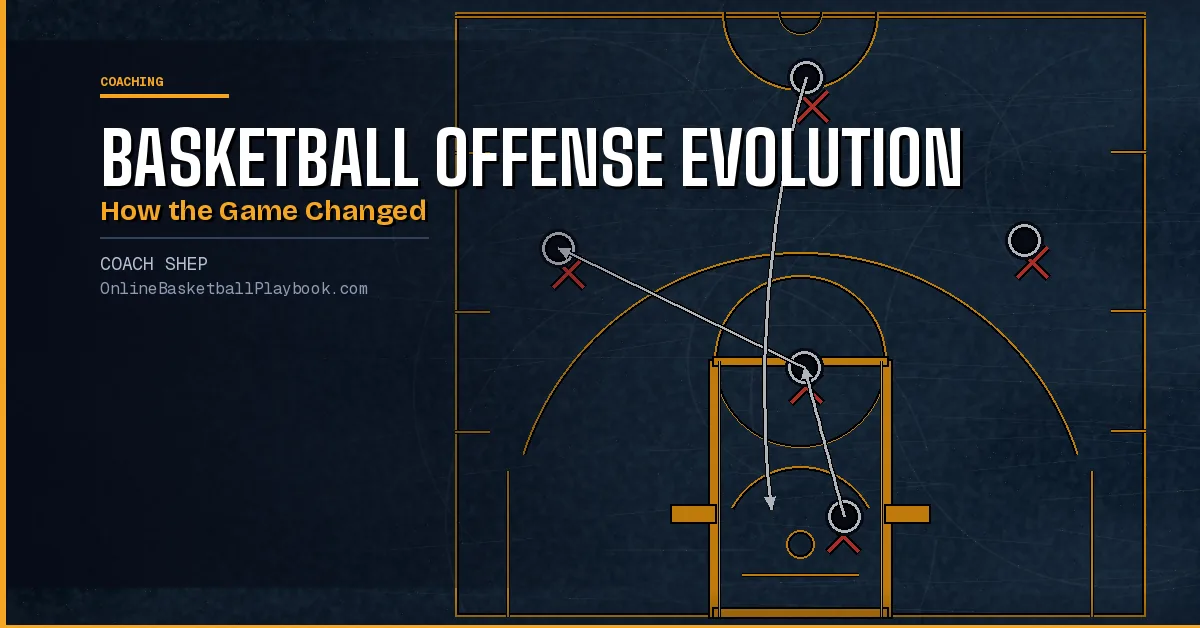
Basketball offense didn't evolve by accident. Coaches responded to defenses, rules changed spacing, and the best ideas spread from gym to gym. Here's the arc every serious coach should know.
The Set Play Era: Memorize and Execute
For most of the twentieth century, basketball offense meant running plays. The head coach drew something up, the players memorized their assignments, and the goal was precise execution. Every player had a designated spot, a scripted cut, and a defined role. This model had an obvious appeal. It was teachable, it gave coaches control, and it created clarity in the heat of competition.
The problem was just as obvious: defenses could prepare for you. A well-scouted opponent didn't need to guard your players. They needed to guard your plays. Once a team learned your four or five go-to sets, they had a significant advantage. Coaches responded by adding more plays, creating larger playbooks, and relying on players to memorize increasingly complex sequences. This arms race between offensive scripting and defensive preparation defined basketball strategy for decades.
There was also a structural ceiling on what set plays could accomplish. A play only works if your players execute it correctly, against the defense that it was drawn up to beat. The moment a defender shades a cut, jumps a passing lane, or switches unexpectedly, the play breaks down and a team trained only to run scripted sequences has no answer. The player looks to the bench, the possession stalls, and the clock burns. Set plays made great coaches out of tacticians, but they exposed teams the moment conditions deviated from the script.
Despite these limitations, set plays produced some of the most effective offenses in history. Coaches like John Wooden built dynasty programs on precisely rehearsed execution. The triangle offense, developed by Tex Winter, began as a structured system of reads that nonetheless kept players in assigned positions and alignments. Even today, no serious program abandons scripted sets entirely, but the dominant philosophy has shifted away from using them as the primary offensive engine.
The Rise of Motion Offense
The decisive shift came when coaches began asking a different question. Instead of "what play should we run?" the question became: "what does the defense give us?" Motion offense was born from that reframe. Rather than scripting where players go, motion offense teaches players to read what the defense is doing and respond accordingly. The offense is not a series of memorized actions. It is a set of rules that players apply in real time.
The foundational motion principle is simple: every pass must be followed by a meaningful action. A player cannot receive the ball, throw it ahead, and stand and watch. After each pass, the player must cut toward the basket, set a screen, or receive a screen. Standing is not a neutral act in motion offense. It is a mistake. It allows defenders to watch the ball, collapse on the ball-handler, and ignore the passer. When every player is moving with purpose after every pass, the defense must account for five threats simultaneously. That is a problem no scouting report can fully solve.
Motion offense gained serious traction at the college level through the 1970s and 1980s. Coaches who were tired of seeing their playbooks scouted embraced the read-and-react model precisely because it removed the entry point defenses were exploiting. If your offense has no fixed sequence, the defense cannot memorize it. Every possession looks different because it is different. The players are responding to what they see, not reciting what they rehearsed. For coaches working at smaller schools with less recruiting power, motion offense was a tactical equalizer.
The early versions of motion offense were deliberately simple. A handful of rules governed the players: space the floor, pass and cut, never stand. As coaches refined the system, they added named actions: specific cuts, screens, and reads that gave players a vocabulary for what they were already doing instinctively. Naming an action does not make the offense scripted. It makes the reads coachable and the communication faster. A player who can say "Flare!" to a teammate is communicating a real-time read, not announcing a play call.
The Spacing Revolution and the Three-Point Line
The introduction of the three-point line in college basketball in 1986 and its gradual adoption at every level forced an entirely new spatial logic onto the game. Before the three-point arc, the most efficient scoring zones were the paint and the mid-range areas near the baseline. Teams built offenses around getting the ball inside, drawing fouls, and kicking out to open mid-range shooters. Spacing was about creating driving lanes and post entry angles, not about positioning shooters at optimal range.
The three-point line changed the value of floor positions overnight. A corner three-pointer is roughly the same distance from the basket as a straightforward mid-range jumper, but it is worth fifty percent more. Any team that could populate the corners and wings with competent shooters while attacking the paint with a skilled ball-handler had a built-in points-per-possession advantage over teams playing traditional spacing. Coaches who recognized this early gained years of competitive edge before the rest of the game caught up.
The spacing revolution also forced a rethinking of what "big men" were supposed to do. Traditional post players operated near the basket, caught entry passes, and scored in traffic. But a team that keeps its five-position player glued to the block is essentially removing a shooter from the perimeter, compressing its own spacing, and making it easier for the defense to pack the paint. Coaches began asking their bigs to step out to the elbow or beyond, stretching the floor and creating the driving lanes that ball-handlers needed. The stretch four became a standard roster archetype rather than a novelty.
Five-out motion offense, all five players operating from perimeter positions, emerged as the natural endpoint of this spacing logic. With no one parked in the paint, every driver has an unobstructed lane. With shooters at every perimeter spot, a defense cannot help without surrendering an open three. The spacing itself creates offense. A team running five-out motion doesn't need a dominant post player or an isolation scorer. The structure of the floor forces defensive mistakes.
Reading the Defense: Offense Becomes a Skill
The most sophisticated development in modern offensive basketball is the elevation of reading to a learnable, coachable, trainable skill. Earlier generations of coaches understood that players needed to read the defense, but treated that ability as something players either had or didn't. You were a natural reader of the game or you weren't. The best modern systems have rejected that assumption. Reading is a skill, and skills can be taught.
The key insight is that every defensive action has a correct offensive answer. A defender who is playing denial, positioning to cut off the passing lane, has left the backdoor open. A defender who sags off to help on a drive has given up the open catch-and-shoot opportunity. A defender who fights over a screen has been set up for the curl. A defender who goes under a screen has given up the pull-up. None of these reads require athleticism or natural gift. They require training the eyes to gather information and training the body to respond without hesitation.
Coaches who operate in the read-based framework build their practice time around exposing players to these decision points repeatedly. Rather than running set play after set play in scrimmages, they create constrained drills (two-on-two, three-on-three, four-on-four) where the situations that generate reads happen constantly. A player who has made the backdoor cut two hundred times in practice does not need to think about it in a game. The decision has become automatic. This is what separates a team that "runs motion" from a team that actually executes it under pressure.
The vocabulary of read-and-react has also expanded dramatically. Coaches like Ettore Messina have articulated that ball movement beats player movement as a first principle. A quick pass finds a late defender faster than any amount of player motion against a stationary ball. Sviatoslav Obradović identified the fake as a prerequisite to every move: not just the shot fake, but faking a cut, a pass direction, a screen. These insights codify what elite players have always done intuitively and make them teachable to players at every level.
The Positionless Era and Modern Principles
The current era of basketball offense is defined by the collapse of positional thinking. The five traditional positions (point guard, shooting guard, small forward, power forward, center) were never really about physical traits. They were about what defenses forced offenses to do. A team that needed a shot-blocker in the paint had to keep a big man near the basket, which shaped the rest of the offense around that anchor. As spacing has forced big men to the perimeter and as ball-handling skills have spread across roster positions, the old positional labels have lost most of their meaning.
Modern offenses are built around skills, not positions. A team needs some combination of shot-creation, floor spacing, ball movement, and defensive pressure resistance, and those skills can be distributed across the roster in different ways. A squad with four players who can each handle, pass, and shoot from range creates offensive problems that no traditional scheme can solve. The defense simply does not have a defensive lineup that matches up cleanly against four interchangeable playmakers.
The positionless model also changes how teams think about player development. In a traditional system, a power forward learns power forward skills: posting up, setting screens, rolling to the basket, defending the paint. In a positionless system, every player needs to be able to catch, read the defense, make the pass, and shoot the open shot. This demands more from each player, but it also produces more complete players. Coaches who have embraced positionless development report that their players are harder to scout and more adaptable in-game because they are not locked into a single role.
The concept-based offense represents the leading edge of where this evolution is heading. Rather than giving players a set of rules to follow, concept-based systems give players a set of decision frameworks: if the defense does X, the offense does Y, but if the defense adjusts to stop Y, the offense has Z built into the same action. The actions are named and triggered, but the responses are layered. This turns every possession into a real-time chess match where the offense always has a trained answer to whatever the defense presents.
Applying the Evolution at Every Level
Understanding offensive history is only useful if it changes how you coach. The through-line of the last seventy years of offensive evolution points in one clear direction: the teams that win consistently are the ones who teach players to read the game, space the floor, and make ball movement automatic. That principle holds whether you are coaching a middle school program or a high-level prep school.
At the youth and high school level, the tendency is still to over-rely on set plays. Coaches feel pressure to have something drawn up, something specific to run in a timeout situation, something that shows preparation. That instinct is understandable, but it frequently produces teams that fall apart the moment the play breaks down, because the players have never been trained to read and react. The most valuable thing a coach can install at a developmental level is motion rules: pass and move, read your defender, cut when the help turns away, shoot when you are open off the catch.
The install process matters as much as the system itself. Motion offense is not taught by running five-on-five scrimmages and telling players to "read the defense." It is taught by progression: starting with the base rhythm of pass-and-cut in five-on-zero, adding screens only after the rhythm is automatic, then adding reads layer by layer. A team that tries to run the full system before owning the basics will produce slow, confused possessions where players are hesitating to think rather than moving to play.
Before you install any motion system, decide on ONE rule and drill it until it is automatic: "every pass must be followed by a cut, a screen, or a screen reception, with no standing allowed." Track standing as an error in film review, call it out by name in practice, and hold players accountable to it before you add any other layer. Teams that try to install ten motion rules at once master none of them; teams that master one rule at a time build a foundation that holds under game pressure.
- Teach the pass-and-cut rhythm in five-on-zero before introducing any defensive pressure. Let players feel the timing of motion without the chaos of reading a live defense.
- Name every recurring action you teach (flare, backdoor, ball reversal, slip screen) so players can communicate reads in real time rather than pointing and gesturing mid-possession.
- Use the points-per-possession framework to teach shot selection: layups and corner threes are worth more than any mid-range jumper, so train players to recognize and attack those two looks first.
- Track standing as a team error in film sessions. When a player catches and stands after passing, mark it on the film log so the habit gets addressed with data, not just frustration.
- Reserve set plays for specific game situations (sideline out-of-bounds, after timeouts, last-shot scenarios) and let motion offense run your standard halfcourt possessions. This keeps your set plays effective precisely because defenses see them rarely.
- Emphasize spacing as active work, not passive positioning. Players must move to maintain the fifteen to eighteen foot gaps that keep driving lanes open and defenders honest.
Want more basketball coaching strategies, drills, and tools?
Join the Online Basketball Playbook newsletter →
Draw this play free in the play drawer →
Membership: the full library, playbook packs, and Pro drawing tools →
Keep Building
Related breakdowns
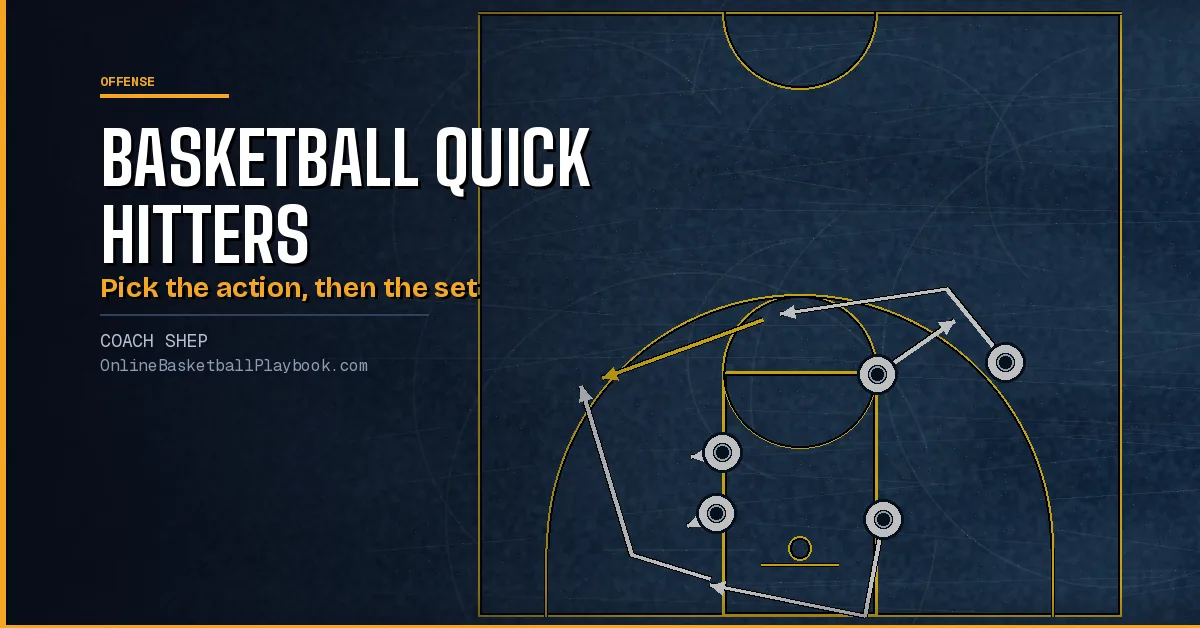
Basketball Quick Hitters: 25 Sets by Action and Formation
Basketball quick hitters sorted by the action you want, catch-and-shoot to post feed, with each set's formation, diagrams, the read and the counter.
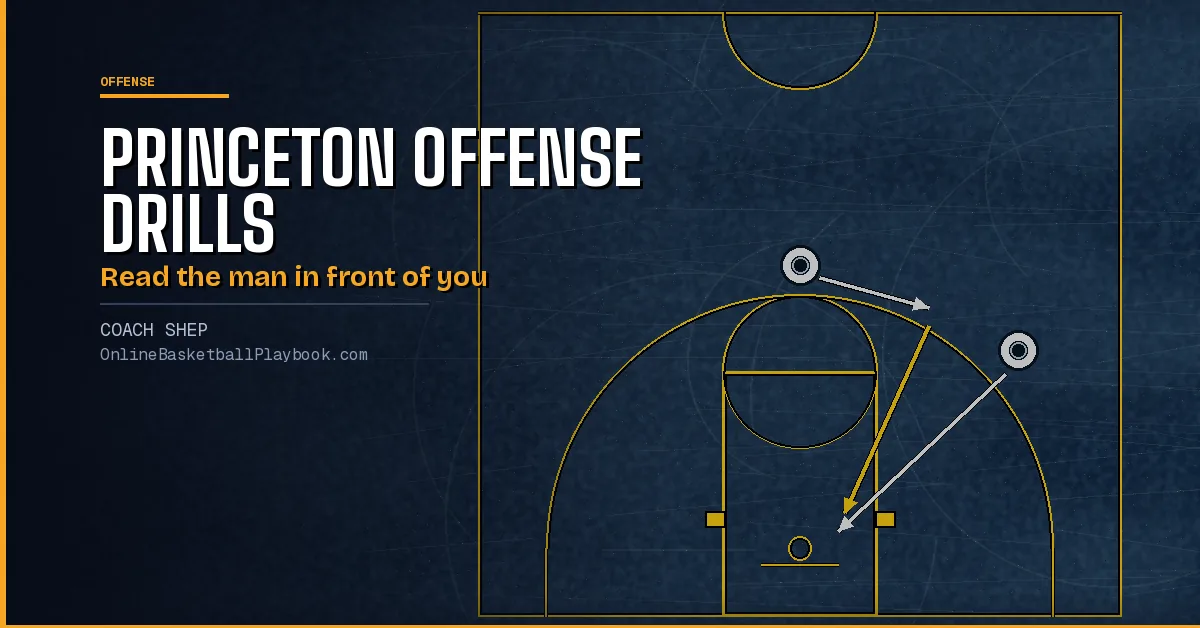
Princeton Offense Drills: Breakdowns, Shooting and Live Reps
Princeton offense drills that teach the reads: spacing, backdoor and hand-off breakdowns, 3-0 Chin and wave drills, Point shooting, a drive drill and an install.
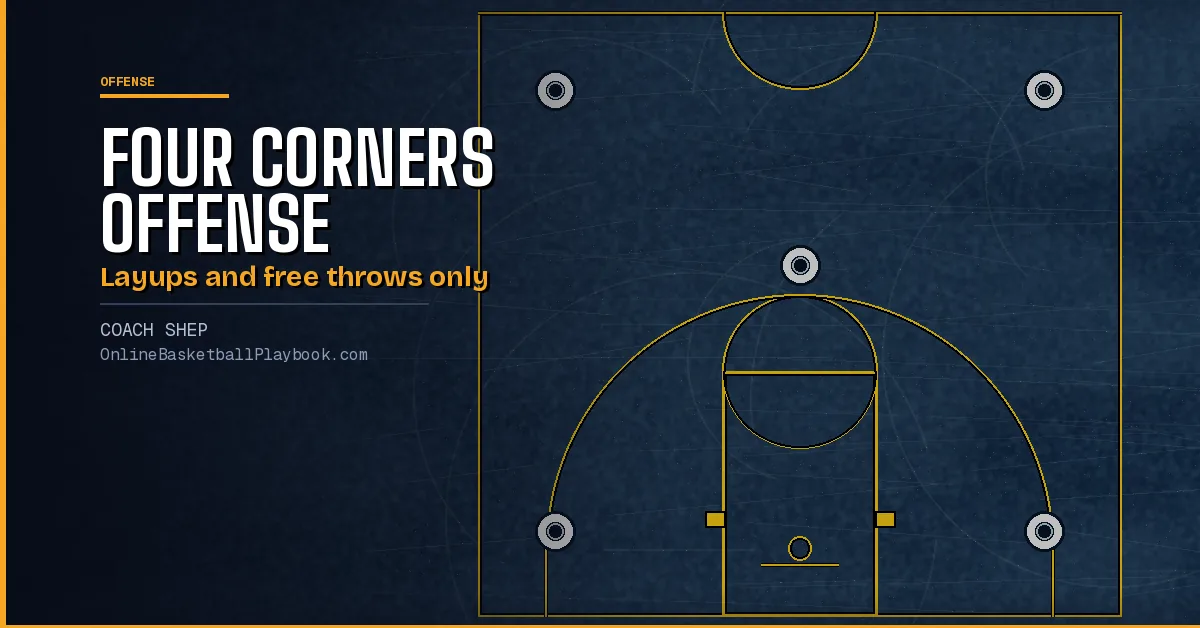
Four Corners Offense Basketball: Roles, Rules and Versions
Four corners offense basketball: the set, the chaser, the corner and post rules, three versions, when to run it, the shots it hunts and shot clock limits by level.