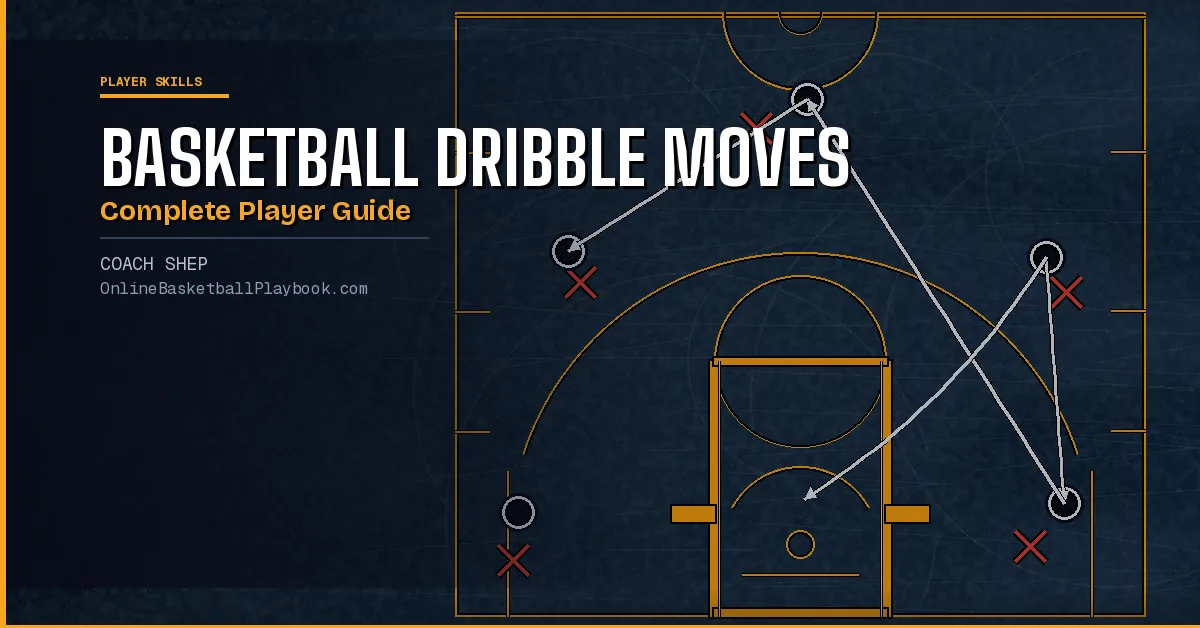
Every elite guard owns a named move library, a small set of mastered dribble moves that create real separation. This guide breaks down the core moves, the footwork behind each one, and how to train them so they hold up in live games.
Why Every Guard Needs a Named Move Library
Most players dribble reactively. They respond to the defender without a clear plan. Elite guards work the other way. They enter every possession with a short list of practiced options, read the defender, and execute the move that fits the coverage. That preparation is what makes them look fast even when they're not.
The naming habit itself is underrated. When you give a move a name (Nash's hesitation, Bodiroga's body fake, Parker's stop-and-shoot), you do three things at once. You build a shared vocabulary between player and coach (one word replaces a two-sentence correction). You give the player a film-study assignment. And you attach the move to a player who executes it at the highest level, which makes self-coaching off film much easier.
Named moves also make practice more efficient. When a guard knows exactly which move they're repping, they can give mental feedback on each rep: did the footwork feel right, did the head fake sell it, did they keep their eyes up? Nameless repetition is just burning time. Named repetition builds a real inventory.
Building a named move library should start in pre-season. Introduce one move per week. Post a short player clip (a pro running that exact move) to the team film account. By the start of the season, guards have six or seven named options they can call on in a game. They start making self-corrections without a coach present, which is the real goal of skill development.
The Core Dribble Moves Every Guard Must Own
Not every guard needs twenty dribble moves. They need five or six they own completely, moves they can execute under pressure, on tired legs, with a live defender. Here are the essential moves drawn from elite guard development work at the pro and college level.
The Hesitation (Shake and Bake)
The hesitation is the most undervalued move in basketball because it looks simple. The guard drives hard, then freezes (knee comes up, eyes go to the rim) and reads the defender. If the defender straightens up and recovers, the guard attacks. If the defender stays spread, the guard pulls up. The hidden piece most players miss is the pull-back dribble as the hesitation's escape valve. When the defender doesn't bite on the freeze, a hard pull-back dribble resets position without losing the live dribble. Most programs never name or rep this variation, which is why guards only use the hesitation as a pull-up setup rather than a two-way tool.
The Body Fake (Shoulder Switch)
The body fake is one of the most underused high-school tools precisely because it isn't flashy. Fake with the shoulders while keeping the ball directly in front of the body, then switch hands. It is explicitly not a crossover. The ball stays tight and protected, the live dribble is preserved, and the shot fake is built into the same movement. Because the ball doesn't travel wide, a help defender can't reach for it. Guards who master this can create separation without risking a turnover. Bodiroga and Ginobili used variations of this at the highest level, making it an easy film-study assignment.
The Crossover and Reverse Crossover
The standard crossover, driving one direction and ripping the ball hard across the body to change direction, is the most practiced move in the game. The reverse crossover (crossing back to the original direction after a crossover) extends it into a two-move sequence that freezes a recovering defender. The key teaching point on both: the ball travels below the knees, never above the waist. High crossovers are easy steals. Low crossovers with a hard push off the outside foot create the lateral separation the move needs to work.
The Behind-the-Back
The behind-the-back is most useful when a guard is attacking downhill in transition and a defender is closing from the side. Wrapping the ball around the back swings the attack angle away from the reach without requiring the guard to slow down. The coaching cue that makes it consistent: the ball comes around the hip, not around the tailbone. Too low and the ball bounces up out of control; too high and it comes around slow. Hip height keeps the move quick and the dribble controllable at speed.
The Between-the-Legs
Between-the-legs is often practiced as a stationary handling drill, but its game application is specific: it works when a guard needs to change direction while moving forward and doesn't have time for a full crossover. The ball threads through the stride, which shortens the time it's exposed. The guard keeps moving through the move rather than pausing. That continuity is what makes it difficult to time for a steal. Most useful in one-on-one half-court situations when the defender has overplayed the strong hand.
The Spin Move and Counter
The spin requires a firm plant on the pivot foot, a tight ball tuck during the rotation, and an immediate power step out of the spin. The most common error is a wide, loose spin that exposes the ball to a reaching defender. The counter, often called the reverse spin or the cross-step turnaround, fakes the spin and attacks back across the defender's body. Guards who have both the spin and the counter become very difficult to read, because the defender must respect both directions of rotation.
The Footwork Foundation Underneath Every Move
Every dribble move lives or dies on the footwork beneath it. You can teach the ball skills of a hesitation or a body fake in an afternoon. Getting the footwork consistent enough to work in a game takes weeks of deliberate practice. Here's the mechanics layer coaches need to install before moves become reliable under pressure.
Balance Is the Organizing Skill
Balance is not a warmup concept. It is the central skill of all guard development. Every rep should start and return to perfect balance: eyes up, feet at the right distance apart, weight centered and ready to go either direction. Challenge that balance deliberately in practice. Step-offs, separation moves, 90-degree and 180-degree spins, and reverse pivots should all end with recovery to a balanced, eyes-up position. The point of challenging balance in practice is that the "crazy" shots (floaters, fades, pull-ups off scrambles) become natural when your body knows how to find balance under any condition. Balance first, move second, every single rep.
The Inside-Heel Pivot for Pull-Up Shooters
The pull-up jumper footwork is learnable precisely because it mirrors the footwork for catching and shooting. On the last dribble before the shot, the guard drives the inside heel into the floor at the exact same instant the ball hits the ground. That heel-plant stops lateral drift and creates the base for a straight-up jump. The free foot swings around to square up as the ball comes into the shooting pocket. Good pull-up shooters land where they took off from. They don't drift or fall away. The coaching cue: last dribble down, inside heel down, same instant. Run this as a standalone footwork drill before adding the ball.
The Blast Move vs. the Front Crossover Drive
From the triple-threat position, there are two named first-step attacking moves depending on where the defender's lead foot is. In the blast move, the guard steps almost directly at the defender's lead foot (north, not east) and scrapes off their shoulder to cut off the pursuit angle. Stepping laterally gives the defender recovery space; stepping into them takes it away. In the front crossover drive, the guard rips the ball hard across the shoe tops, protecting it beside the free knee, then front-pivots across and scrapes off the defender's shoulder as the dribble starts. The distinction matters because a defender can only have their lead foot on one side. The guard's read determines the attack.
The V-Cut: Three Steps, Not One Jab
Guards trying to get open off the ball often use a single jab step and wonder why it doesn't create separation. A V-cut is a minimum three-step sequence: sell a false direction with two hard steps, then cut sharply back the other way to receive the pass. The first two steps must genuinely threaten the direction so the defender has to move. That commitment to the false direction is what creates the separation on the cut back. Treating the V-cut as a full footwork sequence rather than a single jab makes it dramatically more effective at the high school and college levels.
How to Train Dribble Moves So They Actually Transfer
The gap between looking good in a solo workout and executing in a game comes down to how the training is structured. Moves that only get repped in perfect conditions don't hold up when a live defender contests them. Here's how to build training that actually transfers.
Technique Over Makes in the Drill
The common coaching error in skill development is measuring success by shot makes rather than move quality. A guard who makes 60 percent of pull-ups with sloppy footwork will not improve faster than a guard who makes 40 percent with locked-in mechanics. The percentage climbs over a season when the technique is right. The coaching cue: don't stress the make. As long as the guard sees the process working (correct footwork, correct ball position, correct eyes), the session is productive. Technique first, percentages follow.
Build In a Progression: No Defender Then Live Defender
Florida's guard development system is built on a principle worth adopting at any level: every drill has a built-in progression from form work to live defensive pressure within the same session. Guards do a move sequence against no defender, execute it at game speed, then immediately face a live closeout or active defender running the same action. This threads the competence-to-pressure arc inside each workout day. Guards don't just practice a skill in isolation and then wonder why it falls apart in a game. They pressure-test it the same day they drill it.
All-Game-Shots on Tired Legs
The most common gap in individual skill work is practicing moves on fresh legs and then trying to execute them at the end of a game when legs are gone. The fix is simple: build conditioning into the skill circuit. A nine- or ten-shot circuit built off real game actions (elbow catch-and-shoot off the dribble, handoff, side ball-screen pull-up) should finish with five-spot shooting on tired legs. The makes at the end of the circuit are "real percentage, not fresh," which is where the actual scoring difficulty in games lives. Guards who train this way don't fade late in close games because their move execution has been stress-tested under fatigue.
Adding Reads: When to Use Each Move
Dribble moves without reads are just tricks. A hesitation that always leads to a pull-up is eventually scouted and defended. The guard who is genuinely difficult to guard is the one who makes the move that fits the coverage on each possession, and that requires training reads alongside the moves themselves.
Come to a Stop and Create Contact
One of the most important read-based habits for guards driving into traffic is leaning on the defender rather than fearing contact. Guards who shrink away from contact when they drive lose the benefit of their speed advantage. Guards who initiate contact with a lean or a shoulder get two results: either the defender moves and the path opens, or the contact draws a foul. Train this in skeleton-offense sessions with a passive defender who provides resistance. Guards need to feel what controlled contact is so they stop treating defenders as obstacles to avoid and start treating them as reads to attack.
Go Under vs. Go Over the Screen
The screen read is one of the most underdrilled skills in guard development. When the defender goes under the screen, the guard should stop right behind the screener and shoot the pull-up. The screen is the shot. Guards who keep moving past a clear pull-up opportunity are wasting the screen. When the defender goes over the screen, the guard curls tighter and attacks the basket off the screen's angle. These two reads are distinct movements, not variations of the same action. They must be trained separately and then combined in live two-on-two work so the guard makes the right read automatically rather than guessing.
The Hesitation Off the Show
When a ball-screen generates a hard hedge or show from the help defender, most guards try to split the gap immediately. The better read is to use the hesitation: stop just short of the show, freeze the hedge defender with a knee-up pause, and then attack the recovering original defender who is now scrambling back. This read turns the show, designed to stop the drive, into a free pull-up opportunity. It requires the guard to have enough patience to pause when their instinct is to accelerate, which is why it only comes from deliberate skeleton-offense training.
Two-Ball Handling: Building Handles That Free the Mind
The purpose of ball-handling training is not to build impressive stationary tricks. It is to make the dribble so automatic that the guard's mental attention is fully available for reading the defense. Two-ball handling is the most efficient way to reach that level because it forces both hands to work simultaneously, builds ambidexterity faster than one-ball work, and trains the eyes to stay up while the hands manage the ball.
A basic two-ball battery covers: stationary dribbling with both balls together (same rhythm), alternating (opposite rhythm), at shoulder height, crossover (one ball crosses as the other stays), and push-pull (one ball going forward while the other comes back). Once the stationary battery is automatic, progress to non-stationary two-ball work, handling down the full court while changing moves on jump stops without stopping the dribble. The jump stop plus move change without losing either ball is a high-skill benchmark that translates directly to game decision-making.
The end goal is stated plainly: the more a guard dribbles in practice, the less they dribble in the game. When the ball moves automatically in their hand, they make two-dribble passes instead of five-dribble attacks, and the defense never gets time to rotate. Two-ball handling is the fastest path to that economy of dribble use that separates good guards from great ones.
Introduce one named dribble move per week during pre-season workouts and post a short professional film clip of that specific move to your team film account. By your first game, guards have a personal named library of six or seven moves they can call on under pressure, and self-corrections happen without a coach needing to intervene during games.
Putting It All Together: A Guard Workout Structure
Individual skill work without a structure falls apart in practice. Guards who show up and "work on their game" without a plan end up doing whatever feels comfortable rather than what needs the most development. Here is a proven structure that combines handles, moves, footwork, and shooting in a single workout session.
Start every session with balance work (no ball required). Jump stops, pivots at multiple angles, recovery to balanced position on each rep. Five minutes of this before touching the ball primes the motor patterns that every move depends on. Guards who skip this part inevitably show balance breakdowns later in the session when fatigue sets in.
Move into the two-ball stationary battery. Run each variation for thirty seconds: together, alternate, shoulders, crossover, push-pull. The stationary battery is not a warmup. It is a core training component. Don't rush it. Then progress to two-ball non-stationary: down and back twice at game speed, changing moves on jump stops.
Shift to one-ball move work. Pick two named moves for the day, one the guard already owns, one they're developing. Rep each move in both directions off the dribble at the speed a game demands. Not workout speed; game speed. Then run the full-court sprint-catch sequence: start behind half court, push ball, execute the named move at the coach positioned on the wing, finish the layup or pull-up. The next player goes as soon as the previous one shoots (continuous reps at game speed).
Finish with the all-game-shots shooting circuit on tired legs. Hit the five spots (both corners, both wings, top of the key) taking pull-ups, catch-and-shoot, and handoff actions at each. The session's final makes are the real performance data because they reflect what the guard can do when legs are gone and the decision clock is tight. Track the makes. Use that number as the benchmark for the next session.
- Balance every rep: Start and return to a balanced, eyes-up position on every single move rep. Balance is the organizing skill, not a warmup concept.
- Name the move before you drill it: Attach each move to a player who runs it at an elite level; that name becomes a one-word coaching cue and a film-study assignment.
- Rep the pull-back hesitation: Most programs only teach the hesitation as a pull-up setup. Rep the pull-back dribble escape valve so guards have a two-way tool, not just one.
- Drill the inside-heel pivot standalone: Teach last-dribble-down and inside-heel-down as a simultaneous action before adding the pull-up shot; footwork first, shooting second.
- Add live defensive pressure the same day: Run every move sequence against a passive defender in the same session you introduce it because guards need same-day pressure reps for the skill to transfer.
- Train all-game shots on tired legs: The shooting circuit at the end of a conditioning-integrated skill session produces real percentage data, not fresh-legs numbers that don't hold up in games.
- Drill the screen reads explicitly: Stop-and-shoot when the defender goes under, curl-and-attack when they go over. These are distinct movements that must be trained as separate reads, then combined in live two-on-two work.
Want more basketball coaching strategies, drills, and tools?
Join the Online Basketball Playbook newsletter →
Draw this play free in the play drawer →
Membership: the full library, playbook packs, and Pro drawing tools →
Keep Building
Related breakdowns
Basketball Dribbling Moves: Complete Guide
Basketball Dribbling Moves: Complete Guide
Basketball Finishing Moves: Complete Guide
Basketball Finishing Moves: Complete Guide
Post Moves Basketball: Seal, Read and Score From the Block
Post moves basketball coaches teach, from the seal and the catch to the drop step, jump hook and face-up, the read on each defender and the drills that build them.