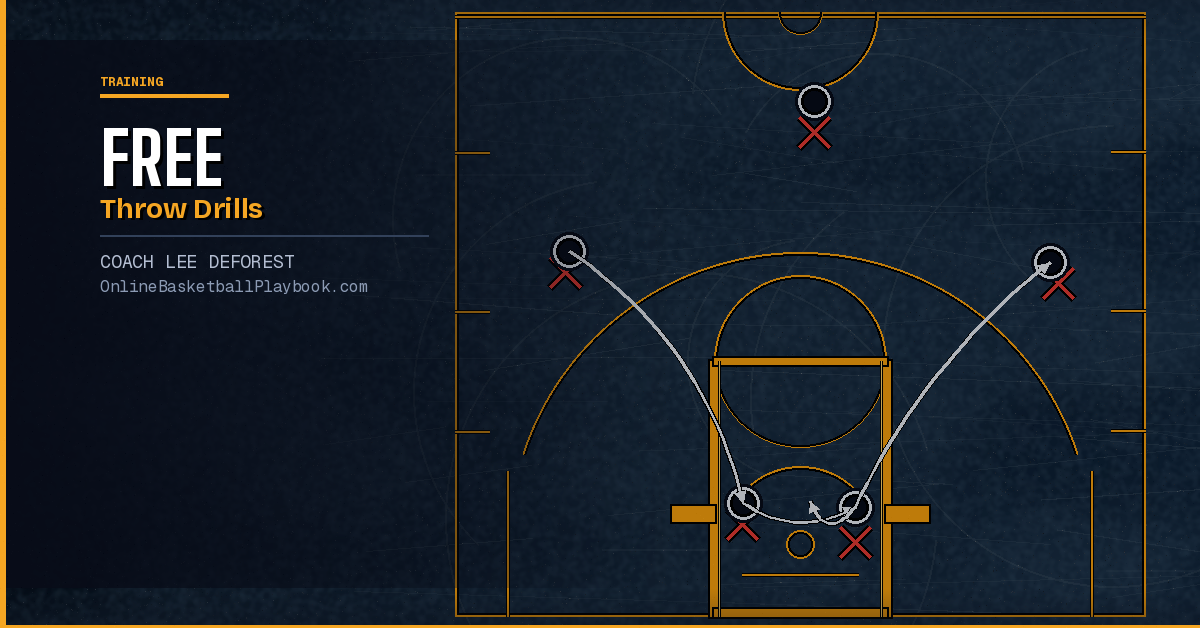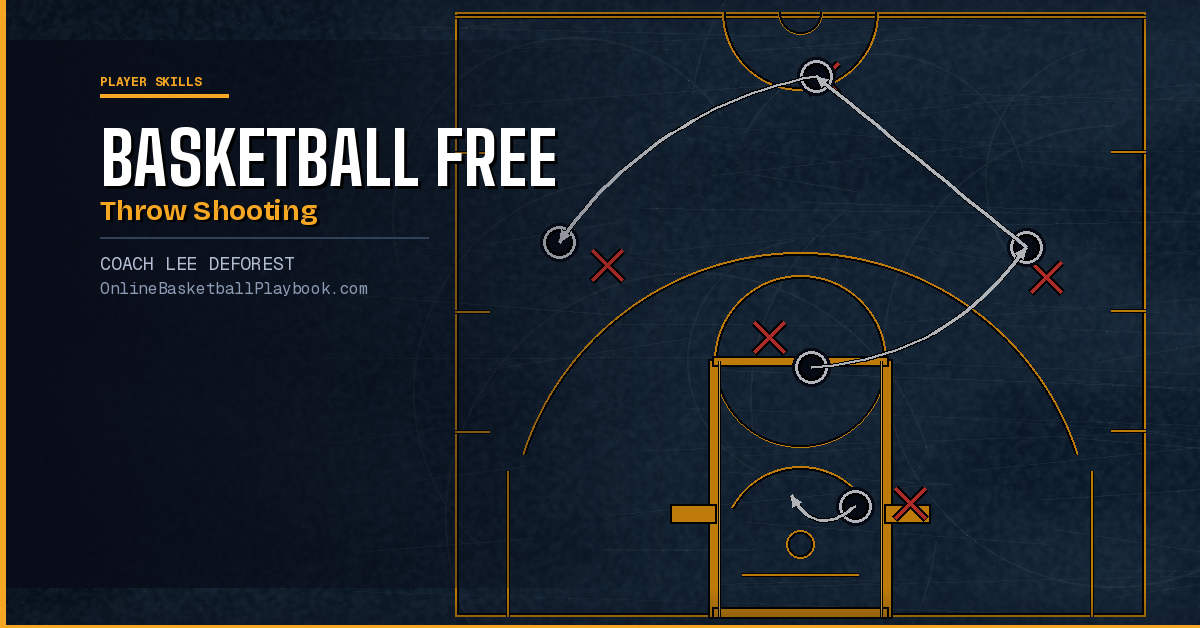

Free throws win games — and lose them. They are the one shot in basketball where the defense cannot touch you, yet players miss them at every level. Here is how to fix that, for good.
The Mechanics: Building a Repeatable Shot
Before a player can develop a mental routine, they need a physical one worth repeating. The foundation of free throw shooting is the same foundation that governs every other field goal attempt: balanced stance, proper hand placement, elbow alignment, and a complete follow-through.
Start from the ground up. The feet should be shoulder-width apart, with the shooting-side foot positioned slightly ahead of the other. The toes should point directly at the basket, not angled. Weight distribution matters — both heels stay light on the floor, knees slightly bent, ready to transfer force upward through the shot.
Hand placement comes next. The shooting hand supports the ball from beneath, fingers spread comfortably across the leather with a visible gap between the palm and the ball. Think of the ball resting on the finger pads of the index, middle, and ring fingers — not in the palm. This grip gives you control over backspin. The guide hand rests on the side of the ball, thumb pointing up and away, never pushing across at release. Players who push with the guide hand — even unconsciously — produce the most common miss pattern: the wide shot that looks like good form but consistently drifts one direction.
Elbow position is the mechanical element coaches most often overlook. The shooting elbow should be directly underneath the ball, aligned over the shooting knee, not flared out to the side. At the set-point — the moment just before the shot is released — the elbow, the wrist, and the ball should form a vertical line straight up from the shooting knee. That vertical line is the repeatable mechanism that makes a free throw feel the same every single time.
The release and follow-through complete the chain. The wrist snaps forward, the index finger is the last point of contact with the ball, and the hand finishes palm-down with fingers pointing toward the rim. Hold that finish. Do not let the hand drop immediately after the ball leaves — holding the follow-through reinforces the correct release point and builds muscle memory across thousands of repetitions.
Ball and head position at the line matters too. Per Rick Pitino's work documented in the Basketball Vault, the ball and the player's head should be over the free throw line — leaning the body forward rather than back — to project the ball toward the basket with arc rather than a flat line drive. A player who leans back to "put more on it" is actually taking arc off the ball and making the basket smaller.
The Pre-Shot Routine: Why You Need One
A pre-shot routine is not a superstition. It is a performance protocol. In high-pressure, game-on-the-line moments, the brain is flooded with cortisol and adrenaline. Players who have a deliberate, automatic sequence to step into have a physical anchor that short-circuits the anxiety response. Players without one have only their thoughts — and their thoughts in that moment are rarely helpful.
The routine should be short, consistent, and repeatable under any conditions. It begins the moment the referee hands the player the ball. From there, the steps never change: find your spot on the line, arrange your feet, take a breath (or two), dribble a set number of times, find the basket with your eyes, set the ball, and shoot. Every element is the same every time. The point is not that the routine has magic properties — it is that when a player executes their routine, they are focused on the process instead of the outcome.
What to include in the routine
The number of dribbles has been studied extensively. Most elite free throw shooters use two to four dribbles as part of their sequence — not more. More than four tends to indicate a player stalling, not a player settling in. The dribbles serve one purpose: give the body a rhythmic, kinetic action that brings focus into the body and out of the head.
Eye focus also belongs in the routine. Pick a specific target on the rim — the back of the front rim is the most common — and lock onto it before the ball moves. Players who scan the court, look at the scoreboard, or glance at the crowd before shooting are giving their brain a distraction it does not need. Lock in early, lock in on the same target every time.
One breath before the set-point is worth teaching deliberately. A slow exhale — not a dramatic one — drops the heart rate slightly and resets the shoulders from a braced position to a natural one. Over a full season, players who incorporate a breath into their routine report fewer "tight" misses (the short, armsy miss that comes from shooting while physically tense).
Training Free Throws Under Fatigue
The most common mistake coaches make with free throw training is shooting them fresh. In practice, players walk to the line after a water break, knock down five in a row, and feel good about their free throw shooting. Then they miss two crucial ones in the fourth quarter of a tied game — after running a full-court sprint, after defending a ball screen, after 28 minutes of physical contact — and they cannot understand why.
Free throws in games happen when players are tired. That is when you train them.
The Basketball Vault principle here is clear and direct: "Shoot free throws at the end of live 1-on-1 games when players are tired and track the percentages — game free throws happen when exhausted, so that's when you train them." This is the Pitino standard from the Brayden Carr Clinic notes. It is not the only source that makes this point — the principle runs across multiple elite programs in the vault — but it is the most explicit version of the rule.
The practical implementation is simple. After a competitive drill — sprints, 1-on-1, shell defense, anything that gets heart rates up — players go directly to the line. They shoot their two, record the result, and that number counts. Over weeks and months, you track those numbers by player. The improvement is measurable, and it is earned under the actual physiological conditions of a game.
A secondary benefit of fatigue free throw training is that it exposes mechanical flaws that proper rest disguises. A player whose technique breaks down under fatigue — whose elbow flares, whose follow-through shortens, whose stance widens — is telling you exactly where the mechanics are not yet automatic. That information is valuable. You cannot fix a flaw you cannot see, and rested players hide their flaws.
Diagnosing and Fixing Common Errors
Dr. Hal Wissel's diagnostic framework — documented in the Basketball Vault from his Basketball World coaching materials — gives coaches a structured way to move from symptom to cause to correction. Most coaches skip the middle step. They see a short miss and tell the player to "follow through." They see a wide miss and say "stay straight." Those cues address symptoms. The diagnostic framework addresses causes.
Wide misses
A ball that consistently drifts right or left — especially from a player who otherwise looks like a good shooter — is almost always caused by the guide hand. The thumb of the non-shooting hand pushes across the ball at release. It happens in a fraction of a second and is invisible to most observers. The fix: have the player shoot one-handed form shots from close range and watch where the ball goes without the guide hand involved. If those go straight, the guide hand is the culprit. Teach the player to consciously keep the guide-hand thumb up and away at release — not pulling it back dramatically, just not pushing forward.
Short misses and flat arc
A shot that hits the front of the rim repeatedly, or that has a flat trajectory, usually traces back to a low release point or a wrist that does not fully flex through. The correction for a flat arc is a ceiling drill: pick a point on the gym ceiling above the front of the rim and aim the arc at that target. Players who shoot line drives gain arc immediately with this cue because it forces them to extend upward rather than push outward. For the short miss caused by a low release, the fix is holding the follow-through with the arm fully extended — elbow not dropping early — until the ball hits the floor on the other end. It feels exaggerated. That is the point.
Inconsistent release timing
This is the miss pattern that frustrates coaches most because the player looks different every time. The root cause is almost always a rushed release — the player shoots before the natural peak of the jump, or during a hesitation, rather than on the way up. The "Sight–Set–Shoot" rhythm protocol from the Wissel diagnostic is the right tool here: three distinct beats, not one continuous motion. Establish the target (sight), pause at the set-point with the ball above the shooting shoulder (set), then release on the way up (shoot). Make each step deliberate in form shooting, then let the rhythm compress naturally as speed increases.
The Mental Game at the Line
Elite free throw shooters are not people who feel no pressure. They are people who have a system for what to do with the pressure when it arrives. The mental game at the free throw line is a learnable skill, not a personality trait.
The first principle is process over outcome. When a player steps to the line and thinks "I need to make this," they have already introduced a variable they cannot control — the outcome. The ball going in or not going in is downstream of the process. What a player can control is whether they execute their routine correctly, whether their elbow is in, whether they follow through fully. Coaching players to focus on process cues — specific, physical, under-their-control cues — at the moment of pressure is the single highest-leverage mental skill you can teach at the free throw line.
The second principle is rhythm. Players who shoot at their normal pace — not hurried by crowd noise, not slowed down dramatically by the moment — perform better than players whose timing changes under pressure. This is why the pre-shot routine matters so much as a mental tool. The routine sets the tempo. If a player's routine takes six seconds in an empty gym, it should take six seconds in a hostile road environment. Coaches can check this with a stopwatch during practice pressure scenarios.
The third principle is short memory. A player who has just missed one free throw in a two-shot situation has approximately four seconds before the second ball arrives. What they do with those four seconds determines the second shot. Players who replay the miss — who think about the rim, the sound, the expression on a teammate's face — carry that mental weight into the second attempt. Players who reset their routine immediately, focusing only on the next ball, do not. Teach the reset. Make it part of practice. When a player misses in a drill, require them to verbalize a reset cue and then step back in for the next rep.
Visualization is underused at the youth and high school level. Ask a player who makes 80% in warmups but 60% in games to close their eyes before a practice free throw and picture the ball going through the net cleanly — not the release, not the arc, just the outcome image. Then shoot. This is not mystical; it is a brief focus anchor. It redirects attention from fear of failure to expectation of success, which changes the body's readiness state in a measurable way.
Building a Free Throw Culture in Practice
Individual technique and mental skill are taught one player at a time. Culture is built in the team environment. The most effective programs treat free throw shooting as a team accountability metric — not because one player's free throw affects another player physically, but because shared standards create shared ownership.
Track it publicly. Post free throw percentages by player — not to shame low shooters, but to create a living record that improves over time. Players who see their numbers next to their name take free throws in practice more seriously than players who shoot into a void. When a player improves from 58% to 71% over six weeks of tracked, fatigued free throw training, that number means something because it is documented.
Build consequence into missed free throws in practice, but keep the consequence team-based rather than individual-based. When a player misses, the team runs — not because the player is being punished, but because in a game, a missed free throw costs the team. The lesson is cause and effect. Players who understand that their individual execution has collective consequences take individual preparation more seriously.
Compete at the line. Team free throw shooting competitions — first group to make ten in a row, highest percentage out of fifty shots by squad — give players repetitions under mild pressure in a lower-stakes environment. That mild pressure is the bridge between fresh shooting and game shooting. Start competitive free throw drills early in the season, before the stakes of conference play arrive, so the pressure environment is not new when it counts.
End practice at the line. Whatever the final drill was, the last action of the session is free throws. Players shoot tired. Numbers get recorded. Players who hit their team-standard finish early. Players who miss keep shooting until they do. This one structural change — making free throws the last act of every practice — communicates more about their importance than any speech a coach can give.
Free throws under fatigue, on a count: bake free throws into the workout so they are shot tired and counted, not at fresh rest — game free throws happen when exhausted, so that is when you train them.
— Shooting Development, Basketball Vault
Before you work on a player's free throw mental game, confirm the mechanics are sound first. A player with a flaw in their release will always find something to think about at the line because the shot is genuinely unreliable. Fix the repeatable physical foundation, then layer the mental routine on top of something solid.
- Shoot tired, not fresh: Run free throws immediately after your most physically demanding drill — sprint series, live 1-on-1, shell defense — and record each player's makes out of two attempts, every session.
- Elbow under the ball every time: At the set-point, the shooting elbow must be directly beneath the ball and aligned over the shooting knee. Check this in the mirror, on film, or with a partner — it fixes wide misses and arc problems simultaneously.
- Standardize the routine length: Time your players' pre-shot routines with a stopwatch in practice and in a simulated pressure scenario. If the timing changes by more than one second, the routine is not automatic yet — keep drilling until it is.
- Track and post percentages: A public record of each player's practice free throw percentage — updated weekly — does more for accountability and improvement than any cue or drill alone.
- Teach the reset cue: After every missed free throw in practice, require the player to say a specific reset word or phrase aloud and step back before the next rep. The reset is a skill. Train it the same way you train the shot.
Want more basketball coaching strategies and drills?
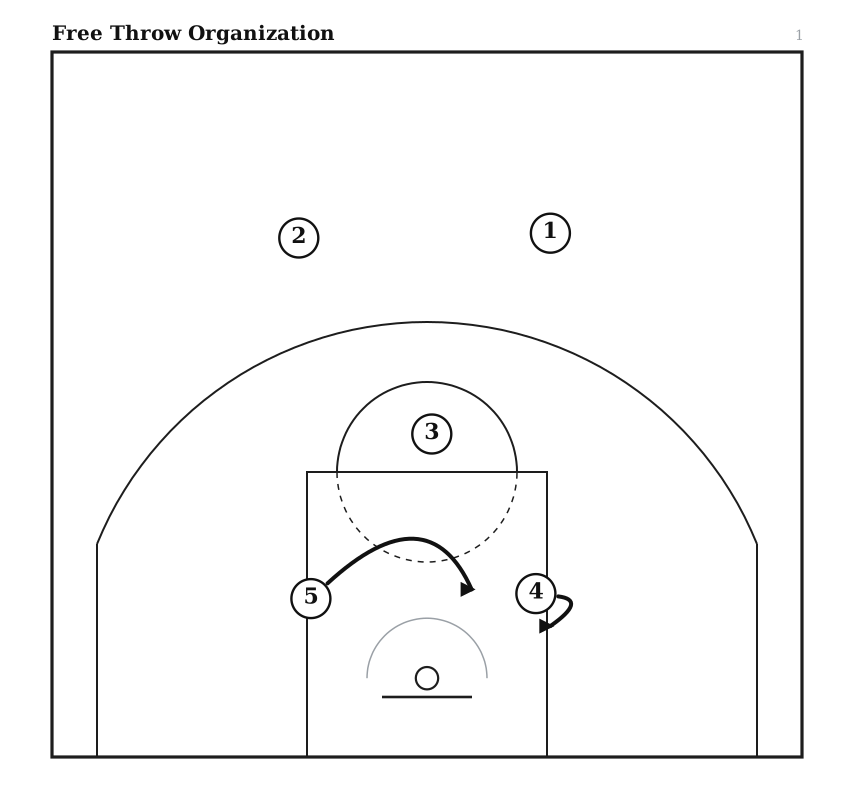
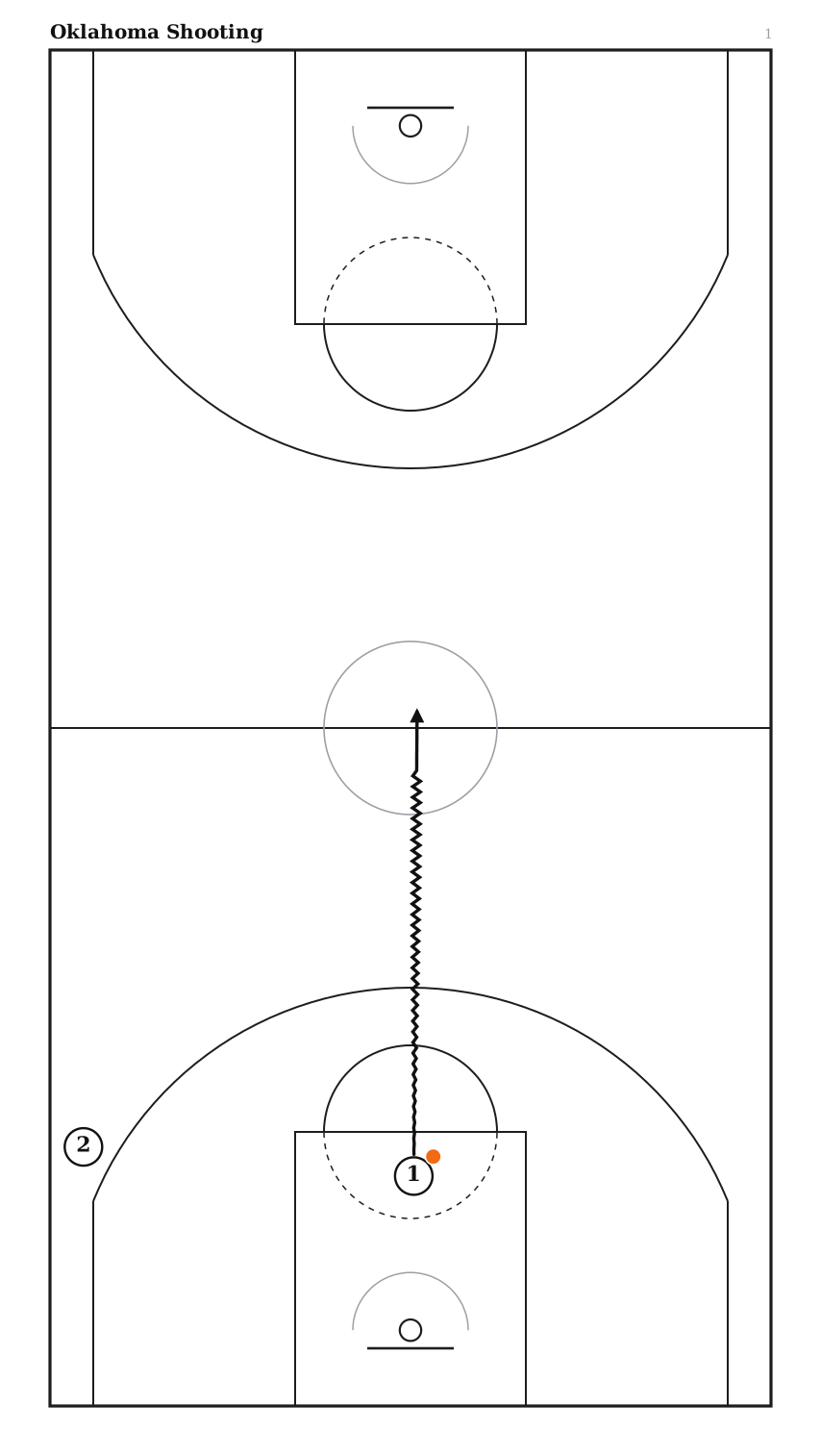
See it drawn up
Related diagrams
Keep Building
Related breakdowns
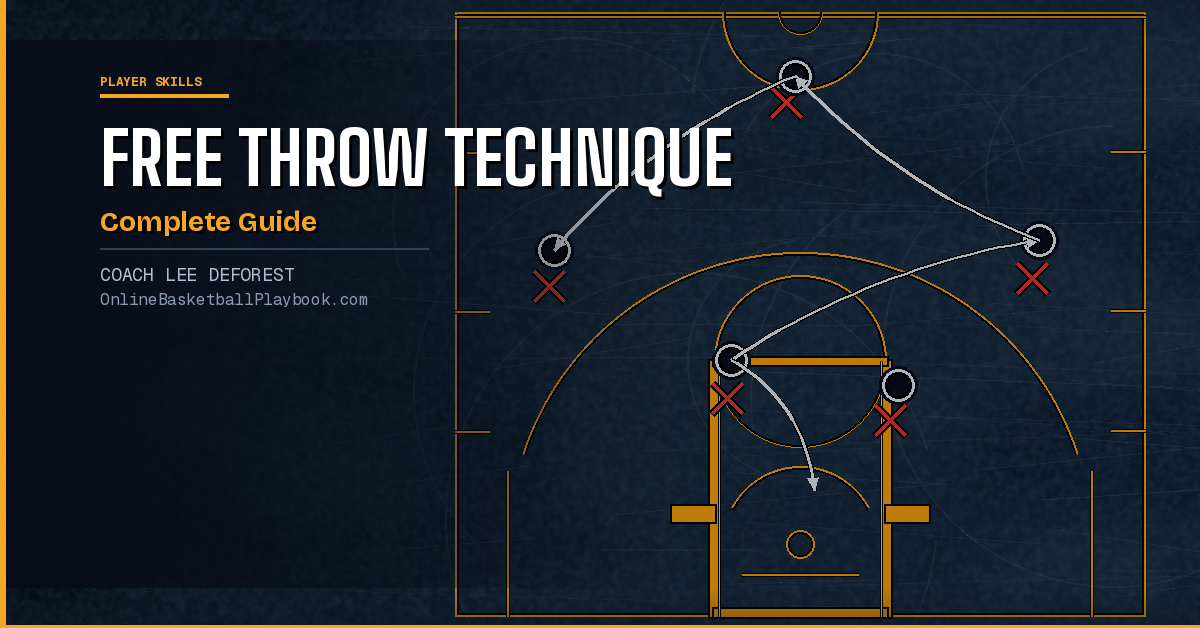
Basketball Free Throw Technique: Complete Guide
Basketball Free Throw Technique: Complete Guide