Free throw shooting is the one shot in the game with no defender, the same spot and the same distance. Most coaches treat a miss as a practice problem and not bad luck. A player who repeats one routine, keeps a few simple form cues and practices the shot tired with something at stake gets better at the line. This guide covers the routine, the form cues, the mental side, the drills and the points where coaches disagree.
Free Throw Shooting at a Glance
| Piece | What the coach asks for |
|---|---|
| Routine | The same sequence on every shot, even after a miss |
| Eyes | One spot on the rim, held as long as possible |
| Base | One settled foot spot, close to the nail hole |
| Legs | A down-and-up rhythm that supplies the power |
| Finish | Hold the follow-through until the ball goes through |
| Mind | Think about the steps and not the result |
| Practice | Small sets, tired, with a consequence |
The Routine

A fixed routine is the top lever, and holding it matters more than which routine a player picks. Darnell Archey's film study of top college free throw shooters found very different routines with one constant. Each shooter spotted the rim and repeated the same sequence every time.
Coaches teach routines of different lengths. One has a player bend his knees slightly before dribbling, take three dribbles without spin, then set the ball and eye the rim. Another asks for the same spot on the line, the same number of bounces and one deep breath. A third uses two bounces while the shooter looks at the valve of the ball to trigger rhythm. A routine can also include a mechanics check and a moment of visualization. All of them agree on consistency.
Write the routine down as a card. It lists the foot spot, the dribble count, the breath, the aim point and one key word. A struggling shooter can strip it to the simplest version so all of his focus goes to watching the ball go through.
Form Cues at the Line
The general mechanics are on Basketball Shooting Form. These cues are the ones that matter most at the line.
- Legs. A down-and-up rhythm supplies the power.
- Release. Start the ball at the chin and not at the belt. Snap the wrist and lock the elbow in one motion. A release angle of about 55 degrees or higher gives the ball a better entry.
- Finish. Hold the follow-through until the ball goes through the net. Stay on the line as the ball travels, even on the second shot.
- Foot spot. The nail hole is the starting point. Each player adjusts an inch or two to find a natural pocket.
- Eyes. Look at the rim as long as possible before the shot starts.
Common errors are the palm on the ball, the off hand on top of the ball, a wrist that is not cocked, an elbow that flares and arms that drop early. A miss to one side often shows up in the index finger on the follow-through. Fix one or two things at a time.
The Mental Side
Tension causes misses. A quick way to show it is to have players clench their fists and hold their breath for ten seconds, then ask them to shoot. Muscle memory cannot run in a tense body. A deep breath before the shot drops the shoulders and arms, and this matters most late in games when the legs are tired.
When a player slumps, check five factors. Confidence, routine, relaxation, concentration and rhythm. Ask what the player was focused on before the miss, because the answer often shows the real problem.
Think about the process. A thought such as "I hope I make this" is an outcome thought in disguise. Give players one cue word to say in the rhythm of the shot, and keep the coach's frustration out of sight. A miss should not shake a shooter's routine or his confidence.
How to Practice Free Throws
In a game a player barely ever shoots an un-fatigued free throw. Telling players to shoot five between drills fails because nothing is at stake. Put free throws after hard running or between skill blocks, keep the sets small and attach a consequence.
- Shoot 40 to 50 free throws a day in sets of two to five between five and seven minutes of other work. That also gives an honest read on how the shooters are doing.
- Another caps practice at two in a row to match a game.
- The winner of a competitive drill makes a free throw to lock in the win.
- Send players to the line whenever a whistle stops a drill.
- Track makes and attempts, and set practice goals above game goals.
Get the next coaching guide in your inbox
One email when a new guide or diagram set goes up. Free.
Free Throw Shooting Drills

Progression. Start three feet from the rim and ask for three clean makes with no rim. Step back through five, seven, twelve and fourteen feet, asking for clean makes at each one. Then shoot five normal free throws, three from the three-point line and five more normal ones. Come back in through the same spots. The shooter starts where success is easy and builds confidence with each clean make. Run it once a week.

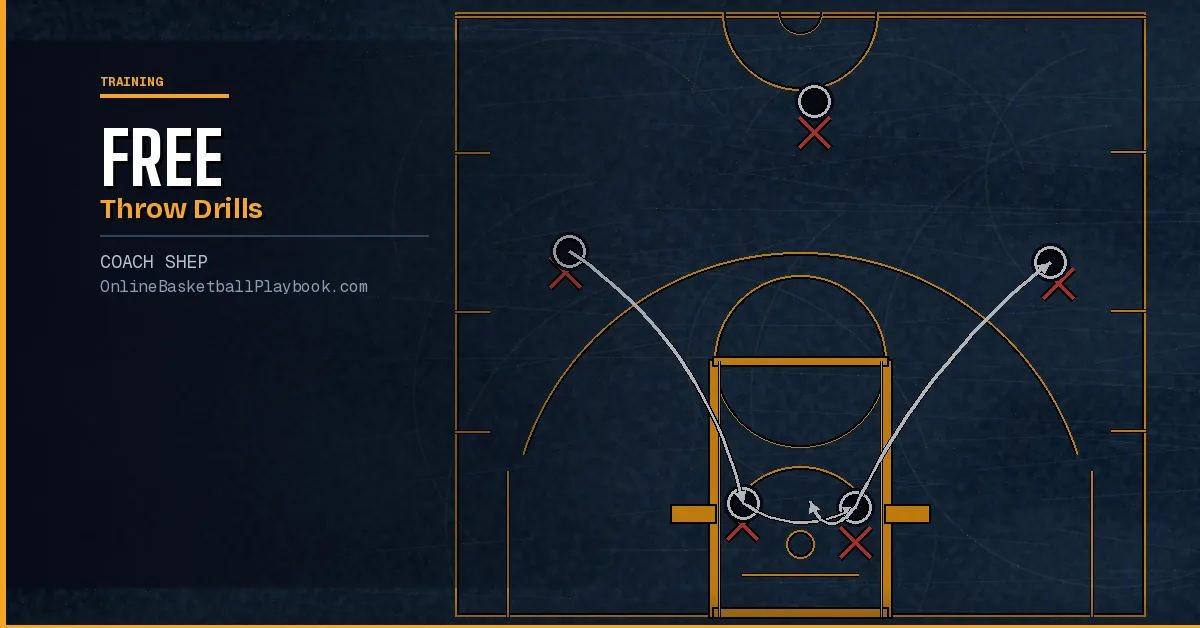
Shooter, rebounder, runner. Groups of three rotate roles after every two free throws, so each shooter arrives at the line breathing hard.

Baseline free throws. The whole team shoots one at a time and any miss sends everyone on a run. Youth teams need one make and older teams need two in a row.
- Five spots. Make five in a row from each of five spots for 25. Restart on any miss.
- 1-and-1. A missed first shot costs a lap and there is no second shot. Or run it for three minutes at each basket. A missed first shot costs two down-and-backs and a missed second shot costs one.
- Swish. Start at 5 and play to 10. A swish is plus 1, a make that touches the rim is 0 and a miss is minus 1.
- 6 in a row. Make six straight in five minutes. A miss resets the count. Raise it to eight for older teams.
- Distraction. Teammates and coaches try to distract the shooter so a loud gym feels easier than a quiet one.
- Beat the pro. A youth game that starts at 10. A make is plus 2, a miss is minus 1 and the shooter wins at 20.
- Close practice with 10 in a row. No one leaves until the team has made ten consecutive free throws.
More formats are on Free Throw Drills and Basketball Shooting Drills.
Game Situations
Name a designated free throw shooter for endings where the other team must foul, and have an inbounds play that gets him the ball. Be deliberate about who is at the line in close games. Some coaches sub out a poor foul shooter late.
Practice the intentional miss with an assigned putback player. The ball must touch the rim, and a try that does not touch it is a violation. See Basketball Free Throw Rules for the details. A missed free throw also starts a rebound, so the defense should be ready to box out. Getting to the line is a separate skill from making the shots, so track how often the team gets there. See Basketball Late Game Situations for end-of-game plans.
Where Coaches Split on Free Throw Shooting
- Streaks or short sets. Long streaks train focus and short sets match the game.
- The aim point. Aim at the back or middle of the rim so a long or short shot still has a chance. Or aim just over the front, or the front middle with a slight arc. Or ask only that the player look at the rim as long as possible.
- Routine length. Two bounces, three dribbles and four dribbles all have supporters. They agree on consistency.
- Form or mindset. Leave mechanics out, because the form need not be textbook if it repeats, or give specific cues.
- When to change form. Some say major changes belong in the off-season. Others fix an inconsistent shooter in season.
- Running as a penalty. Many coaches run the team on a miss. One drill makes the run the reward for a made pair.
- Quiet or noise. Ban talking in free throw time or add noise on purpose.
Coach Cheatsheet
- Give every player a written routine card and never change it after a miss.
- Teach one or two form cues at a time.
- Shoot free throws after running, in sets of two to five.
- Attach a score or a team consequence to every set.
- Hold the follow-through until the ball goes through.
- Track makes and attempts for every player.
- Close practice with ten in a row and end each drill with a free throw.
Questions Coaches Ask About Free Throw Shooting
How do you get better at free throw shooting?
Repeat one routine, hold a simple follow-through and practice the shot tired in small sets with a consequence.
What should a free throw routine include?
A foot spot, a set number of dribbles, a breath and a look at one spot on the rim. The length matters less than repeating it.
Should you change your routine after a miss?
No. Consistency builds muscle memory, and a changed routine after a miss removes it.
Where should you aim on a free throw?
Coaches split. The middle, the back and the front of the rim all have supporters. Pick one spot the player can repeat.
How many free throws should a player shoot a day?
Coaches set different numbers, from 25 a day to 40 or 50 split into small sets. Track attempts and makes and pick one number for your team.
All skill pages sit under the Player Development hub. The general mechanics are on Basketball Shooting Form. Go deeper with Free Throw Drills, Basketball Free Throw Rules, Basketball Shooting Slump Solutions, Mental Toughness in Basketball and Three-Point Shooting Drills.
Want the printable playbook packs?
OBP Pro members get the premium playbook packs: the zone attack, out of bounds and practice plan PDFs, plus each new pack as it is finished. The membership page lists what is in each one. Or draw your own version free in PlayDraw.
See what OBP Pro includesBack to Basketball Shooting Form and every Player Development page.
Keep Building
Related breakdowns
Basketball Shooting Form: Step-by-Step Mechanics
Basketball shooting form step by step, from the ready stance and grip to release and follow-through, with drill progressions and where coaches disagree.