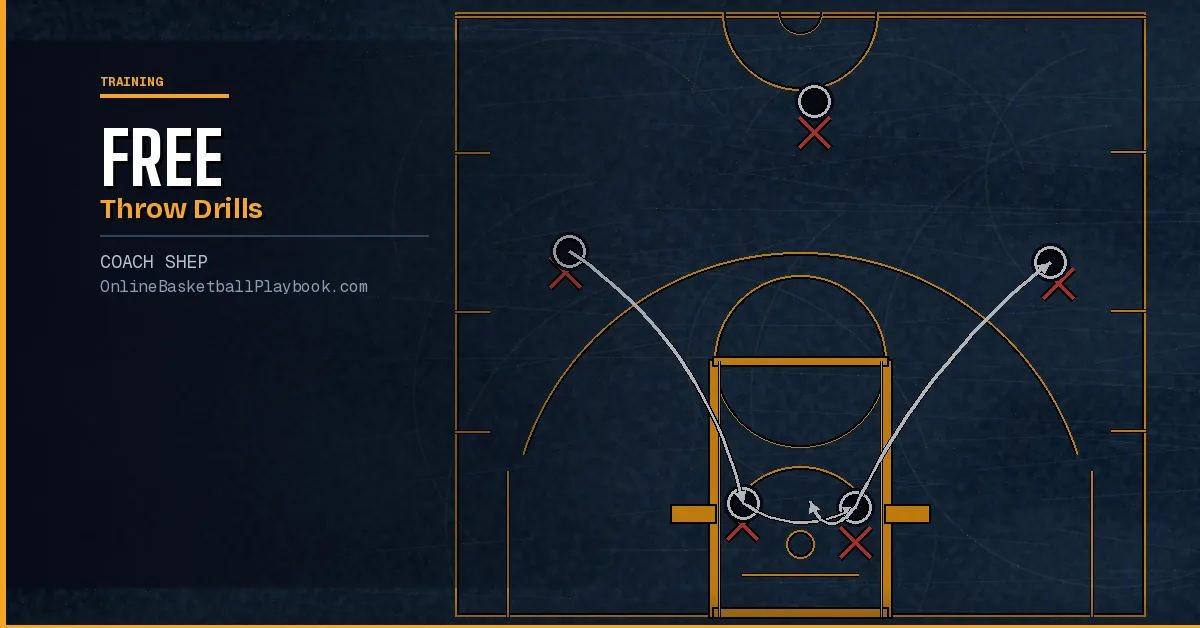
Free throws win close games. These drills build the mechanics, routine, and fatigue resistance your players need to step to the line and deliver, whether it's the first quarter or overtime.
Why Free Throws Require Dedicated Practice
Most teams treat free throws as an afterthought, a quick five shots at the end of warm-ups when players are fresh and unhurried. Then the game arrives, and a player steps to the line in the fourth quarter, legs heavy from a transition sprint, crowd loud, and the motion they rehearsed in a quiet gym disappears entirely.
The gap between practice free throw percentage and game free throw percentage is real, and it is almost entirely explained by one thing: most teams never practice shooting free throws the way they actually occur in games. In games, free throws happen when players are tired, when the score is close, and when there is genuine pressure attached to the outcome. If you only train them fresh and without consequence, you are not training the skill you actually need.
Rick Pitino makes this point directly in his shooting clinics. His prescription for free throws is to shoot them at the end of live one-on-one games when players are legitimately fatigued, and to track the percentages. The data becomes the coaching tool. Players who see a 20-point drop from their comfortable gym percentage to their tired-game percentage understand immediately what needs to change.
The lesson for practice design is simple: free throws need their own dedicated structure, they need to be shot under fatigue, and they need a scoreboard. When there is a number attached to the outcome, players engage differently. A drill where missing carries a consequence, a sprint, extra reps, a team penalty, creates the internal pressure that mirrors a close game. That is the training environment that transfers to performance.
Mechanics First: Building a Repeatable Shot
Before you can train free throws under pressure, your players need a shot that is mechanically sound enough to hold up when the body is stressed. A technically inconsistent free throw will break down under fatigue. A clean, repeatable motion will not.
The core mechanics are not complicated, but they require deliberate attention during early-season teaching. Every shooter needs the same foundational elements.
Stance and Balance
The feet should be slightly narrower than shoulder-width, with the shooting-side foot a few inches ahead of the guide-side foot. Weight stays balanced and centered, not shifted toward the toes or heels. Some coaches teach a slight forward lean at the waist. This is fine, but the lean must be consistent every single repetition. Any variable in the setup becomes a variable in the shot.
On the free throw line specifically, Dr. Hal Wissel's mechanics framework emphasizes that the ball and the head should be positioned over the front of the free throw line, projecting the ball toward the rim rather than lifting it from behind the line. This subtle positioning adjustment helps shooters produce a better arc and a more consistent release point.
Grip and Hand Position
The ball rests on the pads of the index, middle, and ring fingers of the shooting hand. There should be visible daylight between the palm and the ball. The guide hand sits on the side of the ball and does one job: hold the ball steady during the setup. At the moment of release, the guide hand comes off cleanly. It does not push, and it does not follow through. One of the most common free throw errors at every level is the guide-hand thumb pushing the ball on the way to the rim, producing misses that drift sideways.
The Release
The shooting motion starts with the legs. Players who push with their arms and neglect their legs produce flat, inconsistent shots. The legs load and unwind upward, and the arm follows in a smooth, coordinated sequence. At the top of the release, the wrist snaps fully through the ball, the index finger is the last point of contact, and the hand finishes with fingers hanging downward toward the rim. The follow-through holds until the ball reaches the rim. This is a discipline cue, not just a style point. Dropping the elbow early before the ball lands is a sign that the release was rushed or that the shooter lacks confidence in the shot.
The Pre-Shot Routine
Every free throw shooter needs a pre-shot routine and must run that routine identically on every attempt. The routine is not superstition. It is a reset mechanism. Between the whistle and the release, the brain has 10 seconds to fill with productive or unproductive thought. A locked-in routine occupies that space with familiar physical cues and removes the gap where doubt enters. Dribble pattern, breath, sight line to the back of the rim, and go. Teach a routine and hold players accountable to running it every single time in practice so it is automatic under pressure.
The Fatigue Principle: Train Tired, Perform Fresh
The single most underused element of free throw training is deliberate fatigue. Coaches who want to close the gap between practice percentage and game percentage need to build fatigue into every free throw block.
Our coaching research library's shooting development research is direct on this point: "Shoot free throws under fatigue, on a count. Bake free throws into the workout so they are shot tired and counted, not at fresh rest." The key phrase is "on a count." Shooting tired without a target number does not create the mental engagement that transfers to games. Shooting tired with a specific make target and a team consequence for missing does.
Bob Hurley's practice structure includes a daily 20-minute shooting emphasis that integrates free throws into the flow of a workout rather than isolating them at a clean stopping point. Players shoot, rebound, move to the next station, and cycle back to the line when the body has been working. By the time they step up for their next free throw, they have been moving for several minutes. That is a game-accurate training environment.
The simplest way to add fatigue to free throws in your own practice is to attach them to conditioning. After a full-speed shell drill, after the end of a competitive scrimmage sequence, or after a sprint, send two players to the line. Everyone else watches and counts. If the pair misses, everyone runs. If they make both, the group earns a water break. The dynamic shifts immediately: the two shooters are under real social and competitive pressure, and the team is invested in the outcome. That is as close to a late-game free throw as you can manufacture in a practice setting.
Five Free Throw Drills to Run at Practice
These drills are built to be practical, time-efficient, and immediately usable. Each one addresses a specific gap between how free throws are typically trained and how they actually need to be performed.
1. Fatigue-Then-Shoot
Players run a full-speed baseline-to-baseline sprint, then immediately step to the free throw line and shoot two. The coach records makes and misses. Run this at four different points during practice: after warm-ups, after a competitive drill, after a sprint series, and at the very end of practice. Track each player's makes over the session. The goal is a posted record that players know about: 7 out of 8 total free throws across the four shooting blocks is the target. Players who miss fewer than 5 run two extra sprints after practice. This drill compresses an entire game's worth of fatigue-free-throw data into 20 minutes.
2. Team Make-Count
The entire team lines up and each player shoots one free throw in sequence. The team is trying to reach a cumulative make total, for example, 80% of all attempts. If the team hits 80%, practice ends 10 minutes early. If the team falls below 75%, every player runs two sidelines. This makes free throw shooting a collective responsibility, which mirrors how a missed free throw in a close game affects an entire team. Players who are poor free throw shooters feel the social pressure of their teammates depending on them, which is exactly the right stimulus for improvement.
3. Around-the-World With a Free Throw Tax
Players move through five spots around the arc (two wings, two elbows, and the top of the key), making one shot at each spot before advancing. After completing all five spots, the player goes to the free throw line and must make two in a row to finish the drill. If they miss either free throw attempt, they go back to the elbow spot and repeat. The free throw becomes the bottleneck of the drill, which creates a focused practice situation without any setup. Players who want to finish quickly learn to lock in at the line.
4. Pressure Free Throw Ladder
Partners pair up. Player A shoots until they miss, counting consecutive makes. When they miss, Player B shoots. The players alternate, and every miss resets that player's count to zero. The drill runs for four minutes. At the end, the player with the highest single-run streak wins, and the loser runs two sidelines. The competitive structure means players are genuinely trying to stay on a streak under increasing internal pressure, which is exactly the mental demand of a live-game free throw situation. Four minutes of this drill produces more useful practice repetitions than 15 minutes of casual shooting.
5. Post-Scrimmage Two-Shot
At the end of any competitive scrimmage segment (five-on-five, three-on-three, or any live-ball drill), immediately stop play and send one player from each team to the line. Each player shoots two free throws. The made free throws count as points added to that team's final scrimmage score. This means scrimmage outcomes can actually be decided at the free throw line, which creates a game-accurate pressure situation in a context players care about. Run this at the end of every scrimmage all season and your free throw numbers will improve.
Diagnosing and Fixing Missed Free Throws
When a player misses free throws consistently, there is always a mechanical cause. The mistake most coaches make is repeating a generic cue ("bend your knees," "follow through") without identifying what is actually going wrong. Dr. Hal Wissel's diagnostic framework from Basketball World gives coaches a structured way to work backward from a missed pattern to its root cause and then to a specific correction drill.
The Most Common Free Throw Errors
Short shots usually mean the release point is too low. The ball is leaving the hand before the arm reaches full extension. The correction is a high-extension follow-through drill: the shooter holds the finish with the arm fully extended and fingers pointing down at the rim until the ball actually lands. Do not let the elbow drop early.
Missed wide left or wide right is almost always the guide hand. The guide-hand thumb is pushing across the ball at the moment of release and sending it off-line. The fix is a one-handed form shot from close range (3 to 5 feet from the basket) so the shooter can feel what happens when only the shooting hand propels the ball. Once the ball tracks straight one-handed, reintroduce the guide hand with a conscious effort to keep the thumb up and away.
Flat arc (line drives) means the wrist is not finishing above eye level and the release angle is too low. Have the shooter pick a point on the ceiling above the front of the rim and aim the arc to that point. Shooters who aim at a ceiling target gain 4 to 6 inches of arc immediately, and the ball stops clanging off the front of the rim.
Inconsistent release timing is a rhythm problem. The shooter is rushing, releasing before the natural peak of the jump or before the set-point is established. Teach a three-beat rhythm: sight the target, pause at the set-point with the ball above the shooting shoulder, then release on the way up. Three distinct beats, not one rushed continuous motion. This is especially common in young players and in players who are nervous, where the instinct is to shoot faster to get the moment over with.
The Diagnostic Habit
When a player misses in the same pattern three times in a row, stop and work backward: arc angle first, then hand position, then elbow alignment, then balance and foot position. The root cause is rarely what the player believes it to be. A player who thinks they are "not following through" is often actually not loading their legs, and a player who thinks their shot is "short" is often releasing too early in their jump. Identify the actual cause before prescribing the drill.
Building a Free Throw Culture All Season
Individual drills matter, but what sustains free throw improvement across a full season is culture. The teams that shoot 75% or better from the line in March are not just more skilled. They have built a practice environment where free throws are scored, recorded, and taken seriously from the first week of October.
The most efficient culture tool available is a record board. Put up a whiteboard in the gym with each player's name and their personal best for a consecutive-makes streak at the free throw line. Let players sign their own records when they set them. Challenge the team record weekly. This costs nothing and creates a competitive dynamic that no drill can manufacture on its own. The players who are quietly poor free throw shooters see their name near the bottom of that board and feel a pull to improve that is entirely internal, which is the most powerful motivator available.
Track game free throw percentage by player and share it weekly. Players who do not see their data do not feel urgency to change. Players who see that they shot 4-of-10 from the line in the last two games understand specifically what the problem is and where the work needs to happen. Data makes the case the coach does not have to make verbally.
Set a team goal at the start of the season (70%, 72%, 75% from the line) and post it where the team sees it daily. Connect it to a consequence and a reward: if the team hits the season goal, the post-season conditioning runs are cut in half. If the team falls below 65%, there are additional free throw reps at every practice for two weeks. The goal becomes a reference point players return to when they are standing at the line in a close game. That shared target creates collective accountability that individual drills alone cannot build.
Finally, make it a point of pride to be a reliable free throw shooter. Praise players publicly when they go two-for-two in tight situations. Acknowledge the player who made both in the fourth quarter. Culture is built in those small moments of recognition, compounded over weeks and months until making free throws under pressure is simply what your team does.
Before adding new free throw drills, audit when in your current practice you are shooting them. If the answer is "at the start, when players are fresh," shift those reps to the end of your most competitive drill blocks instead. The same drill, placed at the right point in the practice structure, produces dramatically better transfer to game situations because the body is in a state that actually resembles game demands.
- Shoot tired, not fresh: Attach free throw reps to the end of conditioning or competitive drills, never only at the beginning of practice when legs are rested and minds are calm.
- Score every free throw block: use a make target, a team consequence for missing, and a posted record so every player has a personal benchmark to measure against and beat.
- Fix the guide hand first: When a shooter drifts wide consistently, isolate one-handed form shots from five feet before reintroducing the guide hand. It eliminates the most common free throw error faster than any other correction.
- Run a pre-shot routine and hold to it: choose a consistent dribble count, breath, and focal point, then require that exact sequence on every free throw attempt in practice until it becomes automatic under fatigue and pressure.
- Post the record board: Named personal bests, signed by the player who set them, displayed in the gym. These are the cheapest and most effective free throw culture tool available to any coaching staff at any level.
Want more basketball coaching strategies and drills?
Join the Online Basketball Playbook newsletter →
Draw this play free in the play drawer →
Membership: the full library, playbook packs, and Pro drawing tools →
Keep Building
Related breakdowns
Free Throw Shooting: Routine, Form and Drills
Free throw shooting starts with a routine the player never changes. Form cues, the mental side and drills that copy the fatigue and pressure of a game.
A Free Sample Basketball Training Workout
A Free Sample Basketball Training Workout
How to Protect the Ball: Ball Security and Fewer Turnovers
How to protect the ball in basketball: where turnovers come from, ripping and catching, the sure pass, beating a trap, ball security drills and pricing turnovers.