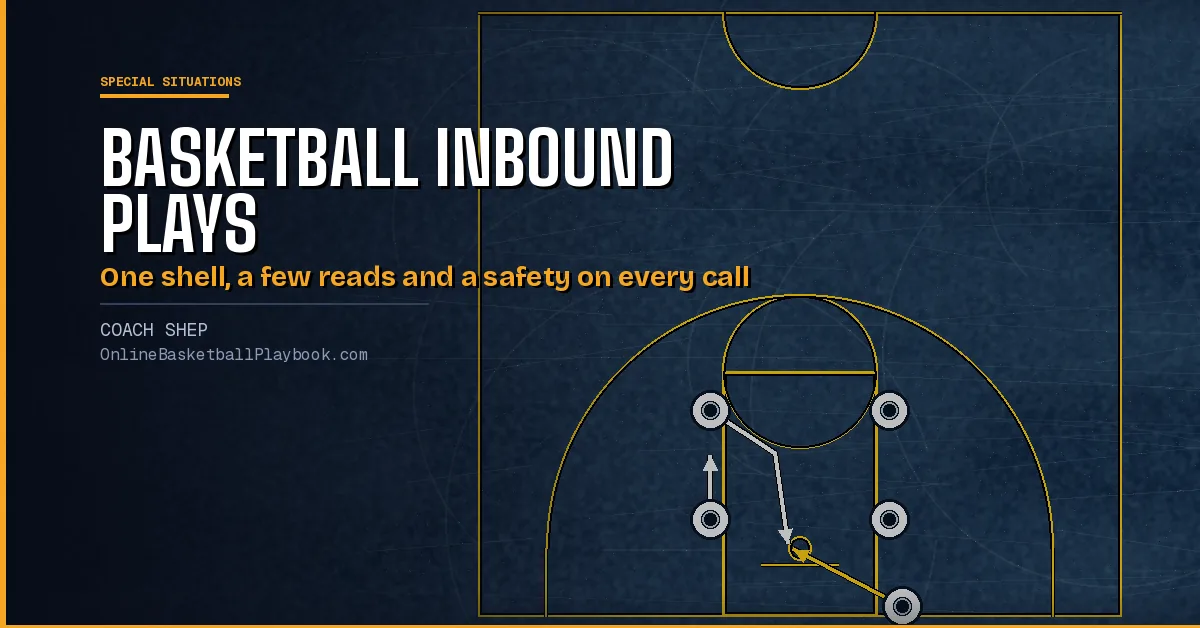
Basketball inbound plays are the called sets a team runs when the ball is dead and a teammate has to throw it in. A baseline throw-in (a BLOB) starts under the basket, and a sideline throw-in (a SLOB) starts beside the court. Both give the offense a stopped clock and a chance to place five players before the defense sets, so coaches treat them as the easiest scores in the game.
Find a Play: By Formation and By Action
Out-of-bounds plays are organized by formation first: pick the shape your team already lines up in, then the play. Every play is tagged baseline or sideline and by the action that scores. Tap a play to jump to it, on this page or the page that draws it.
By formation

16 plays
Two on the blocks and two at the elbows. One picture holds a back screen for a lob, a stagger for a shooter, a cross screen for a post and a step-in for the inbounder.
- Box Wide baseline catch-and-shoot
- Box Elevator baseline catch-and-shoot
- Box back screen and roll baseline layup
- Box corner three baseline catch-and-shoot
- Pick the Picker baseline screen the screener
- Cross screens at both levels baseline post feed
- 54 baseline layup
- The shooter inbounds baseline catch-and-shoot
- Weak-side lob baseline lob
- Double elevator baseline catch-and-shoot
- Youth box baseline layup
- Box set baseline action baseline catch-and-shoot
- Scorer sideline layup
- Zipper pick-and-roll sideline ball screen
- Box sideline back screen sideline layup
- Pull the guard, free the shooter sideline catch-and-shoot vs zone

13 plays
Players in one row. A stack hides who is cutting where, because every player starts in the same row.
- Stack split baseline layup
- Stack opposite the ball baseline layup
- Stack rub baseline layup
- Rack baseline layup
- Post as a tree baseline layup
- Double stack baseline post feed
- Lob for the post baseline lob
- Triple screen to the short corner baseline catch-and-shoot
- One second left baseline catch-and-shoot
- Stack near the elbow baseline catch-and-shoot vs zone
- Splitter (seal and corner run) baseline catch-and-shoot vs zone
- V-cut up the sideline sideline lob
- Back over the double sideline catch-and-shoot

7 plays
Players strung across the lane. In a line, one screener can free two cutters in order and then become the third option himself.
- Middle Split baseline post feed
- 3-across baseline layup
- Line screen and roll baseline lob
- Low line back screen baseline layup
- Tandem baseline screens baseline catch-and-shoot
- Screen the inbounder from a line baseline screen the screener
- Youth line baseline layup

Horns
2 plays
Two posts high, at the elbows. Built for an elevator screen for a shooter or a catch up high into a ball screen.
- Elevator screen for a three sideline catch-and-shoot
- Catch high, then ball screen baseline ball screen vs zone

Spread
1 play
Two in the slots and two on the wings. Built for a layup against an overplay.
- Backdoor cut sideline layup

Other
8 plays
Plays that start without a box, stack or line, or from no fixed alignment.
- Screen the inbounder baseline layup
- Stagger into a dive baseline layup
- Short-corner pull baseline post feed vs zone
- Middle baseline post feed vs zone
- Curl and counter sideline catch-and-shoot
- One-second lob sideline lob
- Two-second sideline three sideline catch-and-shoot
- Middle ball screen sideline ball screen
By action
Layup at the rim
A cutter at the rim off a screen, a slip or a backdoor
- Box back screen and roll box baseline
- 54 box baseline
- Youth box box baseline
- Scorer box sideline
- Box sideline back screen box sideline
- Stack split stack baseline
- Stack opposite the ball stack baseline
- Stack rub stack baseline
- Rack stack baseline
- Post as a tree stack baseline
- 3-across line baseline
- Low line back screen line baseline
- Youth line line baseline
- Backdoor cut spread sideline
- Screen the inbounder other baseline
- Stagger into a dive other baseline
Catch-and-shoot
A shooter off a stagger, an elevator, a double or a down screen
- Box Wide box baseline
- Box Elevator box baseline
- Box corner three box baseline
- The shooter inbounds box baseline
- Double elevator box baseline
- Box set baseline action box baseline
- Pull the guard, free the shooter box sideline vs zone
- Triple screen to the short corner stack baseline
- One second left stack baseline
- Stack near the elbow stack baseline vs zone
- Splitter (seal and corner run) stack baseline vs zone
- Back over the double stack sideline
- Tandem baseline screens line baseline
- Elevator screen for a three horns sideline
- Curl and counter other sideline
- Two-second sideline three other sideline
Post feed
A post catch off a cross screen or a seal
- Cross screens at both levels box baseline
- Double stack stack baseline
- Middle Split line baseline
- Short-corner pull other baseline vs zone
- Middle other baseline vs zone
Lob
A back screen that turns the defender's back to the ball
- Weak-side lob box baseline
- Lob for the post stack baseline
- V-cut up the sideline stack sideline
- Line screen and roll line baseline
- One-second lob other sideline
Screen the screener
The screener is screened right away, so the inbounder has two looks
- Pick the Picker box baseline
- Screen the inbounder from a line line baseline
Ball screen
The throw-in flows straight into a pick and roll
- Zipper pick-and-roll box sideline
- Catch high, then ball screen horns baseline vs zone
- Middle ball screen other sideline
This guide draws six plays, adds the Pick the Picker action in words, covers simple inbound plays for youth teams and sorts out the choices coaches split on, from how many plays to carry to how often to run them.
Baseline plays on game film
Each page pairs the possession with a numbered animation and an editable play download.
- Duke Loop Lob vs. USC Upstate
- Arizona Stagger and Corner Pick and Roll vs. Dayton
- Michigan Loop, Handoff and Flare vs. Maryland
- Auburn Four-Low Slip vs. Ole Miss
- Indiana Box Loop vs. Southern Indiana
Basketball Inbound Plays at a Glance
| Play | Throw-in | Starts from | Built to get |
|---|---|---|---|
| Box Wide | Baseline | A box with both posts wide | A three for the best shooter or an inside seal for the best post |
| Middle Split | Baseline | Three players at the free-throw line and one under the rim | A post catch at the rim |
| Box Elevator | Baseline | A box with the bigs on the strong side | A layup off a back screen or a shot off an elevator screen |
| Pick the Picker | Baseline | A box | A corner shot, then a layup off a second screen |
| Splitter | Baseline, against a 2-3 zone | A stack on the ball-side lane line | A corner three or a gap pass behind the low defender |
| Scorer | Sideline | A box | A layup for the best scorer |
| Zipper Pick-and-Roll | Sideline | A box | A ball screen with the floor spaced |
What Sits Under Every Inbound Play
Most baseline sets collapse into a few starting shapes:
- Box. Two players on each block or elbow. Box calls are on box set inbound plays.
- Stack. Four players lined up on one side.
- Line or 1-4 flat. Players strung across the lane. Stack and line calls are on stack inbound plays.
- Triangle. Three players layered on one side.
The shape stays the same and the call changes the finish, so players see one picture and learn one set of cuts. Three baseline plays can run from one fixed extended-box shape.
Four habits sit under every call:
- Treat the inbounder as a receiver. If the defense ignores him he can step in and take the return pass, and if a defender stays on him the other four have a numbers edge. Pick the inbounder for passing and quick decisions, with size a bonus for seeing over defenders.
- Build in a safety receiver. Put a safety near the top of the key on every baseline call because opponents scout the first option as the season goes on. Pick the Picker and Box Wide write the same rule in, where a guard drops back or slides toward the top of the key.
- Get it in first. Design each baseline play to secure the throw-in first and a scoring chance second, and return to the base offense when the quick look is gone. In plain words, do not force a bad pass just to complete the play.
- Know the automatic reads. They sit on top of whatever is called, and players signal them with eye contact and body language and no spoken call.
- Defender watches the ball. If a defender watches the ball with his back to his man, that man cuts straight to the basket.
- Inbounder unguarded. He passes and cuts for a give and go.
- Defender faces up with his back to the passer. Throw the lob over him.
- Inattentive defender. Pass off his back.
The throw-in has a time limit and a rulebook behind it. Coaches plan around a five-second count, and the exact limit and how it is enforced depend on your level, so check your state association or league rulebook. The full rules are on Basketball Out of Bounds Rules and Basketball Throw-In Rules, and the defensive side is on How to Defend Inbounds Plays.
Teach the shape, the safety and the reads before the plays.
Baseline Inbound Plays
Every play below is drawn with the baseline at the bottom of the diagram. Numbers are the numbers used for that play, so 1 is not always the point guard.
Box Wide
Box Wide moves the two post players wide on the blocks of the usual box. The wider spot gives the screener a better angle.
- Screen for the shooter. The post screens for the shooter, who cuts to the three-point arc, and the shot is often open because the post defender is reluctant to move out to the arc.
- Send a guard to the top of the key. The other guard moves toward the top of the key as the safety.
- Seal on a switch. If the defense switches the screen and the post defender moves out on the shooter, the screener seals the smaller defender and cuts to the hoop for the pass.
- Look for the second post. If the other post's defender picks him up, the second post may be open.
Put the best shooter in the shooter's spot and the strongest post in the screener's spot, and change the numbers to fit the roster.
Middle Split
Middle Split gets the strongest post, or any player with a mismatch, a catch at the rim. Three players start across the free-throw line and one stands under the rim, with the best passer on the baseline.
- Clear the middle. Two of the three at the line cut in opposite directions behind the three-point line to pull their defenders out of the middle.
- Screen for the post. The player under the rim steps up and screens for the post, who reads the two defenders and cuts to the hoop.
- Pop out or finish. The screener then pops to the top of the key as an outlet, and he can also turn and finish inside.
The coaching points are about disguise. Players should face different directions so nobody gives away his cut early, and the screener holds the screen until the post's defender has gone by.

Box Elevator
Box Elevator gives the inbounder two reads, a layup off a back screen and a perimeter shot for the best shooter. It starts in a box with the bigs on the strong side and the best shooter on the low block opposite the inbounder.
- Back screen for the layup. The shooter cuts under the basket and turns back to set a back screen on a teammate's defender, and that teammate cuts to the basket for the inbound pass.
- Close the gate. Right after the screen, the shooter cuts between the two bigs, who close the gate behind him, and the inbounder passes to him for a mid-range or three-point shot.
The shooter turns under the basket before setting the screen so the angle is right, and to close the gate fast so the shooter's defender cannot follow.

Pick the Picker
Pick the Picker, also called Screen the Screener, is the most repeated pattern in a large set of baseline plays. A cutter uses a screen, and the screener is then screened by a third player. Mark Pope, Mike Montgomery and others all run the same idea, some from a box and some from other shapes.
- Call it from a box. The inbounder starts it with a call.
- V-cut and back out. One guard cuts in with a v-cut, then backs out to be the outside passing option and the safety.
- Screen for the corner shot. One player screens for a teammate, who cuts to the corner and shoots if he gets the ball.
- Screen the screener. A third player then moves across and screens for the first screener, who cuts hard to the basket on the far side of the lane for the layup.
- Seal on a switch. If the two inside defenders switch that second screen, the screener seals the screened defender and rolls to the low block.
Pick the baseline play that fits your best shooter and your best post.
Inbound Plays Against a 2-3 Zone
Many teams defend baseline throw-ins from a 2-3 zone. Three zone plays share one job. They pull the outside low defender out to the corner, then give a post the gap he left. More zone calls are on inbound plays against a zone.
- Splitter. A post lines up above the blocks between the zone's low defenders, and a stack of three more players forms along the ball-side lane line outside the top defender. The post seals the inside defender. The best shooter cuts around the screener to the corner, and if the low defender goes out with him, the screener slides down the lane into the gap for a two-on-one against that defender.
- Elbow stack. Use a stack near the elbow and put the point guard on a wing as the safety. The inbounder reads the low defender. If he follows the corner cutter, the pass goes inside, and if he stays, the pass goes to the corner for the three.
- Short-corner seal. The strong post screens the middle defender while a teammate cuts to the short corner, then the post seals for the inbound pass.

A corner-cut call works against the zone too. The point guard shouts the call and a teammate's name, that player cuts to the corner and the post seals the middle defender, so the call needs no diagram once players know the rule. For the half-court side of the question, see 2-3 Zone Offense and How to Beat a 2-3 Zone. Read the low defender before you throw.
Sideline Inbound Plays
A sideline throw-in gives the offense more floor and a bigger lob window than a baseline throw-in, and the inbounder can step back onto the court as a fifth option. That is why sideline plays are often used to set up the half-court offense and not only to score at once. The offense also starts exactly where the coach wants it, with the shooter and the shot spot known in advance.
Sideline sets tend to have two parts. Of five sideline sets charted at the 2024 Paris Olympics, none is a one-pass play. Each uses a first screen to free the catcher and a second action, a handoff, a screen the screener or a ball screen, to create the shot. A two-option design follows the same rule, two or three high-percentage options and then a continuity so the ball never goes backward.
Draw each sideline play twice, once entering from the right and once from the left, so the same reads install on either sideline.
Scorer
Scorer is built from a box to get the best scorer a layup.
- Cut up to the slots. Two players cut up to the slots off screens at the elbows.
- Curl to the basket. The scorer then curls around a screen from the other elbow player to the basket and takes the pass from the sideline.
The inbounder needs to be a precise passer and the scorer a strong finisher. The screener sets the screen on the correct angle and shows for the pass after screening, because his defender sometimes helps on the cut. The play catches the defense by surprise and will not work if run too often.

Zipper Pick-and-Roll
This sideline play arrives in a pick-and-roll with space around it.
- Down screens, then clear. From a box, two players set down screens for two teammates at the same time, then clear to the corners.
- Pop and screen. One of the screened players pops to the ball-side slot for the inbound pass, and the other runs up to the top of the key to screen for the ball handler.
- Inbounder steps on. The inbounder steps onto the floor at the wing.
- Drive and read. The ball handler drives through the middle and looks to score, throw to the roller or throw to the shooters.
All three players outside the screen must be ready to shoot on the catch. Sprinting to the screen usually leaves the screener's defender a step behind, too late to help on the drive.

Get the next coaching guide in your inbox
One email when a new guide or diagram set goes up. Free.
The zipper, a down screen that brings a guard up to the ball, is the most repeated way to free a sideline catcher. Screen the screener is the second. Other sideline plays end in a lob off a back screen, which works because of the space behind the defense, and in a post touch on a mismatch.
The full lists of sets live on Sideline Out of Bounds Plays and Best Inbound Plays for Clutch Situations.
Use the sideline to start your half-court offense as well as to score.
Youth Basketball Inbound Plays
Young players struggle to get free off a throw-in, so the plays have to be easy to read and easy to execute. Five plays fit a youth team, two from the sideline and three from the baseline: Scorer and Zipper Pick-and-Roll above, Middle Split and Box Elevator above, and a stack play from the baseline.
Fourteen simple baseline plays can be built from just two starting shapes, a box and a stack, plus a flat shape with two post players low. Carry a couple of baseline plays against man, a play or two against a zone and a sideline play. A full set of easy-to-teach throw-ins is on youth basketball inbound plays.
Three rules keep a youth menu small enough to work.
- Cap the menu. Carry three or four plays in total for a youth team and match them to the formation of the base offense so the defense cannot read the action from the setup.
- Keep plays as the reserve. Prefer a base offense that teaches decisions and treat plays as a score-now option. A play that only works with no defenders in practice tends to fail in games.
- Use the same shape. The box carries Box Wide, Box Elevator, Scorer and Zipper, so one picture serves four calls.
For more on the other end of the clock, read Drills to Teach Late-Game Situations and Drills to Teach Quick Hitters. The screens behind every play here are on Basketball Screens. Carry few plays and run them well.
Where Coaches Disagree
Coaches split on five questions.
Score at once or just get it in?
- Get it in, then attack. The first goal is to get it in.
- Attack at once. Most teams defend out-of-bounds plays poorly, and sideline plays can be framed as scoring plays.
How many plays?
- A small menu. A couple of baseline plays, a play or two against zone and one sideline play.
- Three or four. That is enough for a youth team.
- A few well-drilled plays. Carry a few, not many half-known ones.
Run them often or hold them back?
- Save the surprise play. Scorer will not work if overused.
- Hold favorites for the postseason. Rivals have seen the rest twice.
- Print new calls each game. Run every baseline play from one set and put new calls on a card each game.
Name the counter?
- Add "again." Call each counter the same name plus "again," so the defense sets up for the first action while the counter runs.
Plays or base offense?
- Plays are a reserve. Keep them behind a base offense.
- Plays are scoring chances. Prepared plays are worth set practice time.
Decide your answers before the season starts.
How to Practice Inbound Plays
Inbound plays need their own time, and coaches differ on how much:
- A ten-minute execution scrimmage. Five minutes per team, score kept and fouls called. Add a daily shadow walkthrough with no live defense, and one baseline, sideline or timeout play between drill transitions, with the losing group running.
- Five chances, three scores. A baseline scrimmage where the offense gets five chances and needs three scores, plus a run-through of last-second plays once a week that takes two to three minutes.
- The last ten minutes. Spend the last ten minutes of practice on last-second situations. Do not slap the ball to signal the start, because the official hands it over and the count is running.
- Three time bands. Prepare a play for each of three time bands, 0 to 3 seconds, 4 to 8 seconds and 9 or more, for each inbound spot, with separate two-point and three-point plays. Spend 15 to 20 minutes a day.
Whatever the schedule, run the plays against live defenders with the count on. Loose screen angles and players who face the direction they are about to cut are the repeated breakdowns, and the timing between a first and second screen is critical.
Want the printable playbook packs?
OBP Pro members get the premium playbook packs: the zone attack, out of bounds and practice plan PDFs, plus each new pack as it is finished. The membership page lists what is in each one. Or draw your own version free in PlayDraw.
See what OBP Pro includesQuestions Coaches Ask
What are good inbound plays for youth basketball?
Scorer and Zipper Pick-and-Roll from the sideline and Middle Split, Box Elevator and a stack play from the baseline. Fourteen simple baseline plays can also be built from a box and a stack.
What is the difference between a BLOB and a SLOB?
A BLOB is a baseline out of bounds play thrown in from under the basket. A SLOB is a sideline out of bounds play. The sideline throw-in has more floor and a bigger lob window, and the inbounder can re-enter easily.
How many inbound plays should a team have?
Plans range from three or four for a youth team to a few well-drilled plays for any level, such as a couple of baseline plays, a zone play or two and one sideline play.
What is a good inbound play against a zone?
Options include Splitter, the elbow stack, the short-corner seal and others against a 2-3. They pull the outside low defender to the corner and then pass inside or to the corner, depending on whether he followed.
What is the best inbound play in basketball?
No coach names one. The habits under every play are a safety receiver, a receiving inbounder and automatic reads for a turned defender.
How long does the inbounder have?
Coaches plan around five seconds. The exact limit depends on your rulebook, so check your state association or league rulebook.
More Guides From This Batch
- 2-3 Zone Offense: Sets, Plays and Continuities to Run
- Basketball Footwork Drills for Teams and Individual Workouts
- Basketball Scouting Report Template and How to Fill It Out
Back to Special Situations and every Special Situations page.
Keep Building
Related breakdowns
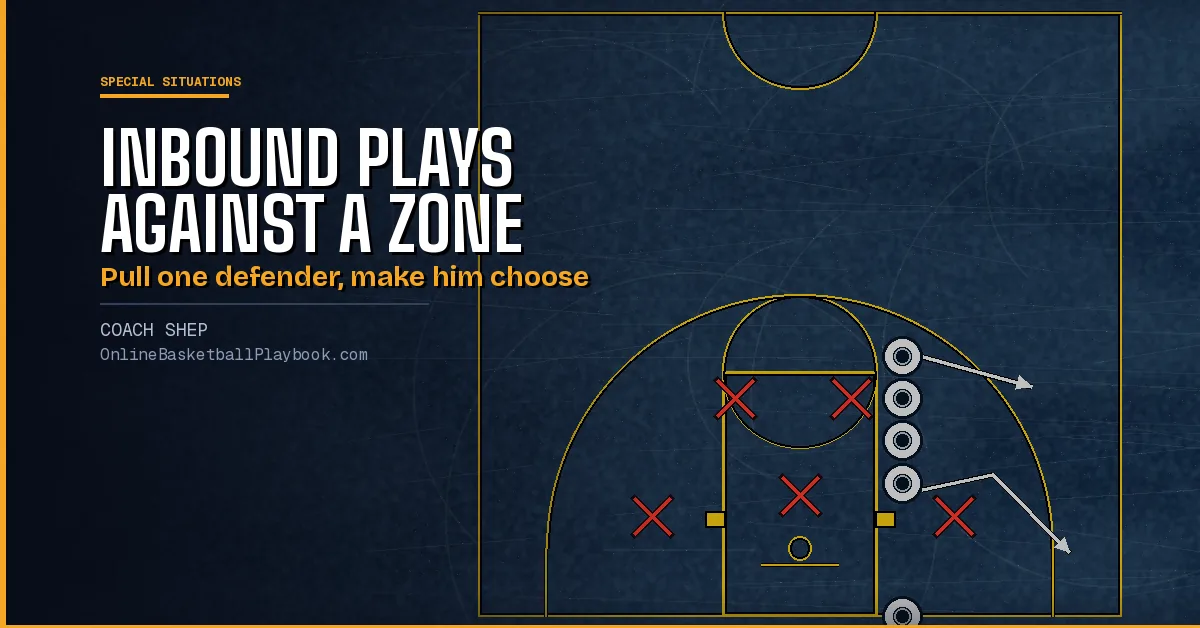
Inbound Plays Against a Zone: Baseline and Sideline Sets
Inbound plays against a zone from the baseline and sideline: the read, the stack near the elbow, short-corner pulls, split cuts, two-part sets and sideline answers.
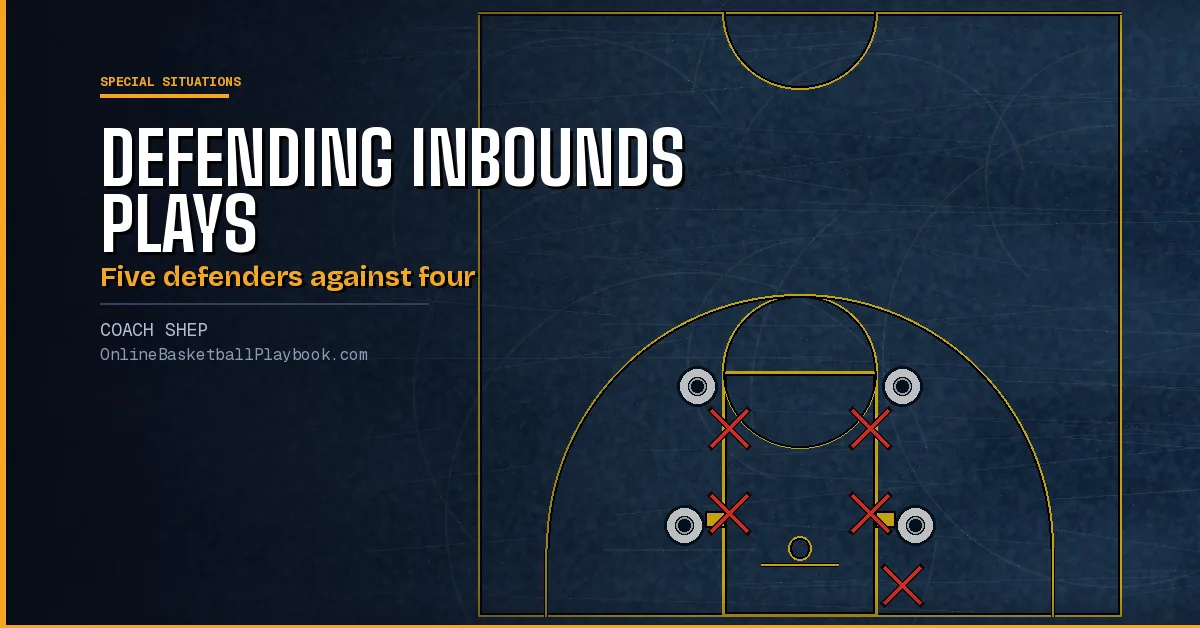
How to Defend Inbounds Plays: Baseline and Sideline Options
How to defend inbounds plays: the 5 on 4 edge, what to do with the inbounder, Jam, Jump Switch, Trap and zone options, sideline answers and late-game calls.
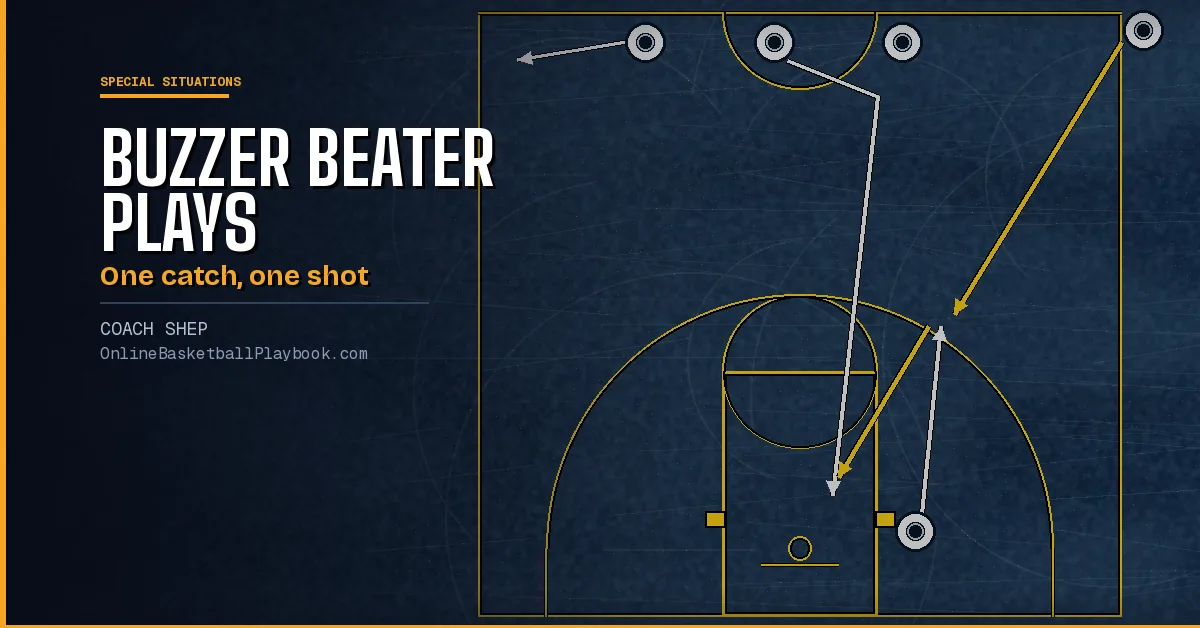
Buzzer Beater Plays From Half Court: Sideline and Baseline
Buzzer beater plays from half court for one catch and one shot: sideline sets at the half-court line, baseline lobs for one second, the reads and the rules.