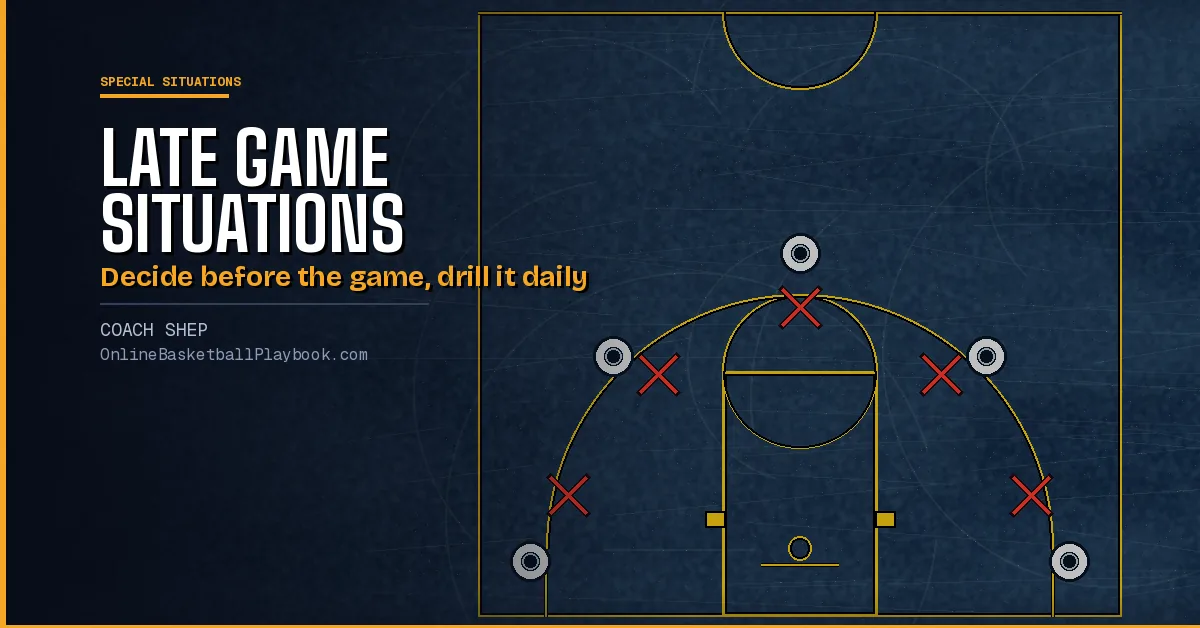
Basketball late game situations are the decisions a coach and team make about time, score, fouls and timeouts in the last minutes of a close game. The set plays are one piece. The decisions around them matter just as much, and they are the ones teams lose by making for the first time at 0:08 with the crowd loud. This guide covers deciding ahead of time, the score math, timeouts, fouling, the last shot, protecting a lead, the last defensive possession and how to practice all of it.
Basketball Late Game Situations at a Glance
| Question | Settle it before the game |
|---|---|
| Foul or defend up 3? | Pick one, name who fouls and set the clock time |
| Timeouts | How many to save, and the reasons you will call one |
| Fouls to give | How many, and at what clock time you use them |
| Trailing by more than two possessions | When the fouling starts |
| Last shot | When the play starts and when the shot goes up |
| Protecting a lead | Attack or hold, and who handles the ball |
| Substitutions | The foul-trouble rule and the late defensive subs |
Decide Before the Game
Write the program's answer to each recurring situation in a preseason staff meeting. Examples are foul or defend up 3, what to run down 1 with under 10 seconds and when to start fouling when behind. Tell the players before the game. Some staffs review two or three situations a day in practice and split the team into two groups to rep them.
Automatic rules take decisions off the coach in the moment. One published list has 11 of them for the last two minutes, such as no timeouts to save a possession before the last two minutes and holding the ball in the last minute when tied or ahead. A staff can also name a special-teams group for late games, such as the best free-throw shooters, the best press group and the best inbounders, with an assistant telling the head coach who to send in.
Teach players to think in possessions. The margin alone does not say whether to hold, push or foul. A point guard should be able to answer two questions on the spot. Down ten with two minutes left means push for quick scores. Up four with two minutes left means burn clock and get a good shot.
Do the Score Math
The score decides what each kind of basket means, and players forget it under pressure. This table shows what a made two or a made three does to the margin.
| Margin | A made two | A made three |
|---|---|---|
| You are up 1 | Opponent leads by 1 | Opponent leads by 2 |
| You are up 2 | Tied | Opponent leads by 1 |
| You are up 3 | You still lead by 1 | Tied |
| You trail by 1 | You lead by 1 | You lead by 2 |
| You trail by 2 | Tied | You lead by 1 |
| You trail by 3 | You still trail by 1 | Tied |
Read the table as a defender and as a shooter. Up 1, any basket they make takes the lead, so a stop matters more than anything else. Up 3, only a three ties, so the defense gives up the two and takes away the three. Trailing by 3 with seconds left, a three only ties, so the staff has to decide whether it wants a quick two followed by pressure or a foul, or a set built for the three that forces overtime. The two-or-three question comes before the play call, because the play follows the answer.
Timeouts
Five reasons to call a timeout appear again and again.
- Stop a run. It calms the crowd and refocuses your players.
- Make a big strategic change, such as dropping a press that is not working.
- Draw a late play. A set the defense has not seen and scouted is more likely to get an open look.
- Rest a tired star without taking him out of the game.
- Wake up a sluggish team.
Two reasons not to call one are frustration with a call and an early adjustment that a substitution can handle. A timeout in frustration wastes the timeout and fixes nothing.
Run the huddle on a plan. Give the first 30 seconds of a full timeout to water and towels and the last 30 to the coach alone, with one voice and eye contact confirmed before he starts. Limit adjustments to one to three, and expect nothing new that the team has not drilled. An assistant should check team fouls and timeouts remaining with the scorer at every timeout, and every player should leave the huddle knowing both numbers. Games have been lost by running out of fouls to give after the last timeout.
Fouling
Fouling is a skill, and an untrained player told to "go foul" will grab or hit. Teach it in a short block. Deny the passing lane and go for the steal first, since a steal beats a foul. If the steal fails, foul by trying to knock the ball loose. Do not grab or push, and never foul a shooter in the act. A shot foul that turns into a three-point play forces your team to score, get a stop and score again.
Choose the player carefully. Fouling the opponent's best scorer sends him to the line to earn points. A player who is struggling from the field may find his rhythm there. Free-throw percentage alone is a weak guide, since some poor shooters do better under pressure and some good shooters do worse.
When trailing by more than two possessions, foul right away. Letting 20 seconds run off before the first foul wastes recoverable time. Put in players who can afford to pick up a foul so a starter is not disqualified, and bring foul-trouble players back once the clock has stopped. Rotation rules are on basketball substitution patterns. If you are the team being fouled, keep the best free-throw shooters on the floor and move the ball with crisp passes to run clock before they can foul.
Up 3 and the intentional miss
The arithmetic explains why up 3 is hard. Fouling a non-shooter before the shot leaves you up 1 if they make both free throws. If they make the first and miss the second on purpose, a rebound and a two ties the game and a three puts them ahead. That is why the intentional miss must be taught and rebounded. The shooter cannot cross the line until the ball hits the rim, and a miss to the left or right side of the rim is harder to rebound than one short to the front. Every defender needs a box-out assignment before the ball is released.

Whether to foul at all is one of the biggest splits below. See intentional foul in basketball for the rule and free throw shooting for the free-throw side of the drill.
Get the next coaching guide in your inbox
One email when a new guide or diagram set goes up. Free.
The Last Shot
With the ball and a tied game, hold for the last shot. Shooting early, make or miss, gives the opponent a chance to answer, and overtime is the worst result of holding. The published timing windows differ a little, and all of them leave room for a putback. One method sets the play at 10 seconds, starts it at 8 and shoots and crashes the glass at 3 to 5 seconds. Another starts at 12 seconds and shoots at 5 or less. A third shoots with about 5 to 6 seconds left when leading and 4 to 5 when tied. A late, good shot beats a rushed shot that gives the ball back with time left.
Dribbles eat the clock. A rough ceiling is about one dribble for every three seconds, so three dribbles fit in five seconds and five in seven. Most last-second plays depend on two passes, a crisp skip pass from sideline to sideline and a baseball pass to the opposite elbow. Without them, the plays do not work.
Prepare a play for each time band at each inbound spot, for a two and for a three. The bands are 0 to 3 seconds, 4 to 8 seconds and 9 or more. With under 4 seconds, one method inbounds to half court and calls a timeout rather than advancing the ball live. With 1 to 3 seconds left, take the timeout. Keep the plays few and simple, and add four automatic reads to every baseline inbounds play, communicated with eye contact and body language instead of calls.
- Cut to the basket when a defender's back is turned.
- Give and go quickly when the inbounder is left unguarded.
- Throw a lob when a defender faces up with his back to the passer.
- Pass off an inattentive defender's back for an easy score.
For set plays see basketball inbounds plays and basketball after timeout plays. The end of game situations page has more play ideas.
Protecting a Lead
Keep strong ball handlers on the floor with a lead, since the opponent will probably pressure full court, and bench players who turn the ball over. Protect the defensive glass and make your free throws. Missed free throws let the trailing team believe a comeback is possible, and defensive rebounding is often the first thing a team gives up once it is ahead.
When you are up 6 to 12 late, shorten the game. Hold for layups only, call the plan from the bench instead of a timeout so the clock keeps running, and play containment defense that avoids stoppage fouls. Do not tinker while up 10 to 20. Keep the aggression that built the lead and save experiments for practice. The delay game itself is covered in basketball delay game offense and four corners offense.
The Last Defensive Possession
When you are up 3 with the other team holding the ball, one approach puts all five defenders on the three-point arc with hands up and nobody helping from inside. The defense concedes the two, switches every perimeter screen and, once the ball goes inside, denies the pass back out. Inside help opens the drive and kick, which is the most common way the plan fails.

Other rules for the final seconds follow the same logic.
- Switch under 8 seconds. Switch every ball screen from the 1 through the 5. A mismatch will not lose the game, but an open shot will.
- Crash the glass. All five defenders box out on the final possession, because many close games are lost on a missed box-out.
- Use the clock math. With 1.3 seconds left, the offense can only catch, dribble and shoot or catch, pass and shoot, so a help defender can sell out to contest once the ball handler has started a live dribble.
- Put the right players in the right spots. Use the tallest player on the long pass and the quickest players on the sideline and wing.
- Keep the ball in play. On a sideline pass, do not bat the ball dead, since that stops the clock. Bat it into the backcourt if you can.
- Watch the inbounder. He can step in after the pass and get it right back for an open three.

Track the fouls you have to give and decide at what clock time to use them. Weigh whether to guard the inbounder on a full-court situation, since pressure takes away a free look but removes a defender from the ball. Avoid ball-watching, and know whether the other bench has timeouts left. See how to defend inbounds plays and preparing for late game defensive situations for more.
Substitutions and Foul Trouble
Announce the substitution order before the game so the first sub is ready and watching from the bench. Late in a game, use defensive-only subs who can afford to foul. Put foul-trouble players back in once the clock stops. Pick one threshold for foul trouble on the team, because the published rules differ. One subs a player on his second foul of the first half and on the third early in the second. Another keeps the foul count below the number of the quarter. See basketball substitution patterns for the rotation side.
How to Practice Late Game Situations
Small and daily beats big and rare. Reserve the last ten minutes of practice for situations. Draw 35 index cards from game-clock scenarios, such as down 4 with 7 seconds left, and pull one a day. Another commits 15 to 20 minutes a day and rotates situations weekly. Add any moment your team struggled with in a game to the next practice list. How to build them into practice is on game situations in practice.
- Situation tournament. Two teams play a set of scenarios, each with a scoreboard, a clock and one timeout. A team wins a set by winning three of five. Examples include down 3 with 8 seconds left inbounding on the front-court side of half court and a tie game with one minute left and a one-and-one.
- The 56-56 scrimmage. Preset the score at 56-56, play to 60, then put 2 minutes on the clock and finish the game. Let an assistant coach each side so the staff practices its own decisions too.
- Free-throw pressure block. Split the team on both baskets, run 6 minutes and set a 70 percent team goal. If the team misses the goal, everyone runs.
- Teach the foul. A short block on denying the passing lane, going for the steal first, knocking the ball loose and boxing out the intentional miss.
The drills to teach late game situations page has more formats, and preparing for late game situations covers the offensive side.
Where Coaches Split
| Question | One view | Another view |
|---|---|---|
| Foul up 3 | Foul a non-shooter with under 5 seconds left, and with 10 seconds or fewer by another rule | Fouling with more than 3 seconds left is risky, because a made first free throw and a rebounded miss can still tie or win it. Decide from the other team's three-point shooter |
| Saving timeouts | Save two or three for the end | Do not bank timeouts, because you cannot eat them. Another view spends none to save a possession before the last two minutes |
| After a late score | Take a timeout to set the defense against a fast break | Push a quick counter, since many teams relax right after scoring |
| Trailing by 3 | Take a quick two and pressure the ball | Run a set built for the three and play on |
| Holding a lead | Hold for layups and free throws only | Keep attacking and keep the aggression that built the lead |
| Fouling when behind | Foul at once to get the ball back | Fouling to extend a game rarely brings a comeback |
None of the published advice on fouling up 3 cites data. On every row the practical answer is the same. Choose a rule, tell the players and drill it, and avoid deciding in the final seconds for the first time.
Questions Coaches Ask
Should you foul when up 3 in basketball?
Coaches split. One side fouls a non-shooter with a few seconds left and drills the intentional-miss box-out. The other defends the arc, concedes the two and does not foul a shooter. Decide before the season, name who fouls and set the clock time.
When should you call a timeout late in a game?
Call one to stop a run, draw a late play, make a big change or rest a tired player. Skip one out of frustration. Check team fouls and timeouts remaining with the scorer every time.
How long should you hold the ball for the last shot?
Coaches who publish timing put the shot between about 3 and 6 seconds left, with the play starting around 8 to 12 seconds. The window leaves time for an offensive rebound and a putback.
What is the score math when up 3?
A made two leaves you up 1 and a made three ties the game. That is why teams on defense give up the two and take away the three.
How do you practice late game situations?
Use the last ten minutes of practice for one scored scenario a day. Add a situation tournament or a 56-56 scrimmage, and add any moment your team struggled with to the next list.
Want the printable playbook packs?
OBP Pro members get the premium playbook packs: the zone attack, out of bounds and practice plan PDFs, plus each new pack as it is finished. The membership page lists what is in each one. Or draw your own version free in PlayDraw.
See what OBP Pro includesMore Coaching Guides
- Mentorship Program for Young Coaches: Match, Meet, Review
- Transition Offense Drills: Outlet, 2-on-1 and Live Ladder
Back to Basketball Inbound Plays and every Special Situations page.
Keep Building
Related breakdowns
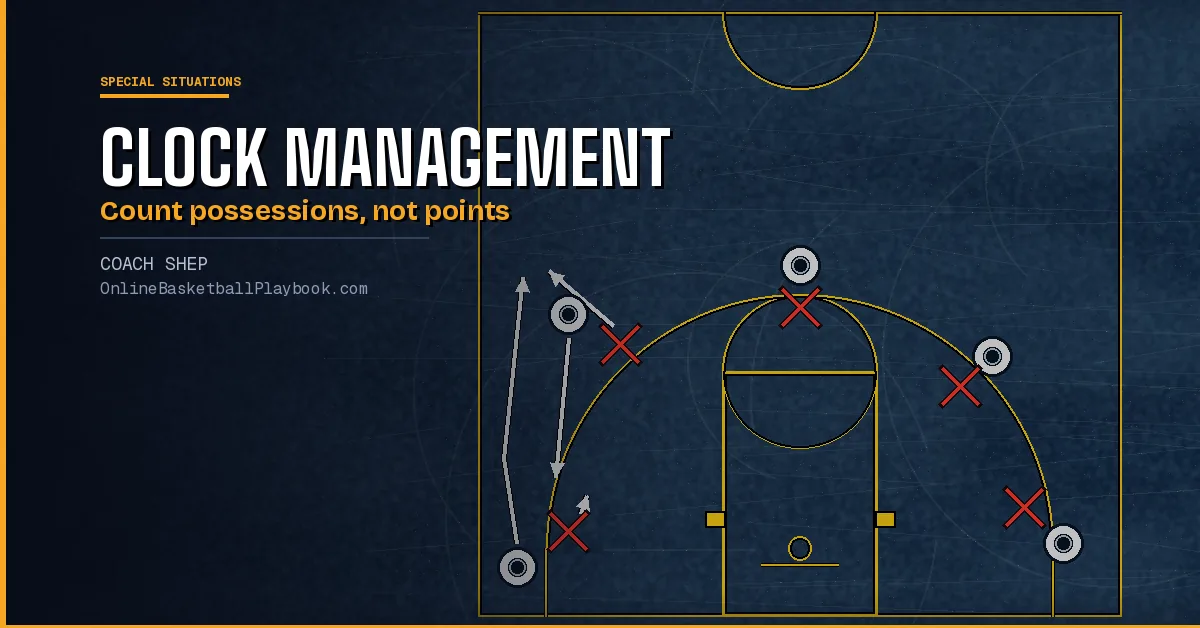
Basketball Clock Management: Foul Up 3, Two for One, Last Shot
Basketball clock management explained: the clock rules by level, counting possessions, foul or defend up 3, fouling when behind, the two for one and the last shot.
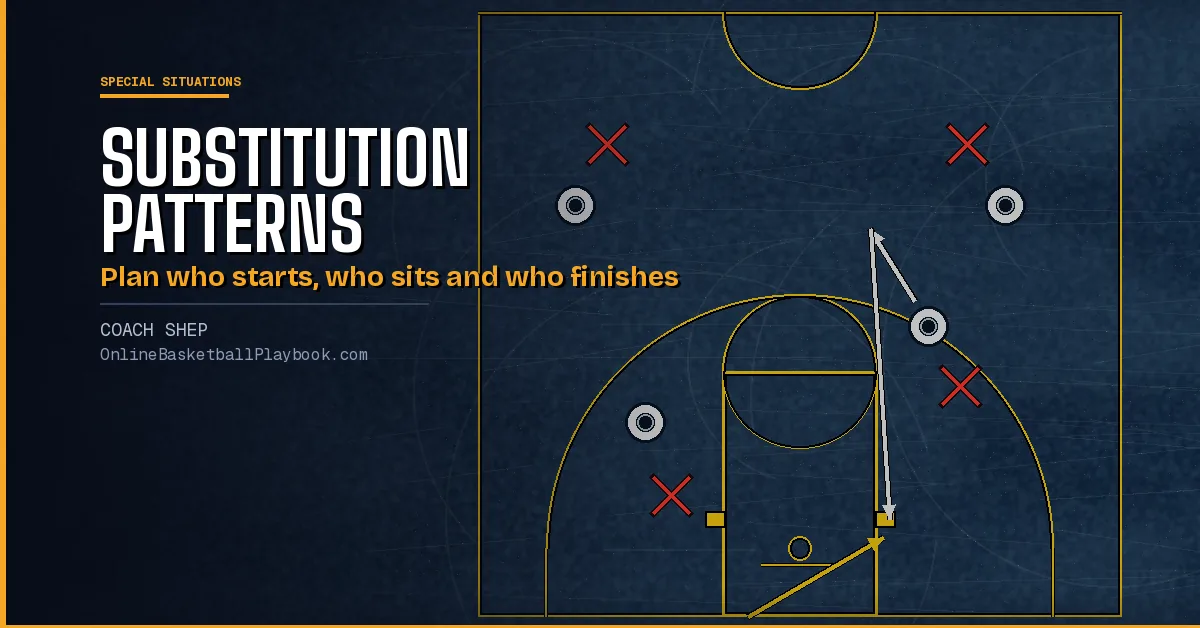
Basketball Substitution Patterns: Shifts, Fouls and Closers
Basketball substitution patterns from tip to final horn: who starts, how long shifts run, unit subs, foul-trouble rules, subbing after a mistake and bench roles.
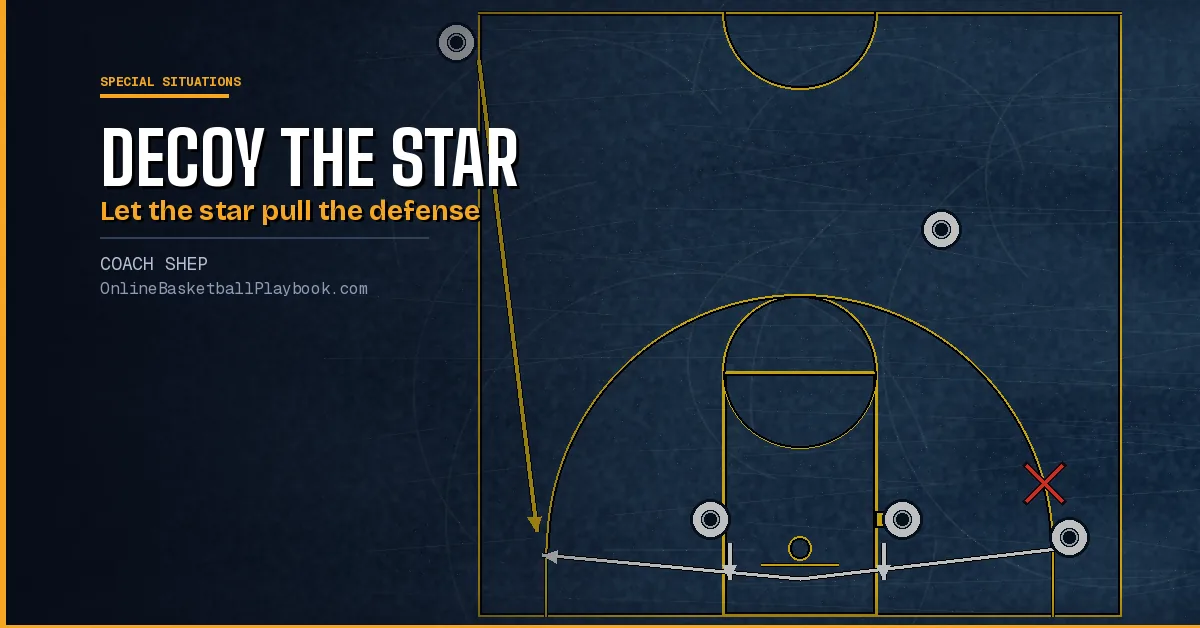
Late Game Plays When They Deny Your Best Player
Late game plays for when the defense denies your best player: decoy the star, where he starts, reads for the sag and the deny, the open inbounder and the back door.