
Late-game execution is a skill, not a personality trait. Teams that thrive under pressure have practiced the specific reads, footwork, and decision habits that hold up when every possession counts. Here is how to build that in practice.
Why Drills, Not Just Plays
Every coach has a late-game play. The problem is that a diagram drawn in a timeout does almost nothing if the movement patterns and decision habits it requires have never been trained at game speed. When the shot clock is down and the deficit is two, players revert to what they have done thousands of times — not what you drew up sixty seconds ago.
Late-game situations require two things your players must already own before crunch time arrives: the ability to read a defender and make a correct decision quickly, and the footwork to finish that decision under a contest. Neither of those things comes from a play call alone. They come from breakdown drills done at game speed, with real decisions built in, practiced so often that the read is automatic.
The best drill library for late-game preparation does not have a "late-game drills" chapter. It has a design principle instead: isolate one read per drill, add scoring to coach behavior without stopping play, and build the connected chain of actions that a late-game possession actually requires. Each section below applies that principle to the situations that matter most when the game is on the line.
Constraint Scoring: Coach the Decision Without Stopping
The most powerful tool in late-game drill design is incentive scoring. Rather than stopping play to correct a decision, you engineer the scoring so that the right decision earns points and the wrong one costs them. Players learn the read because the math demands it, not because a voice from the sideline interrupted the rep.
A useful model comes from Alabama's practice structure, where scored 5-on-5 uses a +3 / +2 / +1 putback / −2 turnover system. The turnover penalty is steep enough that players feel the cost of a poor decision under pressure without a whistle being blown. That negative score functions exactly the way a late-game turnover functions: it shifts the outcome of the game. When players experience that emotional weight in practice repeatedly, they learn to value each possession.
Apply the same logic to smaller-sided drills. In 3-on-2 continuous work, award an extra point for a skip pass that leads to an open corner three versus a rushed drive. In 2-on-1 reads, penalize a hesitation that allows the defense to recover. In 4-on-4, subtract points for dribbling into traffic with under ten seconds on the shot clock. You are not adding complexity — you are making the scoring mirror what late-game basketball actually rewards.
The Blood series from the Memphis breakdown drill library takes this a step further with a constraint: any mid-range jumper in a designated zone counts as a turnover. The rule forces players to make the contested pull-up rare and the drive-and-kick common, which is exactly the shot diet a well-coached late-game possession demands. You do not need to explain why the shot is bad. The score explains it automatically, rep after rep.
Advantage and Disadvantage Drills for Late-Clock Reads
Late-game situations almost always create a numbers advantage somewhere on the floor. A foul bailout in transition creates a 2-on-1. A defensive rotation leaves a corner open. A screen forces a switch that creates a mismatch. Your players need to see and exploit those advantages in real time — not recognize them a beat too late.
Advantage small-sided games are the fastest way to build this recognition. The design is straightforward: engineer the advantage for the offense at the start, require them to read and attack it, then gradually make the advantage smaller so the read gets harder. In Two-Side 3-on-2 work, the offense starts with an extra player and must convert before the defense can recover and equalize. The coaching constraint — ball on the outside hip reads baseline drive, inside hip reads middle drive — makes the decision rule explicit before players ever go live.
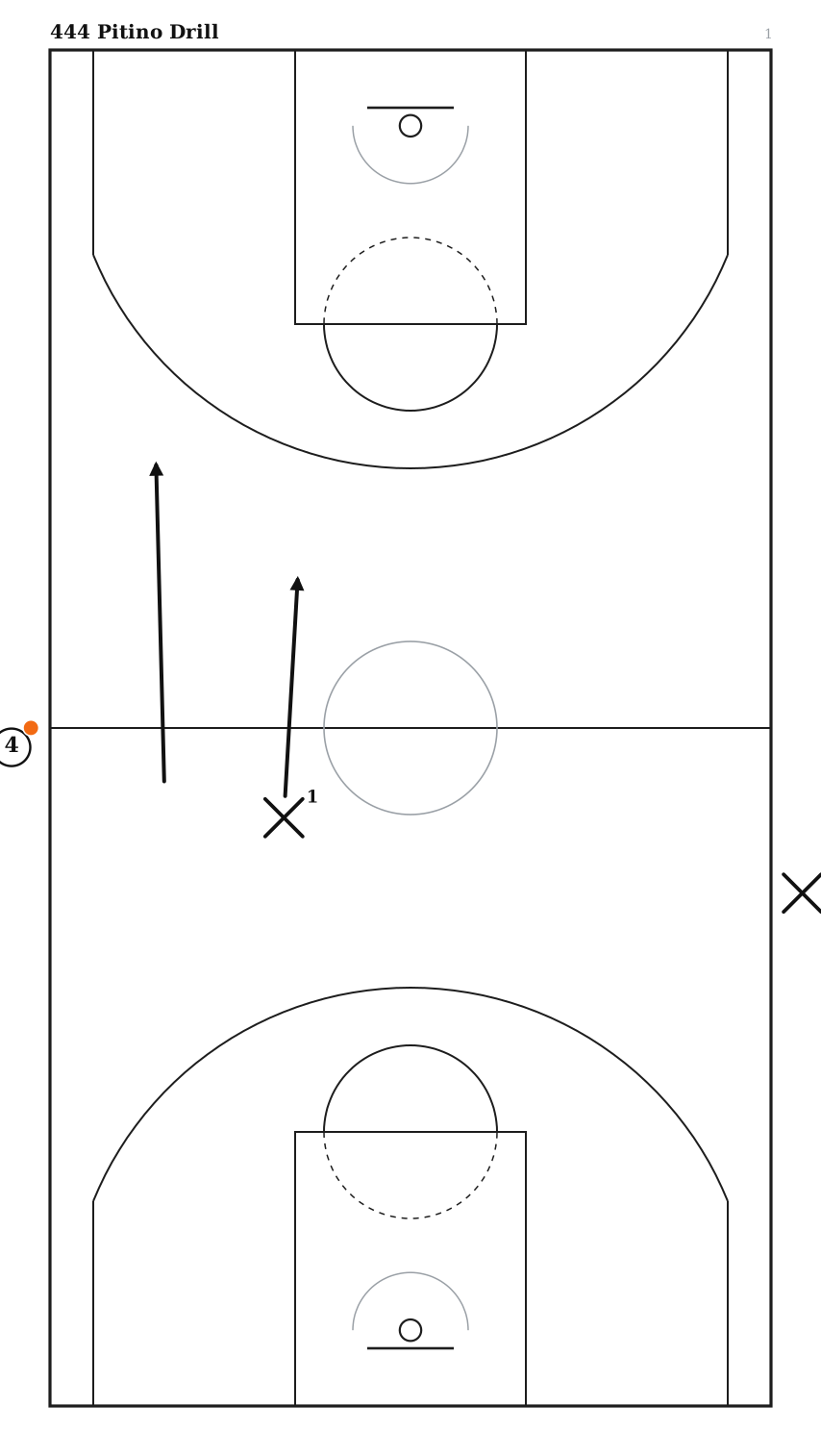
The Texas drill series (22/33/44) from the Memphis system takes the same concept to full-court transition. In Texas 22, two offensive players attack two defenders with one pass and one shot allowed before the defense can set. This mirrors the end-of-quarter situation where a team must advance the ball quickly and make a decision before the defense organizes. Dribble limits and the single-shot constraint force players to read earlier and move with purpose, not impulse.
The Scramble drill, a 3-on-2 continuous format, is especially useful for late-game preparation because it pairs the offensive read with a defensive sprint-back requirement. After scoring, the two players who just finished transition to defense while the third stays back. This creates the exact physical demand of a late-game stop-and-score scenario: you just made a play, now you have to get back and prevent the answer. Training the physiological reset — from the emotion of a make to the discipline of a sprint-back — is as important as the offensive read itself.
Finishing Under Pressure
Most late-game collapses are not strategic failures. They are finishing failures. A player gets to the right spot, reads the defense correctly, receives the ball in rhythm — and then misses the contested layup or rushes the pull-up because the moment is too big. The solution is not a pep talk. It is more contested finishing reps at game speed, long before the game arrives.
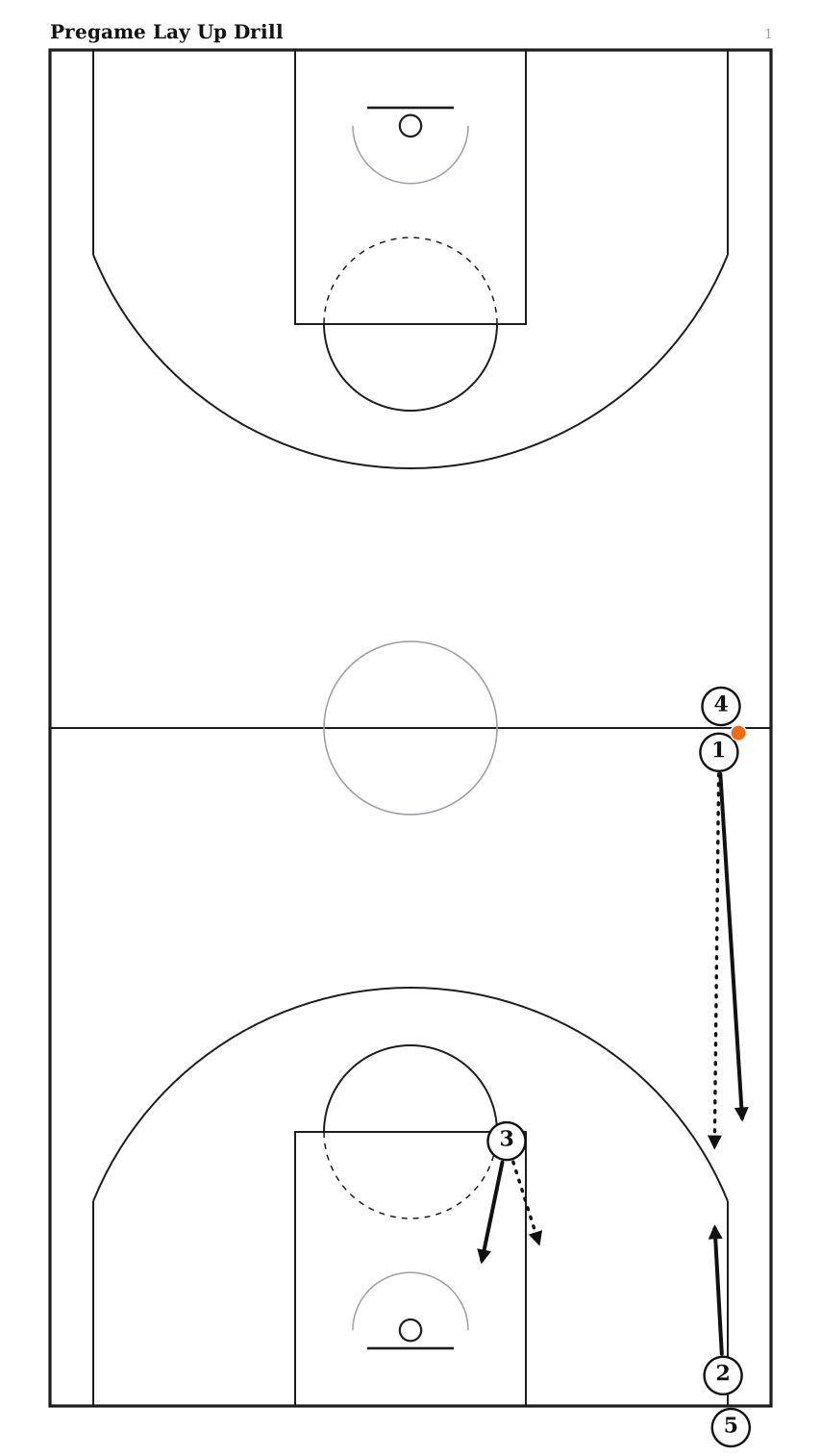
The foundational principle from the vault's sources is consistent: finishing-footwork must be drilled before team reads are added. The layup sequence — both hands, both sides, straight, reverse, crossover, and hesitation finishes — done at game speed in practice builds the body memory that holds up when the lights are bright. A drive-and-kick read is only as good as the finish at the other end of it.
The Chase drill builds both the finish and the psychological component simultaneously. A player attacks the basket and must finish through a contest — a coach or manager closes out as the shot goes up. Miss, and there is a consequence (pushups, a sprint, a restart of the count). Make, and the rep is validated. The pressure in the drill is manufactured, but the response it trains is real: stay composed, use your footwork, finish through contact. That is exactly what your best player needs to do when you draw up a play with four seconds left.
Full-court speed layup circuits — "make 50 in two minutes" — combine finishing with conditioning. By the time your players have been on the floor for thirty-two minutes and must convert a crucial layup in the final possession, they are tired. If every finishing drill in practice was done when players were fresh, you have not prepared them for that moment. Finishing drills that require execution under fatigue are finishing drills that transfer to late-game situations.
The X-Layups drill, which appears across multiple elite practice systems, is a go-to for this reason. Two lines attack simultaneously from opposite sides of the basket, creating congestion and requiring both players to finish without fouling each other. The drill trains composure at the rim when space is contested — exactly the condition you face on a drive in the final two minutes of a close game.
Out-of-Bounds and Special Situation Reps
Out-of-bounds plays at the end of quarters and halves are the most under-drilled category in most practice plans. Coaches diagram these plays on the board and walk through them in team meetings, but rarely rep them at game speed with live defense until a game forces the issue. By then it is too late to build the reads — you are hoping for execution of something that has only ever been a diagram.
The Karl and Stotts approach from the Seattle SuperSonics drill library treats OOB plays as a daily drill category, not a chalk-talk emergency. Six complete baseline and sideline OOB plays — including Double Up, Around-the-Horn-to-Backdoor, and Five-in-a-Line — are practiced with the same frequency as any other breakdown drill. The reads are trained. The timing is trained. When the timeout ends and the play is called, players are executing something they have done hundreds of times, not walking through a diagram they saw once.
Run your late-game OOB drills with these design principles: the inbounder must make a real read (where is the help, where is the open player), not just throw to a predetermined spot; defenders are live enough to require a real decision; and the drill ends with a score attempt, never just a completed pass. A pass that goes somewhere safe but does not lead to a shot attempt has not trained anything useful. Every OOB rep should simulate the full possession: inbound, read, action, finish.
Side-OOB plays under your own basket with under ten seconds on the clock deserve their own weekly rep block. The constraints here are different — no timeout, must advance the ball past halfcourt, need a clean catch before anything else happens — and players need to feel the urgency of that situation before it arrives in a game. Walk through the play once. Then run it live with a horn simulating the clock.
The Controlled Scrimmage: Structure When It Matters Most
Gregg Popovich's "3 Ways" scrimmage format is one of the most transferable drills in this library for late-game preparation. The structure is full-court 5-on-5, but constrained: one point for scoring, one point for a stop — even a made three earns only one point. Play to ten. After going down-and-back twice, throw the ball to the coach and restart.
What this format does for late-game preparation is precise. The equal value of offense and defense forces players to compete for stops with the same intensity they compete for scores. In a standard scrimmage, a stop is invisible — it simply returns possession. In 3 Ways, a stop has the same scoreboard value as a basket. Players learn that the last defensive possession is worth the same as the last offensive possession, which is exactly the competitive reality of a close game's final two minutes.
The coach controls tempo by design. After each down-and-back sequence, play stops, the coach can address one teaching point, and it restarts. This is the equivalent of a late-game timeout: brief, targeted instruction followed by immediate live execution. Players get the mental rep of processing coaching and then going out and executing, which is a skill that must be practiced just like footwork or reads.
Use the 3 Ways format specifically for your last segment of practice, when players are tired and the competitive investment is high. The scoring structure keeps the intensity real without allowing the scrimmage to become chaotic. You can teach in it. You can correct in it. And players experience the emotional arc of a tight game — lead changes, possession-by-possession tension, the weight of a stop — in a structured setting every week.
Putting It All Together in Practice
A late-game preparation block should run roughly fifteen to twenty minutes and include all three layers: a constraint drill that builds the decision, a finishing drill that builds the execution, and a small-sided or controlled scrimmage segment that connects them under competitive pressure. You do not need a special "late-game practice" to build this capability. You need to design your regular practice segments with these principles embedded.
Start with a constraint drill that enforces the shot diet or decision you want in close games. The Blood series mid-range-as-turnover rule works. So does a dribble limit on your 3-on-2 work that forces early reads. Run it scored, with losers running the difference in points. That takes ten minutes and trains the read without a single sideline lecture.
Follow with a finishing circuit under fatigue. X-Layups, Chase drill, or full-court speed layups — pick one and run it at the point in practice where players are already tired. This is deliberate. You want finishing reps to happen when the body is working, not when it is fresh.
Close with a 3 Ways segment or a scored 3-on-2 continuous game. This is where the read and the finish connect under live competition. Keep score. Award stops the same value as scores. Run it until someone wins. The players who thrive in this format will thrive in tight games — and the players who struggle have just identified the exact thing they need to work on.
OOB plays belong in the drill repertoire, not a separate playbook — drilled daily, not chalk-talked in emergencies, so players execute something they have done hundreds of times when the timeout ends.
— Karl and Stotts (Seattle SuperSonics), Basketball Vault
Before your next late-game scenario actually happens in a game, run at least one full week of practice where the final segment uses the 3 Ways format with scored stops. Your team needs the emotional experience of fighting for a stop in practice competition — not just being told that stops matter — before they will do it automatically when the game is real and the clock is under two minutes.
- Use constraint scoring (+3 / +2 / +1 / −2 turnover) in every 5-on-5 segment — the negative penalty trains possession value without stopping the rep.
- Run the Blood series mid-range-as-turnover rule at least twice per week to enforce the correct shot diet in drive-and-kick situations your late-game plays require.
- Rep OOB plays live with a real defensive read at least once per week — walk through once, then run it live with a horn simulating the game clock.
- Place your finishing circuits (X-Layups, Chase drill, full-court speed layups) late in practice when players are already tired — finishing under fatigue is the skill that transfers to late-game execution.
- Close competitive practice segments with 3 Ways scrimmage where a stop scores the same as a basket — this trains the emotional discipline of competing for a stop with the same urgency as competing for a score.
- For transition reads in late-game scenarios, run Texas 22 and 33 drill series with one-pass, one-shot limits — dribble caps force early decisions that mirror the urgency of a late-clock possession.
Want more basketball coaching strategies, drills, and tools?
See it drawn up
Related diagrams
Keep Building
Related breakdowns
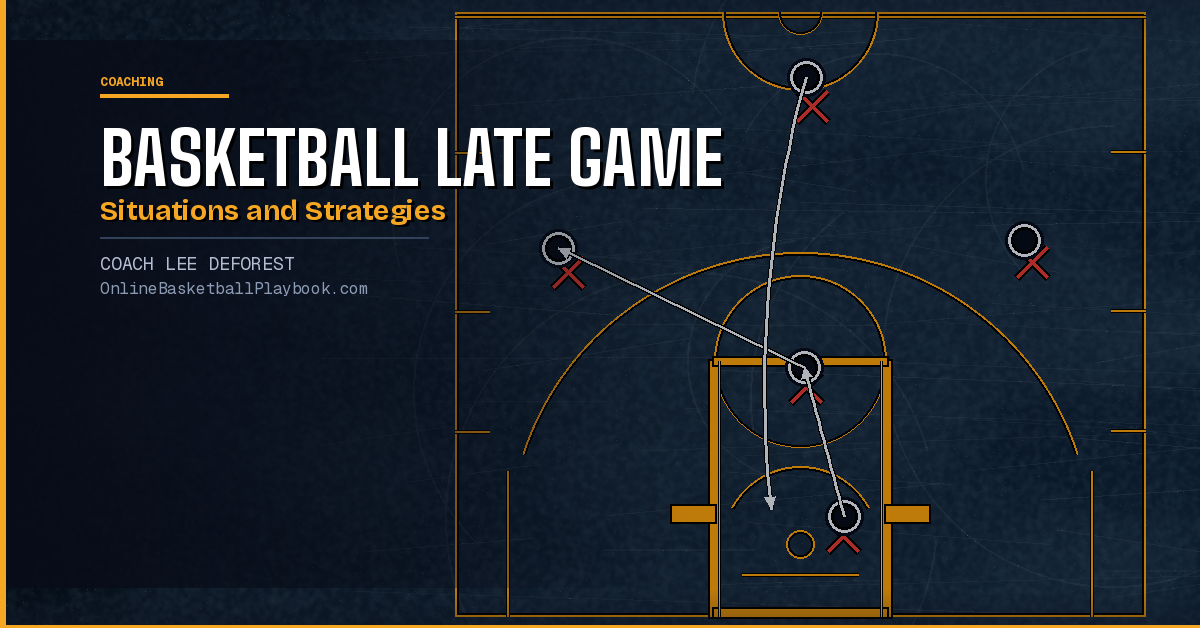
Basketball Late Game Situations and Strategies
Basketball Late Game Situations and Strategies