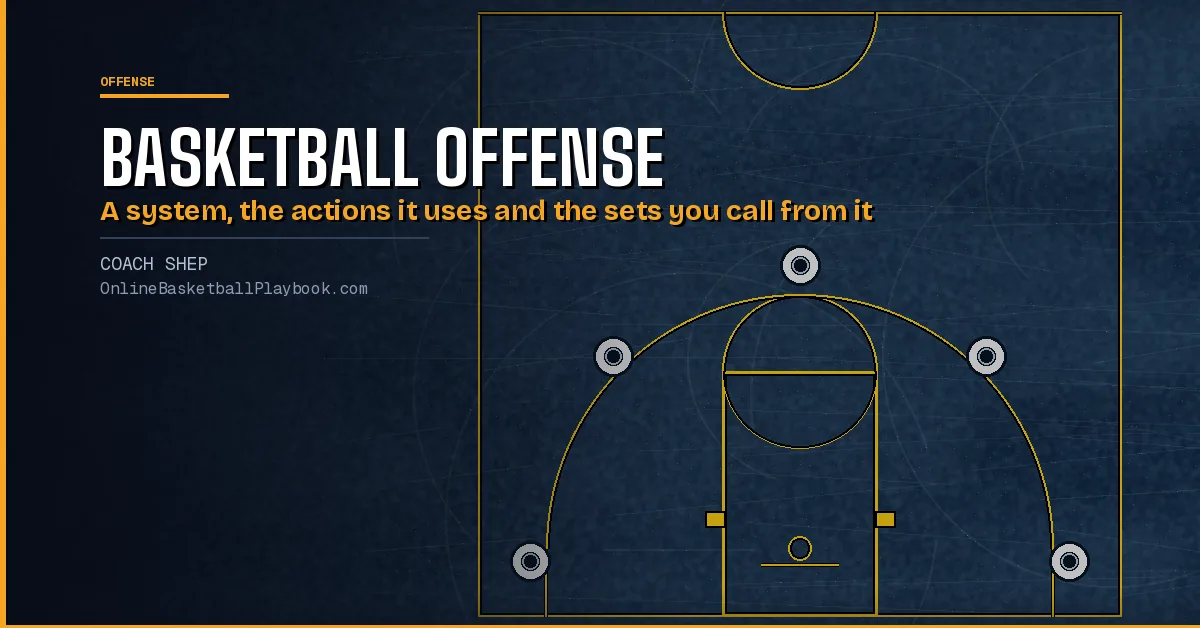
A basketball offense is the plan a team uses to turn possessions into shots. Coaches use the word for three different layers, and mixing them is the quickest way to confuse a roster. A system is a whole offense with a philosophy. An action is a reusable piece such as a ball screen. A set is a named, called play. A team runs a system, calls sets out of it and builds both from actions. This guide maps the layers, shows the formations that organize the floor, and lists the major systems with a one-line description and a link to each full page. Where coaches disagree, both versions appear side by side.
Basketball Offense at a Glance
| Layer | What it is | Examples |
|---|---|---|
| System | A whole offense with a philosophy about spacing, the post player and who gets developed | Dribble-drive motion, Princeton, five-out motion, flex, triangle, blocker-mover, hi-lo |
| Action | A reusable piece of play that more than one system uses | Ball screens, off-ball screens, dribble handoffs, backdoor cuts |
| Set | A named play that a coach calls for a specific look | Quick hitters, baseline and sideline out-of-bounds plays, after-timeout plays |
A team playbook is a library of sets and not an offense. At two major college programs, the playbook is a set library.
Basketball Offense Formations
Formations describe where the five players start. The common ones are named by how many stand outside the three-point line and how many play inside. The ladder view lays out 3-out 2-in, 4-out 1-in and 5-out as a ladder that widens as perimeter skill improves. In its view 3-out 2-in keeps a post presence for teams that do not have five shooters, but works only with two high-IQ posts, and a post who does not understand spacing clogs the lanes in 4-out 1-in.


A two-shape view names 4-out 1-in and 5-out as the two shapes to choose between, and says 4-out 1-in keeps a paint presence for rebounding. The price of 5-out is offensive rebounding. The ladder view gives three crash plans, one with the point guard as safety and four crashing, one with two guards back and three crashing, and one where everyone below the free-throw line crashes. A small-ball version teaches rebounding by committee for small-ball teams and lists lost rim protection as a cost.
Other formations are alignments for sets rather than whole offenses. Horns, with the two bigs at the elbows, two players in the corners and the ball handler at the top of the key, is a base alignment for quick hitters, ball-screen continuities and after-timeout plays. Box and 1-4 stack alignments organize set families in the same way.

Spacing Under Every Offense
Spacing means standing so that no single defender can guard two of the four players without the ball, while every pass stays catchable. Coaches across the major systems call it the first principle, and several rank it above the plays. The distance they use varies.
| Distance between players | Used by |
|---|---|
| 12 to 15 feet | Tex Winter for high school, and many motion offense guides |
| 15 to 17 feet | Bob Huggins |
| 15 to 18 feet | Tex Winter for college, the dribble-drive version, Jay Wright and other college staffs |
| 15 to 20 feet | Tex Winter for the NBA |
| At least 4 meters between outside players | Ettore Messina and Aito García Reneses |
Winter is the only one who ties the number to a level. A gap is the seam two defenders leave between them, and the offense attacks it with a drive, a cut or a pass. See the spacing guide for the full treatment.
The Major Systems
The useful split between systems is what each one does with the post player and who it develops. Each entry below links to the full page.
- Motion offense. Players move and decide off the defense instead of running scripted plays. Every pass is followed by a meaningful move, and standing is a mistake. Motion offense is the connective tissue across several systems below.
- Five-out motion. All five players start outside the arc and choose cuts and screens based on how the defense plays them. It can be built to be hard to scout and to remove technical mistakes. A 3-out 2-in version adds a post. See five-out motion and 3-out 2-in motion.
- Dribble-drive motion. A 4-out 1-in offense that attacks the rim off the dribble through an empty middle. The post stays opposite the ball and the goal is layups, free throws and kick-out threes. Vance Walberg built it at the high school and junior college levels, and John Calipari took it to Memphis. See dribble-drive motion and 4-out 1-in.
- Drive and space. It is called a way of playing, not a system. It looks like dribble drive, but a rim-running center seals the shot blocker instead of clearing out. The ball never stops, and a catch with an advantage attacks while a catch without one swings. Full guide: drive and space offense.
- Princeton. Pete Carril's patient, read-based system for five players who all pass, dribble, shoot and cut, usually around a passing post at the elbow or block. It scores with backdoor cuts against denial and threes against sag. See the Princeton offense.
- Hi-lo. A post-dominant structure that puts a high post and a low post on the same side and connects them with a direct pass window. It is the opposite choice from emptying the paint. See high-low offense.
- Blocker-mover. Dick Bennett's structured motion, and the base offense Tony Bennett's Virginia teams used. Blockers screen by area and movers read the screens and cut. See blocker-mover offense.
- Flex. A continuity built on two repeating sequences, a guard-to-guard pass and a flex cut, and a guard-to-wing pass and a screen away. See the flex offense.
- Triangle. Tex Winter's read-based offense built on spacing, getting the ball to the post along the line of deployment and a menu of automatic reads. See the triangle offense.
- Pace and space. A label for Nate Oats's Alabama offense that he does not use himself. Quick decisions, maximum spacing and downhill play, run as named families the coach assigns. It is a cousin of drive and space. Full guide: pace and space offense.
- Concept-based offense. A third option between motion and set plays. A small set of read rules, installed through small-sided games, with a menu of triggers to flow into when nothing is open. Full guide: concept based offense.
- Two-guard motion. John Beilein's two-guard offense. It starts in a high 2-3 with two guards up top and the post at the nail, and runs through Chin, Shuffle and motion series. Full guide: two guard motion offense.
- Swing and shuffle. Bo Ryan's Swing is a 4-out 1-in continuity that combines pieces of the UCLA offense, the flex and the triangle. The shuffle came from Bruce Drake at Oklahoma in the early 1950s and was taught by Bob Spear at Air Force and Dean Smith at North Carolina. One history calls it the predecessor of Princeton and flex. See the swing offense.
- Spread pick and roll. Billy Donovan's Florida spread: a high ball screen with the other four players spaced, and a set of reads and counters for each way the defense plays the screen. Full guide: spread pick and roll offense.
NBA offense has converged on a five-out delay front with a three-man game in the middle third of the floor. One front leads to many finishes. The full breakdown is on why every NBA team runs the same offense. For the families of continuity offenses see continuity offense, and for stall-and-delay uses see four corners.
Get the next coaching guide in your inbox
One email when a new guide or diagram set goes up. Free.
Actions
Actions are the pieces that systems share, and the same actions show up in very different offenses.
- Ball screens. The ball handler reads how his defender and the screener's defender play the screen and then scores, attacks or passes. The screener rolls, pops, slips or short-rolls. Ball-screen continuity organizes an offense so the pick and roll repeats. See pick and roll.
- Off-ball screens. Down screens, back screens, cross screens, flares, staggers and screening the screener, each with reads for the cutter and the screener. See basketball screens.
- Dribble handoffs. A ball handler dribbles at a teammate and hands off at close range, becoming a screener for the receiver in the same motion.
- Backdoor cuts. A cutter whose defender denies or overplays cuts behind him to the rim. Pete Carril put it as "When closely guarded, go back door."
The shared rule underneath most of these is to do the opposite of what the defense does. If the defender denies, go backdoor. If he plays inside, go outside. If help comes, move the ball to the man it left. Systems differ on how much structure they put around those reads. Motion leaves the most to the player. Blocker-mover gives roles. Concept-based offense gives rules.
Sets
Sets are named plays called for one specific look. Quick hitters are short called plays meant to produce one shot, usually after a timeout, late in the shot clock or at the end of a game. Out-of-bounds plays start a possession from a dead ball under or beside the basket, and after-timeout plays do the same from a stoppage. The named sets live on the play pages, starting at the basketball plays hub. The quick hitters guide, horns sets and inbounds plays cover the common families. Coaches also differ on how many options a set carries. The short-menu view wants two or three high-percentage options and then a straight move into the continuity. The one-play view runs one core special-situation action, a middle ball screen into a pin-down, across five pro clubs, and says the team should feel comfortable with one play. Many of the 2024 NCAA tournament sets build a slip or a backdoor into the play from the start, though not all of them.
Transition and Early Offense
Early offense is the stretch right after the ball changes hands, before the defense is set and matched up. Coaches split on how it fits the system.
| Question | Idea | Example |
|---|---|---|
| Why push | Early offense works in the gap between a set defense and one still scrambling, where a guard may be guarding a post and the helping big is not yet attached to his man | Mismatch window |
| How fast | Push into the frontcourt in 3 to 5 seconds (2 to 3 in a faster telling) so the defense has to react | Fast push |
| Clock and landmarks | Wings at the free-throw line extended in 2.5 seconds and the post rim to rim in 2.8 | Dribble-drive clock |
| Break and half court | The fast break is the half-court offense. The 5 sprints to the rim, two wide wings run the lanes and the same reads carry into the half court | Dribble-drive break |
| Break and half court | Five numbered options, drilled back to back in its 5-on-0 trips drill and paired with its press break in its secondary break | Numbered secondary break |
| Pace or control | Both are described as working. Dan Hurley says "we play fast," while the control camp prefers control | Dan Hurley |
See early offense and transition offense plays, and the half-court side in half-court offense.
Names Coaches Search For
- Weave. An action more than an offense. Weave screen calls have a point guard dribble at a wing and hand off while screening the wing's defender, so a shooter gets a look without a pass to a denied wing. An extended weave runs from a 5-out look with both posts in the corners.
- Wheel. The Italian national team called its 2003 offense the wheel. It starts from a 2-3 formation above the free-throw line, sets positions by the court lines and attacks the basket and the high spot continually. A double-curl play for 3-out 2-in motion also goes by the name wheel.
- Box. An alignment for set families. Wichita State used Horns and Box as workhorse alignments because they make a defense guard elbow ball screens, back screens and handoffs at once.
Installing an Offense
Coaches agree that an offense is installed in stages and disagree on the stages.
| Approach | Sequence | Example |
|---|---|---|
| Reaction drills, then 5-on-0 | Three-player reaction drills of about 90 seconds at the start of practice, then 5-on-0 until pass and cut is clean, then 15 to 20 minutes of 5-on-5 against dummy defenders, a deflection game and live play. Step back a stage when players freeze | Reaction-drill version |
| Cuts first | Each cut type gets its own breakdown, run 2-on-0, then 3-on-0, then with a defender added | Sherri Coale |
| 5-on-0, then live | A 5-on-0 progression with chute shooting and a post split, then 2-on-2 live | Five-out version |
| Games with an engineered advantage | Small-sided games that start from a chosen advantage and add a constraint, such as Two Side 3-on-2 or Blind Cut, so players learn the read live instead of drilling spots | Constraint-game version |
How Coaches Choose
| Roster or situation | Offense | Example |
|---|---|---|
| Guards who can beat their man, and no plan to play through a dominant big | Dribble-drive motion | Drive-first view |
| Five players who can all pass, dribble, shoot and cut, and a high post who can pass | Princeton | Carril. The high-post rule adds that without that high post you should pick another offense |
| Two posts who can work high and low together | Hi-lo | Kansas hi-lo version |
| A program with lesser talent | Blocker-mover, called a great equalizer | Dick Bennett |
| A team willing to build skills before plays | Drive and space, with eyes on the rim, footwork and throwing strikes taught first | Skills-first version |
| You want simple and patient | Flex | Two-sequence version and patient-ball version |
| Two posts who can play inside the spacing | 3-out 2-in | Two-post version |
Related guides are the continuity offense page, the offense evolution and developing a great offense pages, the early offense page, the spread offense page, how to beat man-to-man defense and how to attack a zone defense.
Questions Coaches Ask
What is a basketball offense?
The plan a team uses to create shots. It has three layers. A system is the whole philosophy, an action is a reusable piece like a ball screen, and a set is a named play a coach calls.
What are the types of basketball offense?
Major systems include dribble-drive motion, Princeton, five-out motion, flex, triangle, blocker-mover, hi-lo, swing and concept-based offense. Formations such as 3-out 2-in, 4-out 1-in and 5-out describe where the players start.
What is the difference between an offense and a play?
An offense is a system that runs for the whole possession through shared reads and actions. A play, or set, is a called sequence for a specific look, such as after a timeout.
What is a 5-out offense?
An offense in which all five players start outside the three-point line, leaving the paint open for drives and cuts.
How far apart should players be on offense?
Coaches give different numbers. Tex Winter used 12 to 15 feet for high school and 15 to 18 for college. Bob Huggins used 15 to 17 feet. Messina wanted at least 4 meters between outside players.
Want the printable playbook packs?
OBP Pro members get the premium playbook packs: the zone attack, out of bounds and practice plan PDFs, plus each new pack as it is finished. The membership page lists what is in each one. Or draw your own version free in PlayDraw.
See what OBP Pro includesMore Guides From This Batch
- 1-2-2 Press: Roles, Traps, Rotations and Breakdowns
- Traveling in Basketball: Rule, Steps and Pivot Foot by Level
- 2-1-2 Zone Defense: Rotations, Weak Spots and Personnel
- Triangle and 2 Defense: How It Works and How to Beat It
Back to Offense and every Offense page.
Keep Building
Related breakdowns
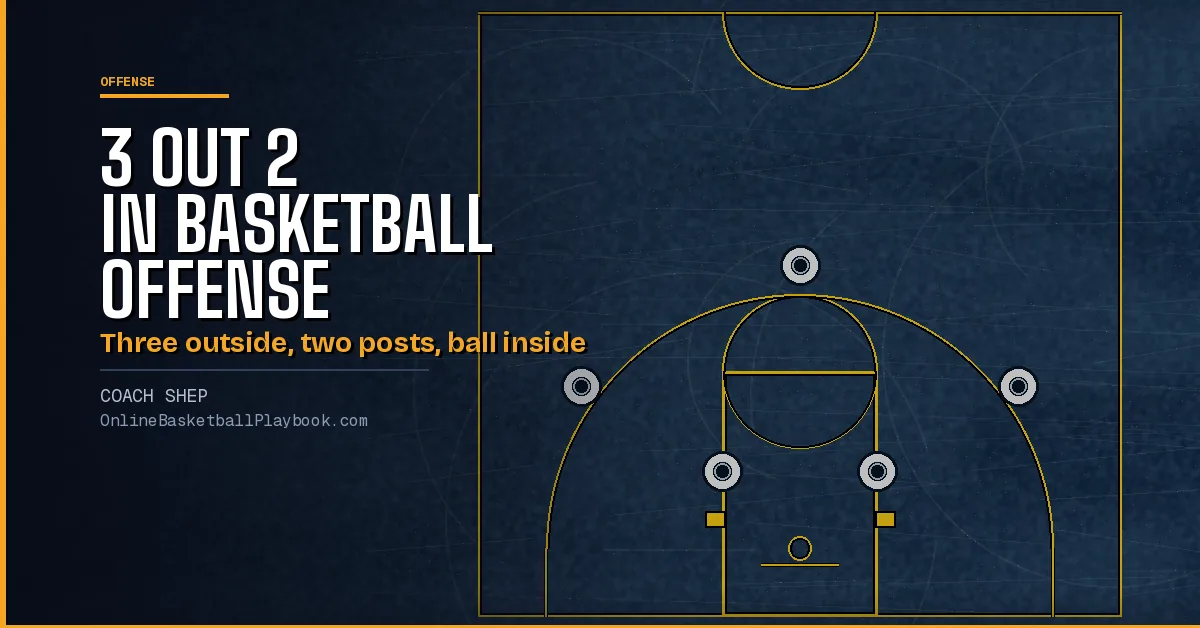
3 Out 2 In Basketball Offense: Spacing, Actions and Reads
The 3 out 2 in basketball offense explained: alignment, actions off every pass, the high-low counter, drive rules for the posts, add-on plays and who fits it.
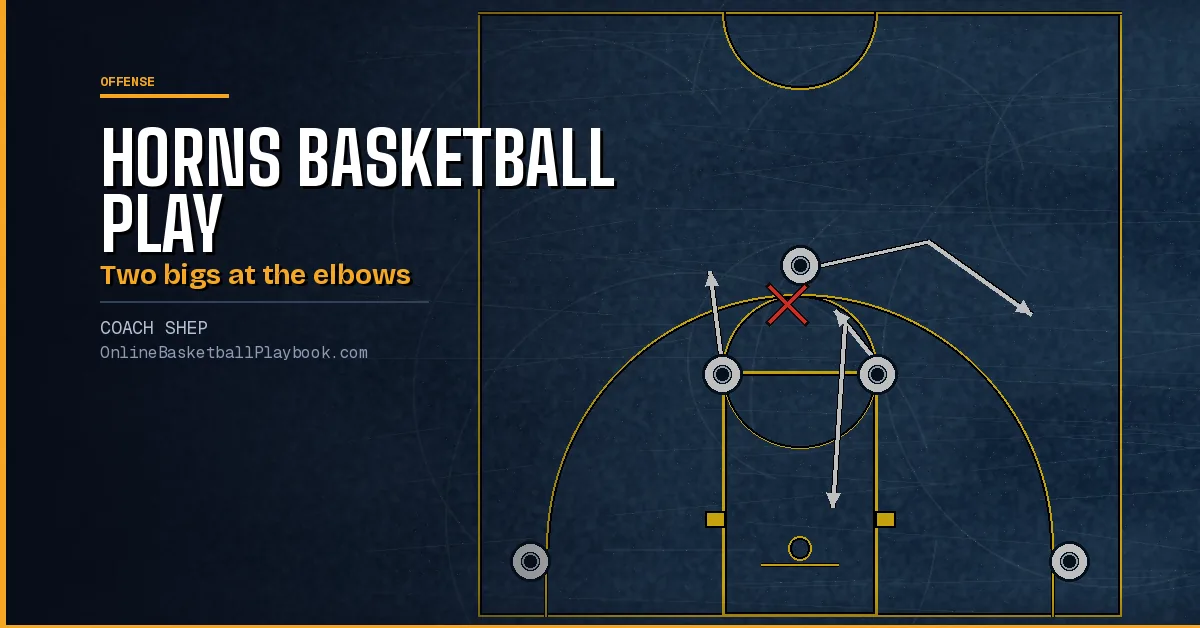
Horns Basketball Play: The Horns Set, Actions and Reads
The horns basketball play explained: the horns set, the elbow pick and roll, roll and pop rules, hi-lo, flex and shooter actions, the reads and the install.
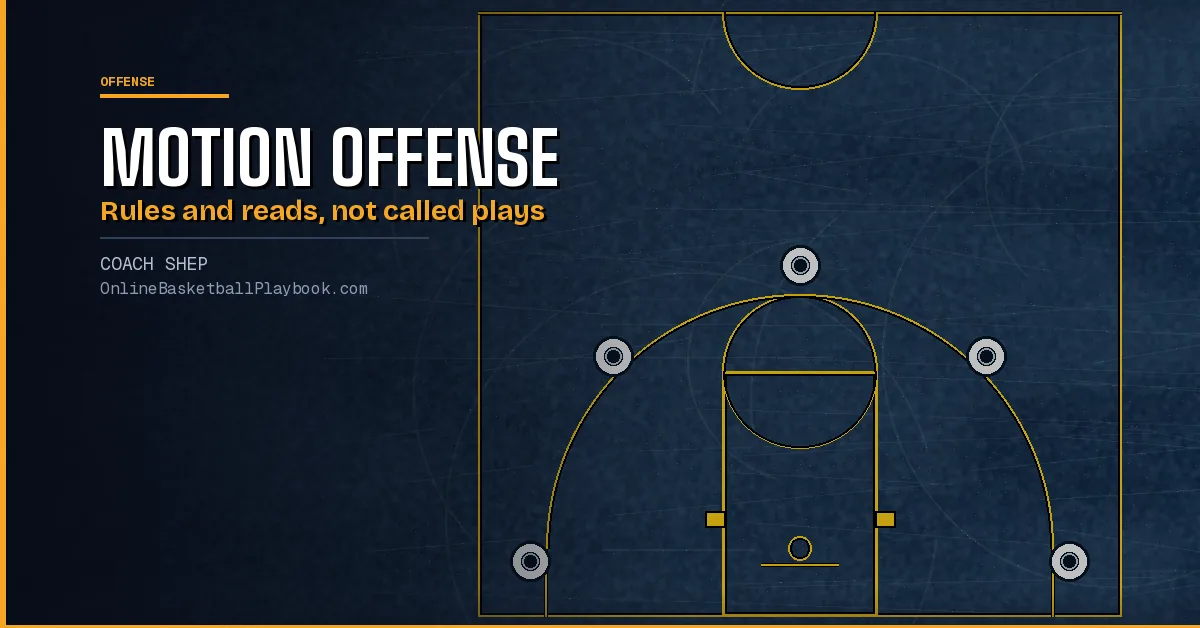
Motion Offense: Spacing, Rules, Actions and How to Install It
Motion offense runs on rules, not called plays. See the spacing, four core actions, 5-out versus 4-out 1-in, the install order, drills and where it struggles.