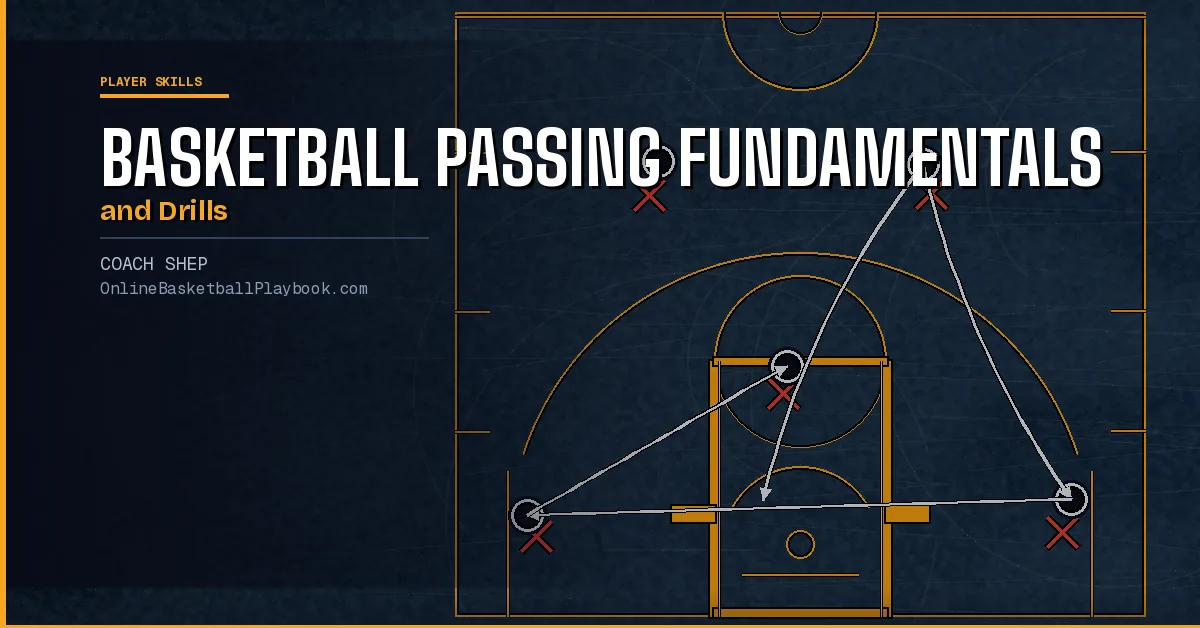
Great passing starts before the ball leaves your hands. These fundamentals and drills build players who read the defense first, then deliver with precision, turning raw skill into decisions that hold up under pressure.
Why Passing Breaks Down in Games
Most passing errors aren't mechanical. The player didn't forget how to throw a chest pass. The error came one step earlier: they did not read the defense before catching the ball, they held the ball too long after the decision window opened, or they telegraphed the pass by looking at the target before the ball arrived.
Coaches who fix passing purely through mechanics (footwork, follow-through, target hand) improve practice film but not game film. The gap between what a player can do in a walk-through drill and what they do under live pressure is a decision gap, not a skill gap. That gap closes through deliberate repetition of reads at game speed, not through more cone-and-line drills with no defense.
The best passing development programs treat mechanics and decision-making as inseparable. You teach proper stance and hand position in a low-stakes setting, then immediately put that skill inside a constraint or a live read so the player learns to execute under pressure. That progression (from part-skill to whole-read) is how breakdown drills are supposed to work.
Understanding why passing fails is the foundation for fixing it. There are three root causes that repeat across every level of the game:
- Late reads. The player catches the ball without a pre-read. By the time they survey the floor, the window has closed.
- Telegraphing. Eyes, shoulders, and footwork all point to the receiver before the ball does. Defenders jump it.
- Mechanical breakdown under pressure. A pass that works in drill situations breaks down when a hand is in the passer's face or when they must make a skip pass on the move.
Every drill in this guide targets one or more of those root causes. Use that lens to evaluate your own drill selection. If a passing drill has no defense or no read, it is training the wrong thing.
Core Passing Fundamentals Every Player Needs
Before players can execute reads, they need a mechanical foundation that holds up under pressure. These fundamentals apply regardless of offensive system. Run them at game speed from day one. The goal is always "game shots at game spots at game speed," borrowed from the individual-skills coaching tradition.
Catch-and-Read Stance
The moment a player catches the ball, their feet and eyes should already be in position to attack the next read. That means catching in a triple-threat stance (feet shoulder-width apart, knees bent, ball secured at the chest) with eyes up to survey the floor before looking at the ball. Teach players to be a passer before they are a dribbler. The ball should move faster than any player can dribble.
Footwork Before the Pass
Most passing errors happen in the feet, not the hands. A chest pass thrown with the weight on the heels is soft and off-target. A bounce pass thrown without stepping toward the target telegraphs direction and loses velocity. The standard footwork cue is simple: step to your target. That step loads the hips and drives the ball with body weight behind it, not just arm strength. For passes against a pressing defense or across the lane, the pivot foot matters. Teach players to use the inside pivot to protect the ball while still squaring to the target.
Pass Types and When to Use Them
Players need a working vocabulary of passes and the judgment to select the right one in real time:
- Chest pass: Primary pass for mid-range, no defender in the passing lane, target stationary or cutting on a predictable angle.
- Bounce pass: For post entries, feeding a cutter who is being overplayed, or passing through a defender's arms. The ball should land two-thirds of the way to the target.
- Overhead pass: Skip passes and outlet passes. Gets the ball over defenders' hands. Requires footwork and body rotation, not just arm height.
- Wrap-around / behind-the-back: Situational. Useful when the passing lane is directly in front and there's a clear target behind. Teach it only after the fundamentals are locked.
- Lob pass: For cutting action or post feeds when the defender is fronting. Timing and arc matter more than velocity.
Receiving: The Other Half of the Pass
Passing development fails when coaches only coach the thrower. A pass is only as good as the catch. Teach receivers to show a target hand, stay on the move when cutting (don't drift to a stop), and field the ball with two hands. Dropped passes in games almost always trace back to a receiver who drifted into the catch or took their eyes off the ball at the last moment.
Foundational Passing Drills
These drills build mechanics and reps before adding a defender. They are not the endpoint. They are the entry point. Every drill here should evolve into a decision-based format as players develop.
Partner Penetrate-and-Pitch
Two players, 20–25 feet apart. One player drives baseline or to the elbow, pulls up, and pitches to a partner standing at the guard-forward angle or the baseline-release spot. The receiver catches in stance and immediately reads (simulate with "shoot" or "drive" cues from the coach). This drill isolates the drive-and-kick mechanic, the most common passing action in modern basketball. Run it with a live-ball drive only, no stationary throws. The passer must attack before releasing.
Circle Drill (Hubie Brown)
Rebound the ball, make an outlet pass, cut to receive a return pass, attack the junction, make a jump-stop, deliver a bounce pass to a cutter who finishes the layup. Add a defender to the passer's station so the jump-stop passer must read the defender's position before choosing a hand for the pass. This two-man drill runs continuously and builds the outlet-to-finish chain that lives inside every fast break. The key coaching point: the passer decides based on what the defender shows, not from a predetermined script.
Skip-Pass Shooting
Players line up at opposite corners and elbows. The drill starts with an overhead skip from corner to corner, with the receiver catching in a shooting stance and immediately attacking the next read. The skip pass is underused and undertrained. Most players throw it too flat or too short. Teaching the proper arc and target-hand receive gives teams a reliable way to move the defense on kick-outs. Run it first with no contest, then add a closeout defender to the receiver's side.
Pairs Shooting (Hubie Brown)
Partners at two adjacent spots on the floor, 8 game-location spots total around the arc. One player feeds, the other receives in a ready shooting stance, not standing flat-footed. A miss requires the shooter to rebound and finish with a power layup before rotating back. Make-it-take-it option: the shooter stays until they miss. Every catch should happen in a "lock and load" position, squared to the basket before the ball arrives, not squaring after the catch. This drill builds the passing-and-receiving rhythm that makes an offense run without wasted motion.
3-Man Weave With Finish
Three lines, two balls, continuous weave with a finish at the basket. The difference from a standard weave: every pass must be a push pass delivered in stride, and the finisher must lay the ball in with the proper hand on the proper side. The weave builds pass-in-stride mechanics and forces players to track two balls simultaneously. Add a constraint (overhead passes only, or bounce passes only) to force deliberate technique instead of muscle memory shortcuts.
Decision-Based Passing Drills
Once mechanics are sound, every passing drill needs a read in it. The design principle here comes from a breakdown progression: start with one defender and one clean read, add a second defender who changes the read, then connect two or three actions so players keep making decisions after the first option is covered.
1-on-1 Post Pass-Out
A post player receives a feed, attacks a single defender. The driver must read the help: if help comes, kick to the perimeter passer; if no help, finish. The perimeter passer is live. They can shoot, drive, or feed back to the roller. Winner stays. The scoring rewards the decision, not just the result: a made shot off a defender's gamble is more valuable than a contested mid-range pull-up. This read (attack, read help, pitch) is the foundation of every drive-and-kick system.
2-on-2 Corner Stunt
Ball-handler at the top of the key, a shooter in the corner. A single defender guards the ball, a second defends the corner. The ball-handler must read whether the corner defender stunts on the drive or stays, and deliver the pass to the corner before the stunt closes. This drill isolates the timing window on a corner kick and forces the passer to make a decisive throw under a recovering hand. Add a "make a free throw to validate the score" rule. If you kick it to the corner and they make the shot, the scoring team validates by making a free throw before the points count.
3-on-2 Scramble
Three offensive players against two defenders in a half-court setting. The offense must find the extra pass. The first pass creates a 2-on-1, the second pass finishes it. If the offense takes an early contested shot or turns the ball over, the two defenders score a point. This drill teaches patience in advantage situations: the pass that creates the advantage is less important than the pass that exploits it. Run it from different starting alignments (two guards and a wing, two wings and a post) so players read different defensive coverages.
Blood Series (Drive-and-Kick)
From the Memphis offensive breakdown tradition: 4-on-4 live, with a mid-range shot counting as a turnover. The constraint forces drive-and-kick execution. Players learn that a pull-up at the elbow is a bad trade when a kick to the corner results in a corner three. The constraint coaches the decision without a coach stopping play. After each possession, the passer identifies the pass they chose and the read that triggered it. Over time, the read becomes automatic because the constraint has repeated it hundreds of times.
Advantage Games That Build Live Passing Reads
The highest-level passing development happens through small-sided games with an engineered starting advantage. These are not 5-on-5 scrimmages. They are structured games that put the offense in a favorable position and make them earn the finish through a correct pass.
Two-Side 3-on-2
Three offensive players attack two defenders from the half-court stripe. The offense has an advantage by design. They must find it through a correct read and pass sequence. The coach controls where the defense starts: a wide spread favors skip passes; a compressed coverage favors attacking the gap and kicking. Run five possessions on each side of the floor. Track the pass type that creates the finish. If it's always the same pass, adjust the defensive coverage to force a different read.
Coach-Controls-the-Advantage Start (Alex Sarama)
The coach holds the ball and positions it on the driver's outside or inside hip before releasing it. Ball on the outside hip means the driver attacks baseline; ball on the inside hip means they attack middle. The defender must hi-five a cone before engaging. The distance from the cone is the size of the advantage. This structure lets the coach engineer specific reads: every rep isolates one decision in one direction, creating the "repetition without repetition" that makes drill reading transfer to games. The offense reads the advantage and delivers the correct pass. No pre-determined play, no walkthrough.
No-Paint Constraint Game
Live 3-on-3 or 4-on-4. The ball cannot enter the paint on a dribble drive. This forces perimeter passing and off-ball movement. Players must create open cutters and relocators through passing, not driving. The constraint exposes teams that rely on one driver and reveals how many players read the kick-out and reposition correctly. After five minutes with the constraint, lift it. Players will attack the paint with correct kick-out timing because the constraint trained the off-ball movement that makes the kick-out available.
When running advantage games, track the specific pass type and the read that triggered it, not just whether the possession resulted in a score. A team that always takes the first available shot in a 3-on-2 is not practicing passing; they are practicing taking shots. The teaching moment lives in identifying which player read the second defender and when they delivered the extra pass. Keep a simple tally: first option taken, second option found, turnover. Over a week of practice, the ratio tells you exactly where the decision-making is breaking down.
Designing Drills That Actually Transfer to Games
The most common mistake coaches make with passing drills is adding complexity before the foundational read is owned. A 5-on-5 passing drill with multiple actions sounds thorough, and it is, for players who already own the 2-on-2 version of the same read. For players who do not yet own it, the 5-on-5 version just creates noise and hides errors in traffic.
The drill-design discipline that transfers to games rests on a few principles that hold across every level:
Isolate One Read Per Drill
Each drill should enforce a single decision. If you are teaching the corner kick-out, the drill should make the corner kick-out the only correct answer. Everything else in the drill's structure (the defender positions, the scoring rules, the starting alignment) should funnel the offense toward that one read. When drills try to teach two reads simultaneously, players find the easier one and never develop the harder one.
Score the Decision, Not Just the Outcome
Incentive scoring is the most underused coaching tool in passing development. When a made shot earns one point and a correct kick-out earns two points regardless of whether the shot falls, players learn that the read is more valuable than the finish. The scoring teaches without the coach stopping play. Alabama's practice scoring model (plus-three for an assisted score, plus-two for an offensive rebound, plus-one for a score, minus-two for a turnover) makes the decision visible in real time. Apply the same structure to passing drills.
Build from Part to Whole
The correct progression is: 1-on-0 mechanics, then 2-on-1 reads, then 2-on-2 live, then connected 3-on-2 or 3-on-3 actions. Never jump to the whole before the part is owned. "5-on-0 install, then add options, then live" is the sequence used by coaches who build passing offenses that hold up in March, not just in November. When a team's passing breaks down in games, the fix is almost never more 5-on-5 work. It is dropping back to the 2-on-2 read and repeating it until it is automatic.
Use Constraints to Coach the Decision Diet
A constraint is a rule that makes a wrong decision visible without the coach interrupting play. The Blood Series mid-range turnover rule is a constraint. Dribble limits are constraints. "Every drill ends with a make" (a Hubie Brown principle) is a constraint that trains the finish mentality. Design constraints that match the decision you are trying to teach. If your team is throwing lazy cross-court passes into traffic, a constraint that penalizes turnovers by two points is more effective than a lecture about decision-making.
Progress by Adding a Defender, Not More Players
The most efficient path from drill to game is adding a single defender at a time. A 2-on-0 drill becomes a 2-on-1 drill by adding a trailing defender. That becomes 2-on-2 by adding a help-side defender. The defensive addition changes the read without changing the drill structure, and it forces the offense to keep playing after the first option is covered. This is the design principle behind a 38-drill decision ladder: each step adds one defender who changes one read.
- Teach catch-and-read stance before the first drill of any practice (feet set, eyes up, ready to pass before looking at the ball). This single habit reduces late reads by half.
- Run Partner Penetrate-and-Pitch at the start of every ball-handling segment: it builds the drive-and-kick pass in the context of a live-ball attack, not as a stationary drill.
- Use the Blood Series constraint (mid-range shot = turnover) for at least two possessions per practice during 4-on-4 work to force drive-and-kick decision-making without stopping play.
- In 3-on-2 Scramble, award a point to the defense for every possession where the offense takes a shot before finding the extra pass. This makes the decision visible in the score.
- Run the Circle Drill with a live defender at the junction station so the passer must read hand position before deciding which side to deliver the bounce pass. Remove the defender only to fix mechanics, then put them back immediately.
- After every passing drill, ask one player to name the read that triggered the pass, not whether it went in, but what the defender did that opened the window. This verbal accountability accelerates transfer to games.
Want more basketball coaching strategies, drills, and tools?
Join the Online Basketball Playbook newsletter →
Draw this play free in the play drawer →
Membership: the full library, playbook packs, and Pro drawing tools →
Keep Building
Related breakdowns
Passing Against Pressure: Beat the Trap, the Deny and the Press
Passing against pressure: the receiver meets the ball, the passer throws away from the defense, the first pass against a press, passing out of a trap and drills.
Basketball Passing Drills for Beginners and Full Teams
Basketball passing drills for beginners, partners and full teams: the basics to coach, drills with setups and coaching points, pressure drills and scored games.
Basketball Drills for 12 Year Olds: Dribbling, Passing and Games
Basketball dribbling drills for 12 year olds, passing and cutting drills, decision games and a 90-minute practice, all written for players this age.