Basketball passing drills build two skills at once, the pass and the catch. This guide groups them by who they suit and what they train. It starts with the basics to coach in every drill, then covers drills for beginners and kids, partner and wall work, team and full-court drills, passing against a defender and scored passing games. It ends with the choices coaches split on and where passing fits in a practice plan.
Basketball Passing Drills at a Glance
| Drill | Players | Best for |
|---|---|---|
| Triangle passing | Three lines per basket | Younger players who are not ready for full-court drills |
| Swing passing | Four lines in the half-court corners | A warm-up or young players, passes to a moving receiver |
| Partner passing | Pairs, 12 to 15 feet apart | Chest, bounce and overhead passes, V-cuts and catches |
| Three-man weave | Three lines on the baseline | A full-court warm-up with passing, calling and a layup |
| Three-lane advance and lane-line passing | Threes and pairs | Many passes of different lengths on the move |
| Monkey in the Middle | Groups of three | Pivots and fakes against a live defender |
| Four on Three | Seven players | Finding the open player |
| Netball and Passing Game | Teams of three to five | Passing decisions in a no-dribble game |
What to Coach in Every Passing Drill
- The catch is half the pass. Soft hands, two-hand catches, eyes on the ball and movement toward it.
- A hand target. The receiver shows both hands and calls for the ball. A fuller set of receiving rules adds block and tuck, catching facing the basket and running through the ball.
- Meet the pass. Square the feet and shoulders to the passer and jump stop on the catch.
- Get open first. A drill rule worth keeping is a two-step V-cut before every catch, the step away from the passer, the plant and the step back to the ball.
- Step and extend. The three basic passes share a step toward the receiver and arms that extend with palms out and thumbs down. In the bounce pass the ball hits the floor about three quarters of the way to the receiver.
- Lead a moving receiver. Pass to where he will be, not to where he is.
- Throw away from the defense. Aim for the target on the side away from the defender, and never pass into a crowd.
- Make the simplest pass. A flashy pass is correct only when it is the easiest one. Touch matters too, because a pass that is too hard cannot be caught and one that is too soft gets stolen.
- Pass and move. The passer screens, cuts or follows his pass instead of watching it.
The three techniques have their own guides. See chest pass, bounce pass and overhead pass, and Basketball Passing Fundamentals for the mechanics. Every pass is on types of passes in basketball.
Basketball Passing Drills for Beginners and Kids
Never assume young players can pass. Kids often throw before they find the receiver, and bad passing and receiving cause many turnovers. The youth approach teaches passing through games. Three drills suit beginners well.

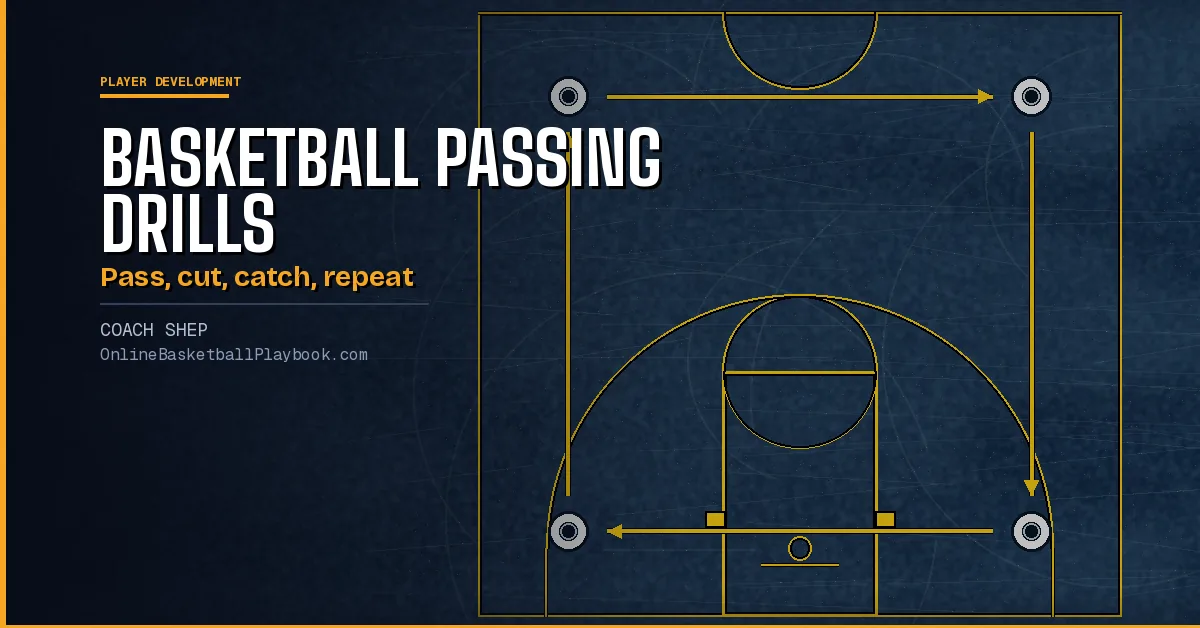
Triangle passing. It suits younger players who are not ready for the weave. At each basket make three lines about 12 to 15 feet apart, one at the top of the key and one in each short corner. The first player at the top passes to the right or left and the ball keeps going in that direction around the triangle. Players start behind a cone, step out to meet the pass and catch in triple-threat position. After passing, each player sprints to the next line in the direction of the ball. After a few trips the coach changes direction and rotates through chest, bounce and overhead passes.

Swing passing. Four lines stand in the corners of the half court. The first player leads the pass ahead of the teammate at the next line to his right, who is already jogging toward the next line before the pass is thrown, so he catches on the move. The passer joins the end of the line he passed to. After a set time the coach changes direction. Start at half speed, allow no traveling and add a second ball once players are comfortable. It can use one-handed or two-handed passes, chest or bounce passes, or one dribble before the pass.
Monkey in the Middle. Three players share one ball. Two passers stand 12 to 15 feet apart with a live defender between them, and they pass with pivots and fakes only. The defender tries to deflect or steal, and after each pass he sprints to the receiver. When he gets a touch, players rotate. Variations include one dribble allowed or bounce passes only. Coaching points are active hands and feet for the defender, no lob passes and no holding the ball more than 5 seconds.
Other beginner games include Ultimate Basketball, a passing-only scrimmage, Hot Potato, Keep Away, Full Court No-Dribble, Ten Passes and a race to five passes. Beginner work also includes Ultimate Passing and 10 in a Row Passing, which ban dribbling and running with the ball. Partner Pass and Pivot adds a jump stop and a called pivot before the pass.
Small changes adjust the difficulty. Start with one ball, add a second ball, use a passive and then an active defender, or allow one dribble if the defense is too tough early in the year. Read Basketball Drills for Beginners and Basketball Drills and Games for Kids for more.
Partner and Wall Passing Drills

Partner passing. Pairs stand 12 to 15 feet apart with one ball and work through the chest pass, the bounce pass and the two-handed overhead pass. The receiver shows a target with his hands and the feet are square and shoulder width apart. The passer steps in and snaps the pass with his thumbs going through the ball. For the overhead pass, partners move farther apart, with just enough arc to clear a defender's hands. Add the V-cut as above before each catch.
Pass with Partner. Players stay 10 to 15 feet apart and move to a new area on every pass, so the passer has to hit a moving target.
Spot Passing. A player stands 10 feet from a wall and hits chest pass and bounce pass targets. One point per hit in 60 seconds.
Blind Pass. The passer calls the receiver's name and throws to a player whose back is turned. The receiver turns, finds the ball and catches it.
Two-man shuffle. Pairs line up on the end line and shuffle the length of the floor and back, chest passing the whole way with no dribbling and no traveling.
Tennis ball catching. A tennis-ball progression builds hands for big players. They catch one ball, then two, then basketballs. The catch-first view holds that a team can hide many weaknesses but not a poor receiver.
Team and Full-Court Passing Drills

Three-man weave. Three lines form on the baseline. The passer always sprints behind the player he just passed to, and the last pass sets up a layup. The group weaves back for a second layup and the next group starts as soon as the one ahead finishes. Add a goal such as a make count or a limit on dropped passes. The sideline-touch version has every passer touch the sideline after his pass. The Tight Three Man Weave swaps passes for hand-offs and name calls. The live-drill view treats the weave as a warm-up, because its wide-open chest passes do not look like a real fast break, and relies on live drills to develop passing.
Three-lane advance. Players form three lines on the baseline and the two outside players each hold a ball. They pass in to the middle player and take the ball back, then the middle player turns to the other side. The outside players can take one or two dribbles to avoid traveling. At the far three-point line the outside players dribble in for layups. Coaching points are passes in front of the runner, 10 fingers up from the receiver and no travels.
Lane-line passing. Pairs start on the edges of the lane and jog the length of the floor passing chest passes down the middle. On the way back they slide wider and pass over the middle group.
Star and scatter. In the star drill five lines sit like the points of a star and the ball follows a fixed order, then the passer follows his pass to the line he threw to. In the scatter drill players hand the ball around a circle, and on a whistle everyone scatters and each passer must find the player he handed the ball to.
Outlet and fill passing. A player throws the ball off the backboard, rebounds it and outlets to either wing. All three sprint up the floor passing back and forth until one wing speed-dribbles in for a layup while the other sprints back to challenge it.
Two-man speed dribble and pass. Player A speed dribbles to the three-point line and passes to B sprinting the sideline. B dribbles to half court and passes back, then A passes to B cutting for the layup. A jump stop before each pass and after each catch is a variation. A related drill has the passer speed dribble, jump stop and reverse pivot while the receiver sprints to either corner, so the passer has to find the target before he throws.
A drill like this feeds into fast-break work. See 3 Man Weave and Fast Break Basketball Drills.
Get the next coaching guide in your inbox
One email when a new guide or diagram set goes up. Free.
Passing Against a Defender
The decision-first view argues that technique drills are far less important than decision drills, because thousands of chest passes with no one guarding them do little for passing in a game. Technique drills have a place, but a defender is what turns a pass into a decision. Add defenders in stages, starting passive and finishing active.

Monkey in the Middle is the first decision drill. Other versions deny a receiver, who must V-cut and back cut, or play the defender tight on the passer. The trapper version has the defender drop step toward each pass like a trapper.

Four on Three. Four offensive players and three defenders. At first every defender guards a man, so one offensive player is always open and the ball handler has to find him. The coach then adds doubles, cheating and gambling.
Other pressure drills. Bull in the Pen has a defender close out and stay for 30 seconds while the offense fakes and passes. Bull in the Ring and Two Bulls in a Ring have defenders deflect or steal and swap places. Triangle and Two has no dribbling, with one defender on the passer and one moving to steal. In Three in a Ring a trapped passer must find a teammate on the circle. Break the Double Team has a coach pass to a player who is doubled, and the player must find a teammate with a defender on him. Feed the Post has the passer read two defenders and face a high, low, front or behind post defense.
No-dribble games. Netball is a full scrimmage with no dribbling, scored 1 point for a two and 2 for a three, which forces spacing and cutting. A 2 on 4 version forbids the dribble and requires four passes and two reversals before a shot. Passing Possessions is a no-dribble 5-on-5 scored by passes over three possessions and lost on an out-of-position catch or a 5-second count.
Passing into a score. Three drills tie the pass to a finish.
- One More. The coach passes to 1, and 2 yells "one more." 1 passes to 2, 3 yells it, and 2 passes to 3 in the corner for a three or a one-dribble jumper, then cuts inside. Passes are quick, like a hot potato. In the Drive the Slot variation an imagined defender overplays the pass from 2 to 3, so 2 drives the slot to the elbow and then passes to the corner. In the Drive and Skip variation, 1 drives to the middle of the paint, passes to the corner and 2 yells "one more" and 3 passes back to him on the wing.
- Rebound and outlet. The coach throws the ball off the backboard and names the pass type, such as a baseball or overhead pass, and the rebounder outlets to a wing.
- 3 on 2 and 2 on 1. Three lines at one end and two defenders stacked in tandem at the other. The outlet goes to a wing and the passer fills the outside lane. The receiver dribbles to the middle and picks a side, and if he attacks one side the opposite wing flashes to the top of the block. He scores or draws the defense and kicks with a bounce pass.
Passing is also how a team beats pressure. See How to Break the Full Court Press, and the passing side of it on passing against pressure.
Scored Passing Games
- Passing Game. One point per pass and two per score, minus two for dribbling and minus three for a turnover, with no dribbling and no posting up.
- Twenty Pass. The offense needs 20 passes in 60 seconds, and a score or a defensive foul is worth three passes.
- Five Touches. The offense cannot shoot until all five players have touched the ball.
- Perfect Passing. Ten passes in 30 seconds or run.
- X passing. Four-out with two balls, flick passes, a post feed and a post pass to the top of the key, with a standard of 25 clean passes with no bobbles and no deflections before defenders are added.
- Four-minute drill. The four-minute version sets a team goal of about 90 layups in four minutes.
- Work-up rules. In 3-on-3 cut-throat, the strict version sends a team off the floor for a deflected pass or a pass with no fake.
Where Coaches Differ on Passing
| Question | One view | Another view |
|---|---|---|
| Where to aim | At the hips, never above the shoulders | The chest of a stationary receiver, leading a moving one. A third view teaches five lanes, both ears, both hips and the head |
| One hand or two | Two hands with a step for control, plus a baseball pass for long throws | One-handed or push passes with a hip roll, because they are harder to deflect |
| Where the ball starts | Triple threat, then pass | No triple threat. Shoot, drive or pass within a second of the catch |
| V-cuts before a catch | A two-step V-cut before every catch | One V-cut, then a back door, so a receiver does not fight for a denied catch |
| Eyes of a beginner | Look at the target | Later, stop staring so the pass is not telegraphed |
Each of these is a working choice, and coaches use all of them.
Fitting Passing Into Practice
The warm-up plan starts practice with passing to warm up and get players communicating. Jay Wright's 30-minute skill block gives passing four minutes after the stretch. Passing games also work as the competitive part of a plan, since scoring the pass makes the pass a competitive rep. Read Basketball Practice Plan for how to lay out the block and Offensive Breakdown Drills for the next step after the pass.
Questions Coaches Ask About Passing Drills
What are the best basketball passing drills?
That depends on the level. For beginners, triangle passing, swing passing and Monkey in the Middle. For teams, the three-man weave, three-lane advance and a no-dribble game such as Netball.
What are good passing drills for beginners?
Triangle passing, swing passing, partner passing at 12 to 15 feet, Monkey in the Middle and passing-only games such as Ultimate Basketball.
What passing drills work for kids?
Games work best. Monkey in the Middle, Hot Potato, Keep Away and Ten Passes keep young players moving and add a defender in a simple way.
How do you teach a chest pass?
Step toward the receiver, extend the arms with the palms out and thumbs down and snap the pass to the chest. The receiver shows a target and catches with two hands.
What is the three-man weave?
A full-court drill in which three players pass and sprint behind the player they passed to, finishing with a layup. The live-drill view treats it as a warm-up rather than a fast-break drill.
How long should a passing drill last?
Practice plans keep drills short. Wright's skill block gives passing four minutes, and Bob Knight capped individual drills at five minutes and team drills at ten.
Passing drills are one piece of basketball player development, and the Drills hub lists the rest of the skill pages.
Want the printable playbook packs?
OBP Pro members get the premium playbook packs: the zone attack, out of bounds and practice plan PDFs, plus each new pack as it is finished. The membership page lists what is in each one. Or draw your own version free in PlayDraw.
See what OBP Pro includesMore Guides From This Batch
- 1-2-2 Zone Defense: Rotations, Weak Spots and Drills
- 2-2-1 Press: Setup, Traps, Rotations and Drills
- Basketball Practice Plan: Template, Youth Plans and Examples
- Technical Foul in Basketball: Rule, Penalties and Calls by Level
Back to Basketball Player Development and every Player Development page.
Keep Building
Related breakdowns
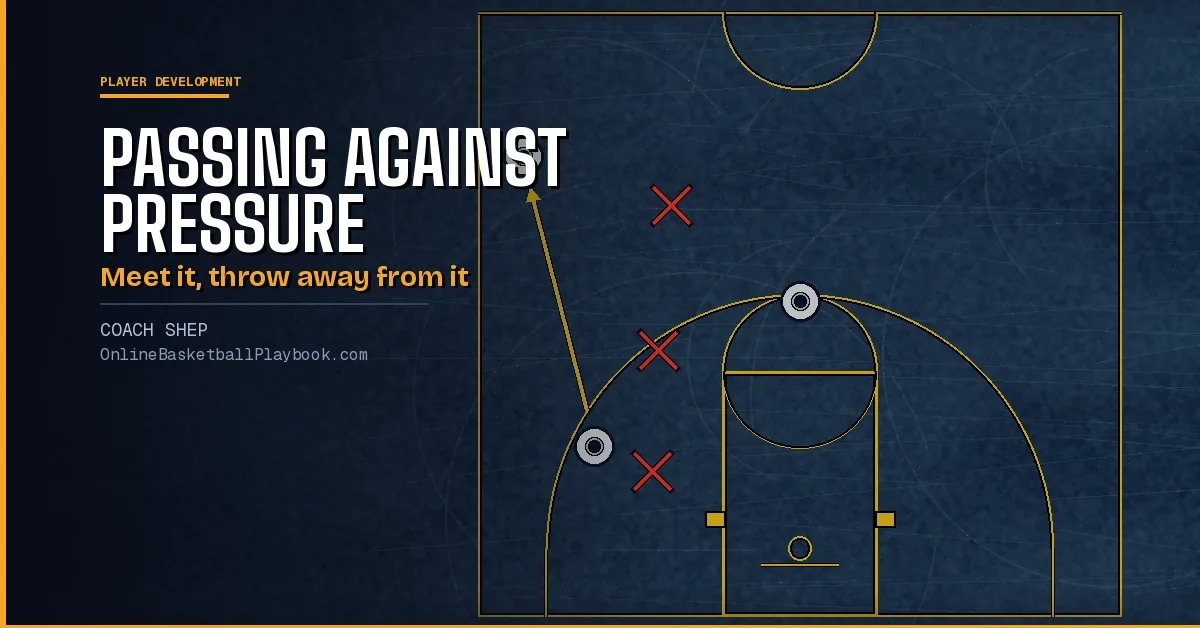
Passing Against Pressure: Beat the Trap, the Deny and the Press
Passing against pressure: the receiver meets the ball, the passer throws away from the defense, the first pass against a press, passing out of a trap and drills.
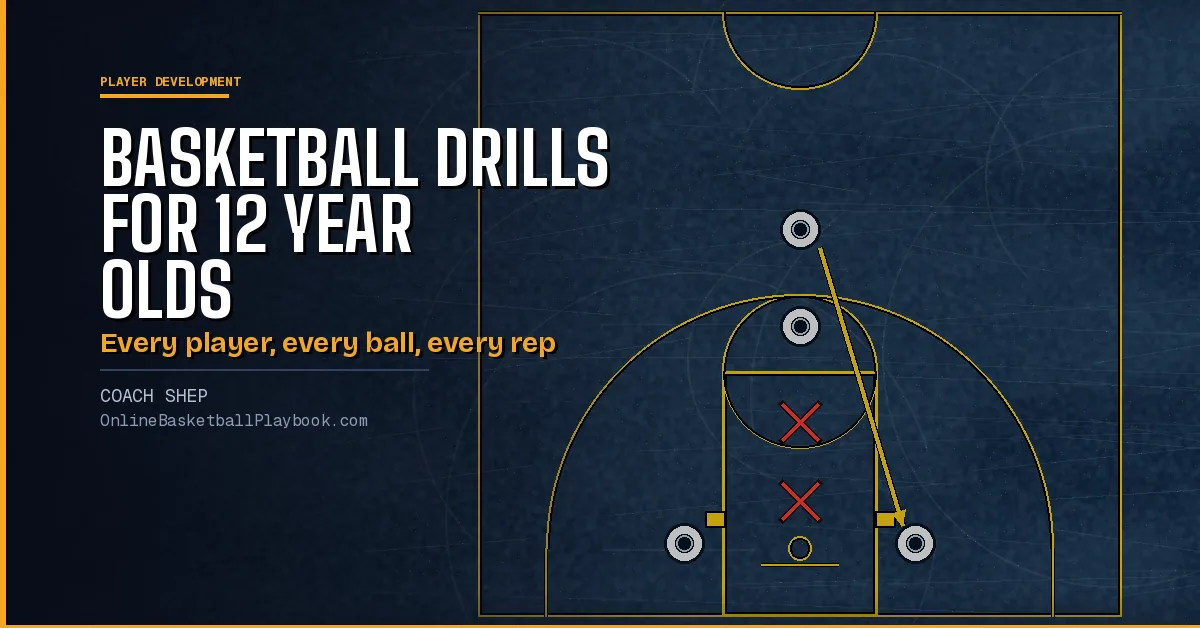
Basketball Drills for 12 Year Olds: Dribbling, Passing and Games
Basketball dribbling drills for 12 year olds, passing and cutting drills, decision games and a 90-minute practice, all written for players this age.
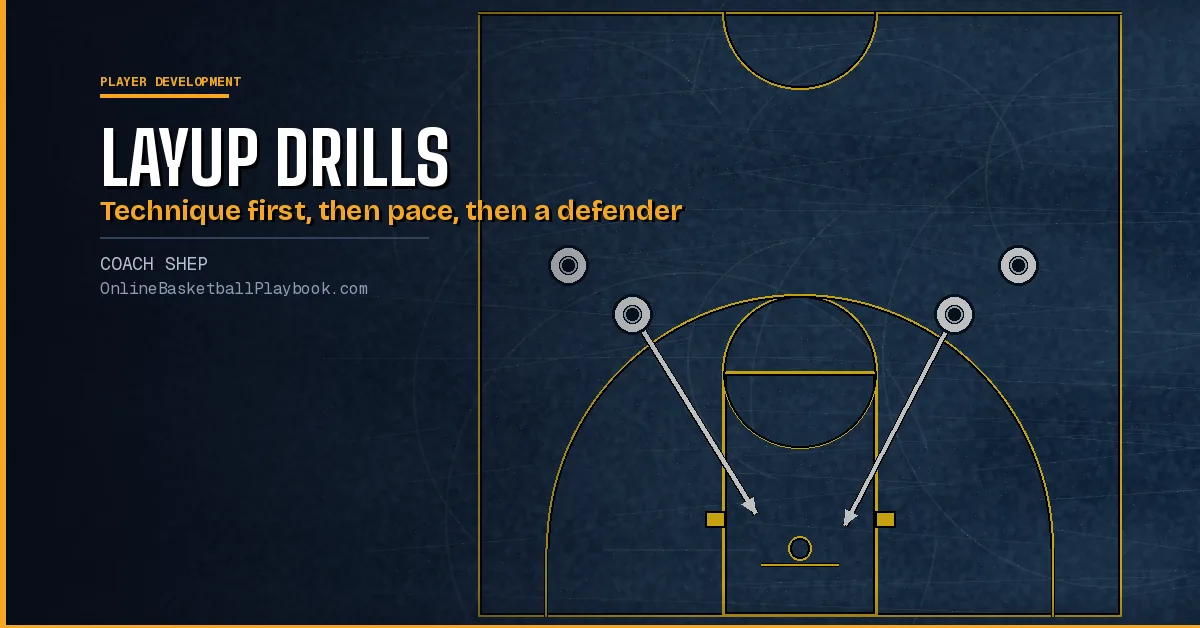
Layup Drills for Every Level, From One Step to Full Court
Layup drills for youth and teams, from footwork and the Mikan drill to layup lines, full-court drills with a made-shot goal and finishing against a defender.