
Shooting wins games — but only when it's taught with the same rigor coaches bring to defense. This guide covers every layer of building shooters, from foundational form to competitive drills that drive lasting improvement.
Building the Foundation: Form Before Volume
Every elite shooting system starts in the same place: form before reps. Volume without mechanics doesn't build shooters — it hardens bad habits. The coaches who produce the best shooters at every level share one discipline: they refuse to let players chase makes until the mechanics are clean.
The youngest players need a simple, memorable model. The "pizza waiter" cue — hand flat under the ball like carrying a pizza tray — immediately places the guide hand correctly and stops the most common youth error of palming the ball from the side. The follow-through becomes the "cookie jar" reach: fingers pointing down toward the rim after release, as if dipping into a jar on a high shelf. These two images do more in a youth session than ten minutes of technical explanation.
Jay Wright's Villanova program runs its first two drills of every practice before a ball hits the rim. The Set Lift drill isolates elbow placement and follow-through extension without involving a make or a miss. The Bradley Drill pushes the ball as high as possible, reinforcing a high release point — the closer you get to the rim, the higher the release must be. Wright's principle: "jumping and lifting, shooting on the way up." That rhythm — not just the arm but the whole-body sequence — separates catch-and-shoot efficiency from contested struggles.
John Beilein's Michigan program built on the same foundation with a footwork-first mandate. "Footwork is more important than any offense you run," Beilein argued, "because the player still has to be able to make a play no matter what the defense does." Both Wright and Beilein arrived at this same first principle independently across the same era. When two elite coaches at that level reach the same conclusion separately, it's not a system preference — it's a coaching truth.
The progression for any player at any age: start without the ball (form shadow), move to a wall target, then to the basket at close range. Build the elbow-under-the-ball alignment, the balanced base, and the high follow-through before adding distance or a defender. Chasing distance before the foundation is set is how coaches produce streaky shooters who can hit in warmups and disappear in games.
Make Every Rep Competitive
The most underused principle in shooting development is this: a shooting workout should have a winner. Aimless volume creates comfortable mediocrity. Scored, competitive reps with real stakes create shooters who perform when the moment is real.
Jay Hernandez's competitive shooting framework — built around drills like Quarters, Personal Best (the 30-30), Streak, Star, Around the Horn, and the Burner — treats every session as a scoreboard event. Players compete against the clock, against a partner, or against their own recorded personal best. The philosophy is direct: "the most dangerous person is the one who is continually improving." That only happens when there's a number to beat.
Shaka Smart's Texas drill bank operationalizes this at a team level. Named drills carry explicit program records: the 3-Minute drill has a record of 157, the Evans drill has a record of 219. These aren't aspirational benchmarks — they are signed marks posted on a board that players actively chase. The "Beat the Pro" drill adds a head-to-head layer where your miss scores two points for your opponent, putting defensive pressure on every shot without a defender on the floor.
One structural rule runs through Smart's bank and echoes across multiple elite programs: you cannot shoot the same spot twice. Movement is non-negotiable. Players who shoot from static spots develop a false confidence that evaporates the moment they have to catch on the move, come off a screen, or create off one dribble. Every drill should require relocating before catching again.
Tom Billeter's Purdue Drill is the clearest single example of consequence-driven shooting: make four threes in a minute with a rebounder and passer, sprinting baseline to half-court between each shot. For every point below four makes, the shooter runs. The consequence isn't punitive — it mirrors exactly the physical and mental state a player faces in late-game situations when clean mechanics under fatigue separate good shooters from great ones.
Diagnosing and Correcting Shot Errors
When a player misses consistently, the wrong coaching response is to repeat a generic cue. "Bend your knees" or "follow through" addresses symptoms without finding the cause. Dr. Hal Wissel's diagnostic framework gives coaches a systematic protocol: identify the mechanical error, find the root cause, then prescribe the specific correction drill. Every shot pattern has a mechanical origin — and fixing the origin changes the pattern.
Short shots almost always trace to a release point that is too low. The ball leaves the hand before the arm reaches full extension. The correction is a high-extension finish drill: hold the follow-through with the arm fully extended, fingers pointing down at the rim, until the ball lands. No dropping the elbow early. When players hold this position through the shot's entire flight, they feel the difference immediately.
The wide-right or wide-left miss has one most common cause: the guide hand's thumb pushes across the ball at release. A simple thumb-lock drill — consciously keeping the guide-hand thumb up and away from the ball — combined with one-handed form shots until the ball tracks straight will eliminate this pattern in most players within a single session. Flat arc (line-drive shooting) traces to a wrist that is not fully flexing through the ball. The ceiling target drill — picking a point on the gym ceiling above the front of the rim and projecting the arc there — adds four to six inches of arc on most players immediately without any mechanical instruction at all.
Inconsistent release timing deserves special attention because it is a cause coaches often attribute to nerves or pressure. In most cases, the player is rushing — shooting before the natural rise of the jump peaks. The Sight-Set-Shoot rhythm protocol breaks the shot into three distinct beats: establish the target (sight), pause momentarily at the set-point with the ball above the shooting shoulder (set), then release on the way up (shoot). When a player rushes all three beats into one continuous motion, the set-point disappears and timing becomes a guess rather than a trained sequence.
The coaching discipline underlying Wissel's entire framework: work backward from the miss. Arc angle first, then hand position, then elbow alignment, then balance and foot position. The root cause is rarely where the player thinks the problem lives.
Build the shot without the ball, then to a wall, then to the rim: balanced stance, "pizza waiter" hand under the ball, elbow under the hand over the knee, follow through high — fingers down toward the floor, cookie jar finish.
— shooting-development, Basketball Vault
Game Shots, Game Spots, Game Speed
Kevin Eastman's framework — game shots, game spots, game speed — defines the standard every shooting drill must meet before it earns a place in a competitive practice. A drill that develops form in a way that never transfers to a game situation is not a neutral activity. It is actively building a false skill set.
Larry Brown's SMU shooting system takes this seriously at its structural level. Every drill is designed around a realistic offensive movement before the shot. Zipper cuts, baseline drives, ball-screen reads, drive-and-kick situations — the player is always responding to a defensive read and making a decision before pulling the trigger. Standing still and catching is never the entry point. This means the shot itself is always preceded by the physical and cognitive state that precedes a game shot, which is the only way the shot transfers reliably under pressure.
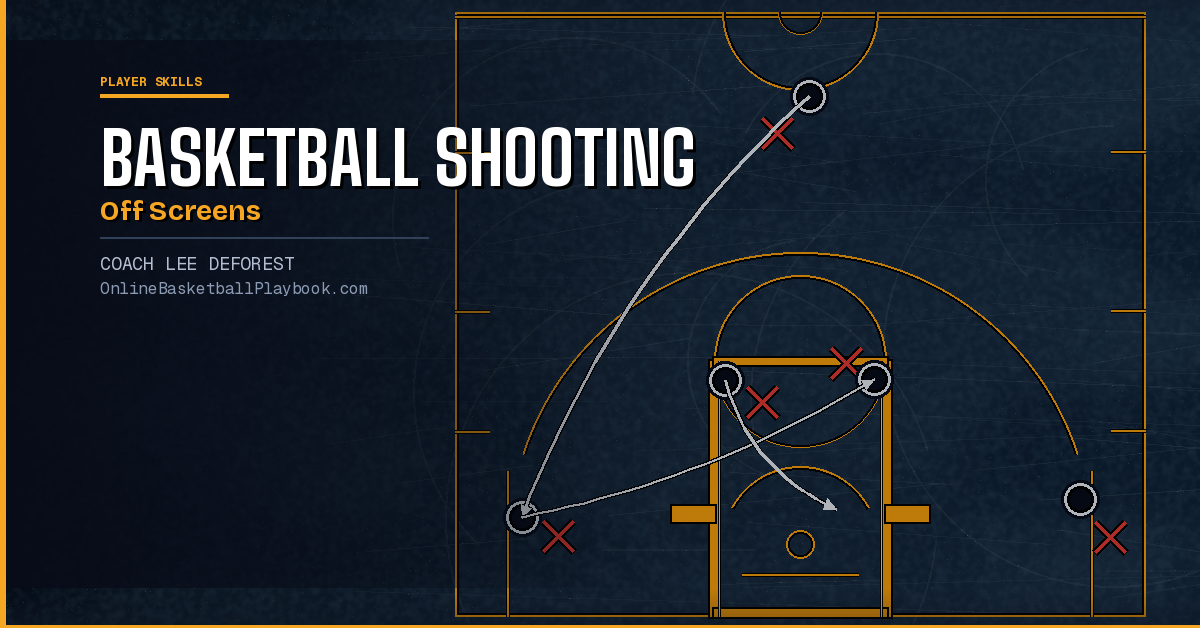
Nelson's work on shooting off screens adds precision to this principle. The footwork requirements for pin-down catches, flare screens, stagger-screen curls, and transition shots are each distinct. Feet-in-position-on-catch is the mandate: the player must already be landing in a shooting-ready stance as the ball arrives. If the catch and the footwork setup are not happening simultaneously, the defender recovers before the shooter is set, which is exactly how good shooters disappear against disciplined closeouts.
The inside foot principle — taught independently by both Jay Wright at Villanova and John Beilein at Michigan — governs all V-cuts and screen catches. Plant the inside foot first. Wright had players verbalize the sequence during technique work: "1-2, lift, follow through." The verbal sequence builds the motor pattern faster than pure repetition because it forces the player to consciously attend to each beat. Wright's competitive shooting standard — six of ten shots in thirty seconds coming off screens — gives this footwork principle a real-time consequence. Sloppy footwork directly reduces the make rate, which runs the whole group.
Free Throws, Pull-Ups, and the Shots Coaches Miss
Two categories of shooting receive less coaching attention than they deserve, and both show up in games far more than the drills that dominate most practices.
The pull-up and the hesitation mid-range shot are, as coach Rumjahn puts it, "lost arts." A player who can take one or two dribbles off a ball screen and pull up cleanly around the free-throw line creates a spacing and scoring dimension that pure catch-and-shoot threes do not provide. The defense cannot simply switch everything and back off the three-point line if the pull-up is a real threat. Building this shot — catch ready to attack, one decisive dribble, pull-up with balance — should be a deliberate piece of every skill player's development plan, not an afterthought.
Rick Pitino quantified the contested-shot problem in a way every coach can teach. His Louisville teams were shooting 22% on challenged attempts, versus an NBA baseline of roughly 42%. His practice rule was simple: if the read says the shot would be contested, pass it back and restart the action. No exceptions. This is teachable as a specific number rather than a feeling, which is why it changes behavior faster than general "make good decisions" coaching. Pair this with George Karl's "no tough twos" mandate and you have a shared language for shot quality across an entire staff.
Free throws get the most obvious neglect: most programs shoot them fresh, in isolation, at the beginning or end of practice. Rick Pitino's approach is more demanding — shoot free throws at the end of live one-on-one games when players are genuinely tired, and track the percentages. Game free throws happen when a player is exhausted, adrenaline is high, and a defender just fouled them hard. Training free throws in a calm, rested state prepares for an experience that rarely exists in games. Bob Hurley's daily 20-minute shooting emphasis includes free throws shot tired as a standard, not an exception.
The mechanical key for free throws: ball and head positioned over the free throw line, projecting the ball toward the rim rather than pushing it. A daily volume goal — 100 free throws per day in Wissel's framework, with sets shot both eyes-open and eyes-closed to build proprioceptive feel — builds the kind of automatic reliability that holds up when the gym is loud and the game is close.
Put your free-throw shooting where your game situations are: tired, counted, and with a consequence. Ten free throws at the end of a competitive drill — tracked against a team record — develops more game-ready shooters than thirty free throws shot alone at the start of warmups when the player is fresh and the gym is quiet.
Building a Shooting Culture That Sticks
A record board is the cheapest and most durable shooting culture tool available to any coach at any level. Post three or four named drills with the program's best marks. Let players sign their records in a different color. Put the board where the team walks past it every day. This single action transforms shooting from a chore into a standing competition that runs itself.
Shaka Smart's program made this concrete at a high level. Texas maintained explicit, publicly-posted records for every major drill in their bank. Players weren't just shooting to get better in some abstract sense — they were shooting to beat a mark, and they knew exactly what mark they were chasing. The structure did what no general encouragement can do: it gave improvement a target, a number, and a name to beat.
Jay Wright's "sloppy drills create bad habits" doctrine provides the cultural counterweight. The record board raises the ceiling; the discipline standard protects the floor. Bad reps are not neutral — they actively reinforce wrong patterns. Running more drills carelessly is worse than running fewer drills with full concentration and correct form. A coach who maintains this standard consistently will see the culture shift within weeks: players stop drifting through reps because they understand that a sloppy make is not actually progress.
For coaches building this culture across multiple teams or age groups, the FCP model offers a practical framework: one record board per team, three to four drills with make targets scaled to age and level, and a consistent opener (form work like Quarters or the pizza-waiter sequence) followed by one scored movement drill every session. Every shooting block has a winner. Every record is current. The scoreboard runs the culture so the coach doesn't have to argue for effort every day.
The Beilein qualifying standard adds one more layer worth borrowing at any level: practice is earned. Michigan players ran 17 sidelines in one minute before getting practice reps. This signals to the entire program that shooting practice is a reward for preparation, not a right. Players who show up to steal reps without the physical standard pay a cost. That framing alone changes how seriously players approach every rep they do earn.
- Open every session with form: Set Lifts, Bradley Drill, or the pizza-waiter progression before any shots go up. Mechanics first, volume second, always.
- Score every competitive drill: make targets, time limits, and consequences (run, reps, or team accountability) so each workout has a winner and a number to beat.
- Post a record board: three to four named drills per team, signed marks, updated after every session — the cheapest culture tool a coach has.
- Diagnose before you cue: when a player misses consistently, trace the error backward (arc → hand → elbow → balance) before prescribing a fix; the root cause is rarely obvious.
- Shoot free throws tired: build them into the end of competitive drills, track percentages as a team, and treat fresh free throw sessions as insufficient preparation for game situations.
- Train the pull-up deliberately: dedicate time each week to one-dribble pull-ups and hesitation mid-range shots — these shots decide close games and most practice plans barely touch them.
Want more basketball coaching strategies and drills?
See it drawn up
Related diagrams
Keep Building
Related breakdowns
Basketball Shooting Off Screens: Complete Guide
Basketball Shooting Off Screens: Complete Guide
Basketball Shooting Form: The Complete Teaching Guide
Basketball Shooting Form: The Complete Teaching Guide