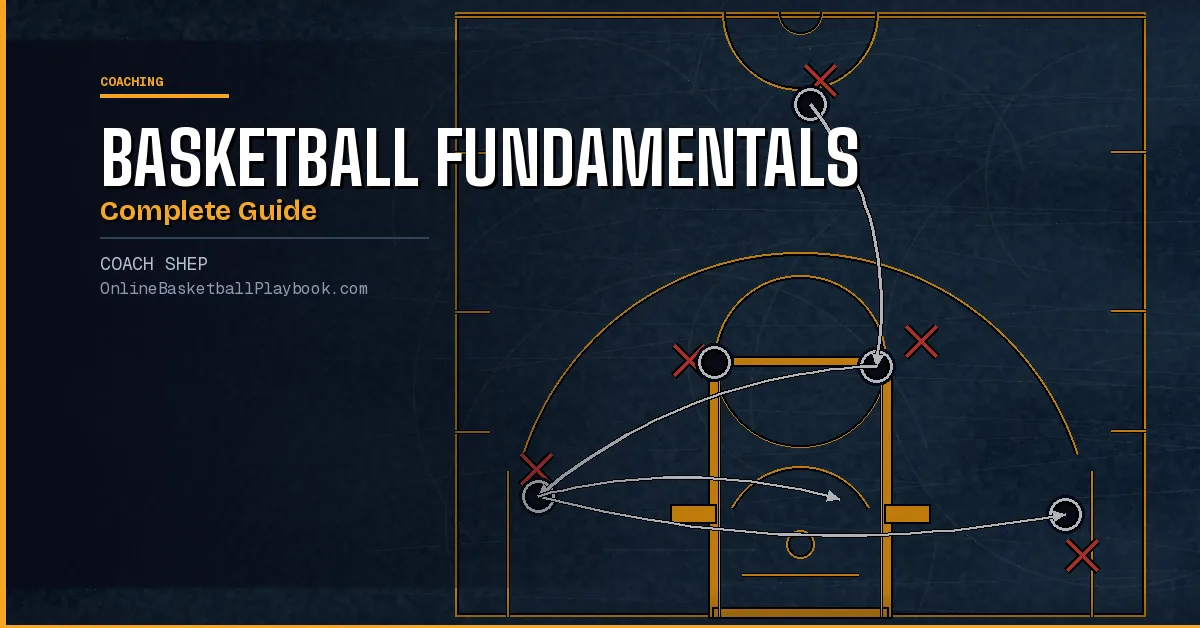
Basketball fundamentals separate good players from great ones. This guide covers shooting form, ball handling, defense, footwork, and passing, the non-negotiable skills every player must develop to compete at any level.
Shooting Form and Mechanics
Shooting is the most practiced and most misunderstood skill in basketball. Players spend thousands of hours in the gym but often reinforce flawed mechanics that limit their ceiling. Before worrying about range or shot selection, every player needs a technically sound base they can replicate under fatigue and pressure.
The foundation of a repeatable shot starts with foot alignment. Shooting-foot stagger, where the foot on the same side as your shooting hand is slightly forward, creates a natural hip turn that channels power up through the core and into the arm. Players who square up flat tend to push the ball rather than guide it, which causes inconsistency at distance.
Hand placement matters equally. The shooting hand sits under and behind the ball with the pads of the fingers creating the contact points, not the palm. The guide hand rests on the side of the ball and releases cleanly on the way up. It should never rotate around or push through. Coaches can check this by watching where the guide hand points at the release: it should face the rim, not the floor.
For more on correcting common shooting errors, see our detailed breakdown of basketball shooting form and the companion guide on how to shoot a basketball with proper mechanics from setup to follow-through.
The follow-through is the coach's best diagnostic tool. A relaxed, full extension with the wrist snapping down and fingers pointing at the basket indicates proper load and release. A stiff or quick follow-through usually means the player is rushing through the shot, not using their legs, or gripping too tightly. Slow-motion film review of the follow-through alone will reveal most mechanical flaws.
Shooting Drills That Build Habits
Form shooting from three to five feet out (no dribble, no movement) is the fastest way to build muscle memory. Players shoot twenty to thirty makes at close range, focusing entirely on mechanics. Once the form is locked in at close range, they extend back incrementally. The goal is never to fake game situations; it is to engrain the pattern before game situations arise.
Ball Handling and Dribbling
Ball handling separates players who need to be hidden from players who can create. At every level above youth basketball, a player who cannot put the ball on the floor with both hands under pressure becomes a liability the defense will exploit. The good news is that ball handling responds faster to deliberate practice than almost any other skill in the sport.
The key principle is dribbling with purpose. Stationary cone drills build hand-eye coordination, but players who only dribble stationary will freeze when defenders apply pressure. The progression must move from stationary to walking, then to full speed, then to full speed against resistance. Each stage must be mastered with the weak hand before advancing.
Low and hard is the fundamental cue. A ball dribbled at waist height gives a defender time to poke through or deflect. A ball kept between ankle and knee height that snaps off the floor with authority is much harder to steal and gives the ball handler more control when changing direction.
Pull-through, between-the-legs, and behind-the-back moves should only be introduced after players can execute a pound dribble, hesitation, and crossover cleanly at full speed. Young players who learn flashy moves before basic control end up losing the ball in traffic because they lack the foundation to recover when the move is contested.
For a structured set of progressive reps, see our ball handling drills library organized by skill level and session length.
Defensive Fundamentals
Defense is the most transferable skill in basketball. Shooting requires athleticism, height, and hours of shooting-specific practice. Defense requires effort, positioning, and communication, all of which can be developed regardless of physical tools. Teams that commit to defensive fundamentals compete in every game, even when their offense is cold.
The defensive stance is the starting point. Feet slightly wider than shoulder width, knees bent, weight on the balls of the feet, hips low. A player in a proper defensive stance can slide laterally, close out quickly, and recover without crossing their feet. A player standing tall with straight legs will always be late.
On-ball defense centers on positioning the body to take away the offense's strength while funneling them into help. A right-handed ball handler who is pushed left and meets a shot-blocker in the lane has lost their primary advantage. This requires the on-ball defender to understand scouting, not just body movement.
Help defense is where individual effort becomes team defense. When a ball handler beats their defender, the entire system breaks down unless teammates rotate correctly. The help defense principles that coaches install in the first week of practice, where to be, when to help, how to recover, determine whether the defense holds or collapses under pressure.
Shell drill is the most efficient teaching tool for team defense. It isolates the four key defensive positions relative to the ball and teaches players to read ball movement, make decisions, and communicate simultaneously. For a step-by-step breakdown, see the shell drill basketball guide.
Teaching Defensive Concepts Progressively
Start with on-ball stance and footwork. Add help and recover. Add communication. Add stunts and rotations. Never move to the next layer until the current one holds under moderate pressure. Teams that try to install complex schemes before individual fundamentals are solid will look good in walk-through and break down in live play.
Footwork and Movement
Footwork is the hidden skill of basketball. The players who consistently get open, finish through contact, and guard multiple positions almost always have superior footwork. Yet footwork gets far less practice time than shooting and dribbling because it is harder to see and harder to teach in group settings.
Pivoting is the first foundational skill. Every player must be able to pivot on either foot without lifting the pivot foot or traveling. This sounds basic, but a majority of youth and high school players either travel on their pivots or do not understand how to use pivoting to create angles for passing and driving. Teaching proper pivoting in isolation before adding defenders is essential.
The jump stop is arguably the most valuable footwork skill for non-elite athletes. By landing on two feet simultaneously, a player establishes either foot as their pivot foot, which gives them more options to read and react before making a decision. Players who always one-foot-land or always catch on the run have fewer options and more turnovers.
Closeout footwork on defense is equally critical. A defender who runs straight at a shooter will either foul or get blown past. The proper closeout shortens the steps at the end, loads into a defensive stance, and contests with the near hand. Drilling closeouts in structured reps, with a coach or partner catching and reading shot-or-drive, builds the muscle memory needed to execute in games.
For a complete system of movement drills, the basketball footwork drills guide covers pivoting, drop steps, closeouts, and defensive slides in a session-ready format.
Passing and Decision-Making
Passing is the skill most coaches say they value and least coaches actually teach. In most practices, players shoot, dribble, and play five-on-five. Passing is assumed rather than developed. The result is teams that turn the ball over in transition, make late reads, and miss open cutters because players were not trained to see the floor systematically.
The chest pass and bounce pass are the two foundational passes and must be mechanically correct before any other pass is introduced. A chest pass that pushes rather than snaps will arrive slow and off-target. A bounce pass that hits too close to the receiver will bounce too high; too far away, and it dies before it gets there. Both passes require a step toward the target, a full extension, and a backspin finish.
The skip pass, entry pass into the post, and pass out of the pick-and-roll are the three situational passes that win or lose possessions at higher levels. Each requires not just the mechanics of delivery but the read that precedes it, recognizing when the defense is overloaded and which pass breaks it before the opportunity closes.
Decision-making is the passing skill no drill can fully replicate but every drill should develop. Coaches should design passing drills with constraints (three passes before a shot, no dribbling, must pass to the cutter) that force players to read before acting. The passing drills that produce smart passers are the ones that create decision pressure, not just repetition.
The mechanics of passing can be taught in isolation, but the decision of which pass to throw and when must be trained in context. Build at least one constraint-based passing drill into every practice. Players must learn to read the defense before they can consistently make the right pass under pressure.
Building a Development Plan
Fundamental development does not happen by accident. Players who become fundamentally sound by high school almost always had a coach or program that prioritized individual skill work in a structured, progressive way from an early age. Programs that run five-on-five every practice and hope skills develop on their own are disappointed every season.
A useful development plan starts with an honest assessment of current skill level across the core areas: shooting, ball handling, passing, defense, and footwork. Each area gets a current grade and a target. Drills and rep counts are assigned to close the gap. Progress is tracked, not assumed.
Individual pre-practice or post-practice work is where the most development happens. Five to ten minutes of focused individual work before team sessions (form shooting, weak-hand dribbling, footwork patterns) compounds dramatically over a full season. Players who arrive early with a specific skill focus develop twice as fast as players who wait for practice to start.
The structure of team practice also reflects a commitment to fundamentals. Coaches who build their basketball practice plan with dedicated fundamental segments (not just drill-into-scrimmage) create players who execute under pressure because the fundamentals have been trained in structured time, not just hoped for in game reps.
For coaches working with younger players who are just starting to build their foundation, the how to coach youth basketball guide covers age-appropriate progressions, practice structure, and how to prioritize skill development over winning at the youth level.
Long-term player development also requires physical preparation. Players who are not conditioned enough to maintain proper mechanics in the fourth quarter will regress under fatigue. Footwork slips, shot mechanics break down, and defensive positioning deteriorates when players are running on empty. Building conditioning into the training plan (not just playing games to get in shape) protects the fundamental habits players worked to build.
- Shooting: Start every session with form shooting at close range and build the pattern before building the range
- Ball handling: Dribble low and hard with the weak hand for at least half of every ball-handling segment
- Defense: Teach stance and footwork before schemes. Individual fundamentals must hold before team concepts are added
- Passing: Use constraint drills (no dribble, must-hit-cutter) to develop decision-making alongside mechanics
- Footwork: Drill the jump stop, pivot, and closeout in every practice. Five minutes of footwork daily compounds over a season
- Development tracking: Assess players in each fundamental area at the start and middle of every season so progress is visible and deliberate
Get free play diagrams, drills, and coaching guides delivered weekly.
Draw this play free in the play drawer →
Membership: the full library, playbook packs, and Pro drawing tools →
Keep Building
Related breakdowns
Basketball Passing Fundamentals and Drills
Basketball Passing Fundamentals and Drills
Basketball Dribble Moves: Complete Player Guide
Basketball Dribble Moves: Complete Player Guide
Basketball Rebounding Fundamentals and Technique
Basketball Rebounding Fundamentals and Technique