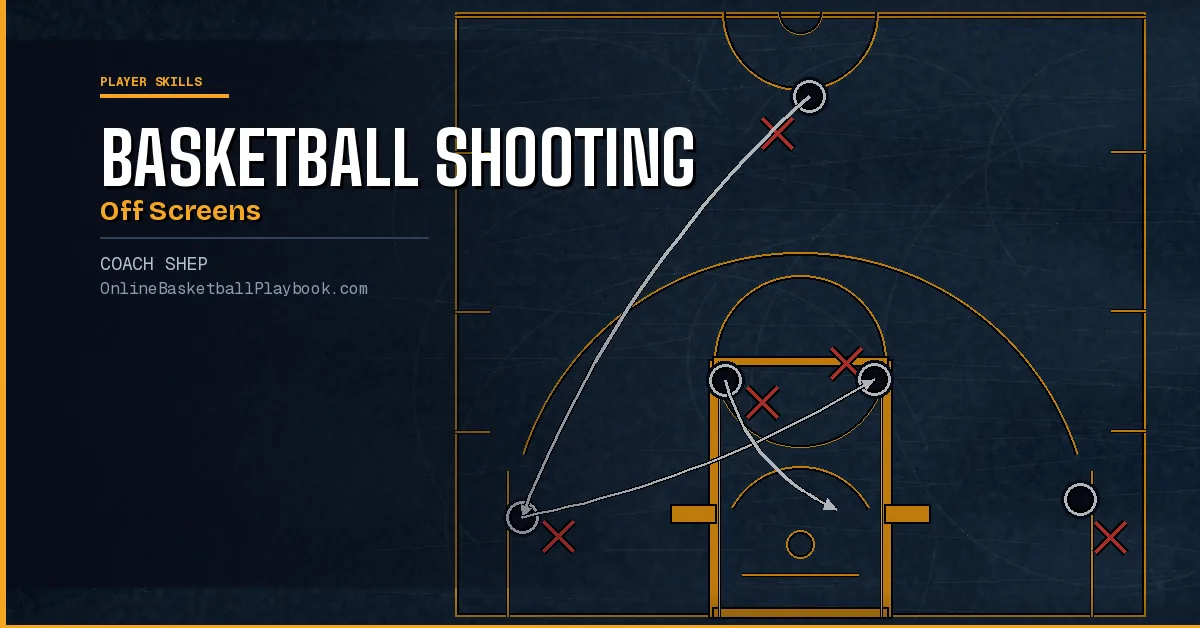
Shooting off screens separates good offenses from great ones. This guide covers every screen type, the footwork that unlocks each read, how to train game-speed reps, and the coaching cues that actually stick.
Why Shooting Off Screens Matters
A stationary catch-and-shoot player is easy to guard. A player who can use a screen, read the defender, and arrive at the catch point with feet already set is a different problem entirely. Shooting off screens is the bridge between spacing and actual scoring. It forces the defense to move, communicate, and make decisions under pressure.
In motion offenses and in any half-court system that values spacing, off-screen shooting is the primary way skilled perimeter players create separation. The screen itself buys time and position. What the shooter does in the two steps before the catch determines whether that separation converts to a made shot or a contested miss.
Rick Pitino measured this directly at Louisville: his team shot 22% on challenged shots versus the NBA baseline of roughly 42%. That gap exists because players shoot contested attempts they should pass back and restart. Training shooters to come off screens with feet in position (so they catch ready, not scrambling) dramatically shifts that ratio in your favor.
The other reason this skill compounds: screeners and cutters who know what to do after the screen is set. A ball-screen with a shooter who pops correctly, or a pin-down with a shooter who reads the defender's hip, creates second-side scoring opportunities that unprepared defenses cannot cover. Coaches who invest practice time here get returns across the entire offense.
The Four Main Screen Types
Each screen type creates a different angle of attack. Shooters who understand all four can function in multiple offensive systems and respond to what the defense gives rather than running a preset pattern regardless of context.
Pin-Down Screen
A pin-down occurs when a screener sets a screen on a defender below the shooter, pinning the defender down as the shooter cuts toward the ball. The shooter starts on the baseline or the block and cuts up toward the wing or the top of the key. This is the workhorse off-screen action in most half-court systems because it attacks the defense at a difficult angle. The screener's body blocks the chase path as the shooter rises.
The read: if the defender goes under the screen (chasing the shooter's path below the screener), the shooter has an open catch-and-shoot look at the wing. If the defender fights over the top, the shooter can flatten the cut toward the basket for a lob or a close catch. If the defender tries to deny early by going around the top of the screen, the shooter back-cuts to the rim.
Flare Screen
A flare screen sends the shooter away from the ball, toward the corner or the wing extended. The screener sets the screen on the help-side defender, and the shooter flares out to create a long catch-and-shoot look. This action works particularly well against teams that help aggressively on the ball, because the shooter can leak behind the defense while attention collapses.
Footwork on the flare is more demanding than a pin-down because the shooter is moving laterally and must get the hips turned to face the passer quickly after the catch. Coaches from John Beilein's Michigan program emphasize that the inside foot must plant first on this catch. Planting the outside foot first leaves the shooter off-balance and forces a slower set-up before the shot.
Stagger Screen
A stagger uses two screeners in sequence, set one after the other along the shooter's path. The shooter runs the baseline, takes the first screen, continues, and takes the second screen before popping out. Because the defender must navigate two bodies, this action creates the most separation of any off-screen set, but it requires the shooter to stay tight to both screens and not drift wide between them.
The stagger is common in NBA half-court sets and in Princeton-style offenses because it generates a true open look at the top of the key or the wing even against good perimeter defenders. The shooter's read is simpler than a single screen (the defender either survives both screens or does not), but the discipline of staying tight through both contacts is teachable and must be drilled repeatedly.
Curl Cut
When a defender cheats over the top of a pin-down or a stagger (leaning toward the shooter's expected path), the correct counter is the curl. Instead of popping out, the shooter plants the inside foot and curls tightly around the screener's body, attacking the middle of the floor for a mid-range pull-up or a drive to the rim.
The curl is the read that makes the other cuts work. Defenders who know the shooter only pops can cheat aggressively and give up very little. Defenders who must also respect the curl are stuck. They cannot leave the shooter's body to help, and they cannot lean early. Training the curl in every off-screen drill is what keeps defenses honest across an entire game.
Footwork: The Foundation of Every Screen Read
Jay Wright at Villanova and John Beilein at Michigan arrived independently at the same teaching cue: plant the inside foot first. Wright required players to say the sequence aloud during technique work ("1-2, lift, follow through") and considered the footwork non-negotiable before any competitive shooting rep began. Beilein held the same standard at Michigan and paired it with a qualifying threshold: 7 makes out of 10 shots in 30 seconds coming off a down screen before players earned full practice reps.
The inside foot rule solves two problems at once. First, it squares the hips toward the basket naturally, so the shooter does not have to make an extra adjustment before the shot. Second, it puts the shooter's weight on the correct side for the gather, which produces a more repeatable release point. A shooter who habitually plants the outside foot first arrives at the catch leaning away from the target, which adds a timing variable to every shot attempt.
The Two-Step Habit Before the Catch
The most common error coaches see at the youth and high school level is players reaching for the pass instead of setting their feet before the catch. The sequence should be: read the screen, run the cut, plant the inside foot, step through with the outside foot, and catch the pass as the outside foot lands, all in one fluid motion. When the two-step happens before the catch, the shooter is already in a power position and can go straight into the shot without reorganizing.
This habit is teachable with form shooting reps before any ball is involved. Have players walk through the cut and the footwork without a pass, then with a stationary pass from a partner, then at progressive speeds. Wright's coaching standard applies here: sloppy drills create bad habits. Running the footwork carelessly to add excitement to practice is not a shortcut. It is practice of the wrong skill.
Footwork on the Curl
The curl requires a hard plant on the inside foot to change direction around the screener. The shooter's hip must stay tight to the screener's body through the cut. Any drift away from the screen gives the defender a recovery lane. After the plant and the curl, the shooter gathers in one or two dribbles and shoots a pull-up rather than a catch-and-shoot, which means the footwork transitions into the pull-up mechanics: balanced base, weight loaded on the back foot, then unloaded upward through the shot.
Reading the Defender and Making the Right Cut
Effective off-screen shooting is not choreography. It is reading and reacting. The shooter must identify the defender's position and hip angle before the screen is set, not after. Three cues do most of the work.
The defender's hips: If the defender's hips are turned toward the ball or toward the anticipated cut path, the defender is cheating. That is the trigger to change direction, a back-cut or a curl rather than the expected pop. If the hips are square and the defender is in good position, the standard cut is the right choice.
The gap or the shadow: A defender going under a screen leaves a gap between the screener and the defender's body. The shooter pops out into that gap and catches in space. A defender fighting over the top is right on the shooter's heels and closes that gap. The shooter's counter is to curl or back-cut before the defender recovers.
The screener's angle: the screener's job is to set the screen at an angle that forces a choice on the defender. Shooters benefit from knowing what each screen angle opens and closes. A screener who sets the screen too far from the defender's path gives the defender a clear lane to go under. A screener who holds position and sets a legal screen at the right angle gives the shooter time to read and react.
Drills That Build Game-Ready Shooters
The research is consistent: drills that include a movement action before the shot (a screen, a cut, a dribble handoff) produce better transfer to games than stationary form work alone. The form work is necessary to build the shot, but the reads and the footwork only become automatic when they are practiced under conditions that resemble the game.
Pin-Down Series (Two-Ball, Three Players)
Set up three players: a screener, a passer at the elbow, and a shooter on the block. The screener sets the pin-down, the shooter reads the imaginary defender and chooses pop, curl, or back-cut, and the passer delivers the pass to the correct spot. Rotate after each rep. Run 10 shots per player, then compete: the player with the most makes in 30 seconds of continuous reps wins. This is the basic building block for all off-screen shooting practice.
Stagger and Pop Drill
Two screeners set up along the baseline. The shooter starts at the opposite block, runs the baseline, takes both screens in sequence, and pops to the wing. A coach or manager delivers the pass. The drill goal from Beilein's standard: 7 of 10 makes coming off the stagger in 30 seconds. If the group of three does not hit the standard, everyone runs a half-court sprint before the next set begins. The consequence turns a skill drill into a competitive rep with stakes.
Curl and Pull-Up Series
A defender plays passive defense at half-effort to give the shooter a visual cue without contesting the shot. The screener sets the pin-down, the defender cheats over the top, and the shooter curls. From there the shooter takes one dribble and pulls up from the mid-range. Progress the drill by adding a live defender who can choose to go over or under. This forces the shooter to make a real read instead of running a preset pattern.
Hernandez Star Shooting (Off-Screen Variation)
Jay Hernandez's Star Shooting drill places five spots around the arc. The standard version moves the shooter from spot to spot after each make. Add off-screen actions at each spot: a coach or manager holds a pad as a simulated screen, the shooter executes the footwork to arrive at each spot, and the standard make-count for the set tracks the shooter's progress. Record the make-count and post it. The competitive scoreboard is what turns this from a shooting drill into shooting culture.
Free Throws After Every Competitive Block
Bake free throw reps into the end of every off-screen shooting block. Shoot them tired, after the competitive portion ends. Pitino's research showed that game free throws happen when players are exhausted. Practicing them only fresh does not prepare players for the moment. Track the percentages. A player who makes 8 of 10 fresh and 6 of 10 tired is telling you something about their mechanics under fatigue.
Coaching Cues That Transfer to the Game
Technical cues work in practice when players can stop, adjust, and repeat. Game cues need to be short enough to fire as instincts, one or two words that activate the correct movement without requiring thought.
"Think shot before you get the shot" Is Wright's cue for screener-cutter shooting at Villanova. It means the shooter should decide "I am going to catch and shoot" before arriving at the catch point, not after. Players who are still deciding when the ball arrives are late, and late means contested.
"Inside foot, then shoot" is the simplified version of the two-step footwork cue. Use it as a reminder during drills, not as a corrective during a game. If a player needs it during a game, they have not had enough practice reps at game speed.
"Curl when they cheat" is the read cue. When players see the defender leaning over the screen, the correct response should be automatic. Drilling the curl at game speed, with a passive defender giving the lean cue, programs this response so the player does not have to process it consciously in a game.
"Tight to the screen" addresses the most common physical error: drifting away from the screener's body through the cut. A screen only works if the defender's path is physically blocked. When the shooter drifts, the defender has room to recover. This cue is particularly useful for the stagger, where shooters tend to drift wide between the two screeners.
Run your off-screen drills at a competitive make-count first, then add a passive defender as a visual cue, and only then introduce a live defender making real choices. Skipping the middle step rushes players into reads before the footwork is automatic, which trains hesitation rather than decisiveness, exactly the opposite of what you want.
Building a Shooting Culture Around Off-Screen Work
The principle from Shaka Smart's Texas program and Jay Hernandez's competitive shooting system applies directly here: record the make-counts, post them, and let players compete against their own records. A shooter who makes 6 of 10 coming off the stagger this week and 7 of 10 next week has a number to chase. A team that knows the record for the pin-down series has a shared target. This is how off-screen shooting moves from a drill to a culture, the scoreboard.
Tom Billeter's Purdue Drill at the POWER Clinic in Sioux Falls formalized this with consequences: make 4 threes in a minute with a rebounder and passer, sprinting baseline to half-court between shots, and the shooter runs for each point below 4. The scoring and the consequence are what make the rep competitive, not the volume. One minute of truly scored, consequence-based shooting produces more adaptive learning than ten minutes of unopposed form work.
- Inside foot first, every catch: Drill this without a ball before adding reps under speed. Correct footwork before volume or it will not transfer to games.
- Record and post make-counts: Track makes per time window (e.g., 7 of 10 in 30 seconds) for each off-screen drill and keep a posted record. Players compete harder against a posted number than against vague instruction.
- Add a passive defender before a live one: A defender who leans over the top gives shooters the visual cue to curl without the pressure of live defense. Build the read before adding full resistance.
- Shoot tired free throws at the end of every off-screen block: game free throws happen when players are exhausted, so practice them that way and track the percentage drop.
- Curl in every session: If you only drill the pop, defenders will cheat over the top all game. The curl must appear in every off-screen practice block so it remains a real threat.
Want more basketball coaching strategies and drills?
Join the Online Basketball Playbook newsletter →
Draw this play free in the play drawer →
Membership: the full library, playbook packs, and Pro drawing tools →
Keep Building
Related breakdowns
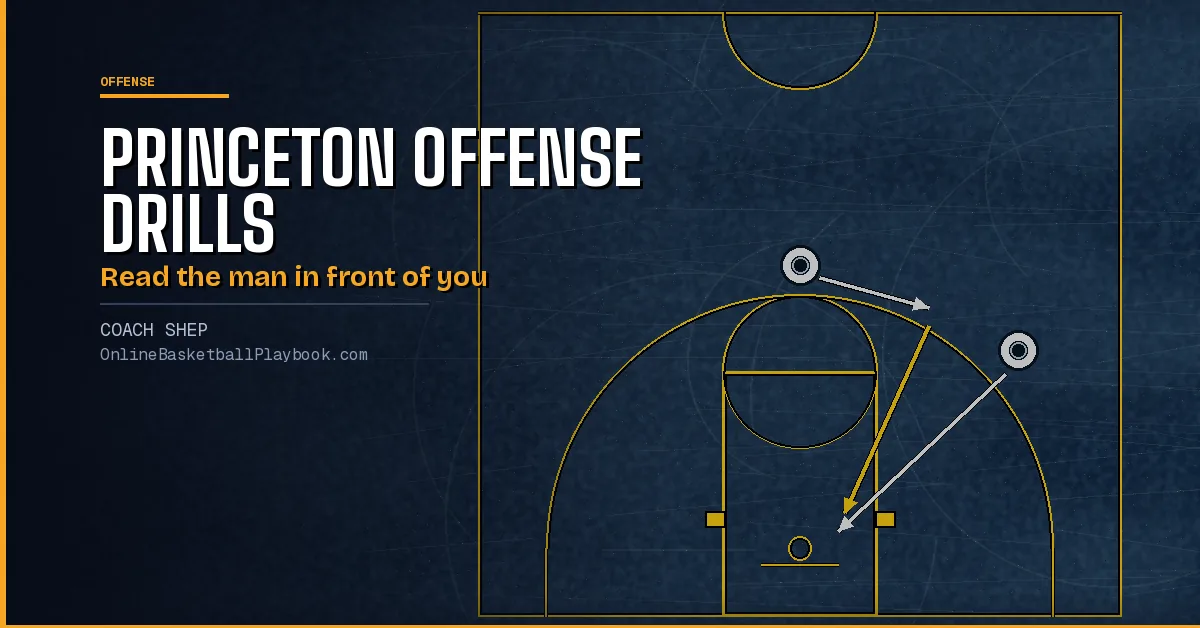
Princeton Offense Drills: Breakdowns, Shooting and Live Reps
Princeton offense drills that teach the reads: spacing, backdoor and hand-off breakdowns, 3-0 Chin and wave drills, Point shooting, a drive drill and an install.
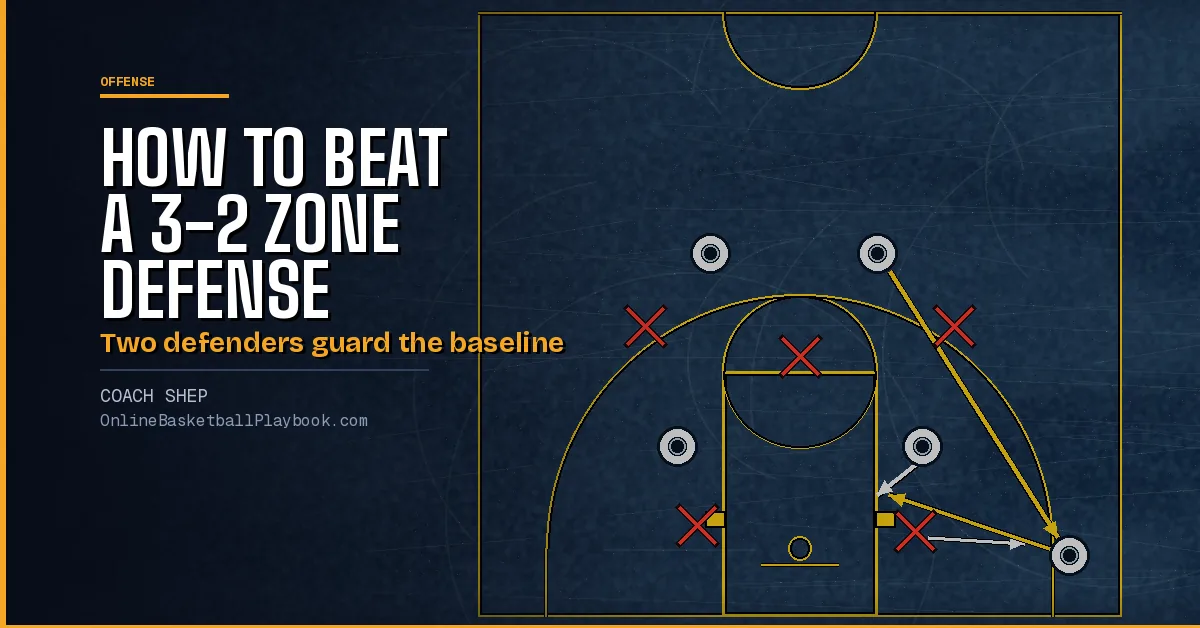
How to Beat a 3-2 Zone Defense: Sets, Screens and Reads
How to beat a 3-2 zone defense in basketball: alignments that split it, corner attacks, inside screens on the back line, the high post, skips, drives and rebounding.
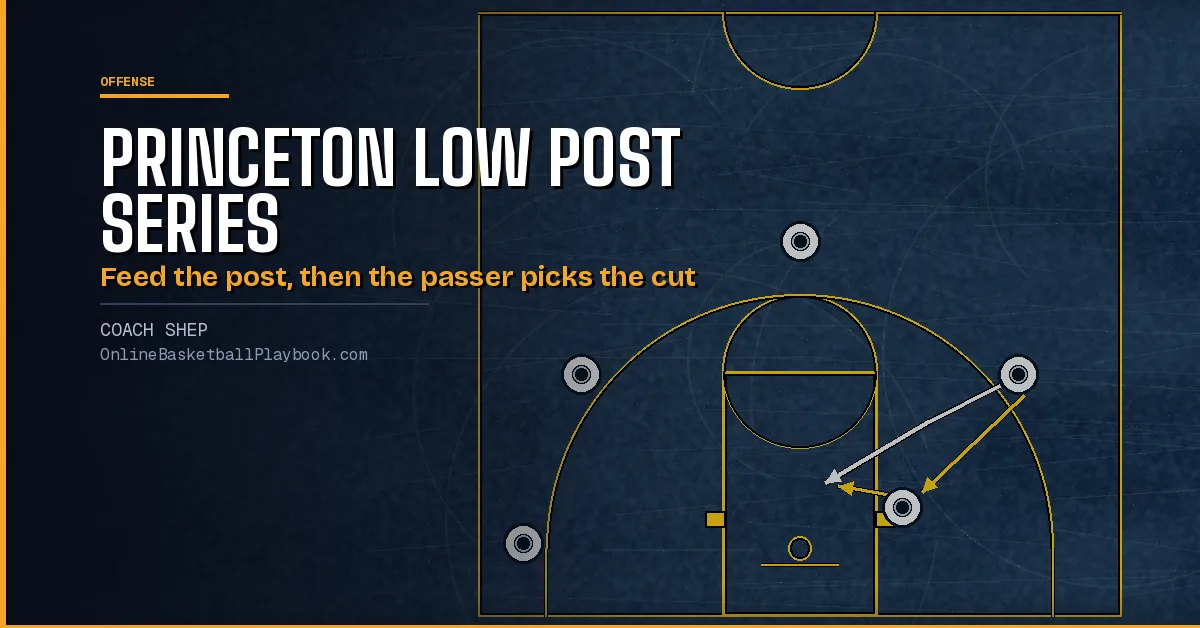
Princeton Low Post Series: Splits, Screens and the Laker Cut
The Princeton low post series: the wing entry, the passer's options after the feed, the high post split, the Laker cut and what to do when the post is denied.