Basketball plays are named sequences a coach calls to get one planned look. A play tells five players where to start, who moves, who screens and what the pass or shot should be. This guide explains basketball plays for coaches. It separates systems, actions and sets, walks through the types of plays (quick hitters, baseline and sideline out of bounds, after-timeout sets, late-game plays, press breaks and zone sets), covers when to call a play and how many to carry, and diagrams three plays step by step.
Types of Basketball Plays at a Glance
| Type | When you call it | What it aims for |
|---|---|---|
| Quick hitter | Late clock, after a timeout, when you want a look for one player | One planned shot or mismatch |
| BLOB (baseline out of bounds) | Ball under your basket after a score or stoppage | A layup or an open three |
| SLOB (sideline out of bounds) | Ball on the sideline | A clean catch, or a flow into the half-court offense |
| ATO (after timeout) | Right after a timeout | A quick basket or a high-percentage look |
| Late-game play | Last possession | The shot the clock and score call for |
| Press break | Against full-court pressure | A safe advance, then a layup |
| Zone set | Against a zone | The seams: short corner and high post |

Basketball Plays: Systems, Actions and Sets
Offense is three different layers, and mixing them up causes most of the confusion about plays.
- Systems are whole offenses with a philosophy. Examples are the dribble drive, the Princeton offense, 5-out motion, the triangle and the Blocker-Mover offense.
- Actions are reusable pieces. Ball screens, pick and roll reads, off-ball screens, dribble hand-offs and backdoor cuts are actions.
- Sets are named, called plays. Quick hitters, BLOB, SLOB and ATO plays are sets.
A team runs a system, calls sets out of it, and both are built from actions. Calling a set an offense, or an action a system, is the tell that someone does not know the game. That is why this page is about sets. The system is your base, and a set is a planned detour from it.
The Types of Basketball Plays
Quick hitters
A quick hitter is a called play built to free a shooter or hunt a mismatch. The coach calls it, and the players run a script instead of reacting to the defense. The best ones carry a built-in answer. On a switch the screener slips. On a smaller defender the screener seals. Every hitter needs three options or a counter, so a defense that takes away the first look does not end the possession. The basketball quick hitters library draws 25 sets sorted by action and by formation, and drills to teach quick hitters covers the practice side.
To pick a quick hitter by the action you want or by the formation your team already runs, use the quick hitters set finder.
Baseline out of bounds (BLOB)
A BLOB is an inbound from under the basket. The clock does not start until the ball is touched, the defense cannot double-team before the pass, and the offense picks the moment to start. That makes it the closest thing in the game to a free possession. Four shells produce nearly every BLOB: the box, the line or stack, the 1-4 flat and the diamond. The mechanisms are the same across them: a back screen for a lob, a stagger for a shooter, a cross screen for a post seal, and a step-in for the inbounder. The inbounder is never just a passer. Every BLOB needs one action that can use him as a receiver late in the count. More at baseline out of bounds plays.
Sideline out of bounds (SLOB)
A SLOB has more court to work with, and the inbounder can step back in after the pass. That makes it less about a layup and more about a clean catch or a smooth flow into the half-court offense. A good SLOB has two phases. Phase one gets the ball in safely. Phase two is the scoring action. A play that hunts a score on the first pass has nothing to fall back on when the pass is denied. See sideline out of bounds plays.
After-timeout plays (ATO)
An ATO is a play drawn up in the huddle. Most coaches run it from one alignment so the picture is familiar and only the call changes. Horns is a common home for them. It puts two bigs at the elbows, the point guard on top and two players in the corners, so the defense has to cover two ball-screen angles at once. Horns is a family of calls, not one play, and coaches use it to name answers to specific coverages. See after timeout plays and Horns set plays.
Late-game plays
The clock decides the play. With under a second left, the inbound catch is the shot. With a few seconds, one screen creates the look. With a minute or less, many teams lean on a clean two-man game or an isolation for the best creator, once they know whether they need a two or a three. A fake before the real action is the most repeated pattern in end-of-game sets, so the defense collapses on the first look and cannot recover to the second. Read end of game situations and clock management.
Press breaks
A press break is a set for full-court pressure. The handler needs three outlets, which are the sideline, the middle and the reverse. Two defenders cannot trap the ball and cover all three. A 1-4 alignment with everyone high works against any press, and the goal is a layup, not just a safe crossing. Once the ball is across, the team flows into its offense. See basketball press break and the 1-4 press break.
Zone sets
Against a zone, plays flood seams. Two cutters go to adjacent gaps so the middle defender cannot cover both. The short corner and the high post are the two spots coaches teach first. Zone baseline plays use a corner cut and a seal on the middle defender. See how to attack a zone defense and zone offense vs the 2-3 zone.
Shells: One Picture, Many Plays
Coaches organize plays by where the five players start. Players learn the picture once, and each call changes the first move or the read. Two shells show up across the types above.


One entry with several tagged finishes is cheaper to teach than several unrelated plays. The finish depends on what the defender does. Coaches also name sister plays that change one variable, so a new call costs little to teach.
Get the next coaching guide in your inbox
One email when a new guide or diagram set goes up. Free.
Three Basketball Plays, Step by Step
These three are different from the six on simple basketball plays. Each one shows a different type of play. Numbers read as positions, and the labels on the diagrams follow basketball terms.
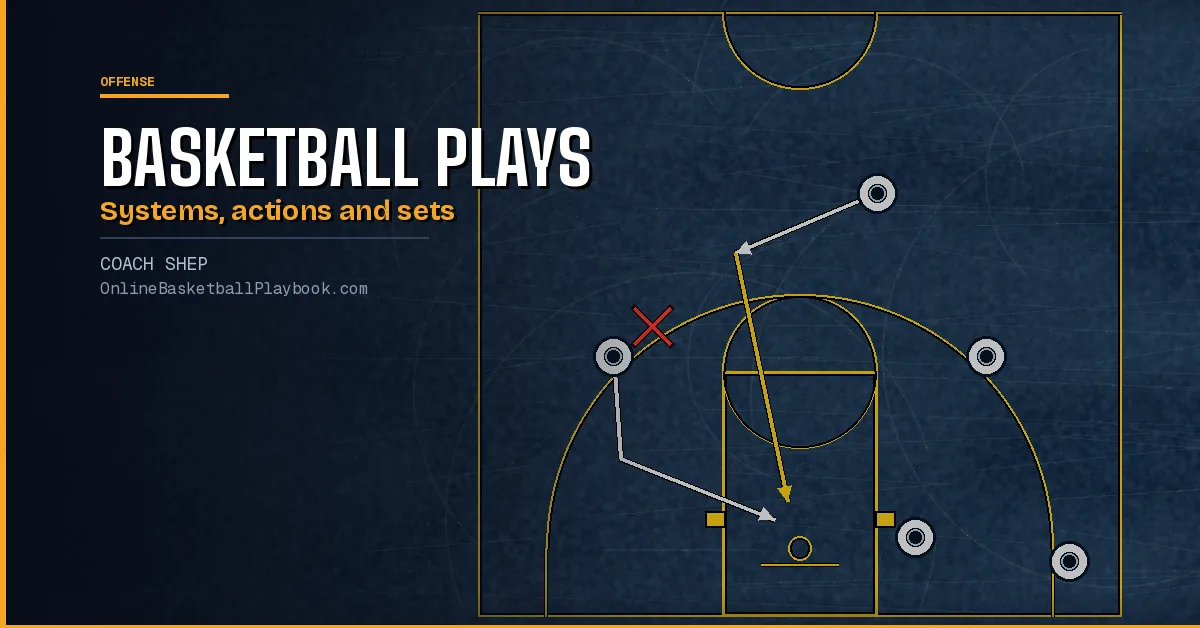
Hand-off fake and backdoor (quick hitter)
- The ball handler (1) dribbles toward a teammate (3) on the wing as if to hand the ball off.
- The defender has to honor the hand-off, so he jumps it.
- 3 reads the defender and cuts behind him to the rim. The back cut is the primary read.
- 1 passes to the cutter.
The catcher reads the defender, not the diagram. It needs one teaching rep for the trigger and fits any tight alignment. The diagram is at the top of this page.
Slash zone baseline play (BLOB and zone set)

- The point guard calls "Slash" and a player's name at the inbound.
- The named player cuts to the corner right away.
- The 5 seals the middle of the zone.
- The 4 clears to the weak side.
- The inbounder reads the zone. A sagging zone leaves the corner three. If the corner is covered, the 5 has a one-on-one post chance.
The call costs no extra teaching once players know their roles.
Sideline after-timeout play for the 3 (ATO)

- The team clears out the area around the athletic 3.
- The 3 goes to the free-throw line extended, not the elbow. The defense cannot deny him or over-help from there.
- The 5 fakes a screen for the 4, which keeps the help bigs busy.
- The fake opens a backdoor cut for the 3. The inbounder passes to him as he cuts.
The 3 stays at the line extended. If he drifts to the corner early, the help recovers. The inbounder does not step to that spot.
When to Call a Play
- Save sets for after timeouts, the end of the clock and moments when you want a look for one player. Most possessions still flow from the base offense.
- Call it, then fall back. When the quick look is not there, the called action ends and the team drops into its normal offense. How the call reaches the floor is on basketball play calling.
- Decide the recurring situations before the game. Settle what you run down one with under ten seconds, and whether you foul up three. Coaches split on fouling up three, so pick your answer and tell the players.
- Keep a play ready for each time band at each inbound spot. Think 0 to 3 seconds, 4 to 8 seconds and 9 or more, with a two-point and a three-point option.
- Cast the play to a scorer or a size. A lob play needs a big who can finish above the rim, and some plays need a switch mismatch.
- Limit timeout adjustments to one to three things, and call only plays the players have already run. Players remember little from a huddle.
- Do not assume players can read a diagram in a timeout. Teach diagram reading before game day.
How Many Basketball Plays to Carry
Coaches split on depth. Some carry a deep library sorted into families, where one entry feeds several tagged finishes. Others carry a few plays and drill them until they are automatic. Many long playbooks turn out to be a handful of entries with many tags, so the real count of things to teach is smaller than the page count.
- Drill fewer things deeper. One play run a hundred times beats a hundred plays run once.
- Carry one set for each late-game need: down three, down two, under two seconds and the last minute.
- Run one simple core special with every team, so players trust it at the buzzer.
- File plays by the situation they serve, then by the personnel they need.
- Change the call, not the play. Run every out-of-bounds play from one alignment and rotate the signal, since those possessions get scouted most.
- Name a play for what you want the defense to hear. A play called Baseline 3 makes the defense think corner three.
- Give every hitter three options or a counter before it goes in the game plan.
How to Teach Basketball Plays
- Teach the symbols first. A diagram looks like hieroglyphics until a player knows what the lines mean. Show the key in the first film session.
- Draw it, walk it, run it against live defense. A play that only works five on zero tends to fail in games.
- Sell the fake. Plays move a defender with the first action. The inbounder's eyes and the first cut do that work.
- Practice the situation, not just the play. Spend the last ten minutes of practice on a late-game situation, with a few plays and real defense.
- Number the frames. Follow one play through its steps the same way every time, then add the read, so a player sees why as well as where.
See basketball plays for point guards. Defenders prepare for them too, in how to defend inbounds plays.
Questions Coaches Ask About Basketball Plays
What is the difference between a play and an offense?
An offense, or system, is a whole way of playing with a philosophy, like motion or dribble drive. A play is a named set the coach calls out of that system. Both are built from actions like ball screens and cuts.
What is a quick hitter in basketball?
A fast, called play built to free a shooter or get an easy basket for one player. It is run late in the clock, after a timeout or whenever a coach wants a look for one player.
What does BLOB mean in basketball?
Baseline out of bounds, an inbound taken under the basket. SLOB is the sideline version and ATO means after timeout.
How many plays should a team have?
Fewer than most coaches think. Give each play a counter, drill a small menu until it is automatic, and file the menu by situation.
How do you run a play against a zone?
Flood the seams. Send two cutters to adjacent gaps so the middle defender cannot cover both, and use the short corner and the high post.
When should you call a play instead of running the base offense?
After timeouts, near the end of the clock and when you want a look for a specific player. Then fall back into the base offense if the look is not there.
More offense pages sit under Offense. Related guides: simple basketball plays, how to draw basketball plays, basketball offense, baseline inbounds plays, sideline inbounds plays, counter plays for common defenses, ball screen plays and basketball terms.
Want the printable playbook packs?
OBP Pro members get the premium playbook packs: the zone attack, out of bounds and practice plan PDFs, plus each new pack as it is finished. The membership page lists what is in each one. Or draw your own version free in PlayDraw.
See what OBP Pro includesMore Plays
Back to every Offense page.
Keep Building
Related breakdowns
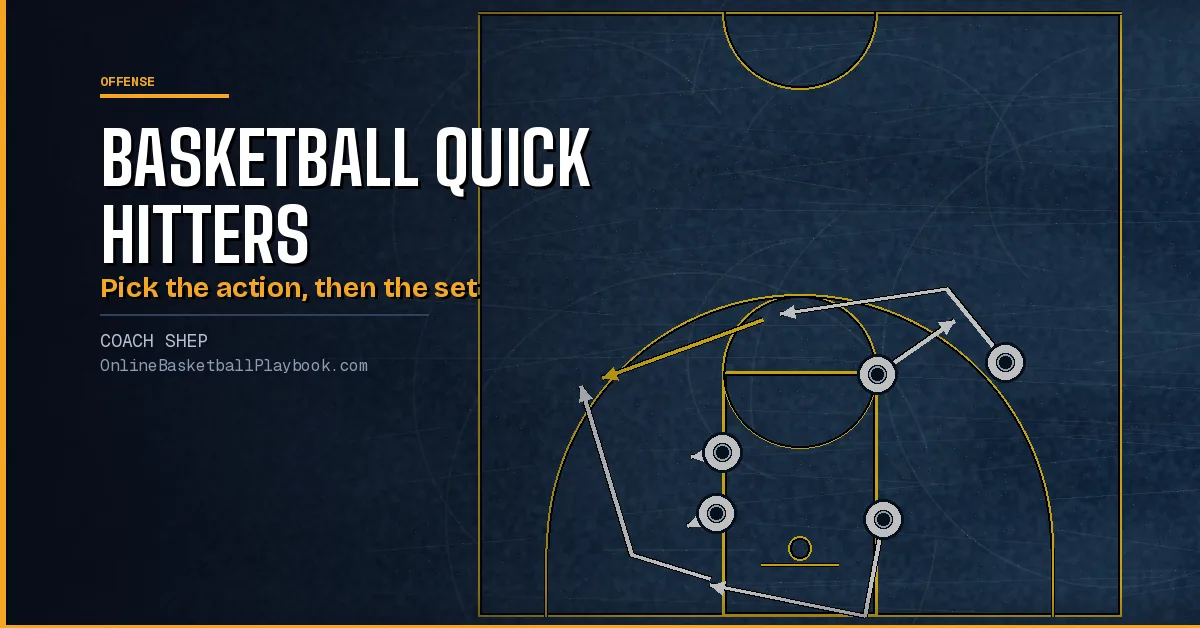
Basketball Quick Hitters: 25 Sets by Action and Formation
Basketball quick hitters sorted by the action you want, catch-and-shoot to post feed, with each set's formation, diagrams, the read and the counter.
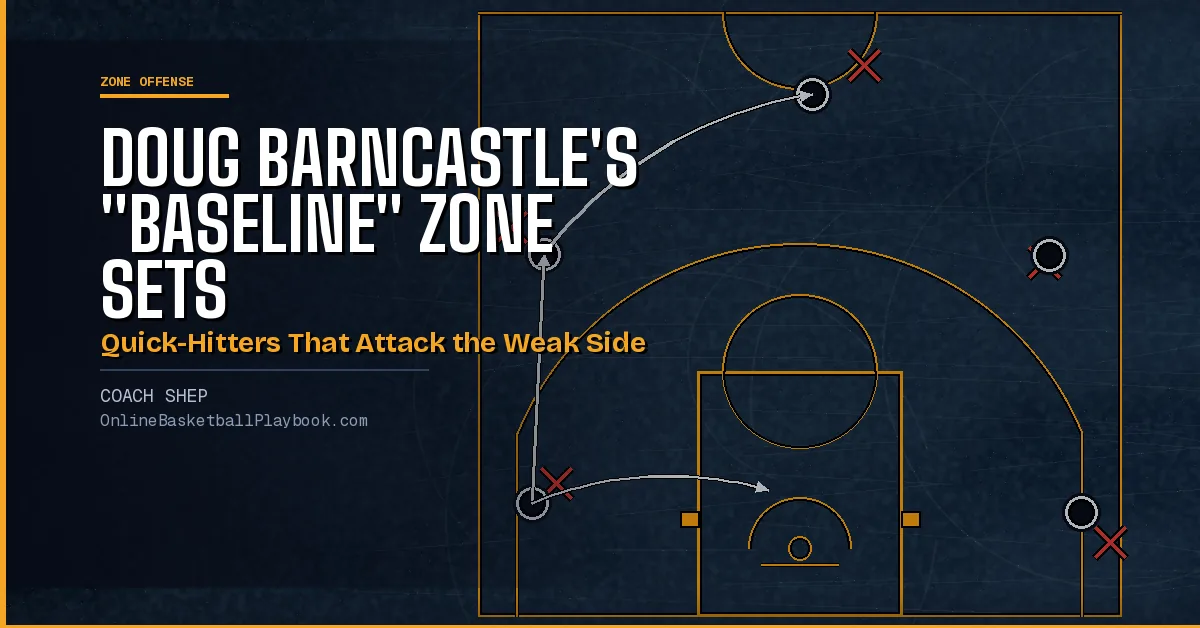
Zone Offense Quick Hitters: 3 Sets That Attack the Weak Side
A handoff-action quick-hitter and two counters, Baseline Push and Baseline Dive, built to attack a zone to the weak side and get clean, makeable shots.
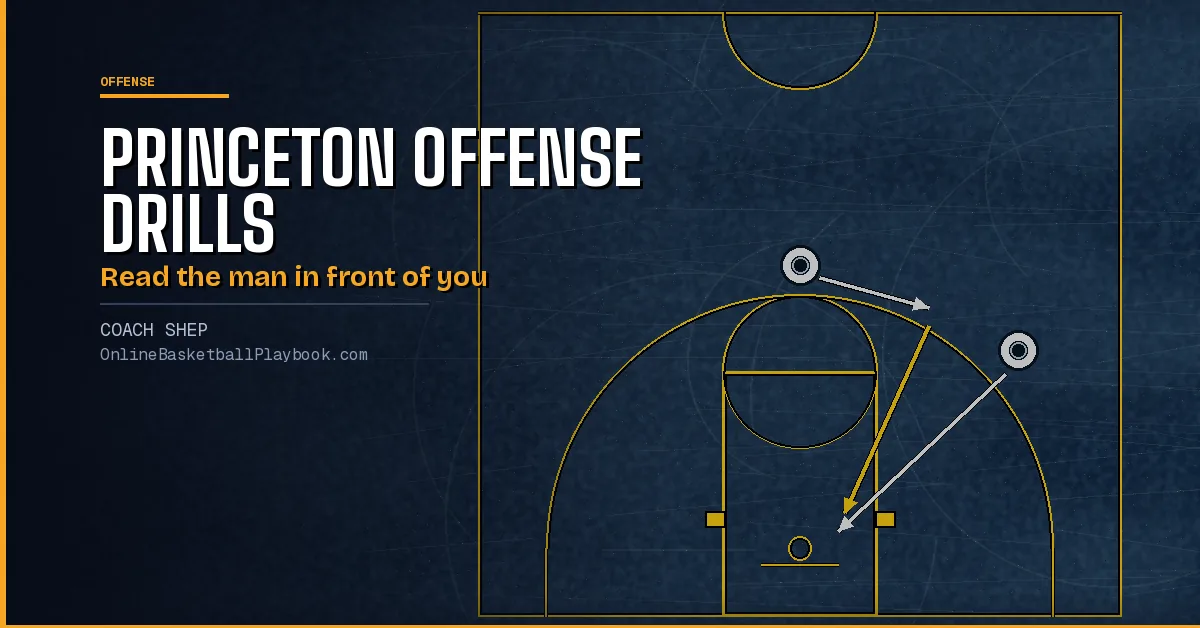
Princeton Offense Drills: Breakdowns, Shooting and Live Reps
Princeton offense drills that teach the reads: spacing, backdoor and hand-off breakdowns, 3-0 Chin and wave drills, Point shooting, a drive drill and an install.