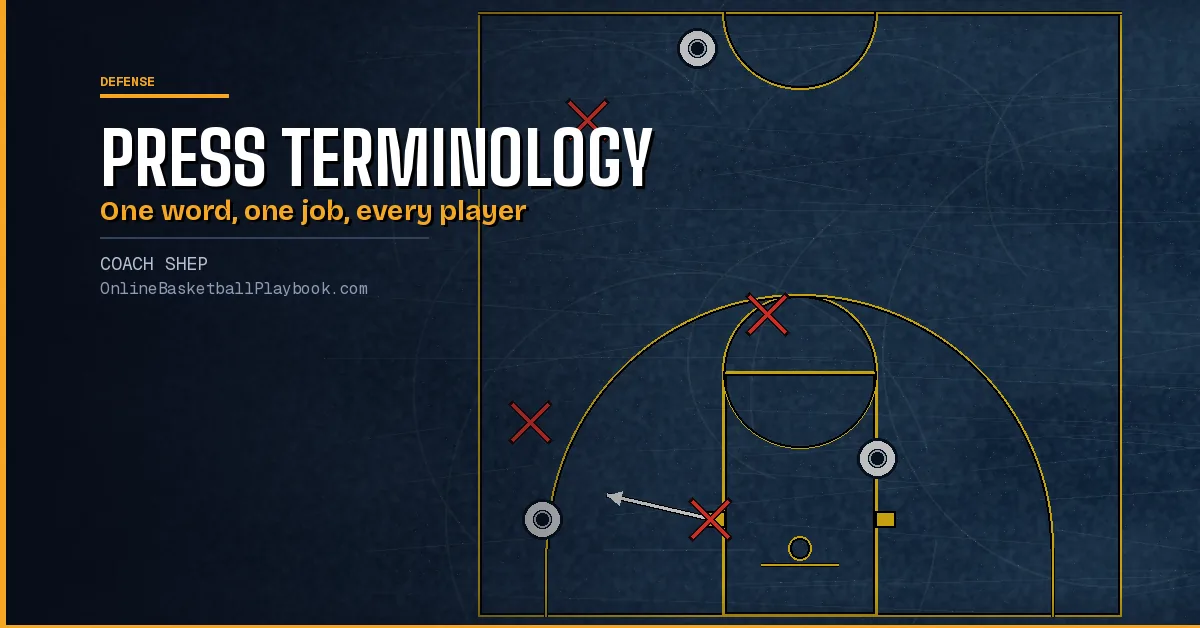
Basketball press terminology is the set of words a staff uses to put in a press and call it during a game: names for the formation, for each player's job, for the moments the ball creates and for the mistakes that break the press. The same word often means something different from team to team, so this page lists the words by job and shows each version side by side. The presses themselves are compared on the best full-court press hub, and the trap technique every press shares is on trapping in basketball.
Basketball Press Terminology at the Trap
When the trap goes on, the five defenders have five jobs, and most press vocabulary starts here.
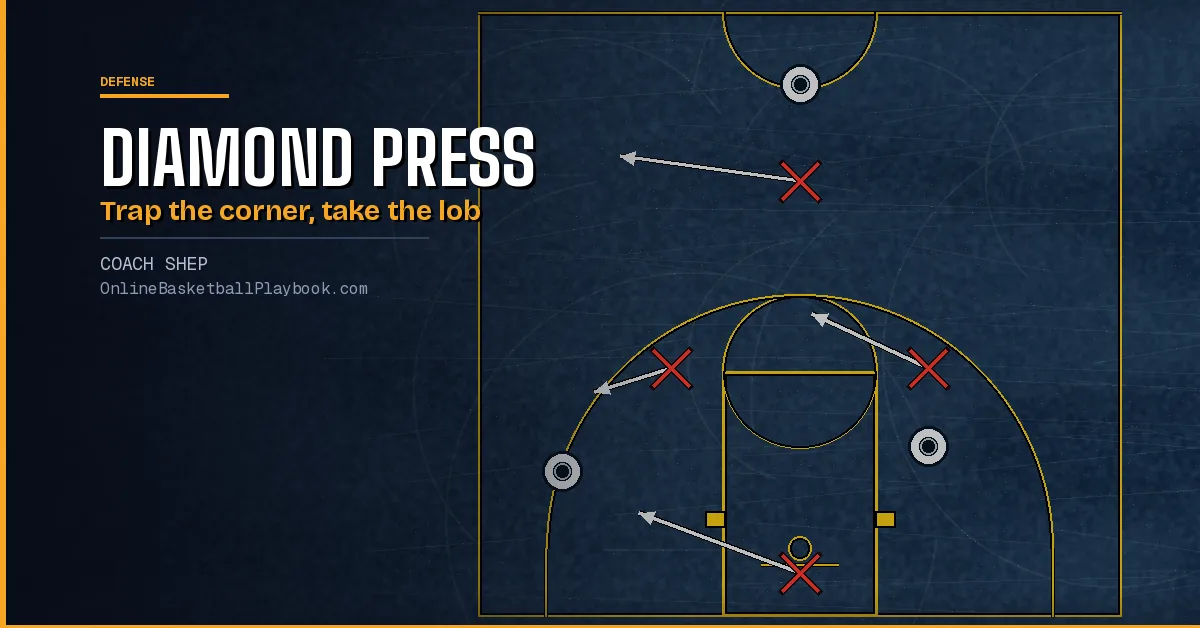
- Trapper. One of the two defenders on the ball. In a 1-2-1-1 diamond press the defender on the inbounder and the near wing trap the catch in the corner.
- Interceptor. One of the two defenders reading the passes out of the trap. In the diamond one interceptor plays the middle and the other lines up with the trap to take the lob. Some press guides call the interceptor the most important spot, more than the trappers, because the steals come from there.
- Safety. The deepest defender, who takes the long pass and defends the 2 on 1. In the diamond he plays as deep as the last offensive player and may cheat up against young teams who cannot throw the length of the floor.
- Goaltender. The same last job under another name: the defender who never leaves the rim. The job also goes by goalie, back man, protector or basket.

Coaches count the same five jobs with different words:
| Naming | The five jobs |
|---|---|
| Trapper, interceptor, goaltender | Two trappers, two interceptors and one goaltender on every trap. Jim Larranaga's full-court scramble labels every player one of the three, and Sylvia Hatchell assigns the three jobs the moment the first trapper touches the ball. |
| Two interceptors and a goalie | Don Meyer counts two trappers, two interceptors and a goalie, and says getting the trap is not enough without shooting the gap. |
| Two interceptors and a safety | The diamond guides and the 1-2-1-1 that funnels the catch to the corner keep two trappers, two interceptors and one safety. |
| Stealer and back man | A 1-2-1-1 that names one defender the stealer and the last defender the back man, who prevents the layup. |
Name the five jobs before you name the press.
Front, Middle and Back Lines
Line names follow the digits of the formation. In a 2-2-1 press the front line is the two guards, the middle line is the two bigs and the back line is the best anticipator, playing as the interceptor. The 2-1-2 uses the same three lines. The 2-2-1's back-line interceptor stays in line with the ball and does most of the talking, because he sees the whole floor.

The defender on the inbounder has his own set of names:
- Disruptor. In the diamond, a tall, long player on the inbounder who forces the pass to the corner, traps it and counts the five seconds out loud.
- Centerfielder or linebacker. In a deny press, the inbounder's defender drops off and reads the passer's eyes to intercept or trap.
- Shortstop and Center field. Tubby Smith's 55 Shortstop puts him at the free-throw line, and 55 Center field drops him to half court.
Whatever you call them, every line knows its one job before the ball comes in.
Runner, Slider, Chaser, Floater, Protector
The movement words name roles by how a defender moves. Read as phases, one defender moves through the first three on every pass.
- Runner. Moves at full speed while the ball is in the air.
- Slider. Once the ball is caught, takes short, choppy steps in any direction, set to go on the next pass.
- Chaser. Goes after the ball on instinct, with no rules.
- Floater. The safety to the middle of the floor when the ball is reversed, who gambles only on middle passes.
- Protector. Covers the basket and guards against easy shots.
In the 1-2-2 that uses these words, the length of the throw-back decides who chases and who floats. A short throw-back is caught no farther than the free-throw lane area, and a long one beyond it. On a short one X1 chases and X5 floats, on a long one they trade, and X4 always protects the basket.
Move while the ball is in the air, and know before the pass who chases and who floats.
Controller, Gapper, Taker, Reader, Teaser
Vance Walberg names his press by jobs, not by who you guard. Five spots let a coach hide a weaker defender and feature a ball hawk. The Controller guards one man and everyone else covers two.
- Controller. Your toughest defender. Pressures the ball, forces a turnover in the backcourt, stops the sideline dribble and zig-zags the handler. Walberg keeps three players who can play it, for foul trouble.
- Gapper. The active help-side defender. Traps the sideline dribble with the Controller, coming from behind so the handler never sees him, and jumps a middle dribble. If the press starts to break, he sees it and fixes it.
- Taker. Can be slower but must be smart. Takes away the sideline pass over half court.
- Reader. The smartest player on the floor. Reads the ball, gambles for steals and sprints back to protect the rim if the press is beaten.
- Teaser. The back safety. Gets slightly off his man to bait the long pass, with his eyes on the ball and the passer's shoulders.
The jobs move with the ball. When the ball switches sides, the Controller and Gapper swap. On a middle drive, the Reader and Taker swap.
Other presses borrow some of these names for different jobs. If you use them, write the job next to each name on your call sheet so every player hears one meaning.
Run and Jump, Peel Down and Rotate
Run and jump. A forward or second-line defender moves up hard to stop an oncoming dribbler, and the two defenders swap jobs. The definition calls it a rotation, not a hedge. The full press built on it is on how to coach the run and jump press.

Peel down. A defender comes from ball level and gets in front of the dribbler to stop him. In the 1-2-1-1 version, X2 plays inside the inbound receiver and steers him down the sideline, which creates a new trap spot along the sideline. X1 gets level with the ball, then sprints ahead of the dribble and peels in front before half court. If the peel down stops the dribble, X2 may leave the trap and pick up the nearest open outlet.

Both moves need a defender at the basket, which is why the same word list runs them only from the 1-2-1-1 and not from its all-in 1-2-2. A throw-back after either move is close to half court, so the defense recovers to its half-court defense instead of chasing.
Rotate. Two meanings, both in pressing playbooks:
- Rotate as a change call. Rotate can switch a 90 press to an 80, with the 4 bumping himself back.
- Rotate as a shape call. Rotate can also bump the weak wing back for a 2-2-1 or 2-1-2 look.
In every system on this page, the defenders off the trap move while the pass is in the air, not after the catch.
Whatever you call the swap, both players move at once and nobody stops to watch.
Formation Names: Letters, Numbers and Colors
Programs name whole presses in four ways.
- Letters. Abel is a 1-2-2, Baker a 1-2-1-1 and Charlie man-to-man with fronting and an anticipator. Abel sends all five into the backcourt. Baker keeps X4 behind half court for basket coverage. Charlie tries to steal the first pass, the inbound, while Abel and Baker play the second pass out of the trap.
- Depth numbers. 80 is full court with the inbounder guarded, 60 three-quarter court, 40 half court and 20 quarter court. A trailing 1 adds a denied inbound, so 81 is full-court deny and 61 three-quarter deny.
- Numbers as aggression. In a 1-2-2 with aggression numbers, 70 is a safe press that floats in front with no trap, 80 is the aggressive three-quarter trapping version and 76 is a press that starts as 70 and then springs a corner trap.
- Numbers as names. Tubby Smith uses 55 and 22, and Rick Pitino's handwritten list, taught on match-up press, uses 3, 22, 24 and 5. The numbers do not line up across programs.
Colors do three different jobs:
- Whole press. The color names the whole press.
- Pick-up. The color names how the defense picks up the inbound.
- Pressure level. The color names a pressure level inside one defense, such as Gold for conservative and Red for aggressive.
Vance Walberg's press sheet tells coaches to color-code intensities. Don Meyer uses fists to say when to trap, as covered on scramble press: one fist traps the first pass, two fists trap the dribble, a side fist traps after half court and a cross fist is the only trap from the sideline.
Give every press one word that tells all five players where to line up and when to trap.
Words for the Ball and the Floor
- Gap shot. Shooting the gap between the passer and the receiver when a trap is set.
- Influence. Pressuring the ball to steer it a chosen route.
- Trap location. Two spots in the 1-2-2 and 1-2-1-1 word list: the deep backcourt corners, and the sideline about halfway between the baseline and the center line.
- Ball level. The off-side defender stays even with the ball to cover passes that go past it.
- Diagonal pass. A long looping pass from one side of the floor to the other, across the press.
- Deflection. Tip the pass away rather than going for a clean steal. It is the key technique in Charlie, the press that plays the first pass.
- Eyes and shoulders. Tubby Smith's rotating defenders read the trapped handler's eyes and shoulders to time the steal.
- Blind alley and gut pass. In the containment 2-2-1, the blind alley is the backcourt strip about 5 feet from the sideline, and a gut pass is a pass into the middle.
- Tag. In the same 2-2-1, the middle guard waits until his partner touches him before he rotates, which keeps the gut covered.
- Coffin corner. Billy Donovan's automatic trap on a ball-side inbound below the block. He never traps the long-side inbound.
- Air time. The trigger to move. The runner moves while the ball is airborne, and Walberg's sheet says to move on the pass, not on the catch.
Steer the ball to your trap spot first, then shoot the gap.
Words for a Beaten Press
- Back-tip. Sprint after the ball handler and tip the ball from behind with the inside hand, never reaching. Donovan also calls it back pursuit.
- Level off. Tubby Smith has one defender level off a dribbler who beats the trap while the others back-tip and run through the lanes.
- Slow the dribbler. When the press is broken and the offense rushes the basket, lunge and fall back, take a charge and holler.
- Sprint out of traps. Both trappers sprint to the next job the moment the ball leaves the trap.
The drills that build these habits are on full court press defense drills.
When the press breaks, sprint first and talk second.
Fakes, Disguises and Named Mistakes
Stunt. Fake a trap and recover. Donovan says stunt, don't lunge, and the stunt drill cue is "once up, two back." Gold in Walberg's press acts as if it will trap and does not. Conceal is a 1-1-1-2 that hides man or zone for one pass, taught on disguised press defense, with a first-pass match-up or a first-pass trap from the same look. Larranaga's 55 lines up to look like a match-up before it traps.
Named mistakes give a coach one word to stop a drill with:
- The three sins. Getting split, running at a ball handler nobody is pressuring, and three defenders on the ball.
- The two terrible threes. Walberg's version: three on the ball and three behind the ball.
- Fake hustle. Donovan's name for a lunge past the handler that takes the defender out of the play.
- Steal off the ball. "We steal OFF the ball, not ON the ball," which names reaching on the ball as a foul.
Call the mistake by its name on the stop, and the team learns the word and the habit together.
Same Word, Different Meanings
Before you borrow a call, learn one meaning for each word. These are the meanings their coaches use:
- 55. Tubby Smith's full-court man with ball-line traps, in base, Isolation, Shortstop and Center field versions.
- White and Black. Tubby Smith's two starting shapes. White is a diamond start after a close-in shot, and Black is a box start after a deep make. Once the ball is in, they are the same press.
- Red. Rick Pitino's half-court trap.
- Fist. Don Meyer's trap triggers: one fist, two fists, side fist and cross fist.
- 80. In the depth numbers, full court with the inbounder guarded.
Other presses use these same words for other jobs, so write the job next to the name on your sheet.
Press words carry over to ball screens too. Red, Blue, Black and X are also reused as ball-screen coverage calls, so a staff that uses them for presses needs a separate word list for each. The rest of the game's words are on basketball terminology, and the offense's side of the same language is on how to beat a full-court press.
One word, one meaning, on your team.
Get the next coaching guide in your inbox
One email when a new guide or diagram set goes up. Free.
Questions Coaches Ask
What is an interceptor in a press?
An interceptor is one of the two defenders off the trap who read the passes out of it. In a 1-2-1-1 diamond one plays the middle and the other lines up with the trap to take the lob. Press guides that rank the spots put the interceptor first, because the steals come from there.
What is the difference between the safety and the goaltender?
Both name the last defender. The diamond's safety plays as deep as the last offensive player and takes the long pass and the 2 on 1, while the goaltender's rule is never to leave the rim. It is also called goalie, back man or protector.
What does run and jump mean in basketball?
A second defender moves up hard to stop the dribbler, and the original defender keeps going and takes the second defender's job. The two swap assignments, which makes it a rotation rather than a hedge.
Want the printable playbook packs?
OBP Pro members get the premium playbook packs: the zone attack, out of bounds and practice plan PDFs, plus each new pack as it is finished. The membership page lists what is in each one. Or draw your own version free in PlayDraw.
See what OBP Pro includesMore Coaching Guides From This Batch
- After Timeout Plays: ATO Sets by Score, Clock and Spot
- Full Court Last Second Plays: Long Passes, Screens and Splits
- Buzzer Beater Plays From Half Court: Sideline and Baseline
- Late Game Plays When They Deny Your Best Player
Back to Best Full-Court Press and every Defense page.
Keep Building
Related breakdowns
1-2-1-1 Diamond Press Basketball: Roles, Traps and Install
How to run the diamond press in basketball: who plays each role, how to trap the corner, what to do on the reversal and the lob, and how to install it step by step.
When Not to Press: Bad Reasons, Thin Benches, Poised Guards
When not to press in basketball: the bad reasons, the roster you need first, the opponents who beat it, the moments to drop it and the youth limits.
1-3-1 Full Court Press: Roles, Traps and Rotations to Install
The 1-3-1 full court press from setup to frontcourt trap: each role, the reversal rotations, an aggressive version, the costs and when coaches call it.