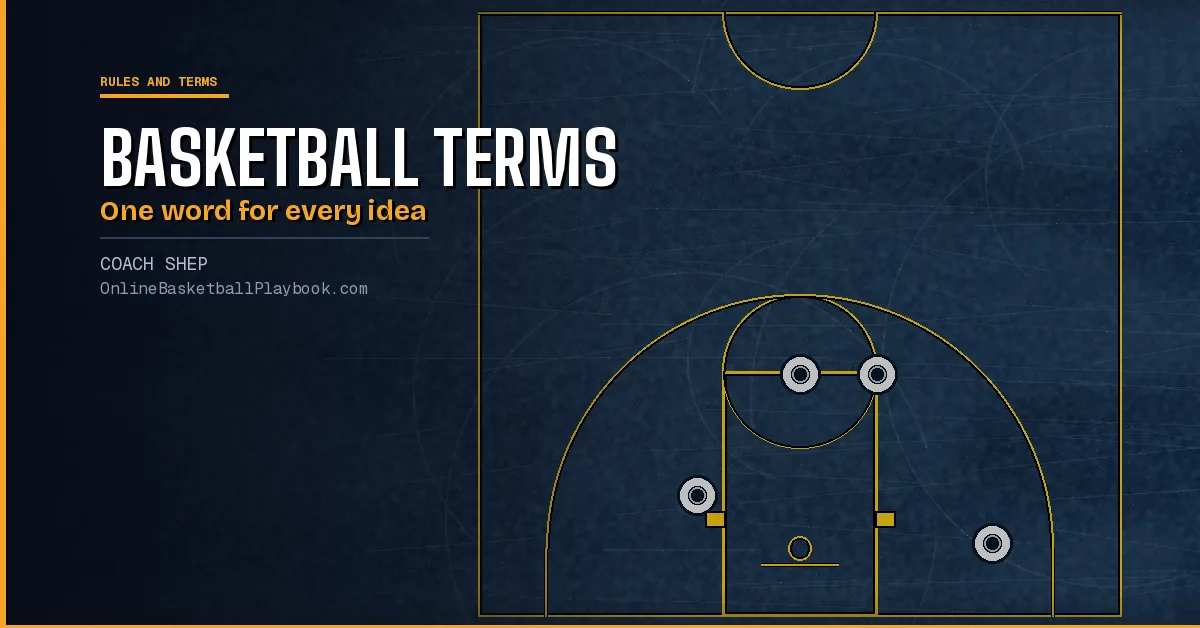
Basketball terms give a team one set of words for the floor, the players, the plays and the rules. A coach who says "wing," "help side" or "ball screen" should get the same picture in every head.
This glossary defines the basketball terms coaches and players use most, one entry per term, grouped into court spots, positions, offense, screens and cuts, defense, rules and stats. Each group runs in alphabetical order, and each entry links to its full page where the site has one. Where the game has two names for one idea, both are listed. Teaching the words to a team is on coaching communication.
Basketball Terms at a Glance
| Group | What it covers | Sample terms |
|---|---|---|
| Court spots | Where a player stands | Wing, elbow, block, short corner |
| Positions and numbers | The five jobs and how diagrams number them | Point guard, stretch four, the 5 |
| Offense | Systems, actions and sets | Drive and kick, horns, quick hitter |
| Screens and cuts | The most crowded naming family | Down screen, flare, UCLA cut |
| Defense | Coverages, stances and team defenses | Closeout, ICE, pack line |
| Rules and violations | Fouls, violations and clocks | Bonus, goaltending, shot clock |
| Stats | What the scorebook counts | Assist, turnover, plus-minus |
Basketball Terms for Court Spots
Court words tell a player where to stand. This site uses one set of spot words on every page and every diagram, and they are defined here. Measurements are on basketball court dimensions.

- Backcourt: the half of the floor a team defends, with the basket it guards. See backcourt violation.
- Ball side: the half of the floor the ball is on, also called the strong side. It changes each time the ball crosses the middle.
- Baseline: the boundary line behind each basket, also called the end line.
- Block: on the lane line, low, by the block marks. "Low post" means the same area.
- Corner: along the baseline outside the three-point line.
- Elbow: where the free-throw line meets a lane line. Each lane has two.
- Free-throw line extended: an imaginary line from each end of the free-throw line out to the sideline. The wing sits about on it.
- Frontcourt: the half of the floor a team attacks, with the basket it shoots at.
- Half-court line: the line across the middle of the floor, also called the midcourt line or division line.
- Help side: the half of the floor the ball is not on, also called the weak side.
- High post: anywhere around the free-throw line, including both elbows and the nail.
- Low post: the block area. See post play.
- Nail: the middle of the free-throw line.
- Paint: the whole painted lane between both blocks and both elbows, also called the lane or the key. An offensive player may not stay in it for three seconds. See 3 seconds rule.
- Short corner: along the baseline inside the three-point line, between the block and the corner. A spot just outside the lane beside the rim is called the dunker spot and kept apart from the short corner, so pick one name.
- Sideline: the boundary line on each side of the floor.
- Slot: between the top of the key and the wing, above the arc. The two guard spots in a two-guard front.
- Top of the key: the center of the floor just above the three-point arc. Say the whole phrase. "The top" alone can mean any spot up high.
- Wing: outside the arc at about the free-throw line extended.


Use one word for each spot all season.
Positions and Numbers
The numbers 1 through 5 are shorthand in diagrams and huddles. The full guide is basketball positions explained.
- Bigs: the 4 and 5, also called posts.
- Center (5): usually the tallest player. See center.
- Combo guard: a guard who can play the 1 or the 2.
- Guards: the 1 and 2.
- Point forward: a forward who brings the ball up and runs the offense.
- Point guard (1): the main ball handler. See point guard.
- Positionless basketball: a style where every player can dribble, pass, shoot and guard more than one spot.
- Power forward (4): a big who rebounds and scores near the basket, and in many offenses shoots from three. See power forward.
- Shooting guard (2): usually the best outside shooter. See shooting guard.
- Sixth man: the first substitute off the bench.
- Small forward (3): the wing who drives, shoots and often guards the best scorer. See small forward.
- Stretch four: a power forward who shoots threes and pulls a big away from the rim.
- Swingman: a player who can play the 2 or the 3.
- Wings: the 2 and 3 together, an informal label.
Role numbering is the meaning used here:
- 1: the point guard, wherever he stands.
- 2: the shooting guard.
- 3: the small forward.
- 4: the power forward.
- 5: the center.
Other systems number spots instead, in a 3-out, 2-in set: 1 at the top of the key, 2 and 3 on the wings and 4 and 5 on the blocks, taught to young players as evens on the right and odds on the left.
"The 5" then means a low post spot and not a center, so tell every new player which way your diagrams read and write the job next to the number. Most diagrams on this site number by role.
Offense Terms
Offense has three layers. A system is a whole offense with a philosophy, an action is a reusable piece, and a set is a named, called play. A team runs a system, calls sets out of it, and builds both from actions. The basketball plays guide goes deeper.
- Action: a reusable piece of offense, such as a ball screen, a dribble hand-off or a backdoor cut.
- Alley-oop: a pass near the rim caught in the air and finished before landing.
- ATO: a play drawn up after a timeout. See after timeout plays.
- BLOB: a baseline out-of-bounds play. See baseline out of bounds plays.
- Box set: four players lined up as the corners of a box, common on baseline out-of-bounds plays.
- Catch-and-shoot: a shot taken off the catch with no dribble. See catch and shoot.
- Continuity offense: a pattern that repeats until a good shot appears. See continuity offense.
- Delay offense: an offense built to use clock. See delay game offense.
- Dribble hand-off (DHO): the ball handler dribbles toward a teammate and hands him the ball, with his body acting as a screen. See DHO.
- Drive and kick: a drive that ends in a pass out to an open shooter as the defense collapses.
- Early offense: the organized attack after the first fast-break look, before the defense is set. See early offense.
- Fast break: pushing the ball up the floor after a change of possession to score before the defense sets. See fast break.
- Gather step: the step a player takes as he picks up the dribble. See gather step.
- Give-and-go: pass to a teammate and cut to the basket for the return pass.
- High-low: a pass from a player at the high post to a big on the low post. See high-low offense.
- Horns: two bigs at the elbows, the point guard at the top of the key, and the other two spread to the corners. Horns is an alignment and a family of sets, not a system.
- Isolation (iso): clearing space so one player can attack one defender. See isolation.
- Motion offense: a read-based offense where players move by rules. See motion offense.
- Pick and pop: a ball screen where the screener steps out for a shot instead of rolling. See pick and pop.
- Pick and roll: a ball screen where the screener rolls to the basket. See pick and roll.
- Pivot: turning on one foot while the other moves. See pivot foot.
- Quick hitter: a short called action built to get one shot fast. See quick hitters.
- Set play: a designed sequence with a defined ending.
- Skip pass: a pass from one side of the floor over the defense to the other side.
- SLOB: a sideline out-of-bounds play. See sideline out of bounds plays.
- Spacing: spreading players so no two crowd the same area. See spacing.
- System: a whole offense with a philosophy, such as 5-out motion, the dribble drive or the Princeton offense.
- Triple threat: a stance after the catch that lets a player shoot, dribble or pass. See triple threat.
- Weak-side lift: a help-side player moving up to a new spot when the ball is driven, part of the shared language for installing 5-out.
Name the action, then name the set.
Screens and Cuts
Screens are the most crowded naming family in the game, and several screens carry two names. The full family is on basketball screens, and the legal-screen rules are on illegal screen.

- Back cut: a cut behind the defender toward the basket, also called a backdoor cut. See cut or backdoor.
- Back screen: a screen set behind a defender, with the screener's back to the basket, so the cutter can go to the rim.
- Ball screen: a screen on the defender guarding the ball. Also called an on-ball screen or a pick.
- Cross screen: a screen set across the paint so a help-side player can come to the ball side.
- Curl: a cut that wraps tight around a screen toward the basket.
- Down screen: a screen set with the screener facing the baseline, so the cutter comes up away from the rim, also called a pin down. See down screen.
- Elevator screen: two screeners stand side by side and close together after the cutter runs between them, also called a gate screen. See elevator screen.
- Flare screen: a screen that lets the cutter fade away from the ball toward the sideline. See flare screen.
- Flash cut: a quick cut into an open area toward the ball, often into the lane against a zone.
- Off-ball screen: a screen for a player who does not have the ball.
- Pick: another word for a screen.
- Pick the picker: the player who just screened then gets a screen himself. Also called screen the screener.
- Stagger screen: two screeners a step apart, one after the other, for one cutter.
- UCLA cut: a cut from the slot off a back screen at the high post, down toward the block.
- V-cut: a cut one way, then back the other way to get open.

Defense Terms
Coverage names are half of teaching a coverage, because the whole team needs one word for each. Press names have their own language on basketball press terminology.
- At the level: a ball-screen coverage where the screener's defender comes up to the level of the screen, sometimes called "up to touch." See how to defend the pick and roll.
- Blitz: a ball-screen coverage where both defenders trap the ball handler. See blitz and trap ball screens.
- Box-and-one: four defenders in a box zone and one guarding a single player. See box and 1.
- Closeout: a sprint to a player who just caught the ball, finishing under control. See closeout.
- Defensive stance: knees bent, feet wide, ready to slide. See defensive stance.
- Deny: guarding a player one pass away so he cannot catch.
- Drop: a ball-screen coverage where the screener's defender backs toward the basket. See drop coverage.
- Fronting: guarding a post player from in front, between him and the ball.
- Hedge: the screener's defender steps out to slow the ball handler while his teammate recovers. See hedge.
- Help and recover: leaving your player to stop a drive, then getting back. See help defense principles.
- ICE: a ball-screen coverage that keeps the ball handler from using the screen and sends him toward the sideline and baseline. See ice coverage.
- Junk defense: a combination of zone and man, such as a box-and-one or triangle-and-two. See junk defenses.
- Man-to-man: each defender guards one opponent. See man-to-man defense.
- Matchup zone: a zone that matches up with offensive players by rule. See matchup zone.
- Pack line: an imaginary line inside the arc, about 16 feet from the rim when a program sets it there. The four defenders off the ball stay inside it. See pack line defense.
- Press: defense picked up beyond half court. See full court press.
- Switch: two defenders trade the players they guard. See defensive switching.
- Trap: two defenders on the ball handler at once. See trapping.
- Transition defense: getting back to stop a fast break. See transition defense.
- Zone defense: each defender guards an area. See 2-3 zone defense.
Get the next coaching guide in your inbox
One email when a new guide or diagram set goes up. Free.
One word for each coverage, used by the whole team.
Rules and Violations
Rule words carry different numbers by level (NFHS, NCAA men, NCAA women, NBA and FIBA), so each entry points to its rule page. The full lists are basketball violations list and basketball fouls list.
- Backcourt violation: sending the ball back across half court after gaining frontcourt control. See backcourt violation.
- Blocking foul: illegal contact by a defender who has not established a legal position. See blocking foul.
- Bonus: the team-foul count after which common fouls send the other team to the line. NFHS, NCAA women, NBA and FIBA start two shots on the fifth team foul of a quarter or period. NCAA men give a one-and-one on the seventh foul of a half and two shots on the tenth. See free throw rules.
- Charge: an offensive player runs into a defender in a legal guarding position. See charge.
- Closely guarded: at the NCAA level, a player holding the ball in the frontcourt with a defender within 6 feet has five seconds. FIBA uses 1 meter and five seconds. See 5 seconds rule.
- Double dribble: a second dribble after the first has ended. See double dribble.
- Eight-second rule: the time to get the ball into the frontcourt in the NBA and FIBA. NFHS and NCAA use 10 seconds. See 10-second rule.
- Flagrant foul: contact that is excessive or severe. See flagrant foul.
- Free throw: an unguarded try for one point from behind the free-throw line. See free throw rules.
- Goaltending: a defender touching a shot on its way down above the ring with a chance to go in. See goaltending.
- Held ball: players from both teams hold the ball at once.
- Intentional foul: the high school term for a foul that is not a legitimate play on the ball. The other levels use their own names. See intentional foul.
- Jump ball: the official tosses the ball between two opponents. See jump ball rules.
- Loose-ball foul: a foul while neither team has control. See loose ball foul.
- Overtime: an extra period to break a tie. See overtime rules.
- Shot clock: the time a team has to get a shot to the ring: 35 seconds where a state adopts it, 30 in college, 24 in the NBA and FIBA. See shot clock rules.
- Technical foul: a foul for unsporting conduct or certain rule infractions, mostly without contact. See technical foul.
- Three-second violation: an offensive player stays in the lane too long while his team has the ball in its frontcourt. See 3 seconds rule.
- Throw-in: putting the ball in play from out of bounds, with five seconds to release it at the NCAA, NBA and FIBA levels. See out of bounds rules.
- Timeout: a stoppage a team requests. The number and length change by level. See when to call a timeout.
- Traveling: moving the pivot foot or taking too many steps without dribbling. See traveling.
Officials signal every call. The signals are on basketball referee signals.
Check the number behind a rule word before you teach it.
Stats Terms
- Assist: a pass that leads directly to a basket. See assist.
- Blocked shot: a defender deflects a shot attempt.
- Double-double: double figures in two categories, such as points and rebounds.
- Field goal: a two-point or three-point basket in live play.
- Plus-minus: the team's net score while a player is on the floor.
- Points per possession: points scored divided by possessions.
- Possession: one team's turn with the ball, ending in a shot, a turnover or free throws. See possession.
- Rebound: gaining control of a missed shot, offensive or defensive. See box out.
- Steal: a defender takes the ball or intercepts a pass.
- Triple-double: double figures in three categories.
- Turnover: losing the ball without a shot, through a bad pass, a violation or an offensive foul. See turnover.
Two Names for One Idea
The game carries many names for one thing. The FIBA Europe glossary lists the pairs side by side and does not choose, so each program picks its own word. The glossary's coverage, screen and cut names are on FIBA basketball terminology.
| Idea | Name | Also called |
|---|---|---|
| Keeping a player off the boards | Box out | Block out |
| Cutting behind a defender | Back cut | Backdoor cut |
| The ball's half of the floor | Ball side | Strong side |
| The other half | Help side | Weak side |
| A screen toward the baseline | Down screen | Pin down |
| Two screeners closing together | Elevator screen | Gate screen |
| A screen from behind | Back screen | Blindside screen |
| The line behind the basket | Baseline | End line |
| The painted area | Paint | Lane, key |
| The middle line | Half-court line | Midcourt line, division line |
| A screen | Screen | Pick |
Pick one name for each idea and use it all season.
Using a Glossary With Your Team
Write a program dictionary. One is titled "Words We Use" by the staff that started it, and the coach who carried the idea on argues that new and young players take in only part of an instruction until they know the program's own words. He sorts terms three ways:
- Technical words. Words for a skill ("on the line, up the line").
- Emotional words. Words for an attitude.
- Words that do both. Such as "paint touches."
He trains the staff on the dictionary as hard as the players, because assistants arrive with their own words. A written terms sheet handed to every new player to memorize works too. How teams turn these words into play calls and hand signals is on calling plays and signals.
Two habits sit beside the dictionary:
- Teach the families. Cuts, screens, passes, shots, coverages and alignments, rather than a long list, since most words in a family follow the same pattern once it is clear.
- Check rule words as skills. A skills checklist marks double dribble, travel, backcourt and closely guarded as Introduce, Refine or Master.
Diagram symbols are the second half of the shared language, covered on how to read a basketball play diagram.
Teach the words the way you teach the skills.
Questions Coaches Ask
What are the basic basketball terms every player should know?
Start with the court spots (paint, block, elbow, wing, corner, top of the key), the five positions, and the words for a screen, a cut, a drive, a closeout and a box out. Then add the violations players are called for most, such as traveling and double dribble.
What is the difference between the block and the low post?
On this site they are the same area: on the lane line, low, by the block marks.
What is the high post in basketball?
The high post is anywhere around the free-throw line, including both elbows and the nail in the middle.
What is the difference between a system, an action and a set?
A system is a whole offense, like motion or dribble drive. An action is a reusable piece, like a ball screen. A set is a named, called play, like a quick hitter or an out-of-bounds play.
What is the difference between a down screen and a back screen?
A down screen is set with the screener facing the baseline, and the cutter comes up away from the rim. A back screen is set behind a defender, and the cutter goes toward the basket.
Do basketball terms change by level?
The words mostly stay the same, but the numbers behind rule words change. Shot clock length, the bonus and the backcourt count all differ among high school, college, the NBA and FIBA.
More explanations sit under Rules and Terms and in basketball rules and regulations.
Want the printable playbook packs?
OBP Pro members get the premium playbook packs: the zone attack, out of bounds and practice plan PDFs, plus each new pack as it is finished. The membership page lists what is in each one. Or draw your own version free in PlayDraw.
See what OBP Pro includesMore Rules, Terms and Game Guides
- When to Call a Timeout in Basketball: Strategy and Rules
- How to Read a Basketball Play Diagram: Symbols and Lines
- Basketball Shot Clock Rules: Length and Resets by Level
- Basketball Free Throw Rules: Lane, Rim and Violations by Level
Back to Basketball Rules and Regulations and every Rules and Terms page.
Keep Building
Related breakdowns
FIBA vs NFHS Rules for Coaches Who Play Internationally
FIBA vs NFHS rules for coaches: goaltending and the ball on the ring, timeouts, travel and the gather, the clock, the throw-in, plus Olympic rules vs the NBA.
Unusual Basketball Rules Most Coaches Get Wrong
Unusual basketball rules by level: blocked shots and the shot clock, backboard-only free throws, the clock on a throw-in, the end line and the boundary plane.
FIBA Basketball Terminology: Words Coaches Hear Abroad
FIBA basketball terminology for coaches abroad: ball screen coverage words, screen and cut names, spacing words, the rulebook's terms and one word per idea.