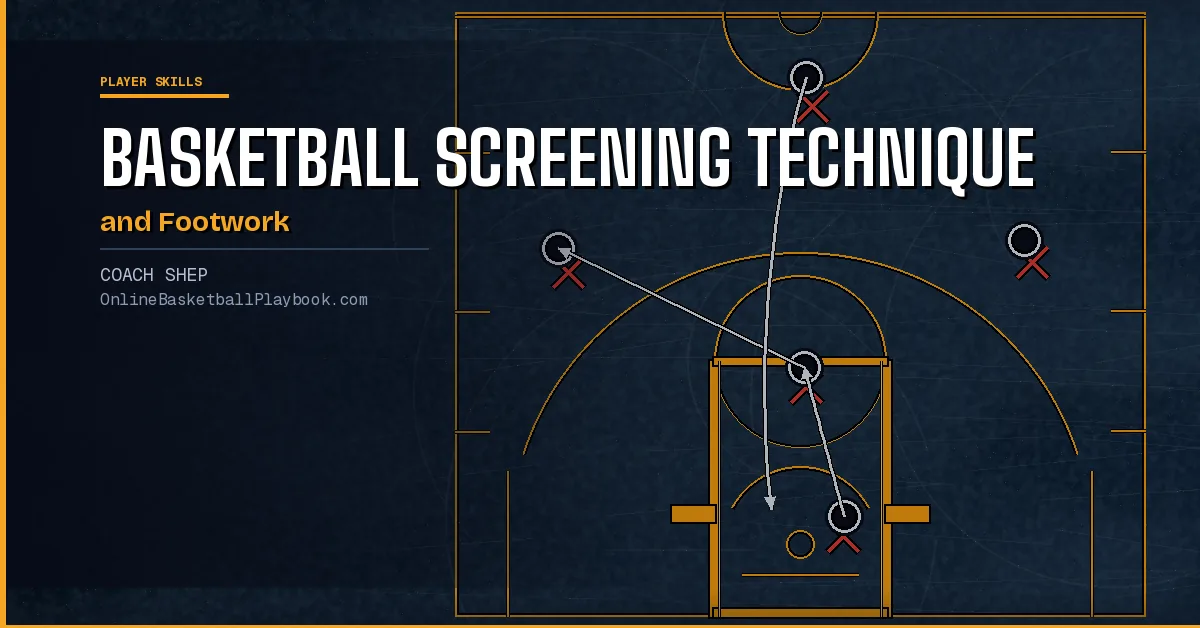
A good screen is not just a pick. It is a decision. The angle you set, the foot you pivot on, and the read you make after contact determine whether your offense scores or stalls.
Why Screening Fundamentals Win Games
Most coaches teach the ball screen as a play. The great ones teach it as a two-player read system. When your screener and your ball-handler are both making decisions off the same defensive cues, you have an offense that the defense cannot stop with one adjustment. When only the ball-handler is reading, you have a play, and a decent defender takes it away.
The difference between those two things lives in the details: how the screen is angled, which foot the screener pivots on, and whether the screener is reading the defense before making contact or after. These are teachable fundamentals. They do not require elite athleticism. They require reps, correct language, and a coach who has organized the reads into a system the players can call in real time.
This guide lays out the core principles of screening technique and footwork, organized around the reads that make each mechanical detail matter. By the end you will have a complete framework, from screener alignment to ball-handler counters to a drill progression, that you can install in your program this week.
The Screening Angle Rule Every Coach Teaches Wrong
The single most common screening error at every level is the North-South screen, a vertical screen body that effectively narrows the ball-handler's path and gives the defender room to recover. Brad Stevens, during a Butler coaching clinic, made this explicit: the screening angle must be East-West, not North-South. A flat, horizontal screen surface gives the ball-handler maximum room to come off with speed and angle.
A vertical screen angle does the opposite. It walls off one side of the floor without truly opening the other. The defender can shade behind or in front and still recover before the ball-handler turns the corner. The horizontal screen forces the defender into a clear choice: fight over the top or go under, and whichever choice is made, the ball-handler has a named read waiting.
Teaching the East-West Cue
The cue is simple enough to call from the bench in real time. Tell your screeners: "Set the screen East-West." At practice, mark the direction with a line or a cone. The goal is that the screener's body is perpendicular to the ball-handler's path, not parallel to it. Spend one full practice drilling this angle before adding any reads. Once it is automatic, the rest of the system builds on top of it.
A second related cue: the screener should be "low and wide" before setting the screen. Wide base lowers the center of gravity and makes the screener harder to push through. Low keeps the screen legal and sturdy. These two body-position cues: low-and-wide base, East-West angle, are the foundation everything else rests on.
Screener Footwork: The Pivot, the Roll, and the Pop
Once the screen is set, the screener's job is not over. It has barely started. The screener's footwork after contact determines which of six options he executes. The simplest framework teaches three: roll, pop, or slip. A more complete framework, used by elite programs and sourced from Basketball Immersion coaching materials, identifies six distinct screener actions. Understanding all six gives your players options for every defensive look they face.
The Roll
The roll is the default option when the defense shows a contain or hedge. The screener pivots on the inside foot, the foot closest to the defender, and sprints aggressively to the rim. Brad Stevens' coaching note here is direct: the roll is committed and aggressive, with no pausing to wait for the ball. A roll man who hesitates gives the defense time to recover and switch assignments. The sprint to the rim is what creates the gap.
Footwork on the pivot matters. The inside foot is the anchor. The outside foot swings wide and drives toward the basket. This motion naturally opens the screener's chest toward the ball, which is exactly where the catch needs to happen. Screeners who pivot on the wrong foot often end up with their back to the ball, a mechanical error that turns a great roll into a difficult catch.
The Pop
The pop is the screener's answer when the defense switches or sags. Instead of rolling to the rim, the screener opens to the wing or arc and presents for a pass. For programs with versatile bigs who can shoot from the perimeter, the pop is self-defeating for the defense on a switch: a smaller guard is now matched up against a big who can shoot threes, and no help adjustment compensates for that. The Florida Spread system built this principle in explicitly. The pop to three is the built-in switch counter, requiring no separate play call.
The Slip
The slip fires before the screen is fully set. The screener reads the defender's stance. If the defender is already showing a high hedge, the screener slips to the basket before making contact. This is a pre-read, not a post-read. The Florida Spread coaching material describes it this way: the slip fires on the defender's stance, not on the coverage call. Waiting for the screen to be fully hedged costs a half-second; reading the defender's body position early gets to the basket before the help can arrive.
One eight-way taxonomy also names this read explicitly as "early slip" and notes that it mirrors the Florida Spread principle exactly. The same concept, named and drilled in two different elite systems. When two separate high-level programs arrive at the same read, it is worth teaching.
The Short Roll, Re-Screen, and Flare
Three additional screener options complete the picture. The short roll holds position at the elbow or mid-post to create a triangle with the ball-handler, useful when both the rim and the pop are covered. The re-screen loops the screener back to set a second screen when the first is disrupted; this forces the defense to adjust twice and is a zero-cost habit that every screener should default to after a broken action. The flare sends the screener out to the three-point line when the roll is covered and his defender has committed to stopping the drive. The screener becomes an outlet rather than a cutter.
Ball-Handler Reads Off the Screen
The ball-handler's job off the screen is to come off at the level of the screen, not higher, not lower. This is Stevens' "ball-handler level rule." Coming off higher than the screen kicks out the angle and lets the defender recover. Coming off lower gives the defender the baseline. At the level of the screen, the ball-handler is in the optimal read position with maximum options.
From that position, one ball-screen taxonomy identifies eight distinct reads, all named and drilled separately. The goal is that guards recognize which situation they are in and execute the matching read, not default to one move regardless of coverage. Here are the eight reads organized for coaching:
The Eight Ball-Handler Reads
Turn corner. The standard go-over. The defender goes over the screen, the rim is open, the ball-handler drives off the screener's hip and attacks downhill. This is the base read everything else branches from.
Hesitate. The ball-handler slows the dribble coming off the screen to freeze the defender mid-recovery, then accelerates once the defender commits. Effective when coverage is late and the defender is close enough to be frozen by a pause but not close enough to contest cleanly.
Split hedge. When both defenders hedge, the ball-handler threads the dribble between the hedging big and the trailing on-ball defender. Requires a tight, controlled dribble and a commitment to going through the gap rather than around it. Underused at most levels because it demands practice. And that is exactly why it works when it is drilled.
Fake split. Sell the split move to collapse the hedge, then kick the ball to the open cutter or corner as the defense collapses. Turns defensive overreaction into an advantage pass.
Reject. The defender shades hard toward the screen side; the ball-handler abandons the screen entirely and attacks the opposite direction. Also called "going away from the screen." Forces the defense to recover to a completely different side of the floor.
Shoot behind. The ball-handler pulls up and uses the screen as a legal pick on the trailing defender. Works when the on-ball defender is trailing close enough to be screened on a pull-up jump shot.
Re-screen. When the first screen is disrupted, the ball-handler circles back and the screener re-sets. Keeps the action alive and forces the defense to make a second adjustment without a recovery interval.
Early slip. The screener reads the defender's stance and slips before contact. The ball-handler must recognize the slip is coming and deliver the pass on time, before the defense can rotate.
Reading the Defense: Coverage-Specific Counters
Elite programs do not teach their guards to "read the screen" in a general sense. They teach guards to identify which of several specific defensive coverages they are facing and execute the named counter for that coverage. A Brad Stevens clinic gave each coverage a specific offensive answer, comparable to the eight-way taxonomy but framed from a sideline-calling perspective with shorter verbal cues.
Hard Hedge
The hard hedge sends two defenders to cut off the ball-handler above the three-point line. Stevens' primary answer: "Fire the dribble back to the screener's butt" because the handler physically splits between the hedging big and the trailing on-ball defender. Both defenders are out of position; the lane opens. The verbal cue "fire the dribble to the screener's butt" is the clearest single-sentence description for beating a hard hedge, and it is precise enough to call from the sideline.
An alternative answer to the hard hedge is the hesitate-and-go: use a change of pace to freeze the hedger, then accelerate once he commits. This works when the gap between the two defenders is narrower than ideal for a split.
Drag Hedge
The drag hedge is more patient than the hard hedge, the big lingers rather than jumping aggressively. Stevens' counter is a patience read rather than a speed read: "Attack the hedge man's outside shoulder, drag the hedge, rip and pass back with outside hand, screener opens to the ball." The ball-handler waits for the hedger to over-commit before delivering the pass. Rushing the pass here is the mistake; the read requires waiting.
Reject and Soft Hedge
When the defender jumps under the screen early, the ball-handler abandons the screen and the screener loops behind the ball-handler to the wing for a kick-out. Stevens calls this the "Reject Screen, screener loops to wing." The ball-handler looks baseline drift and extra passes.
Against a soft hedge, the best shooter posts in the spot the help defender just vacated. Stevens' note: "Defender cannot help on roll man." The soft-hedge coverage over-commits to one threat. Exploit the spot they just left. This is the Soft Hedge to Post read.
Drop Coverage
When the big drops under the screen, the ball screen action is effectively over and the read becomes one-on-one. The Euro ball screen read tree from Basketball Immersion names this directly: "Drop coverage, it becomes 1-on-1 vs. the dropped big. Attack him in space." Do not continue the pick-and-roll choreography. Recognize the drop, and attack the defender in the space they gave up.
Installing the Reads: Progression Drills
Knowing the reads in a playbook is different from executing them in a game. The Iowa coaching staff's progression, sourced from Akser, moves players from naming to decision-making in four stages, and the stages matter. Skipping to competitive play before players can name the reads produces athletes who look unsure and default to one move.
Stage 1: Two-on-Zero, Naming the Read
The ball-handler and screener walk through each of the eight reads with no defender present. The screener sets the screen; the coach calls the read by name; the ball-handler executes. The purpose is fluency with the vocabulary. Players who can say "I'm in a hesitate-and-go situation" make faster decisions than players running one default move. Do this until every player can identify each read by name without prompting.
Stage 2: Two-on-Zero, Screener Cues the Read
Same structure, but now the screener communicates a cue ("high hedge," "soft," "switch") and the ball-handler selects the matching read independently. This bridges vocabulary to decision-making without the cognitive load of a live defender.
Stage 3: Two-on-Two with Defender Cues
Defenders play specific coverages on command, and coach tells the defenders which coverage to show before the action. Ball-handler and screener must identify the coverage and execute the right read in real time. This is the critical stage. Most programs jump here too fast; the earlier stages make this one productive rather than chaotic.
Stage 4: Live Two-on-Two
Defenders choose their own coverage. Ball-handler and screener execute from the full read menu. After each possession, the ball-handler names the coverage they saw and the read they selected. The verbal debrief is not optional. It builds the habit of reading before reacting that carries into five-on-five.
The Minnesota Timberwolves coaching staff built one of the most transferable screener habits in their practice structure: after any disrupted ball screen, the screener turns and immediately re-screens at a better angle. They call it the re-screen rule. Coaching it as a default, not a called option, means it happens automatically when the first screen is blown up. It costs nothing, creates a second defensive adjustment, and turns a failed action into a live read. Install it as a rule, not a play call, and your screeners will use it without prompting.
Coaching Application for High School Programs
High school programs do not need to teach all eight ball-handler reads and all six screener options in week one. The effective sequence is to build the foundation, screening angle, footwork, and three screener actions, then layer in the named reads as your players demonstrate fluency at each stage.
Start with Stevens' six named coverage counters as your guard vocabulary. They are short enough to call from the bench: "Split," "Hesitate," "Drag," "Reject," "Soft," one word, one action. Guards who can hear the call and execute it without stopping to think have a real competitive edge over guards who improvise on every possession.
For screeners, start with the three core answers: hedge means slip, contain means roll, switch means pop. Once players understand those three decisions, add the re-screen as a default habit on any disrupted action. The short roll and flare can come later as players develop within the system.
The corner lift is the spacing rule that makes all of this work at the five-on-five level. When the ball-handler uses a wing pick-and-roll, the corner guard automatically lifts into the vacated spot. This is a rule, not a read. It should require no decision. The Florida Spread builds it in as non-negotiable: a replacement shooter is always available after every drive, which means the possession does not die on a stopped ball screen. Teach the corner lift explicitly in your first ball-screen installation session and repeat it until it is automatic.
One additional rule for programs facing pressure defenses: give every ball-screen possession a blitz counter. The basic structure is simple. On a hard double team, throw back to the corner and have a cutter "slice" to the rim. Named and drilled, this counter removes panic from the ball-handler when the blitz comes. Without it, a good double team forces a turnover or a bad shot. With it, the blitz becomes a mistake that the offense converts.
Finally, teach the cut-after-pickup rule for broken-down possessions. When the ball-handler picks up his dribble in the downhill scoring area, the spacing rule is: two cutters cut to the rim first, three players fill back out to the perimeter. This prevents the possession from dying on a stopped drive. Most programs leave this implicit and watch the offense go flat whenever the drive is stopped. Making it explicit, "if you pick it up in the scoring area, two cut first, three fill," keeps the action moving without requiring a new play call.
- East-West screening angle: Drill the horizontal screen surface until it is automatic before teaching any reads. A North-South screen kills every read that depends on it.
- Low-and-wide screener base: Require a wide, low stance before every screen. This cue is repeatable in practice and correctable in real time. It is the physical foundation for a legal, sturdy screen.
- Inside-foot pivot on the roll: The screener pivots on the foot closest to the defender and sprints, no hesitation, no waiting for the ball. Commit to the rim and the pass arrives.
- Pre-read slip on the high hedge: Train screeners to read the defender's stance before contact. A high hedge read fires the slip before the screen is set. It is faster than any post-contact adjustment.
- Six named guard reads as bench vocabulary: "Split," "Hesitate," "Drag," "Reject," "Soft," "Re-screen," one-word calls the guard executes without deliberating. Build this vocabulary before competitive play.
- Corner lift as a non-negotiable rule: The ball-side corner guard lifts into the vacated spot on every wing pick-and-roll. No decision required. It is automatic, and it keeps a replacement shooter available on every possession.
- Re-screen as screener default: Any disrupted first screen triggers an immediate re-set at a better angle. Coaching it as a rule rather than an option means it happens without a call, and the defense has to adjust twice.
Want more basketball coaching strategies, drills, and tools?
Join the Online Basketball Playbook newsletter →
Draw this play free in the play drawer →
Membership: the full library, playbook packs, and Pro drawing tools →
Keep Building
Related breakdowns
Basketball Quick Hitters: 25 Sets by Action and Formation
Basketball quick hitters sorted by the action you want, catch-and-shoot to post feed, with each set's formation, diagrams, the read and the counter.
Princeton Offense Drills: Breakdowns, Shooting and Live Reps
Princeton offense drills that teach the reads: spacing, backdoor and hand-off breakdowns, 3-0 Chin and wave drills, Point shooting, a drive drill and an install.
Four Corners Offense Basketball: Roles, Rules and Versions
Four corners offense basketball: the set, the chaser, the corner and post rules, three versions, when to run it, the shots it hunts and shot clock limits by level.