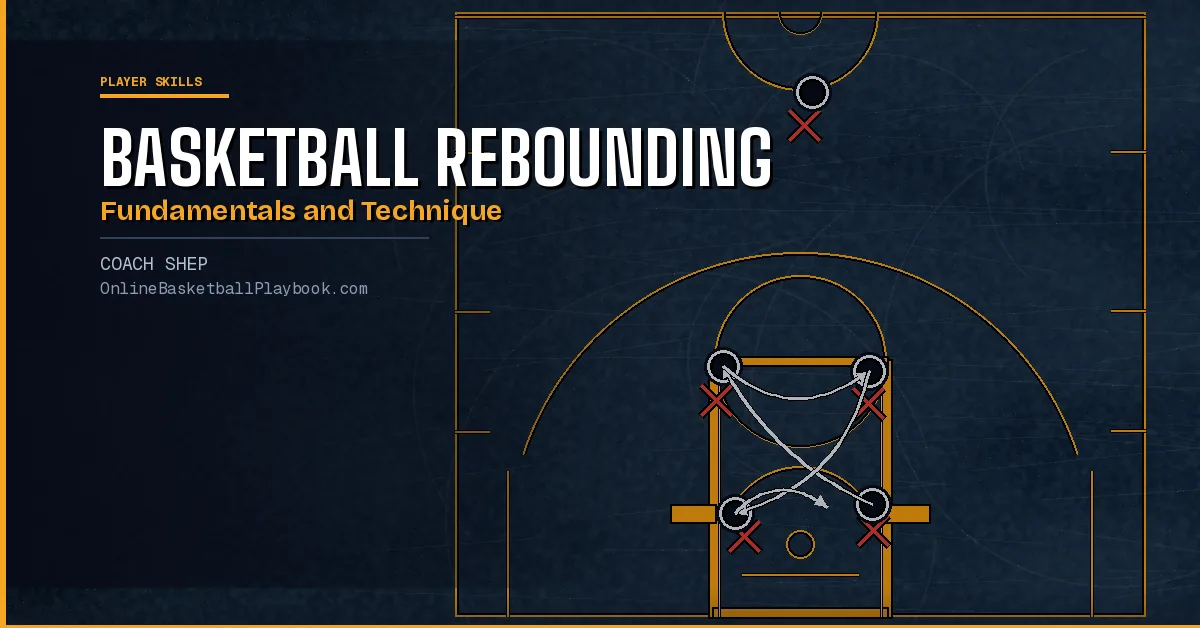
Rebounding is the one skill that changes possession math every single game. Master the box-out, read the ball, and compete for every missed shot. And your team wins more without adding a single play to your playbook.
Why Rebounding Wins Games
Walk through any film session from a losing game and you will almost always find a rebounding gap somewhere in the footage. Missed box-outs, bodies standing still when the ball hits the rim, guards watching instead of pursuing. These moments cost possessions, and possessions cost games.
The math is direct. A defensive rebound ends the opponent's possession. An offensive rebound extends yours. When your team grabs five additional offensive boards in a game, you're effectively adding five possessions for free (no turnovers forced, no steals required). Five possessions, against an average offense, is worth roughly five to eight points. That's often the margin of the game.
David Richman's program standard at NDSU frames it cleanly: the goal is to win 65 of 100 possessions in a game. Rebounding is the possession lever your players control entirely through effort and technique. No special talent required, no scheme advantage needed. A well-coached, undersized team that boxes out every shot can outrebound a taller, more talented opponent that doesn't.
That's the opportunity rebounding gives your program. Effort, positioning, and discipline convert directly into extra chances on offense and stops on defense. No other skill on the court has that clean of a conversion rate from preparation to outcome.
The Box-Out: Foundation of Every Rebound
Every strong rebounding program starts in the same place. The box-out. Technique here is not optional. A player who can't box out consistently will get outworked by a less athletic opponent who knows how to use their body correctly.
The Mechanics of a Sound Box-Out
The sequence is three steps. First, locate your man before the shot goes up. When the shot leaves the shooter's hands, your eyes should already be on the offensive player you're responsible for, not on the ball. Most players do the opposite. They watch the ball and lose their man. That's a habit you can correct in practice, but only if you name it and drill it.
Second, make contact before they move. The moment the shot is released, step into your man's path and establish contact with your body. This doesn't mean pushing. It means positioning. You're using your backside and arms to feel where the offensive player is and prevent them from getting to the ball's landing zone ahead of you.
Third, hold the position. Spread your base wide (feet shoulder-width or slightly wider), keep your knees bent, your backside low, and your arms angled out. You're creating the widest surface area possible. The offensive player has to go around you, not through you. Make them earn every inch.
The hands go up when you release to pursue the ball, not before. Players who reach for the ball while they still have a man to box out almost always lose body position at the critical moment. Finish the box-out first, then go get the ball.
Common Box-Out Mistakes
The two most common failures are watching the ball before making contact and releasing the box-out too early. Both happen because players are eager to go get the ball. Use this cue in practice: tell your players their job is not to get the rebound. Their job is to get their man. If they get their man, the rebound tends to follow. Framing it that way keeps their focus on the right sequence.
A third mistake worth drilling out: jumping without a target. Players who leap toward the ball without knowing where it's going often collide with teammates, leave the floor at the wrong time, and come down empty. Teach your players to read the arc and decide before they jump.
Defensive Rebounding Positioning and Pursuit
Defensive rebounding is a team discipline, not an individual one. The goal is to have all five defenders account for all five offensive players on every shot. No one slips through uncovered. That sounds simple. Executing it consistently under game pressure is where teams separate.
Zone of Responsibility
Every player on the floor has a zone of responsibility the instant a shot goes up. Guards tend to assume rebounding is only a frontcourt job. That assumption costs you possessions on every long rebound and every skip-out situation where the ball lands at three-point range. Your guards need to sprint back toward their own man on a shot. And if they're not near anyone on the ball side, they need to be tracking the long rebound path.
In man-to-man defense, the assignment is clear: every defender boxes out the player they're guarding. In zone defense, it's a geographic responsibility. Each defender owns the nearest offensive player in their area when the shot goes up. The principle doesn't change; only the trigger for who you're finding is different.
The Pursuit Step
Once the box-out is set and the ball is in the air, the pursuit step is what separates good rebounders from great ones. Don't wait for the ball to come to you. When you release from your box-out, take an aggressive first step toward the ball's trajectory. Players who stand in their box-out spot and hope the ball finds them are at the mercy of a random bounce. Players who pursue after securing their man create opportunities.
Teach your players to read the arc early. A flat shot tends to produce a hard, long bounce. A high-arc shot tends to come down more softly and closer to the rim. A shot from the corner kicks out to the weak side at a predictable angle. These are trainable reads. Your players can learn them in film and reinforce them in live-ball drill work.
Offensive Rebounding: Crashing the Glass
Offensive rebounding requires a different mindset than defensive rebounding. On defense, you have a man to find first. On offense, you're already in motion. Your job is to get to a piece of the floor before the defense can establish position.
Crashing Angles
Players who crash straight to the basket are easy to box out. Players who crash at angles (cutting behind a defender or going opposite their initial path) create problems for the defense. Teach your players to read which side of the floor is weak-side and attack it hard. A shot from the left wing has a predictable kick-out to the right block and the right elbow. The first player to that spot gets the live ball or the second-chance opportunity.
Timing is the other variable. Offensive rebounders who leave the floor too early are easy to push away from the ball. Players who hesitate (watching the ball instead of moving) are already beaten by the time the ball comes off the rim. The read is: shot up, immediately decide whether to crash or convert to defense, then execute that decision at full speed.
Tip-Outs and Securing the Ball
Not every offensive rebound leads to a clean catch. When you can't secure the ball with two hands, tapping it out to a teammate in a better position is the correct play. Teach your players that a controlled tip counts the same as a caught rebound if it produces a possession. What doesn't count, and what you should drill out of them, is a wild tip that goes out of bounds or back to the defense.
When you do secure the ball with two hands, protect it at chin level before you make any decision. Chin it. Don't bring it down to your waist. That's where it gets stripped. Once you've secured and chinned the ball, you have a power move to the basket, a kick-out to the perimeter, or a timeout call. All three are good options. Giving it back to the defense is not.
Reading the Ball: Anticipation and Timing
Elite rebounders don't get more boards because they jump higher. Most often, they get more boards because they jump at the right time toward the right spot. That's a skill you can teach, and it starts with training your players to read the shot before it reaches the rim.
Arc and Angle Cues
The angle of the shot tells you the likely landing zone. Long shots from the perimeter produce longer rebounds. Shots from the corners tend to kick perpendicular to the baseline. Mid-range shots produce shorter, more vertical bounces. Bank shots stay low and close to the backboard.
Build these reads into your drill work. Run your rebounding drills from multiple spots on the floor and have players practice reading the shot trajectory before the ball reaches the rim. Give them feedback on whether their positioning matched the actual landing zone. Over time, these reads become automatic.
Timing the Jump
Jumping early is the single most common timing mistake in rebounding. Players who jump the moment the ball hits the rim are already descending when the ball arrives at catch height. The correct timing is to read the ball off the rim, take your pursuit step, and jump as the ball is coming down to meet it, not after it's already bouncing away.
A useful cue: jump through the ball, not at it. Your trajectory should carry you forward and up toward the ball's path, not straight up underneath where it was. This adjustment alone will increase your players' effective rebounding radius without any change in athleticism.
Rebounding Drills That Build Game-Ready Habits
Every rebounding drill should simulate game pressure. Drilling in a cooperative setting (where no one is fighting for the ball) builds form but not competitive instincts. Your practice environment needs to make rebounding hard, contested, and consequential.
1-on-1 Box-Out Drill
The coach shoots (or tosses) the ball. The defender must find their man, make contact, and hold the box-out. The offensive player attempts to get to the ball. Score a point for the defender who secures the rebound, a point for the offensive player who gets it. Run it as a competition with stakes. Winners stay on the floor, losers sub out. Stakes in practice transfer to composure in games.
3-on-3 Rebounding Competition
Divide the team into two three-person groups. The coach shoots from the perimeter. Both groups fight for the rebound. The team that secures possession gets to shoot. First team to score five baskets wins. This drill develops communication between teammates, simultaneous box-out responsibility, and the transition from defensive rebound to outlet pass, all in one competitive sequence.
Tipped Ball Drill
Stand under the basket and throw the ball off the backboard. Players must tip or catch the ball and score before it hits the ground again. Increase difficulty by throwing the ball harder or from more extreme angles. This builds hand strength, timing, body control around the basket, and the confidence to finish in traffic, all attributes that translate directly to offensive rebounding in games.
Outlet Drill
Pair players at each basket. One secures a defensive rebound, chins the ball, pivots away from pressure, and hits the outlet. The receiving player catches, turns, and pushes the pace. This drill makes defensive rebounding feel complete, not just catching the ball but launching the break. Players who practice the full sequence become more decisive rebounders because they know exactly what to do with the ball after they get it.
Add a scoreboard to every rebounding drill and you will see competitive intensity double within a week. Players rise to meet the standard of what's being measured. If you track rebounding effort, technique, and possession wins in practice the same way you track points and assists, your team's rebounding will improve faster than any amount of instruction alone can achieve.
The Mental Edge: Rebounding as Effort and Identity
Every technical skill in this guide can be taught in a week of focused practice. What takes longer, and what separates teams that rebound well from teams that don't, is the mental identity that players carry toward rebounding. Do your players believe rebounding is their job? Do they take it personally when an opponent gets an offensive board on their side? Do they hold each other accountable on box-outs in practice?
Culture matters here as much as technique. Coaches who treat rebounding as a footnote in practice will find their teams treating it as a footnote in games. Coaches who make rebounding a measurable, competitive, non-negotiable part of every practice build teams that rebound under pressure as a reflex, not as a reminder.
Make Rebounding Visible
Track it. Post it. Celebrate it. Not just total rebounds: track box-outs completed, offensive boards generated, and long rebounds pursued. When your players see rebounding metrics on the same board as points and assists, they start to compete for it the same way. Role players who will never lead the team in scoring can lead the team in box-outs. Give them that identity.
Hold the Standard Every Day
Obradovic's principle applies directly here: non-negotiables only work if they're enforced every single day, not when the coach feels like it. If a player skips a box-out in practice and it's not corrected, you've made that a negotiable. Call it. Run it again. Make the expectation clear and keep it clear, from the first practice of the season through the last game. The players who internalize that standard are the ones who rebound when the game is on the line in February.
Peer Accountability
The most effective rebounding programs don't rely on the coach to catch every missed box-out. They build a player culture where teammates correct each other. When a defender misses a box-out and gives up an offensive rebound, teammates should say something, not to embarrass, but because it matters. That peer expectation is more powerful than any coaching correction, because it means players are holding the standard whether or not the coach is watching.
Build this by modeling it. When you correct a missed box-out, ask the player who was nearest: "Did you see that? What should have happened there?" Turn the correction into a team conversation. Over time, players start asking each other those questions without waiting for you to prompt them.
Rebounding as Program Identity
The programs that consistently win the rebounding battle share one trait: rebounding is treated as an identity, not a statistic. It's in the language coaches use, in the drills that make up practice, in what gets celebrated after wins and examined after losses. When your players introduce themselves as a team that competes on the glass (and mean it), the technical skills you've taught them have something to anchor to.
That's the level this work is aiming for. Technique gives players the tools. Identity gives them the reason to use those tools when they're tired, down ten points, playing against someone taller, and the ball comes off the rim with fifteen seconds left. That's when rebounding culture wins games that X's and O's alone cannot.
- Every shot up, every player finds their man first (eyes off the ball, onto your assignment) before releasing to pursue the rebound.
- Box-out with your backside and a wide base, feet shoulder-width apart, knees bent, arms angled out to create maximum surface area and hold position.
- Read the shot arc before jumping: flat shot means long bounce, high arc means short drop. And time your pursuit step to meet the ball coming down, not after it bounces away.
- Crash offensive boards at angles, not straight-line, to avoid easy box-outs; attack the weak side where the defense is softer on kick-out shots.
- Secure every rebound with two hands at chin level before making any decision. Do not bring the ball to waist height where it gets stripped.
- Track box-outs and offensive boards in every practice with a visible scoreboard; what gets measured gets competed for.
- Build peer accountability by asking the nearest player (not just the one who missed) what should have happened after every missed box-out in practice.
Want more basketball coaching strategies, drills, and tools?
Join the Online Basketball Playbook newsletter →
Draw this play free in the play drawer →
Membership: the full library, playbook packs, and Pro drawing tools →
Keep Building
Related breakdowns
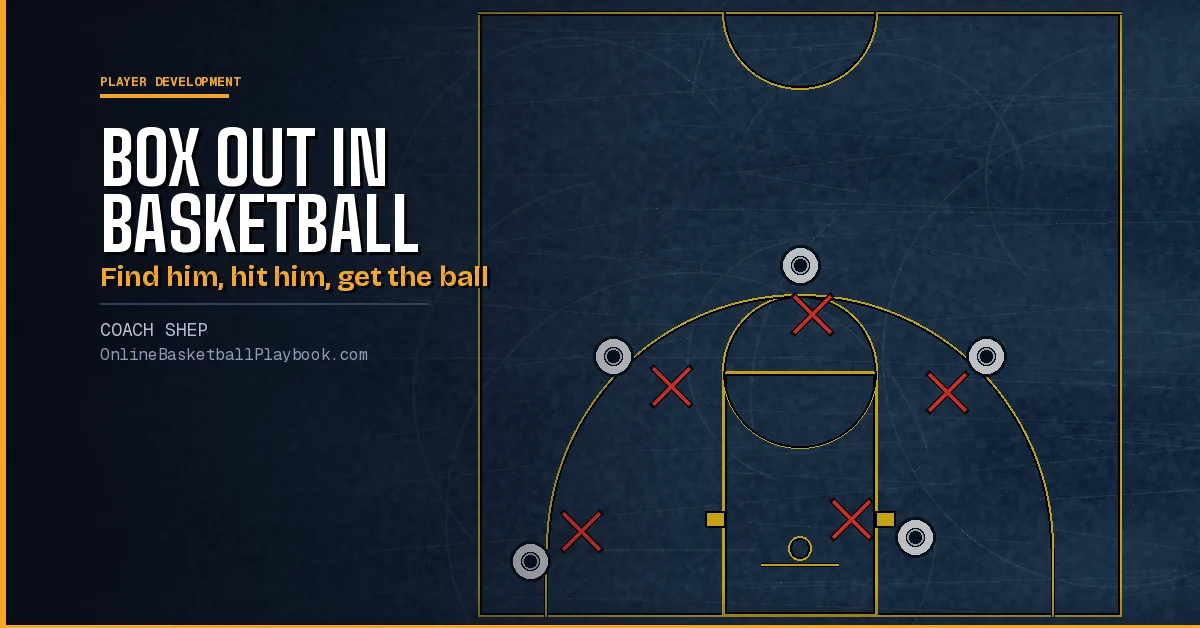
Box Out in Basketball: Technique and Drills
How to box out in basketball: find, hit and get, contact before the turn, where coaches split on hold or go, free throws, the zone triangle and the drills.
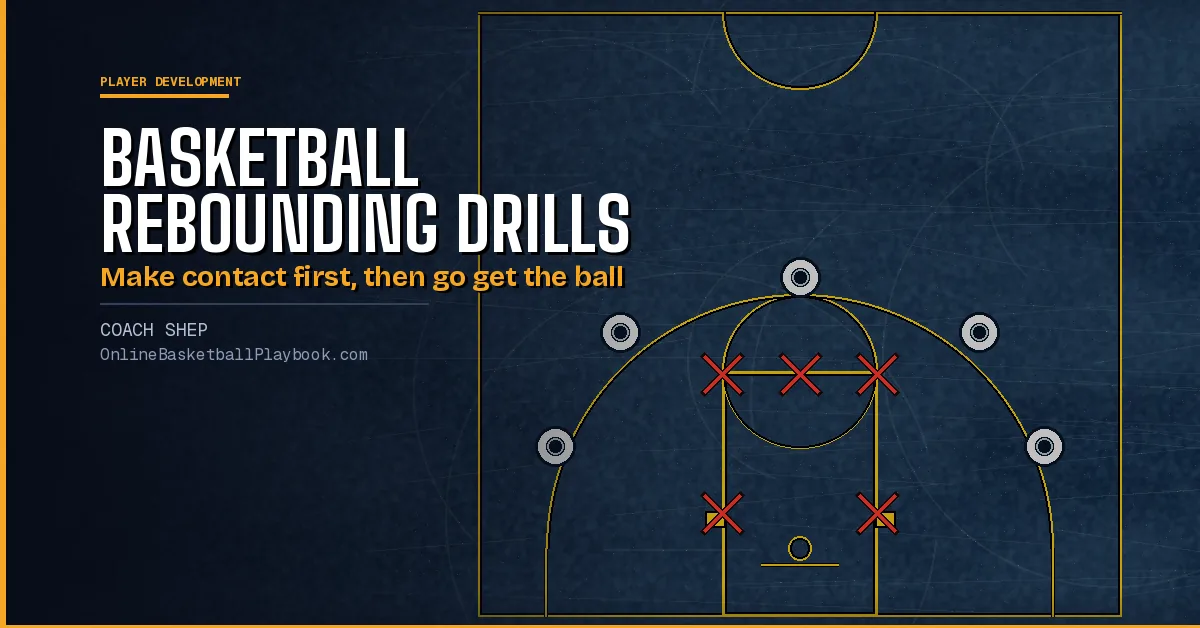
Basketball Rebounding Drills for Every Age and Level
Basketball rebounding drills from technique and box-out circles to scored small-group games, War drill and youth drills, with the goals and rules coaches attach.
Basketball Passing Fundamentals and Drills
Basketball Passing Fundamentals and Drills