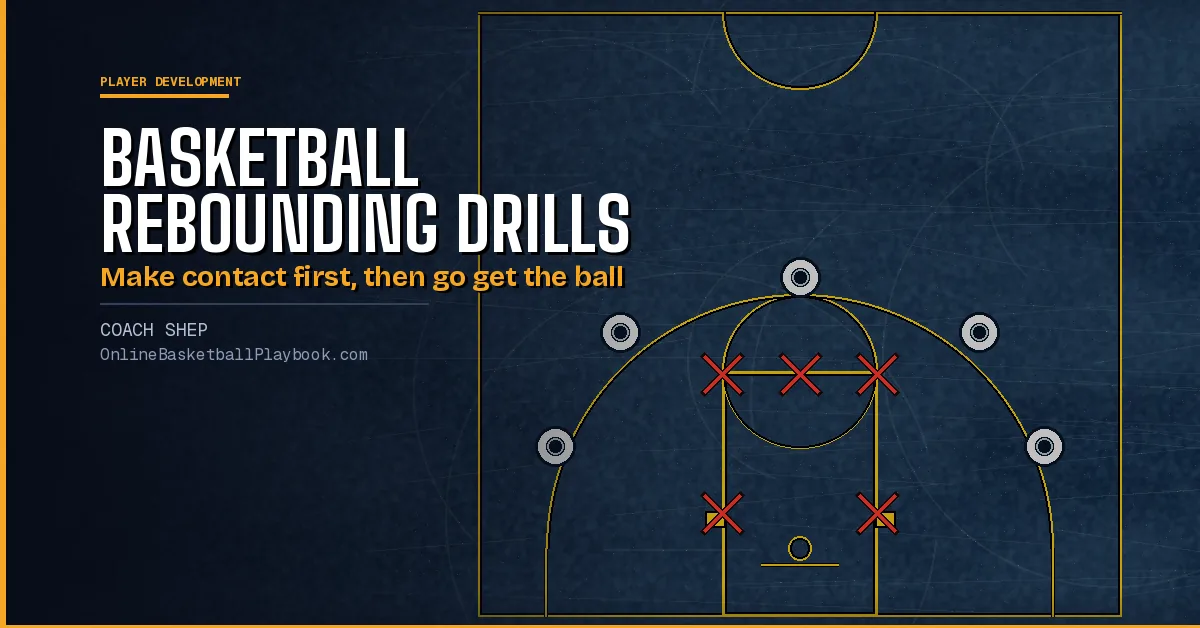
Basketball rebounding drills train the three things a rebound needs, finding a player during the flight of the shot, making contact first and then going to get the ball. This guide sorts the drills by stage, from technique work with no shot to scored games and full-team drills, and adds youth basketball rebounding drills.
Where drills differ, each is listed, because the hold times, the scoring and the technique are not the same everywhere.
The Three Steps Every Basketball Rebounding Drill Trains
Find an opponent while the shot is in the air, hit him, then get the ball.
- Find, Hit, Get. Players find an opponent as soon as a shot is released, make contact with him and then secure the ball with two hands.
- Battle near the key. The defender battles for front position and boxes out.
- Use a forearm on the perimeter. A perimeter defender uses a forearm to stop the offensive player from sprinting in, because leaning back into him leaves the defender in a poor stance to pursue the ball.
- Block out, pursue, chin, rebound, outlet. The same sequence in other words.
- Use the flight time. The window to take position is the two to three seconds of flight time between the release and a reboundable ball.
| Stage | Drills |
|---|---|
| Technique, no shot | Rebounding Technique, guard the ball circle, circle box-out, Team Box Out |
| Small group with a score | 2-on-2 with immunity, 1v2, Battle Boards, Slide Rebounding, Rack Up, Seesaw, Let It Bounce |
| Full team | War drill, 5 on 3 Wedge, 3 Consecutive Rebounds, Rebound Scrimmage |
| Into transition | Rebound-Outlet-Break, battle-and-outlet run, UCLA drill |
| Youth | Rebounding Technique, five-second contact box out, outlet drill with a "shot" call |
For the technique itself see Box Out in Basketball and Basketball Rebounding Fundamentals. For the offensive side see Offensive Rebounding Drills and How to Defend the Offensive Rebound. More box-out drills are on Box Out Drills. Take the position before the ball comes down.
Rebounding Drills With No Shot: Technique and Hold Time
Rebounding Technique. Two lines stand on opposite sides of the backboard. The first player passes off the backboard to himself, jumps as high as he can, takes the ball with two hands and grips it under the chin with elbows out. After landing he front pivots with the outside foot and passes to the line he came from before joining the other line.
Knees stay slightly bent with a wide stance, and the player does not rise out of the stance until after the pass. It is a good drill for all youth teams.
Guard the ball circle. Pairs of an offensive and a defensive player stand around the free-throw circle or the center circle with a ball in the middle. On the coach's call the offensive players try to reach the ball without pushing and the defenders make contact, get into position and keep them out for five seconds. Pairs switch roles every three to five turns. The drill runs from one-on-one up to five pairs. The coaching points:
- Face the defender.
- Bump him when he picks a side.
- Pivot into the box out. The backside goes in and the arms are wide.
- Stay low. Stay in constant contact.

The circle drill has several rules for how long the defender holds.
| Drill | Hold or count | Style |
|---|---|---|
| Guard the ball circle | Defender keeps the offense away for 5 seconds | Five-second keep-away |
| Box-Out Circle Drill, ten or twelve players paired by position at the free-throw circle | Hold the position for a count of five. A holding foul gives the offensive player a point | Paired-by-position hold |
| Circle Box-Out Drill, one on one at the jump circle | 3-second count. The offensive rebounder wins if he touches the ball within three seconds | Three-second touch |
| Team Box Out, inside and outside groups | Hold the box out for 3 full seconds before touching the center pole pad on the whistle | Team three-second hold |
Make the contact first, then hold it for the count.
Small-Group Rebounding Drills With a Score
Put a score on the rebound so the contact matters.
2-on-2 Rebounding. Two lines stand on either side of the free-throw lane. Up front in each line, one player defends the player behind him. An outlet player waits on each wing and a coach or manager shoots from the free-throw line. The defense boxes out, rebounds and outlets. Then the defenders move to the outlet spots and the old outlet players join the back of the offensive lines.
- Cap the offense at six seconds. Offensive possessions end at six seconds.
- Run a lap for a miss. If the defense fails to get the rebound, both defenders run a lap.
- Earn immunity. A team that scores on offense earns immunity that carries into its next turn on defense as long as it keeps rebounding, and an offensive rebound without a score earns nothing.

1v2 Rebounding. One offensive player starts at the free-throw line against two defenders at the blocks. On the shot both box out and the offensive player tries to get around them. The score is a ladder.
- Defense scores 1. The ball bounces twice.
- Offense scores 2, 1 or 3. 2 for touching it in the air, 1 for touching it after one bounce and 3 for an offensive rebound put-back.
Each team plays three minutes on each side.

- Battle Boards. One offensive and one defensive player stand on each high-post elbow and a coach or a player shoots. A defensive rebound earns the defense a point. An offensive rebound is a strike and three strikes switch the teams. Bigs may defend guards and guards bigs sometimes.
- Slide Rebounding. Four defenders slide side to side in the key against four offensive players outside the three-point line. The coach passes to a shooter and calls a defender's name. That defender boxes out the shooter and the other three must communicate who they box out. The defense scores by getting a set number of rebounds, usually three, or three in a row.
- Rack Up. A shooter at the top of the key shoots continuously while two teams of two battle for each rebound. A rebounding team scores a point and feeds the shooter again, racing to 10.
- Seesaw. After passing to a shooting wing, the passer sprints to box out the opposite wing who is crashing, and the roles rotate every possession.
- Let It Bounce. Four defenders try to hold box outs on four offensive players until a free-throw miss or make bounces on the floor.
- 3-Man PowerUp. Three players fight for a coach-shot rebound under the basket. Whoever gets it powers back up through the other two with no more than a one-bounce dribble adjustment.
- Rotating Defensive Rebound. Three defenders and three offensive players at each basket. On the coach's shot each defender rotates one basket to box out and rebound there.

Watch the physical play in these drills and call fouls when players push in the back.
Get the next coaching guide in your inbox
One email when a new guide or diagram set goes up. Free.
Team Rebounding Drills
War drill (credited to Tom Izzo). The defense begins with all five players inside the lane area. Two take the blocks, two take the elbows and one stands at the free-throw line. The offense starts on the perimeter arc. A coach, assistant or manager shoots from 12 to 17 feet and each defender must find and hit a body before going for the ball.
- Crash the boards. Every offensive player except the point guard crashes the boards and tries to score off an offensive rebound.
- Outlet and run. If the defense rebounds, it outlets and runs the fast break and can crash the offensive glass on any miss in that break.
- Reset. The drill ends when the defense secures the rebound and then resets.
- Chase every loose ball. There is no out of bounds.
- Score it. 1 point for a made basket, 1 for a defensive rebound, 2 for an offensive rebound, 1 for a steal and minus 1 for a turnover or a foul. It runs 10 minutes, 5 on offense and 5 on defense, or to 15, and the losers run.

- 5 on 3 Wedge. A bubble in the rim guarantees a miss. Three offensive rebounders work the blocks and the top of the key against five defenders, and a defensive rebound scores 1 and an offensive rebound scores 2.
- 3 Consecutive Rebounds (Tim Floyd). A rebounder must block out, rebound with two hands and complete the outlet three times in a row.
- Oversize ball drill. Pairs box out from the block against pairs starting at the elbow after a coach shot. The oversize ball pushes players to rebound with two hands.
- Rebound Scrimmage. A basket scores 2, an offensive rebound 3 and a foul 1, with the ball kept. It plays to 10 and the losers run.
Find a body and hit it before you go for the ball.
Rebounding Drills That Run Into Transition
Rebound-Outlet-Break. Two rebounders start on the blocks facing two shooters, with two outlet players, one defender and an entry passer. When the pass goes in, one rebounder calls "ball" and covers his man while the other denies the other shooter.
- Shoot and contest. The shooter shoots at once, the covering rebounder contests and yells "shot" and both hold their box outs until the ball hits the floor.
- Start the break. Whoever rebounds starts the break, one outlet player calls for the ball and the other sprints to the basket. The single defender drops back to stop the 2-on-1.
- Pay for a turnover. A turnover or a rebounder who lets a shooter get the offensive board runs two walls.
Battle-and-outlet run. Two players inside battle for a coach's shot until one scores. The scorer rebounds his own shot and outlets to a wing player, who dribbles the length of the floor and makes a layup, a midrange shot and a three before returning to the line. The next player in line challenges the loser.
UCLA drill. X1 closes out on a wing shooter, sprints to box out and rebound a second shooter's shot, speed dribbles the length of the floor, passes to a coach and finishes with a pull-up jumper at the free-throw line.
Rebound, outlet and run in one motion.
Youth Basketball Rebounding Drills
Youth teams can run the drills above with fewer players, a closer shot or a lower scoring target. Youth drills add their own.
- Rebounding Technique. The solo self-pass drill is a good fit for all youth teams.
- Five-second contact box out. It stresses contact with the offensive player and a five-second box out.
- Catch it at its highest point. Other youth drills teach catching the ball at its highest point with two hands and anticipating the angle, since shots from one side tend to come off on the other.
- Block out, hold, release. This drill teaches boxing out, holding the position and then being hungry for the ball, with the ball at chin level and elbows out. The outlet drill adds a defender who yells "shot," pivots and makes contact.
- The "shot" call and an L elbow. Defenders yell "shot," chop a shoulder and for younger players hold a 90-degree L with the elbow, then go get the ball. The youth War drill is a continuous 3 v 3 where a defensive rebound, a made shot or a steal triggers "WAR."
For age-based plans see Basketball Drills and Games for Kids and Fundamental Basketball Drills for Youth Players. Rebounding also fits inside Basketball Practice Plan blocks, and the finishing side is on Mikan Drill and Layup Drills. Keep the drills short and make every rep a contest.
Where Coaches Disagree
Coaches split on four questions.
How do you make the contact?
- Chest contact. Forearm or hand to the chest, then drop step and seal. Turning before contact lets the opponent step around you.
- Leg and hip first. Tim Floyd impedes with the leg and hip first, then goes for the ball.
Should all five box out?
- All five box out. Every defender boxes out, because one missed box-out wastes the other four.
- Inside only. Inside and near the key, box out. Perimeter defenders check with a forearm and go.
Crash or get back?
- Guard to half court. Tom Izzo's point guard runs to half court and everyone else goes to the paint.
- Guards split the floor. Bennett's point guard goes to the opposite free-throw line and the off guard to half court.
- Crash on a true 50/50 chance. Otherwise sprint back.
How is it scored?
- Two for an offensive board. 1 for a defensive board and 2 for an offensive board.
- A ladder. Up to 3 for an offensive put-back.
- Strikes. Three offensive rebounds switch the teams.
The crash-or-get-back choice decides how you set up the War drill and the transition drills, so choose it before the season and write it into rules that assign roles.
Want the printable playbook packs?
OBP Pro members get the premium playbook packs: the zone attack, out of bounds and practice plan PDFs, plus each new pack as it is finished. The membership page lists what is in each one. Or draw your own version free in PlayDraw.
See what OBP Pro includesQuestions Coaches Ask
What are the best rebounding drills for basketball?
For technique, Rebounding Technique, the guard the ball circle and the circle box-out. For competition, 2-on-2 with immunity, 1v2, Battle Boards and the War drill.
What are good youth basketball rebounding drills?
Rebounding Technique with a self-pass, the five-second contact box out, an outlet drill where the defender yells "shot" and makes contact, and a small-sided War drill.
What is the War drill in basketball?
A continuous five-on-five rebounding game where the defense starts in the paint and the offense crashes the boards. It is credited to Tom Izzo and scored by rebounds, steals and turnovers.
How long should a box-out be held in a drill?
It depends on the drill. The guard the ball circle and the paired circle drill use five seconds, and the one-on-one jump circle and Team Box Out use three.
What does Find, Hit, Get mean?
Find an opponent during the flight of the shot, hit him with contact and get the ball with two hands.
Do all five players box out?
Not always. Players near the key box out and perimeter players check with a forearm, so they can still pursue the ball.
More Guides From This Batch
- Floater Basketball: How to Shoot It and How to Teach It
- Flare Screen Basketball: How It Works, Reads and Counters
- Layup Drills for Every Level, From One Step to Full Court
- Basketball Dribbling Drills for Beginners and Other Basics
Back to Box Out in Basketball and every Player Development page.
Keep Building
Related breakdowns
Basketball Shooting Drills for Every Level
Basketball shooting drills for every level, from form work and youth games to team competitions and free throws, each with a score or a consequence.
Layup Drills for Every Level, From One Step to Full Court
Layup drills for youth and teams, from footwork and the Mikan drill to layup lines, full-court drills with a made-shot goal and finishing against a defender.
Taking Your Basketball Workout to the Next Level
Taking Your Basketball Workout to the Next Level