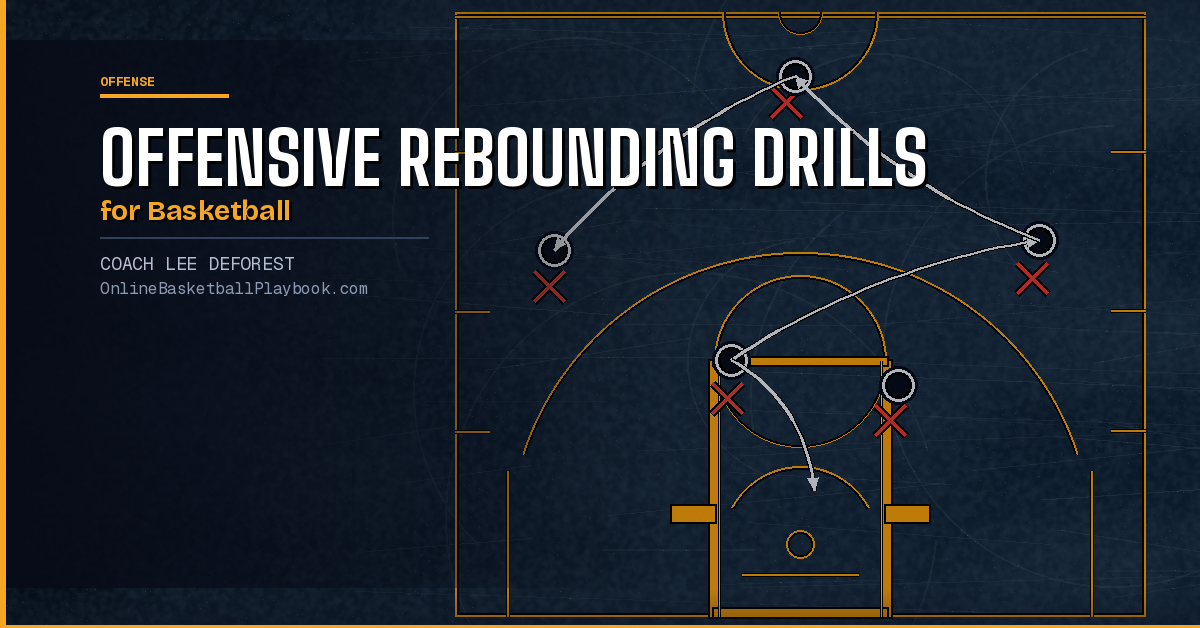

Offensive rebounding turns missed shots into points without running a single play. These drills teach your players where to go, how to pursue the ball, and how to finish strong when they get there.
Why Offensive Rebounding Wins Games
Every missed field goal attempt is a 50-50 possession fight. Teams that send multiple players to the offensive glass consistently generate more second-chance opportunities than teams that pull back on every miss. Over the course of a game, those extra possessions compound — a team that converts just three offensive rebounds into points per game has essentially added a foul-shot line's worth of scoring without generating a single additional shot creation from half-court offense.
The data at every level of basketball confirms what coaches have observed for decades: offensive rebound percentage is one of the highest-leverage stats a team can improve through deliberate practice. Unlike three-point shooting, which requires elite individual skill, offensive rebounding is largely a product of effort, positioning, and anticipation — traits any coach can develop with the right drills.
There is also a psychological dimension. A team that crashes the offensive glass signals toughness to its opponents. Defenders who must locate and box out a crasher every single possession wear down over four quarters. By the time the fourth quarter arrives, your offensive rebounders are getting to spots that were locked down in the first half, simply because the opposition is fatigued from the effort of blocking them out repeatedly.
Incorporating a dedicated offensive rebounding emphasis into your basketball practice plan pays dividends that carry far beyond second-chance points. Players who crash hard develop better feel for the game, learn to read shot trajectories, and compete for the ball rather than watching it. These habits transfer directly into basketball IQ development and a team-first mentality that affects every aspect of your program.
Positioning and Pursuit Fundamentals
Before drilling, players need a mental model of where missed shots tend to land and how to read them in real time. A missed shot from the right wing typically kicks left. A short miss from the elbow tends to die at the front of the rim. A deep air ball caroms long. Teaching players to read the arc and the shooter's body language before the ball leaves the hand is the foundational skill that separates average offensive rebounders from great ones.
The three primary crashing positions off any shot are the strong-side block, the weak-side block, and the high-post tip zone. Coaches should assign roles on every shot attempt during practice — not everyone crashes, but the crashers have specific destinations. The player designated to fill the strong-side block sprints directly at the backboard. The weak-side crasher takes a pursuit angle toward the opposite block, reading where the ball is going rather than going straight to a predetermined spot. The high-post player positions for tips and long caroms near the lane line extended.
Pursuit angles matter enormously. Players who run straight to the basket are easy to box out. Players who take pursuit angles — coming from outside-in — are far harder to contain because the defender must turn her body in a direction that compromises her balance. Teach your players to approach the glass from angles, not straight lines, and the box-out fundamentals that defenders drill all year become significantly less effective.
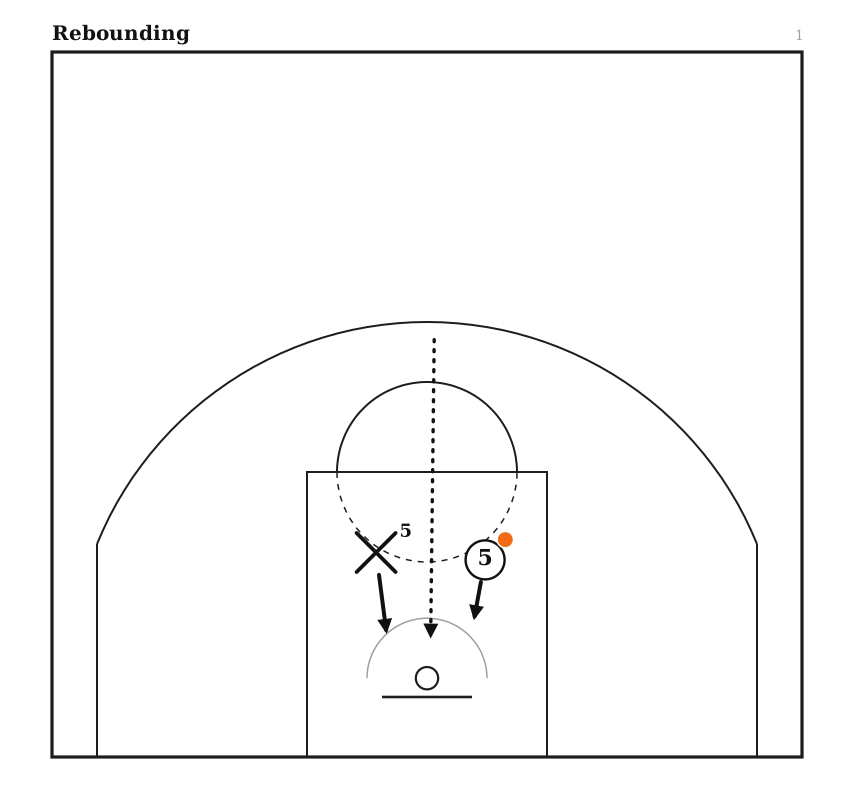
One critical and often overlooked element is the contact point. Offensive rebounders must make contact before going up. Watching for the defender to establish position and then pressing into that defender's lower back with a forearm seal — without pushing — shifts the defender's center of gravity forward and opens the path to the ball. This is legal, physical rebounding that refs expect at every level above youth basketball.
Individual Offensive Rebounding Drills
Mikan Series with Pursuit
The Mikan drill is typically taught as a finishing drill, but modified for offensive rebounding it becomes one of the best individual pursuit reps available. The player tosses the ball off the backboard to the opposite side, sprints beneath the basket, and finishes with the opposite hand on the other side. The key coaching point: the player must read where the ball is going and adjust her sprint path accordingly rather than running to a predetermined spot. The ball dictates the angle.
Progress from the standard Mikan into the Power Mikan — where the player catches the ball with two hands, lands on two feet simultaneously, and goes back up strong without resetting. This directly trains the power-layup mechanic that converts in traffic. Make sure players absorb contact by staying wide-based and keeping elbows out for protection without committing a foul.
Tip Drill
Player stands below the backboard on the left side, tosses the ball above the square, and tips it with the right hand back above the square. Repeat continuously for 10 reps, then switch sides. The goal is controlled tipping, not wild swings. Fingertip control, not palms. After 10 tips, the player catches, lands on two feet, and finishes with a power layup. This drill builds the hand-eye coordination and upper-body explosiveness that translates directly to tip-in situations during games.
One-on-One Box-Out Pursuit
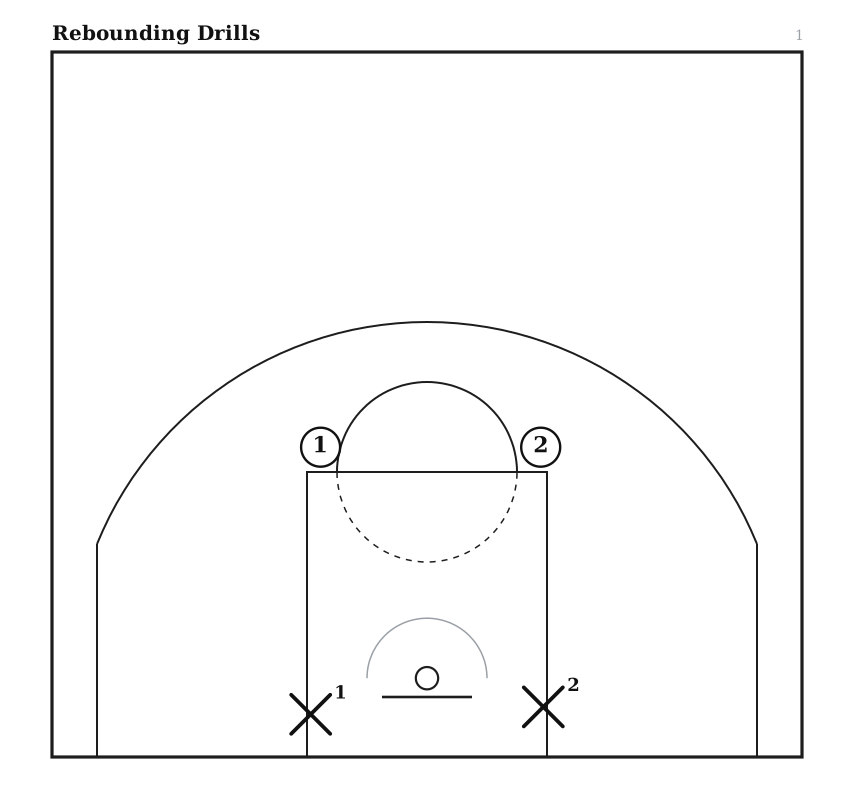
A coach or teammate shoots from the wing. One offensive player and one defensive player are matched up near the block. The offensive player works to avoid the box-out and get to the ball. The defensive player practices legal containment. This competitive 1-on-1 format forces the offensive rebounder to use real moves — the swim move, the spin, the front-turn — rather than just running to open space. Rotate through all three wing spots so players practice pursuit angles from every common shot location.
Team Offensive Rebounding Drills
3-on-2 Crash Drill
Three offensive players crash the glass against two defenders protecting the basket. A coach shoots from the perimeter. Offensive players have assigned crash zones — strong side, weak side, and high post. Defenders must box out two of the three crashers, leaving one attacker free. The goal is to drill the habit of multiple players pursuing simultaneously so that defenders can never cover every angle. Run this drill continuously for 90 seconds, tracking offensive rebounds versus defensive rebounds, and make the winning side earn a rest break.
5-on-0 Crash with Assigned Roles
The entire offense runs a set play or motion sequence. When the designated shooter releases, every other player crash-reads their assignment — two players hit the blocks, one fills high post, one fills the corner as a safety valve. The coach calls out "crash" or "back" as the shot goes up, teaching players to read the situation rather than defaulting to one habit. Over time, players learn to make this read themselves based on shot location, defensive positioning, and score. Pair this with your motion offense in basketball teaching to connect crashing with your primary offensive system.
Scramble Rebounding Game
Three offensive players versus two defenders in a live possession game. The offense shoots, both sides battle for the rebound. If the offense gets the rebound, they score and stay. If the defense gets it, they clear and the next offensive group comes in. Score to seven, or run it for a set time. The competitive structure forces players to produce real second-chance opportunities under pressure, replicating game conditions more accurately than any non-competitive drill can.
"Constrain to coach the diet — rules force behavior."
— Basketball Vault
Putback Finishing Drills
Getting the offensive rebound is only half the job. Finishing in traffic — with contact, off-balance, under fatigue — is where offensive rebounding actually puts points on the board. Too many players secure the ball and then reset into a standard finishing position. That reset is a window for the defense to recover and contest. Elite offensive rebounders go straight back up, reading whether the kick-out pass or the putback is the better play in a single second.
Catch-Power-Finish
Player catches a coach's toss from below the lane, lands on two feet simultaneously, and goes straight back up with a power layup before any defender can recover. The two-foot simultaneous catch teaches players to gather efficiently without wasted motion. Add a defender who applies token resistance — not trying to block, just adding a body — so the finisher practices going through contact rather than avoiding it. Repeat from both sides of the lane.
Outlet-or-Attack Decision Drill
After a simulated miss, the offensive rebounder secures the ball and reads a coach's signal: open hand means finish, closed fist means kick it out to a waiting perimeter player. This trains the split-second decision-making that separates players who score off offensive rebounds from players who get fouled or turn it over trying to force a shot. The drill can be run 2-on-1 or 3-on-2 to add realistic defensive pressure on the kick-out read.
Putback Series under Fatigue
Players run a basketball conditioning drill — three full-court sprints — and then immediately step in for a putback finishing sequence. Finishing when tired is a specific skill, and it is only developed by practicing it tired. This mirrors the end-of-shot-clock scrambles and late-game possession battles where offensive rebounding actually wins or loses close games. Keep the finishing reps simple — power layup or tip-in only — so technique does not break down under fatigue.
Fitting Offensive Rebounding into Practice
The most common reason teams do not crash the offensive glass effectively is not skill — it is habit. Players default to pulling back on missed shots because coaches have not built crashing into the daily practice structure often enough for it to become automatic. Offensive rebounding requires at least five minutes of focused drilling per practice, plus constant reinforcement in competitive live-action drills.
One practical structure is to end every full-court drill with an offensive glass sequence. When running your transition offense, every possession that ends in a shot should have designated crashers pursuing. This links offensive rebounding directly to your primary offensive system rather than treating it as a separate skill. Players begin to see crashing as part of playing offense, not as an add-on.
Scoring and accountability also accelerate development. Track offensive rebounds in every live drill. Post the numbers. Make teams compete for second-chance points in scrimmages. When offensive rebounds count on the scoreboard in practice, players compete for them with the same intensity they bring to transition baskets and three-pointers. Connect this to your broader work on basketball player development — offensive rebounding is a measurable individual skill with direct impact on team performance.
For younger or less experienced teams, start with the non-competitive individual drills and the 5-on-0 crash-with-roles drill before introducing live competitive formats. Players need the muscle memory of pursuit angles and power finishes before they can execute under pressure. Progress from controlled → constrained-competitive → fully live over the course of a season.
Finally, build cultural accountability around the glass. When a player crashes hard and does not get the rebound, acknowledge the effort vocally. When a player drifts to half-court on a long shot, address it immediately. Teams that crash hard are teams where coaches reinforce the habit relentlessly — not just in specific drills but in every single live repetition from the first week of practice through the final possession of the season.
Offensive rebounding percentage is one of the most coachable stats in basketball. It does not require elite athleticism — it requires disciplined pursuit angles, contact before going up, and a willingness to compete for every missed shot. Build it into your daily practice structure and track it every session.
- Assign crash roles on every shot — strong-side block, weak-side block, high-post tip zone. Everyone has a destination.
- Teach pursuit angles, not straight-line sprints — outside-in angles make box-outs nearly impossible for defenders to sustain.
- Make contact before going up — a legal forearm seal into the defender's lower back shifts their balance and opens the lane to the ball.
- Power-layup footwork first — the two-foot simultaneous catch-and-finish is the foundational putback mechanic; drill it daily until it is automatic.
- Train the outlet-or-attack decision — not every rebound should be a putback attempt; the kick-out to a shooter is often the higher-percentage play.
- Run finishing drills under fatigue — offensive rebounding in close games happens when players are tired; practice it that way so technique holds up.
- Track second-chance points in every live drill — what gets measured gets competed for; post the numbers so players know it counts.
Get free play diagrams, drills, and coaching guides delivered weekly.
See it drawn up
Related diagrams
Keep Building
Related breakdowns
Top 20 Offensive Plays for Youth Basketball Teams
Top 20 Offensive Plays for Youth Basketball Teams
Strategies for Coaching Different Offensive Styles
Strategies for Coaching Different Offensive Styles