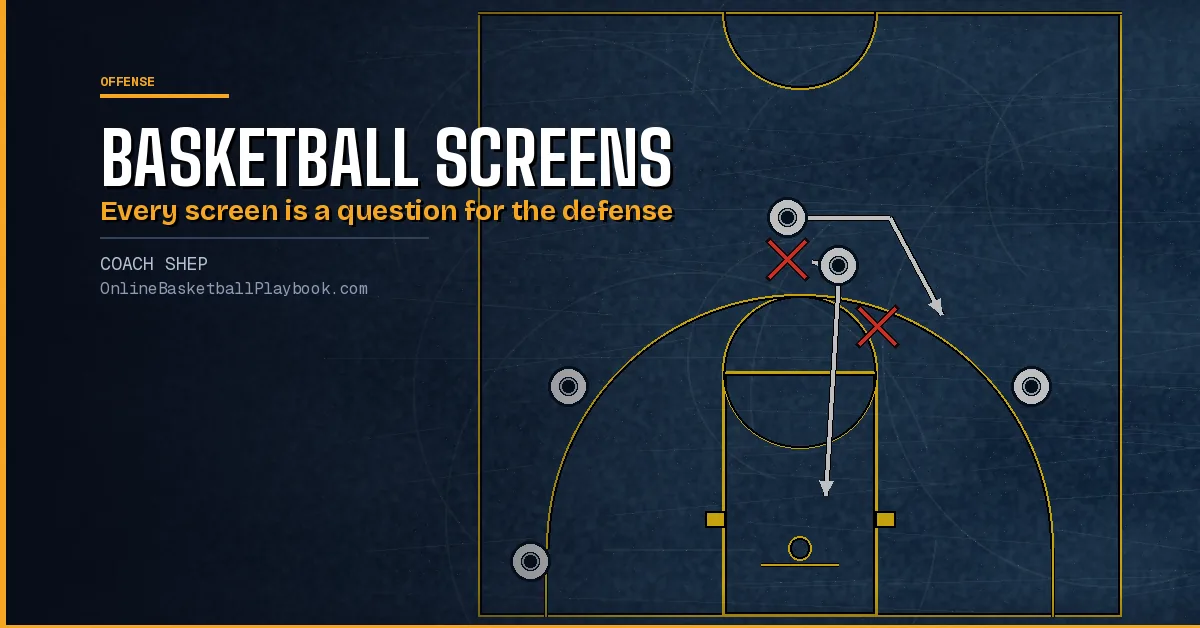
Basketball screens are the tool an offense uses to get a player open without a perfect pass or a great one-on-one move. One player stands still in the path of a teammate's defender, and both offensive players then read what that defender does. This page is the screens hub for the offense section.
It lists each type of screen in basketball, what the screen creates, the read for the cutter and the screener, and the counter when the defense takes the first option away. Each section links to the full guide for that screen. If you are new to the idea, start with what a screen is.
Basketball Screens: Three Jobs on Every Screen
Every off-ball screen breaks into three jobs:
- The cutter. Runs his man into the screen, changes speed and direction, and reads the defender.
- The passer. Delivers on time and at the right angle without losing his dribble.
- The screener. Finds a target, sets a solid screen with contact, holds still, then becomes a threat himself.
A failed set is often a good play run badly, and the fix is better technique, not a new play.
The details of the screener's stance, the angle and the timing are on setting screens in basketball and basketball screening technique. A short checklist for both ends of the floor is on 10 keys to setting and defending screens. Teach the three jobs before you add plays.
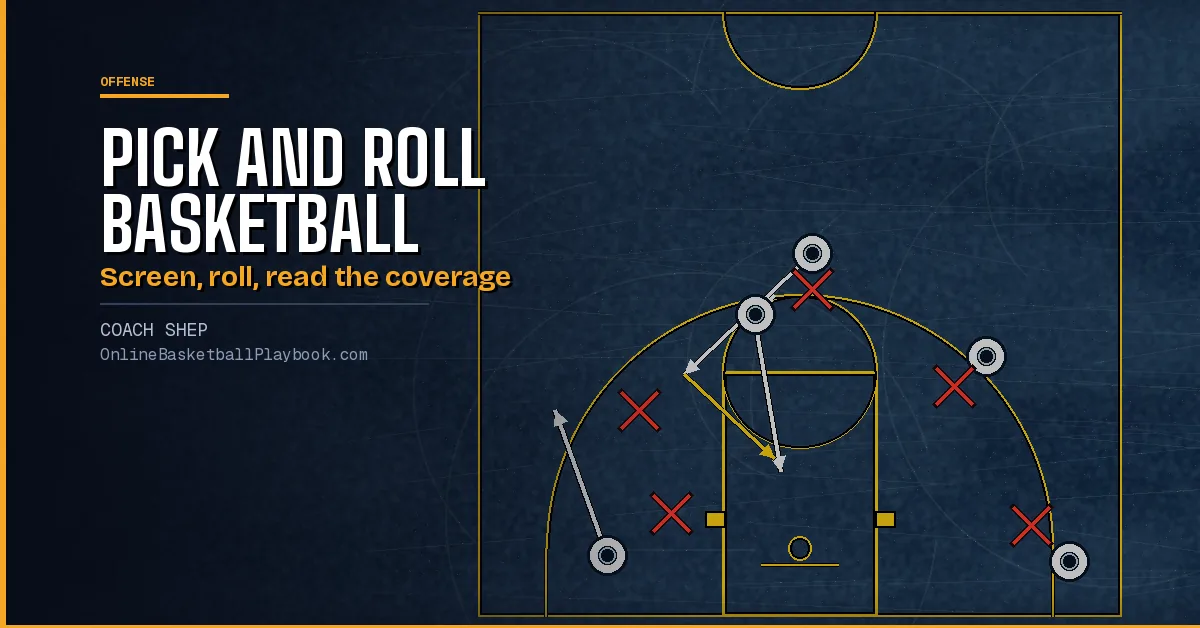
On-Ball Screen (Pick and Roll)
What it creates: a decision for the defense on every possession. Two defenders have to deal with the ball, or the defense has to switch. It also beats pressure and keeps the guard live.
The read: the handler reads both defenders. If his own man goes under, he pulls up behind the screen. If his man goes over, he turns the corner and attacks downhill. A hedge gets attacked at the hip, split, or backed out. A trap means get the ball out of the two defenders and play four on three. The screener has more than two options: roll, pop, short roll, re-screen, flare or slip.
The counter: the reject, when the defense cheats over early, and the slip, which one spread offense fires off the defender's stance before the screen is even set.

Full guide: pick and roll basketball. The drills that install these reads are on pick and roll basketball drills. Read both defenders before you decide.
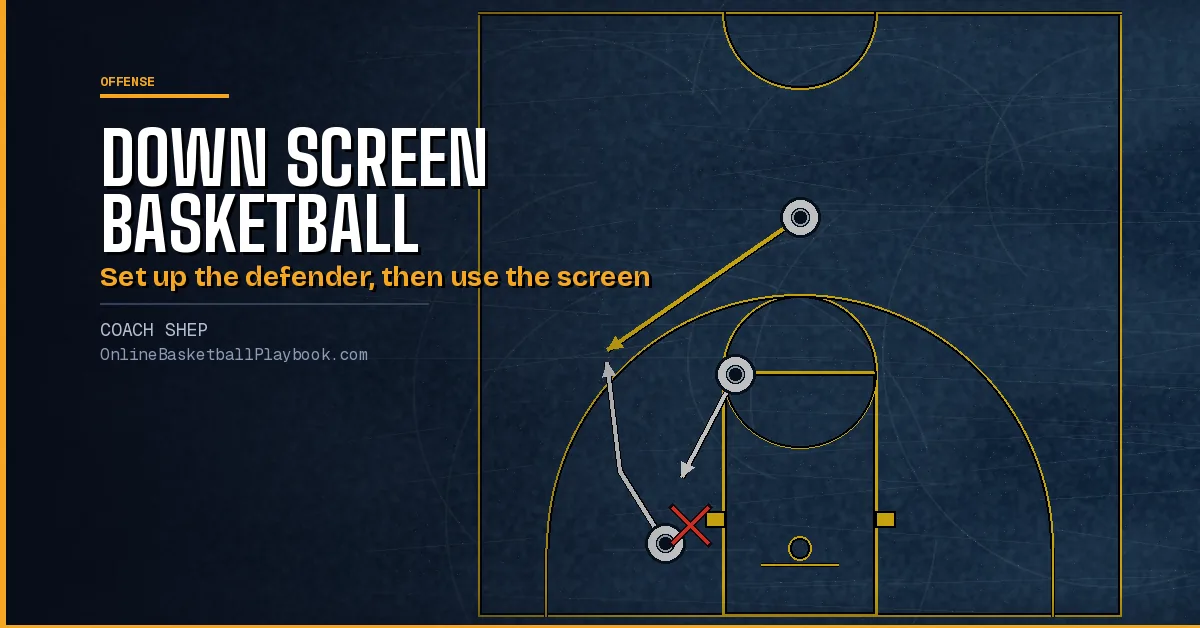
Down Screen
What it creates: a catch for a cutter coming up from the baseline toward the ball. Back and down screens also beat pressure defense.
The read: the cutter has four reads. Straight cut against a defender who sags, curl against one who trails, fade against one who goes under, and back cut against one who overplays. The screener goes opposite the cutter: pop if the cutter curls, dive if he cuts straight.
The counter: the screener slips when his defender shows early, and seals for an inside catch if the defense switches.

Full guide: down screen basketball. Rep all four cuts until the cutter reads them without thinking.
Pin Down
Pin down is another name for the down screen, and the reads are the same. A narrow pin and a wide pin can be called as two separate screens. The pin down also shows up as the finish of many chains: one common delay finish is a UCLA cut into a pin down. Shooting off it is covered on basketball shooting off screens. Teach it alongside the down screen.
Flare Screen
What it creates: a catch-and-shoot look for a player fading away from the ball. Set flares only for good shooters and only with bigs as the screeners. Pin and flare screens also work against sagging and pack defenses.
The read: the cutter steps toward the ball below the screener so his defender drops, then pushes off and backpedals behind the screen. The pass is an overhead pass thrown with height to clear the screener, released when the passer sees the defender drop under.
The counter: the screener slips when his own defender cheats up to help. Always re-screen the flare after a down screen.

Full guide: flare screen basketball. Teach the fade and the overhead pass together.
Back Screen
What it creates: a cut to the rim behind a defender who is playing high or denying. The UCLA cut, a back screen at the elbow for a cutter going to the ball-side block, is one named version.
The read: the cutter sets his man up, then cuts shoulder to shoulder off the screener. The screener reads his own defender, and if that defender helps on the cut, the screener is open.
The counter: Bob Knight back-screens a shooter, then turns and re-screens for him. Do not send the back-screen cutter and the screener's slip to the same spot.
Setting it, the screener's reads, the blind-screen rule by level and how defenses switch it are on back screen basketball. Rep the cut and the re-screen so the screener is never surprised.

Cross Screen
What it creates: post position. A screen across the lane hands a post player a catch near the ball-side block. A cross screen from a small player to a big is one answer for the post player who never gets the ball.
The read: Knight sets the cross screen high when the post is below the block and low when he is above it.
The counter: chain the cross screen into a down screen for the same cutter on the weak side, so he gets a second cut when the ball reverses.
Give the post a way to touch the ball and the rest follows.

Get the next coaching guide in your inbox
One email when a new guide or diagram set goes up. Free.
Stagger
What it creates: two screens in a row for one cutter, so his defender has to get through both.
The read: the screens have to be spaced on purpose, and the cutter sets up the first screen before he uses the second. If they are too close, one defender covers both. The second screener reads live and calls curl or fade for the cutter. After a stagger, a screener whose defender helped on the cut posts up.
The counter: the backdoor cut when the defense overplays the stagger. Space the screens on purpose and rep the read.

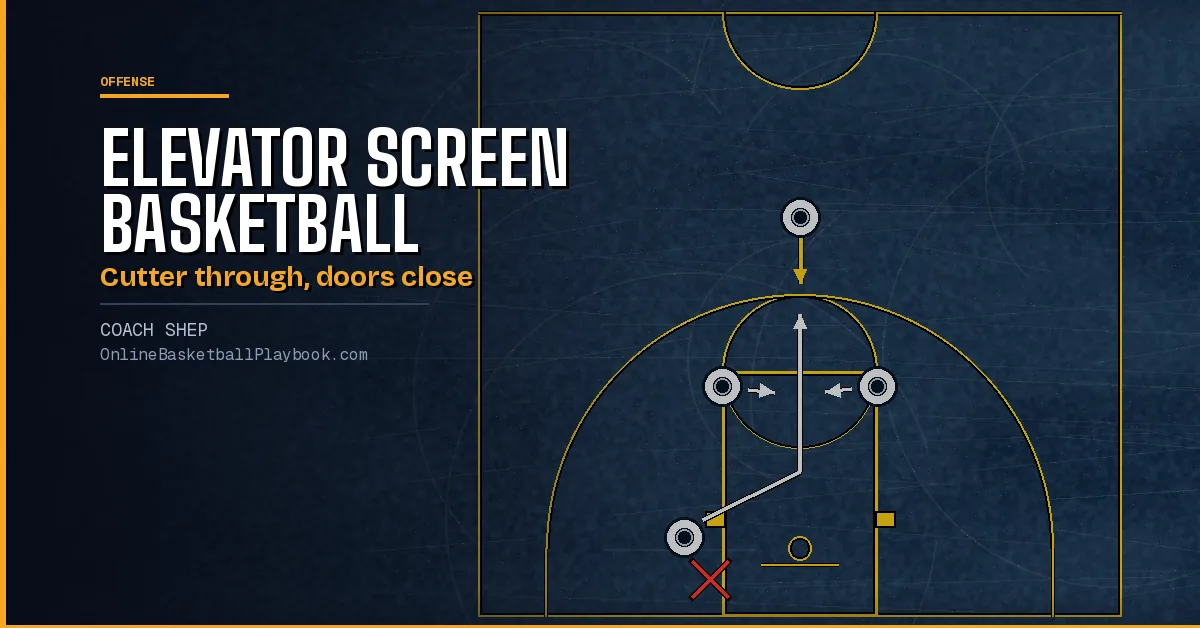
Elevator
What it creates: a catch for a shooter who runs between two screeners standing side by side, who then step together and shut the door on his defender.
The read: timing. The two screeners have to close at the right moment. Too early or too late gives a moving screen or lets the defender through. Use two posts as the doors, not two guards, because guards invite the switch.
The counter: against a switch, a slip or a diagonal cut. If the defense jumps the action, add an "Up" call.

Full guide: elevator screen basketball. Close the doors on time, every time.
Screen the Screener
What it creates: a second screen while the defense is still handling the first. The player who just screened becomes the cutter.
The read: in the plain version, 1 back-screens for 2 and then comes off a second screen from 4.
- After every double screen. Screen the screener after every double screen.
- Step, then screen. A switch counter has the cutter step to the basket, then screen for the screener.
The counter: run any screen action a second time with a fake screen or a fake curl into a back cut once the defense adjusts.
Make the screener ready to be the cutter.
Dribble Hand-Off
What it creates: a pass, a screen and a new point of attack at once. The giver dribbles at a teammate, hands him the ball from almost no distance and screens his defender in the same motion. Coaches call it to beat wing denial without a risky pass, to get a guard downhill, to force a switch or to free a face-guarded player.
The read: a defender who chases over means turn the corner and drive. A defender who goes under means shoot it, or re-screen it. A switch means punish the mismatch or slip.
The counter: an overplayed receiver back-cuts, and well-known college coaches make it an automatic lob. When the defense cheats early, the giver fakes the hand-off and keeps it.

Full guide: dribble hand-off in basketball. Pass, screen and drive happen in one motion, so rep it at game speed.
All Screens in One Table
| Screen | What it creates | First read | Counter |
|---|---|---|---|
| On-ball | A decision on the ball | Under: shoot. Over: turn the corner | Reject, slip, re-screen |
| Down | A catch moving toward the ball | Straight, curl, fade or back cut | Screener slips or seals |
| Pin down | Another name for the down screen | Same as the down screen | Same as the down screen |
| Flare | A shot fading from the ball | Defender drops, fade behind | Screener slips, re-screen |
| Back | A cut to the rim | Cut shoulder to shoulder | Re-screen for a shooter |
| Cross | Post position | Set high or low by the post's spot | Cross into down screen |
| Stagger | Two screens for one cutter | Use the first, then the second | Backdoor on overplay |
| Elevator | A shot behind closed doors | Timing of the close | Slip or diagonal cut on a switch |
| Screen the screener | A second screen | Screener becomes cutter | Fake screen, back cut |
| Hand-off | Pass and screen at once | Over: drive. Under: shoot or re-screen | Back cut, keep it |
Drills that teach the off-ball reads are on drills to teach off-ball screens. The defense's side of every screen in this table is on defending screens in basketball.
Where Coaches Split
Hunt the man
Find a target and screen a body. Treat screens as collisions and have the screener straddle the defender's near leg. Head-hunt a defender and never screen air.
Screen an area
Screen a spot at the midpoint between the basket and the sideline instead of the man, because the defender feels it less and it draws fewer moving-screen calls on the road.
Ball-screen angle. The descriptions differ:
- Flat screen. Side to side, so the handler has room to come off.
- Back hip. Set it on the defender's back hip with the screener's back to the corner.
- Low and wide. The screener sits low and wide with his back to the paint.
- Back to the baseline. The screener's back to the baseline takes away the show.
How many dribbles the handler takes also splits:
- One dribble to the paint. Two at most.
- Two hard dribbles. At least two.
When to slip.
- Slip before contact. Slip off the stance of the screener's defender.
- Slip on the read. Slip whenever the screener's defender gets above the screen or hedges.
- Slip as the shot. Design the slip as the shot and use the screen as the bait.
Who screens.
- Blockers screen, movers score. In Blocker-Mover, as Dick Bennett and Tony Bennett run it, blockers never screen for blockers.
- Guards for guards. Guards screen only for guards, and forwards screen only for guards.
- Best shooters screen away. The best shooters set the away screens and pop back for shots.
- Bigs for small players. Bigs screen for small players.
Whichever way you split, teach every screener the same rule.
Legal Screens by Level
At the levels whose books were read (NCAA men, NCAA women, the NBA and FIBA), the screener must give a moving defender time and distance to stop or change direction. The details:
- NCAA men and women: the screener stays within his vertical plane with his feet no wider than shoulder width. Outside a stationary opponent's visual field he must allow a normal step. A moving screen that causes contact is illegal.
- NBA: no closer than a normal step to a stationary opponent who is unaware of him, one to two steps from a moving opponent depending on speed, and no moving laterally or toward the opponent after taking a legal position.
- FIBA: stationary inside his cylinder with both feet on the court. Outside the field of vision the opponent must be able to take one normal step, and against a moving opponent the distance is one to two normal steps.
- NFHS: the NCAA's rules-differences chart lists a vertical-plane, shoulder-width stance. For the rest, check your state association rulebook.
Calls, examples and the coaching fixes are on illegal screen in basketball and moving screen basketball. Know your level's book before you teach the screen.
Questions Coaches Ask
What are the types of screens in basketball?
The common ones are the on-ball screen, the down screen, the pin down, the flare, the back screen, the cross screen, the stagger, the elevator, screen the screener and the dribble hand-off, which works as a screen with the pass built in.
What should the screener do after the screen?
Read his own defender. He goes opposite the cutter, popping if the cutter curls and diving if he cuts straight, slips if his defender shows early and seals if the defense switches.
What is the difference between a down screen and a back screen?
A down screen frees a cutter coming up from the baseline toward the ball. A back screen frees a cutter going to the rim behind a defender who is playing high.
What makes a screen illegal?
At the NCAA, NBA and FIBA levels: moving into the defender, a blind screen without a normal step of room, or not giving a moving defender time to stop. For high school, check your state association rulebook.
Want the printable playbook packs?
OBP Pro members get the premium playbook packs: the zone attack, out of bounds and practice plan PDFs, plus each new pack as it is finished. The membership page lists what is in each one. Or draw your own version free in PlayDraw.
See what OBP Pro includesMore Coaching Hubs
- How to Beat a Zone Defense: Every Zone and Where to Attack It
- Transition Offense Basketball: Lanes, Reads and Early Offense
- Junk Defense Basketball: Box and 1, Triangle and 2, When to Use
- Basketball Workout Plan: How to Build One by Position
Back to every Offense page.
Keep Building
Related breakdowns
Down Screen Basketball: How to Set It, Use It and Read It
Down screen basketball for both players: how to set it, how the cutter uses it, the curl, pop, back cut and slip reads, and where coaches disagree.
Elevator Screen Basketball: How It Works, Plays and Counters
Elevator screen basketball explained: how two screeners close on a cutter, the plays that use it, how to time it legally, and the counters when the defense reads it.
Pick and Roll Basketball: How to Run It and Read It
How to run the pick and roll in basketball: the screen and its angle, the handler's reads, roll, pop, slip and short roll, spacing, and a youth teaching order.