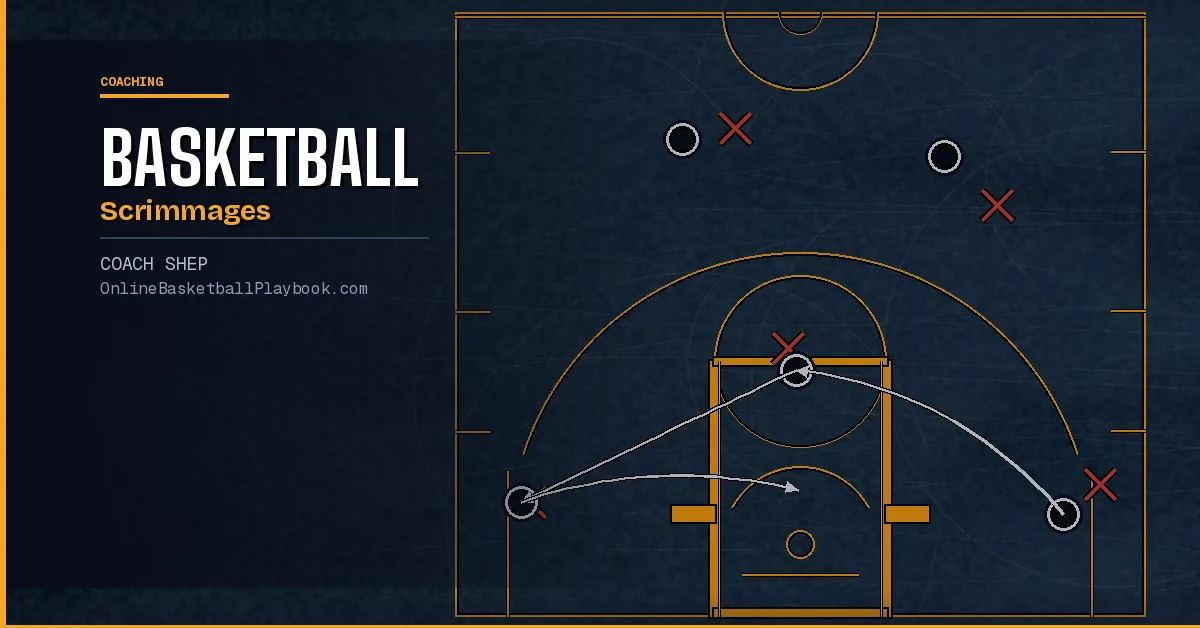
Most scrimmages teach players nothing. They become pickup games with a whistle. This guide shows you exactly how to structure live play so every rep competes and every minute transfers directly to game situations.
Why Most Scrimmages Fail
A scrimmage without structure is a test you haven't taught to. Players default to whatever habits they already have, which is usually not the thing you spent the last week of practice drilling. The result is that coaches watch game-speed reps of exactly the problems they were trying to fix.
The core mistake is treating scrimmage time as evaluation time rather than teaching time. When a coach steps back and just watches, the default reads of each player fill the void. The better players find ways to score. The developing players hide. Nobody is forced into the reads you need them to practice.
This doesn't mean you stop the scrimmage every two possessions. Overcorrecting into constant whistle-blowing kills pace and competitive intensity, which are the two things that make scrimmage valuable in the first place. The goal is a middle path: deliberate structure that steers behavior without destroying flow.
Three things consistently separate productive scrimmages from wasted ones. First, a clearly communicated teaching focus before the scrimmage begins. Second, at least one constraint that makes the desired behavior the path of least resistance. Third, a short debrief after the scrimmage that links what happened in the live play back to the teaching point. Get those three things right and your scrimmage does real work.
Set a Single Teaching Focus
Before any live play starts, name the one thing you are looking for. Not three things: one. When coaches list multiple focal points, players absorb none of them clearly, and the coach ends up stopping play for whatever catches the eye in the moment rather than for the declared focus.
The teaching focus should connect directly to what the team just drilled. If you spent twenty minutes on drive-and-kick reads out of the pick-and-roll, the scrimmage focus is: "Handler attacks the nail, weak-side shooter is ready, corner catches and shoots if the help rotates." Say it once, say it clearly, and hold players to it.
A good teaching focus is also specific enough to be verifiable. "Play harder on defense" is not a teaching focus. It is a mood. "Closeout on all catch-and-shoot opportunities (feet under you, hand in the face)" is a teaching focus. Your players know what it means, you know what you are watching for, and everyone in the gym can tell whether it is happening or not.
If a second issue surfaces during the scrimmage that is unrelated to your declared focus, write it down for the next practice session. Resist the pull to stop play and address it. The discipline of holding to one focus through an entire scrimmage is one of the hardest things for coaches to do, and one of the most important. You can only fix one thing at a time in live play.
Use Constraints That Force the Right Read
Constraints are rules layered on top of normal scrimmage play that make the behavior you want the easiest option available. They do the coaching for you without requiring constant interruption, because the rules of the game itself steer player decisions.
Possession-Based Constraints
A simple example: in a half-court scrimmage focused on ball movement, the offense must complete three passes before any shot attempt. This constraint forces weak-side movement, punishes stand-and-watch tendencies, and creates natural decision-making pressure on the ball handler without any coaching intervention. If a player shoots after two passes, the possession is dead and the defense gets the ball. The rule enforces the behavior automatically.
Another possession constraint that works well: the first touch after a live dribble kill must result in a pass or a shot within three seconds. This directly addresses the habit of killing the dribble and holding the ball while the offense goes static. You name the footwork expectation (jump stop, read the defense, act) and the time limit keeps it competitive.
Area Constraints
Area constraints define where the ball can and cannot go. If you are working on attacking close-outs rather than settling for pull-up jumpers, mark off the mid-range area and make any shot from that zone a turnover. Players will find the rim or find the corner. This sounds artificial, but it maps directly to how you want them to play in games, and the habit of attacking downhill builds quickly when settling is removed as an option.
Personnel Constraints
Personnel constraints assign specific roles during live play. Designate one player as the "shooter". Every drive must find that player on the weak side before any other shot attempt. Or designate one player as the "driver". Every possession must include one drive attempt, regardless of whether the shot is taken. These constraints give developing players repetitions in specific decision-making roles they might otherwise avoid.
Scoring Systems That Drive Behavior
Standard scrimmage scoring (two points for a basket) rewards outcomes but not process. A well-designed scrimmage scoring system rewards the behavior you are trying to build, so the team competes at the thing you care about.
Bonus Points for Execution
Award bonus points for specific execution. If you are teaching the drive-and-kick, a made corner three off a drive-and-kick is worth three points instead of two. A made basket off a post feed is worth three. A transition layup after a defensive stop where all five players ran the floor is worth four. The score becomes a proxy for execution quality, not just shooting percentage.
Negative Scoring to Eliminate Habits
Negative scoring removes points for the exact behaviors you want to eliminate. A pull-up two from the elbow when a driver was open costs the offense a point. An uncontested three-point attempt when the ball handler was being blocked costs a point. Players will make exactly as many poor decisions as they are allowed to make for free. Negative scoring puts a price on them.
Use negative scoring carefully. If the penalty is too steep or too frequent, it creates a fear-of-making-mistakes culture that slows the offense down. The goal is not to punish players. It is to make the wrong read cost something, which is exactly what happens in games.
Defensive Scoring
Run a scoring track for defense on the same board. A deflection earns a point. A charge taken earns two. A defensive stop in transition earns a point. This simple step changes the competitive dynamic of every scrimmage: both teams are competing for something on every possession, and defensive effort becomes part of the scoreboard rather than a background expectation.
Stopping, Coaching, and Keeping Flow
The hardest in-scrimmage decision a coach makes is when to stop play. Stop too often and you lose competitive intensity. Stop too rarely and player habits run uncorrected through every rep. The best coaches have a clear internal standard for what earns a stoppage and what gets addressed at the next dead ball or the debrief.
Stoppage Rules
Limit yourself to two planned stoppages per ten-minute scrimmage. Not two per half, two total. Each stoppage should address the declared teaching focus, not whatever just happened to catch your eye. When you stop, address the situation briefly, reset the possession, and restart. The entire interruption should last under ninety seconds.
Some coaches use a designated "freeze" whistle. One short blast means everyone holds their position, no one moves, and the coach walks onto the floor to address a specific situation. This is different from stopping play because it preserves exactly where every player is standing at the moment of the coaching point. It works well for teaching defensive positioning or off-ball movement because the players can see in real time where they should be.
What to Say When You Stop
When you stop the scrimmage, follow this sequence: name what you saw, name what you wanted to see, and restart. No more than three sentences. Players process coaching points better when they are short, direct, and immediately followed by another opportunity to execute. The mistake coaches make in stoppages is talking too long. A two-minute monologue does not produce a two-minute improvement in the next possession.
Address individuals by name but never in a way that removes the focus from the group. "Darius, drive baseline" (the help was late) is a coaching point. "Darius, you keep making that same mistake" is a morale problem. The difference is whether the player walks away knowing what to do next time.
If the same mistake appears three times in a single scrimmage without improvement after a coaching stoppage, that is not a scrimmage problem. It is a practice design problem. The skill needs more isolated drilling before it will hold up in live play. Stop correcting it in the scrimmage and add a drill block before the next live session.
The Debrief Habit That Makes It Stick
The debrief is the most skipped part of the scrimmage cycle and also the most important. Without it, the scrimmage is a sequence of events that players experience but do not fully process. The debrief converts live experience into retained knowledge.
A debrief does not need to be long. Three minutes is enough if the teaching focus was clear from the start. The structure is simple: what was the focus, did we do it, what did we do when we didn't do it, and what do we do next practice.
Asking vs. Telling in the Debrief
The best debrief is mostly questions, not statements. "What was our focus today?" Let players answer. "Did we do it consistently?" Let them assess. "What got in the way?" Let them name it. When players articulate the breakdown themselves, they own the correction. When the coach diagnoses everything, the players become passive recipients of information rather than active problem-solvers.
This does not mean the debrief becomes a free-form discussion where any answer is accepted. You are asking questions with a specific answer in mind. If a player names the wrong breakdown, you redirect briefly and move on. The goal is to create the habit of players thinking analytically about their own performance in real time, which is exactly what high-level competitors do during games.
Connecting the Debrief to the Next Session
End every debrief with a forward-looking statement, not a verdict on what just happened. "Tomorrow we're going to start with five minutes of drive-and-kick reads from the top of the key, then we'll scrimmage again with the same focus" is a better close than "we need to do much better at this." One gives players something concrete to prepare for. The other leaves them with a vague sense of having fallen short.
Write down two or three observations from the scrimmage before you leave the gym. Not long notes, just the moment, the player, and the pattern. These become your practice design input for the next session. Over time, this habit builds a real map of where your team breaks down under live-play pressure, which is information no drill can give you.
- Name one focus before live play starts: Post it on the whiteboard so every player reads it before the first possession. Referencing a shared written focus eliminates the "I didn't know that's what we were doing" excuse.
- Add one constraint that enforces the behavior automatically: Three-pass minimum, area restriction, or personnel role assignment. Let the rule do the coaching so you can watch and observe rather than constantly intervene.
- Limit yourself to two stoppages per ten minutes: Both must address the declared focus, both must be under ninety seconds, and both must end with an immediate restart so competitive intensity is preserved.
- Score defense on the same board as offense: Deflections, charges, and transition stops earn points. When defense competes for something concrete, every team plays harder without being told to.
- Run a three-minute debrief with player-led answers: Ask what the focus was, whether it held, and what broke it down. Players who diagnose their own breakdowns own the correction far more deeply than players who are told what went wrong.
Want more basketball coaching strategies and drills?
Join the Online Basketball Playbook newsletter →
Draw this play free in the play drawer →
Membership: the full library, playbook packs, and Pro drawing tools →
Keep Building
Related breakdowns
Fun Basketball Games for Practice: Scored Games for Any Team
Fun basketball games for practice at any level: shooting games, defense-only scoring, rebounding contests and passing games, with scoring rules and records.
Basketball Conditioning Drills for Teams: Runs, Games and Tests
Basketball conditioning drills in three styles, timed runs, conditioning inside skill drills and scored games, with the tests and yearly plans coaches use.
Basketball Agility Drills: Cone, Reaction and Ladder Drills
Basketball agility drills from timed cone tests to reaction, mirror and ladder drills and defensive circuits, with schedules and where coaches differ.