
The Blocker-Mover offense divides your five players into two clear roles — Blockers who screen and Movers who cut — creating a read-based motion system that's nearly impossible to scout and gets better every week of the season.
What Is the Blocker-Mover Offense?
The Blocker-Mover offense is Dick Bennett's structured-motion system — the same base offense his son Tony Bennett rode at Virginia all the way to the 2019 national championship. At its core, it is a freelance read system inside a defined structure: every player has a role, every screen has a purpose, and the reads are made in real time by the players themselves — not called from the bench.
What separates it from generic motion offense is the role clarity. In most motion systems, players rotate through ball-screen, cut, and post actions interchangeably. In Blocker-Mover, you assign each player to one of two permanent categories before the season starts — and you coach those categories differently.
The result is an offense with a genuine identity. Defenses can scout your personnel, but they cannot predict the sequence, because the sequence is a product of reads, not a memorized play. Coaches who have installed it describe the same experience: the offense starts rough in October, is recognizable by Thanksgiving, and by January it flows so naturally that even late-possession possessions under pressure produce good shots.
Dick Bennett described the system as a "great equalizer" — built specifically for programs that cannot outathlete their opponents. When your players know their roles and your Blockers set physical, intelligent screens, you can slow a more talented team down, generate quality looks inside and out, and play a brand of basketball that compounds as the season progresses.
The continual screening is exhausting to guard, hard to scout, creates an offensive identity, and gets better as the season progresses because it's a read system, not memorized plays.
— Dick Bennett / Tony Bennett Blocker-Mover System, Basketball Vault
The Two Roles: Blockers and Movers
Every player in a Blocker-Mover offense is assigned to exactly one role before the season begins. The assignment is based on skill, athleticism, and willingness — not position. A 6'4" forward with post instincts might be a Blocker; a 6'6" wing who can shoot off screens is a Mover. The role, not the number on the jersey, determines what that player does on every possession.
Blockers
Blockers are the backbone of the offense. Without physical, willing screeners, Movers cannot get open — the system stalls. Blockers operate from assigned areas of the floor (Lane, Wide, Top, or Bottom), and they do not chase their defenders. They screen from their region and read how the defense reacts.
The key to selling the Blocker role is this: the screen creates their own scoring. When a defender cheats on the screen, the Blocker slips to the basket. When a defender fights over the screen, the Blocker posts up on the seal. Blockers who are near the lane when shots go up are already in rebounding position — put-backs and second-chance points are a structural output of the offense, not accidents. If you do not sell this in week one of the install, your willing screeners will disengage by week three.
A critical rule: Blockers screen for Movers, not for the other Blocker. The role boundary is what keeps the offense's spacing clean and its screening angles predictable.
Movers
Movers are the primary scorers and ball handlers. Their job is to set up the defender before the screen — two steps away, change of pace — then use the screen to get open. A Mover who sprints directly into a screen without setting up the defender makes every screen easy to fight through. The setup step is non-negotiable.
After using the screen, the Mover reads the defense. The read is not optional, and it is not the coach's call — it belongs to the Mover, made in real time based on how the defender plays the action. Movers must be able to curl, fade, pop, slip, and cut to the basket off any screen in the offense. Teaching all five reads to every Mover is the primary offensive teaching task during the install phase.
Movers also attack gaps. Flare screens generate driving lanes, not just catch-and-shoot looks. A Mover coming off a flare screen with a step on his defender should attack north-south first, drawing a second defender and kicking to an open Blocker or Mover. Draw-and-kick from the gap is a primary Mover action — not a fallback when the shot is unavailable.
The Four Blocker Alignments
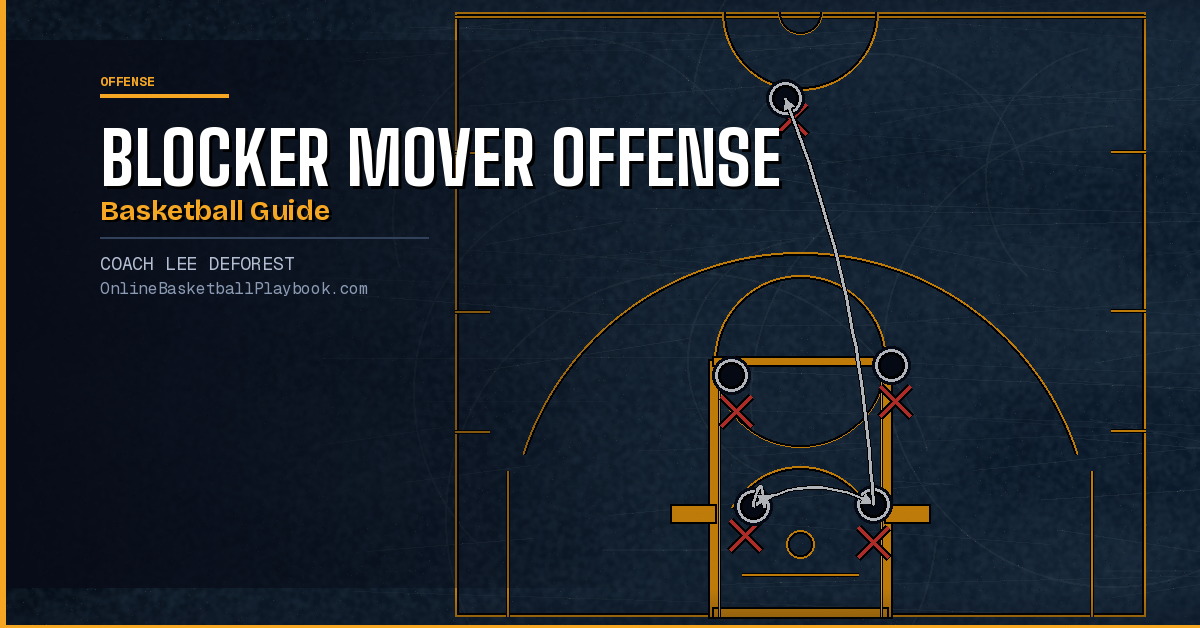
Blockers are assigned to one of four floor areas: Lane, Wide, Top, or Bottom. The two Blockers on the floor at any time operate in one of four combinations — Lane-Lane, Lane-Wide, Wide-Wide, or Top-Bottom — each with distinct spacing implications.
Lane-Lane puts both Blockers on the blocks, each owning one side of the paint. It is the simplest combination to teach, produces the most paint access for post scoring and offensive rebounding, and is the recommended starting point for most programs installing the offense for the first time. It is also the best fit for less-athletic big men who are effective screeners but not floor-spacers.
Lane-Wide puts one Blocker in the lane and one in a wider floor position on the same or opposite side. This combination creates more diverse screening angles — the Wide Blocker can set flare screens that the Lane-Lane formation cannot — and is the common starting point when one of your bigs has some perimeter skill. Many coaches begin their install in Lane-Wide because it introduces the wide screening concept without requiring both bigs to space the floor.
Wide-Wide puts both Blockers in wider floor positions, maximizing screening angles and spacing. It is the hardest set to defend but also the most demanding on Blocker IQ and skill. The tradeoff is that both bigs are farther from the lane, which reduces paint access and offensive rebounding. Reserve Wide-Wide for your most skilled and IQ-advanced Blocker pairs.
Top-Bottom puts one Blocker above the free-throw line and one below. It is the best zone-attack alignment in the offense: the Top Blocker attacks the top of the zone, and the Bottom Blocker seals inside off skip passes. If you run Blocker-Mover as your base offense, you may not need a separate zone package — Top-Bottom gives you everything you need to attack a 2-3 or a 1-3-1.
Blocker assignments are not locked permanently. As the season progresses, a Blocker who started as a Lane man may earn Wide privileges when his perimeter reads and screening angles develop. The structure is the starting point, not the ceiling.
Circle Action: The Default Motion
The Circle is the base movement pattern that repeats throughout a possession whenever a named set breaks down or a team wants to generate offense without calling something specific. It is four movements that happen simultaneously, producing two reads that the defense must guard at the same time.
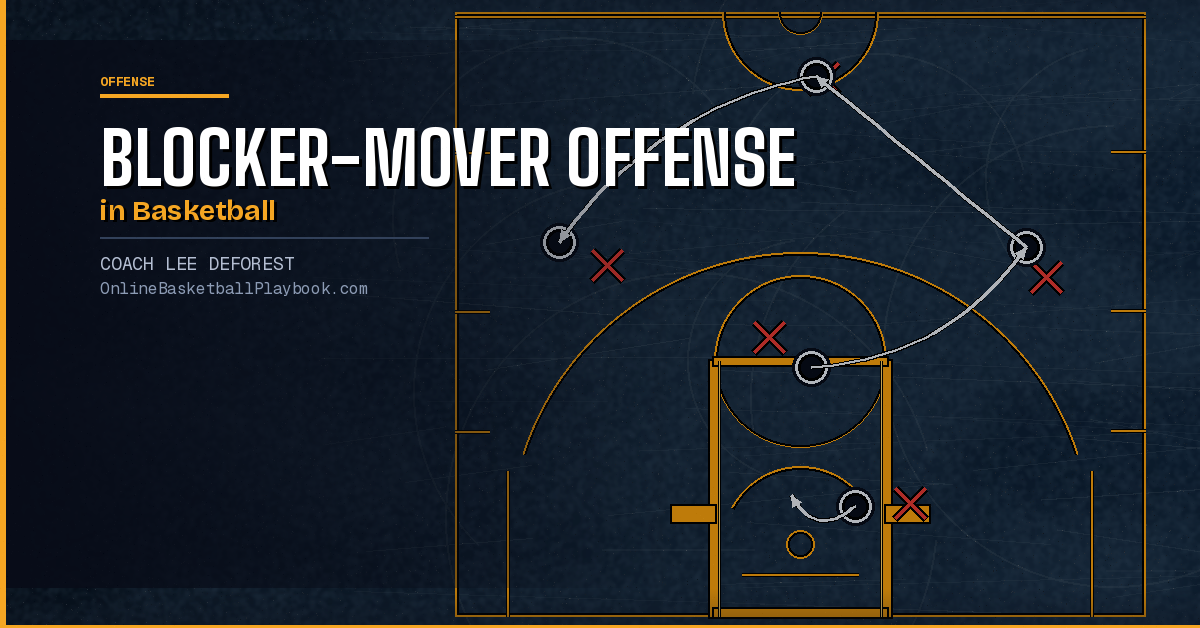
Here is the sequence. The ball handler dribbles top toward the weak side. As that happens, the weak-side Blocker sets a flare screen for the cutting guard on that side. Simultaneously, the ball-side Blocker sets a baseline pin screen for the opposite Mover. Two reads trigger at once: the flare cutter reads the flare screen, and the baseline cutter reads the pin.
The reason Circle is exhausting to guard is the paired-read principle. Stopping the flare cutter surrenders the pin-and-dive to the basket. Stopping the pin cutter opens the flare catch on the perimeter. The defense must choose which read to give up — and either choice produces an open look. There is no coverage that eliminates both reads simultaneously, which is why the Blocker-Mover system generates offense consistently without a single shot being called.
Circle is also the primary vehicle for Blocker scoring off their own screens. When the flare defender cheats over early, the Blocker sets the slip instead of the full screen — turning into the cutter himself. When the pin defender gets over-extended helping on the baseline read, the Blocker seals and dives for a duck-in feed. These are not accident points. They are built into Circle's structure.
When you introduce Circle action in practice, run it first as a 5-on-0 walkthrough so every player can see both reads triggering at the same time. Then add a shell defense and let the players make the reads live. The goal is for both Movers to read their screens simultaneously and attack — not for one to watch the other finish. Both reads run every time, even if only one results in a shot.
The Five Mover Screen Reads
Every Mover in the Blocker-Mover offense must master five reads off a down screen or pin-down. These reads are not a menu of options the coach selects — they are the Mover's individual decision, made in real time by reading the defender's position and momentum the moment the screen is set.
Pop (baseline). If the defender goes under the screen, the Mover pops to the corner for an easy catch-and-shoot. This is the most basic read and the first one to teach, because going under the screen is the most common early-season defensive shortcut. A clean pop is a high-percentage corner three — the offense rewards it every time.
Post (low block). If the defender tries to fight through the screen by pressuring the cutter's body, the Mover seals the defender on his back and ducks in to the block for a post touch. This read turns the Mover into a post scorer off a perimeter screen — an unusual and difficult action for the defense to prepare for.
Fade (corner three). If the defender chases hard over the top of the screen, the Mover fades toward the corner for a three-point catch. This is the hardest read for the defense to contest because the Mover is moving away from the defender's momentum. A Mover who can shoot off a fade creates enormous spacing problems for the defense.
Slip (early cut). If the defender reads the screen early and tries to hedge or switch before contact, the Mover slips — cuts to the basket before the screen is fully set — taking the shortcut the defender left open. Blockers who sense a slip coming can pop out and become a secondary passer. The slip creates the most direct path to the basket in the entire offense.
Basket cut (curl to the rim). If the defender trails over the screen, the Mover curls hard to the rim. The curl read happens when a defender recovers too slowly and gets caught on the Blocker's back. A lob or a layup is the typical result. Movers must finish the curl to the rim — not stop at the elbow for a mid-range jumper, which is a common early-install error.
Teaching these five reads requires repetition in small-group breakdowns — 2-on-2 and 3-on-3 with live defenders — before they become automatic in 5-on-5. Running them as isolated walkthroughs is useful for introducing the concept, but the reads only become real when a defender is making a live decision that the Mover must respond to.
Named Half-Court Sets
The Blocker-Mover playbook contains dozens of named sets — entries that begin a possession by getting your best scorers a look before the offense flows into free Blocker-Mover motion. The rule for every named set is the same: when the set breaks down or the primary read is not available, the offense continues into motion. Sets never dead-end.
The most teachable sets to add early in an install are Wheel (a Lane-Lane entry with staggered screens for the Mover curling through the lane), Curl (a direct Mover curl off a Blocker's screen triggering a secondary Blocker post-up), and Indiana (a wing entry into a handoff plus flare screen, with multiple reads including a throwback post-feed). These three sets cover the most common coverage adjustments defenses make and give Movers immediate decision points they can execute without extensive practice time.
More advanced sets like Elevator (staggered elevator screens for a three-point catch at the top) and Panther (a back-screen generating a three-point look for the Blocker — particularly effective against switching defenses) can be added as the team's screen reads become automatic. Blur ISO clears one side for a 1-on-1 isolation of your best Mover after ball reversal — a useful late-clock set that fits naturally into the offense's structure.
The timing for introducing named sets depends on how well your players know the base reads. Coaches who add too many sets too early create a play-call dependency — players wait for the coach to call something instead of playing in the motion. A team that knows Circle action cold and can execute five Mover reads in live 3-on-3 is ready to add named sets. A team that cannot does not need sets yet; it needs more time on the reads.
How to Install Blocker-Mover at Your Level
The Blocker-Mover offense takes four to six weeks of committed practice before it flows. That is not a knock on the system — it is a feature. The weeks spent building the reads compound into an offense that improves faster than defenses can adapt to it, and by midseason you are playing something that is genuinely difficult to prepare for in a single film session.
Start by assigning roles. Look at your roster and identify your two or three most willing, physical screeners — the players who do not mind setting a hard screen without guaranteed touches. Those are your Blockers. Your best shooters coming off screens, your primary ball handlers, and your most decisive cutters are your Movers. The role assignment may surprise a few players; address it directly. Show Blockers the slip and the duck-in and the offensive rebound put-back — make the scoring case before the first team session.
Begin with Lane-Lane or Lane-Wide alignment. These are the simplest starting points. Run Circle action as your primary motion before adding any named sets. Use the Team Shooting drill series as your daily offensive practice structure — each drill in the series reps a specific read within the offense, so every shooting repetition is simultaneously a decision-making repetition. Prioritize 2-on-2 and 3-on-3 breakdowns so Movers are reading live defenders daily, not walking through schemes.
If you are not ready for a full system install, three Blocker-Mover concepts port directly into any offense without a complete overhaul. Circle action as a 10-minute breakdown drill teaches the paired-read principle and improves screen IQ immediately. The five Mover reads (curl/pop/fade/slip/basket cut) can be drilled in 2-on-2 format without any Blocker positioning rules. And the side-top-side ball movement principle — be deliberate at the top, attack quickly on the side — transfers to any offensive system and makes your players more decisive with the ball.
Strengths and Weaknesses
The Blocker-Mover offense is not the right system for every program, and understanding what it demands is the first step to deciding whether to install it.
Its primary strength is its scoutability problem — or rather, the defense's scoutability problem. Because the offense's sequence is a product of real-time reads rather than memorized plays, there is no "stop their play" that a scouting report can hand a defense. Defenses can game-plan for personnel; they cannot game-plan for a system where every player makes an individual decision on every screen. The offense also produces a genuine identity. Players know their roles, coaches can give targeted feedback, and the system gives every player — including the Blocker who will never be a primary scorer — a clear path to contribution and success.
Its primary weakness is timing. The screens and cuts in Blocker-Mover must be precisely coordinated in ways that pass-and-cut offenses do not require. A Mover who cuts too early ruins the Blocker's setup. A Blocker who screens too early gives the defense time to recover. Getting that timing right at game speed requires more practice time than simpler motion systems, and the early-season version of this offense will frustrate coaches who want to see clean execution in the first week of practice.
The offense also demands IQ from every player, not just the Movers. Blockers must read whether to slip, re-screen, seal, or dive — decisions that depend on what the defender is doing in real time. Programs with players who struggle to read and react in real time will find the learning curve steeper. Commit fully or use the individual concepts without running the system. A half-installed Blocker-Mover offense is worse than a well-installed simpler system.
- Assign Blocker and Mover roles before the first team practice — do not let players self-select, and sell the Blocker role immediately by showing scoring opportunities (slips, duck-ins, offensive rebounds) before they ever feel like screen machines.
- Start with Lane-Lane alignment and Circle action only; add Lane-Wide and named sets after your Movers can make all five screen reads correctly against a live defender in a 3-on-3 breakdown.
- Run the Team Shooting 8-series daily — Throw-ahead, Trail, Side PnR, Corner, Tight, Flash, L, and Zipper — so every shooting rep is also a decision-making rep tied to a specific read in the offense.
- Use the Top-Bottom alignment against zone; the Top Blocker attacks the zone front, and the Bottom Blocker seals inside after skip passes — this eliminates the need for a separate zone package if Blocker-Mover is your base offense.
- After installing the base, progress Blockers to Wide positioning as they develop perimeter screening IQ; Wide-Wide is the hardest set to defend and the natural endpoint of a mature Blocker-Mover install.
- Every named set must flow into free motion when the primary read is unavailable — never let a set dead-end, because a stopped offense is harder to restart than a motion offense that never stopped.
Want more basketball coaching strategies, drills, and tools?
Keep Building
Related breakdowns