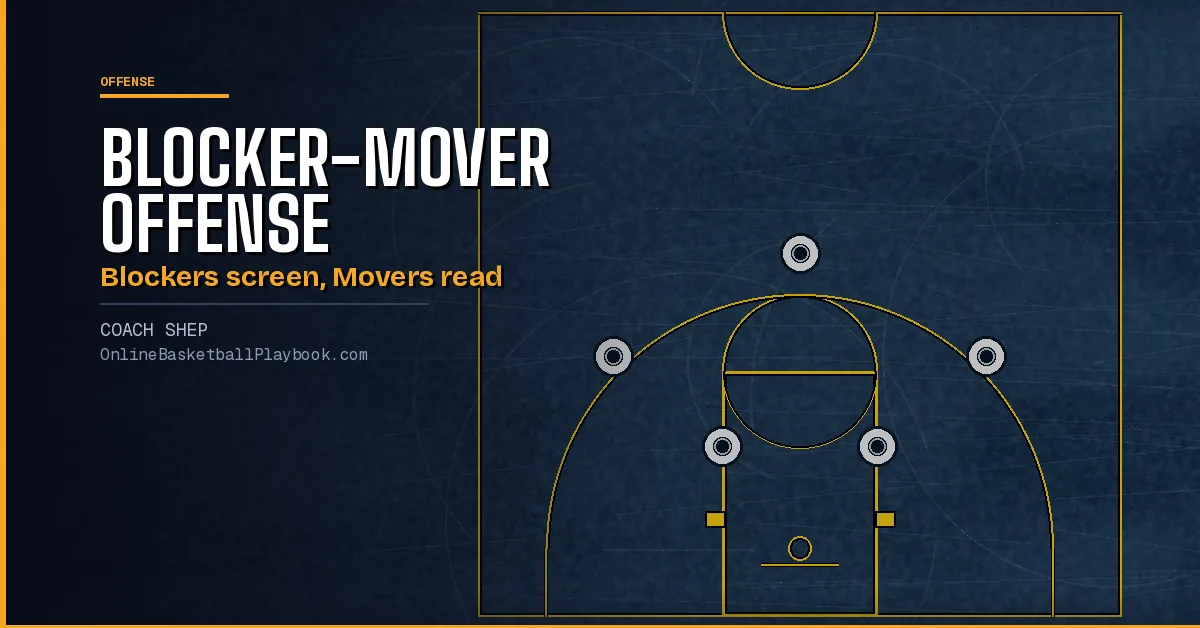
The Blocker-Mover offense is a structured motion system. Five players split into two role groups. Blockers are the designated screeners, and each owns an area of the floor. Movers are the cutters and primary scorers, and they read how the defense plays each screen. It is freelance play inside a structure, which gives a team the continual screening that defenses tire of guarding and a set of roles every player can learn. This guide covers the roles, the four alignments, circle action, the screen reads, the named sets, the install order and where coaches split.
Blocker-Mover at a Glance
| Question | Answer |
|---|---|
| Who screens? | Blockers, from an assigned area. They screen for Movers and usually never for the other Blocker |
| Who reads? | Movers, off every screen, based on how the defender plays it |
| What is fixed? | The roles, the areas and the set entries |
| What is open? | The reads. There is no memorized sequence |
| What does it cost? | Timing and basketball IQ. Plan on four to six weeks of committed practice |
| Who is it for? | Programs that are skilled but not the most athletic |
What Is the Blocker-Mover Offense?
The Blocker-Mover offense answers a question every coach faces. How do you let players read the defense without the offense turning into chaos? The answer is role clarity. Because every player knows his job, you can put each one where he can succeed and narrow or expand the rules to fit his talent. Players want to know their roles, and this offense tells them.
The system is often called a great equalizer. The continual screening is exhausting to guard, it is hard to scout because it is a read system and not a set of memorized plays, it creates an offensive identity and it gets better as the season goes on. Virginia paired it with Pack Line defense, which gave the program a complete identity at both ends. See How to Coach Pack Line Defense for that side. The catch is time. The offense takes full buy-in to develop the countless screening and cutting reads.
The Two Roles: Blockers and Movers
Blockers
- Assigned to an area, not a man. A Blocker does not chase his defender. He screens from a fixed region of the floor (Lane, Wide, Top or Bottom) and cannot cross sides or screen for the other Blocker. That limit keeps spacing clean and the reads predictable for Movers.
- Scores off his own screens. He slips when his defender cheats, posts up when his defender tries to front him and is already in rebounding position on every shot. A Blocker who feels like a screen machine disengages, so selling this scoring path early is the biggest install task.
- Physical, willing and smart. Setting a good screen is a decision. The Blocker reads whether to slip early, re-screen, seal or dive based on how the defense plays, and no rule makes the decision for him.
Movers
- Set up the defender first. A Mover who does not set up his defender makes every screen easier to fight through. Take two steps away, change pace, then cut.
- Read the defense, not the play. The read is the Mover's own decision, made in real time. That is the offense's demand on IQ and its teaching value.
- Attack the gaps north and south. Movers coming off flare screens can penetrate and kick, which makes draw-and-kick a primary action and not a fallback.
- Screen for another Mover only on occasion. This is the exception, and it is not the base rule.

The Four Alignments
Each Blocker gets one of four areas, and the areas combine into four alignments. The combinations are not rigid. A Blocker who starts in the lane can earn Wide privileges as his perimeter skill grows.
| Alignment | Blocker areas | Best for |
|---|---|---|
| Lane-Lane | Both Blockers in the lane, each owning one side | The most common alignment, with the simplest spacing |
| Lane-Wide | One Blocker in the lane, one who can work a full side | A team with one skilled forward |
| Wide-Wide | Both Blockers can work a full side | The hardest to defend. It needs smart, skilled bigs and exposes the most offensive rebounding |
| Top-Bottom | One Blocker above the free-throw line, one below | A stretch four, or a zone defense |
A weaker team can run Lane-Lane all year. A more skilled team earns Wide privileges and moves toward Wide-Wide over the season.
Circle Action
Circle is the base movement that repeats through a possession. The ball handler dribbles to the top of the key toward the weak side. The weak-side Blocker sets a flare screen for a cutting guard, and the ball-side Blocker sets a baseline pin screen for the opposite Mover. The two reads start together. The flare cutter reads the flare screen and the baseline cutter reads the pin, so the defense has to guard both at once. Stopping the flare gives up the pin and dive, and stopping the pin opens the flare catch. See Flare Screen Basketball for the flare itself.
The Five Mover Reads
Every Mover has to know five reads off a down screen or pin-down: pop, post, fade, slip and basket cut. The defender decides which one is correct.
- Basket cut. The defender chases or trails over the top of the screen, so the Mover curls hard to the rim for a layup or a lob.
- Pop or fade. The defender goes under the screen, so the Mover pops or fades to the corner for a catch and shoot.
- Post. The defender pressures the cutter, so the Mover seals him and ducks in to the low block for a post touch.
- Slip. The defender anticipates the screen, so the Mover slips early to the basket before the screen lands. A Blocker who senses the early slip can pop out and become a passer.

The reads are not a menu where Movers pick a favorite. Each one has a trigger, and the teaching goal is automatic recognition. More on off-ball screens is on Basketball Screens and Drills to Teach Off-Ball Screens.
How Blockers Score
A Blocker's shot diet is built into the system and does not depend on a player's generosity. Three actions stand out.
- Back door. If a defender cheats in front of the Blocker to stop a slip, the Blocker cuts back door and becomes the cutter.
- Duck-in against a zone. In Top-Bottom against a zone, the bottom Blocker catches the bottom zone defender on his back after a skip pass. He seals, catches and finishes.
- Offensive rebound and put-back. Blockers in the lane are already in rebounding position on every shot.
Get the next coaching guide in your inbox
One email when a new guide or diagram set goes up. Free.
Named Sets
The system holds 31 named sets, and more Virginia sets such as Elevator sit beyond them. Base entries feature your best players before the free flow begins, and every set flows into free Blocker-Mover motion when it breaks down, so the offense never dead-ends. These are the most teachable.
| Set | What it runs |
|---|---|
| Wheel | A Lane-Lane entry where Blockers set staggered screens for a Mover curling through the lane, with several counter reads |
| Blur ISO | Clears one side after a ball reversal and features the best Mover one on one |
| Curl | A Mover curls off a Blocker's screen to the paint and the Blocker can post up as a second read |
| High PnR | A ball screen at the top of the key. The Mover attacks off the dribble and the Blocker rolls or pops based on the coverage |
| Elevator | Two Blockers set a staggered elevator screen for a Mover who catches off the top for a three or a pull-up |
| Indiana | A wing entry, a hand-off and a flare screen, with counter reads that include a throwback post feed |
| Panther | Back-screen action that creates a three-point look for a Blocker, a fit against switching defenses |
Against a zone the answer is already built in. Run Top-Bottom, with the top Blocker attacking the zone front and the bottom Blocker sealing inside off skip passes, and you do not need a separate zone package. For the wider picture on beating zones see How to Beat a 2-3 Zone and How to Attack a Zone Defense.

How to Install Blocker-Mover
The offense is unscripted, so the reads come from reps against a live defense. The drill progression runs from one-on-zero reading work to two on two live, the two-man game, the Team Shooting series and five-on-five constraint games.
- Pick the roles. Make your willing post screeners Lane Blockers and your best guards and wings Movers.
- Start simple. Begin with Lane-Lane and a few actions that feature your best players. Add options when the base is automatic.
- Sell the Blocker role in week one. Run a five-on-five constraint where only Blockers can shoot. It shows that slips, duck-ins and offensive rebounds are real scoring chances and not leftovers.
- Run the Team Shooting series daily. Eight named shooting series rep the offense's actions.
- Open with an entry set. Indiana or Panther works as a first entry.
- Be patient. Expect four to six weeks of committed practice before the offense flows.
| Drill | What it reps |
|---|---|
| Throw-ahead | Early offense and a fast pass in transition |
| Trail | The guard trailing the break for a catch and shoot |
| Side PnR | Ball screen action for Movers in Top-Bottom |
| Corner | A flare to the corner for a catch and shoot |
| Tight | A catch off a pin-down against a tight defender, curl or fade |
| Flash | A Mover flashing to the ball and attacking |
| L | An L-cut, jab baseline and cut to the wing, off a Blocker's screen |
| Zipper | A Mover coming up from the low block on a zipper cut |
These are not isolated shooting drills. Each rep trains a read inside the offense.
Borrow pieces without the full system
Three actions port into any offense.
- Circle action. Install the flare and pin together as a 10-minute breakdown drill to build screen IQ.
- Mover screen reads. Drill the five reads two on two with no Blocker rules.
- Side-top-side ball movement. Be deliberate at the top of the key, where the ball handler looks inside and lets help clear. Be quick on the side, where the offense attacks before the defense settles.
Where Coaches Split on Blocker-Mover
- The full menu or a layered install. The full menu pairs base entries, four alignments and five screen reads. A layered install teaches the same two roles on a weekly ladder. Week one is basic screen and cut reads, week two adds the screener's roll or pop read and week three adds weak-side action. The layered route suits younger or less experienced rosters that would be overwhelmed by the full menu.
- Alignment. The base system uses Lane, Wide, Top and Bottom areas. The layered version defaults to 4-out 1-in, with the single post as the primary Blocker and all four perimeter players as Movers. It is a simpler picture and a stepping stone toward the full system.
- Roles or equal rights. Blocker-Mover assigns roles. Free 5-out motion keeps every player equal. See 5-Out Motion Offense and Motion Offense for that approach.
- When to go Wide-Wide. It is the hardest alignment to defend, and it also costs spacing and rebounding if the Blockers have not earned it. Scale the alignment to the personnel.
Coach Cheatsheet
- Blockers own an area and screen for Movers. Movers read the defense.
- Start in Lane-Lane and earn the wider alignments.
- Teach the five reads: pop, post, fade, slip and basket cut.
- Sell the Blocker's own scoring on day one.
- Run the Team Shooting series daily and expect four to six weeks before it flows.
- Use Top-Bottom against a zone.
Questions Coaches Ask About Blocker-Mover
What is the Blocker-Mover offense?
It is a structured motion system with two role groups. Blockers are designated screeners who own an area of the floor. Movers cut off those screens and read how the defense plays them.
How long does it take to learn?
Plan on four to six weeks of committed practice. Timing is the hardest part, because screens and cuts have to sync in a way pass-and-cut offenses do not require.
Does Blocker-Mover work against zone?
Yes. Top-Bottom handles a zone, with the top Blocker attacking the zone front and the bottom Blocker sealing inside after skip passes.
Can you run pieces of it without the whole system?
Yes. Circle action, the five Mover reads and side-top-side ball movement port into other offenses.
What is the biggest risk when installing it?
Blockers who disengage. A willing screener who never sees the ball stops screening hard, so show them their slips, duck-ins and rebounds from the first week.
All offense pages sit under the Offense hub. Related guides include Basketball Offense, 4-Out 1-In Offense, How to Attack Every Ball Screen Coverage and Setting Screens in Basketball.
Want the printable playbook packs?
OBP Pro members get the premium playbook packs: the zone attack, out of bounds and practice plan PDFs, plus each new pack as it is finished. The membership page lists what is in each one. Or draw your own version free in PlayDraw.
See what OBP Pro includesMore Coaching Guides
- Building Team Chemistry in Basketball: Roles, Rules and Habits
- Defending Screens in Basketball: 5 Keys for Every Coverage
- 1-3-1 Baseline Out of Bounds Defense: Shape, Jobs, Traps
Back to Motion Offense and every Offense page.
Keep Building
Related breakdowns
Press Break Basketball: Alignments, Reads and Drills
Press break basketball guide with the 1-4, 80-60-40 and 4-across alignments, reads against the 2-2-1, diamond and 2-1-2 press, and where coaches disagree.
Dribble Drive Motion Offense: Spacing, Reads and Install
The dribble drive motion offense explained: 4-out 1-in spacing, the Drop, Drag and Rack zones, the read off a drive, shot diet, weak spots and the install.