
Coaching basketball is about more than drawing up plays. The best coaches build skills, shape culture, and create environments where players actually want to come back next season.
The Coach's Primary Job
Before you design a single drill or diagram a single set play, you need to answer one question in practice: what is the coach's actual job? Most coaches default to winning games. But if you coach youth or developmental basketball — middle school, high school, or recreational leagues — winning games is the least important thing you do.
Ashworth's model, outlined in Coaching Basketball With Purpose, identifies five roles every coach must fill simultaneously. The first is teacher of fundamentals. The second is builder of confidence. The third is shaper of team culture. The fourth is example of leadership. The fifth is facilitator of fun. Drop any one of those and the system breaks. A coach who teaches fundamentals but destroys confidence produces technically decent players who quit the sport by age 14. A coach who prioritizes fun but never teaches real skills produces kids who enjoy pick-up but can't compete when it matters.
What's worth noting about Ashworth's ordering is that confidence-builder comes before culture-shaper. That's not an accident. Players need to feel safe with a coach before any culture can take hold. If a kid is afraid to make mistakes in your gym, they won't experiment, won't absorb correction, and won't grow. The psychological safety has to come first.
The measure of whether you're doing the job is simple: do your players want to come back? That single metric — retention — is the greatest indicator of a successful youth season. If the answer is yes, you're doing the job. If the answer is no, the fundamentals don't matter.
Building Fundamentals That Stick
There are four non-negotiable fundamentals in basketball, and they're the same across every age group: ball-handling, passing, shooting, and footwork. What changes by age is the drill vehicle, not the skill itself. A second-grader and a tenth-grader are both working on ball-handling — the second-grader is doing a cone slalom with eyes up, the tenth-grader is working a two-ball pressure box. Same skill, different complexity.
Ball-Handling
For younger players — grades two through four — ball-handling work should prioritize eyes-up dribbling with both hands in a stationary or simple movement context. Cone slaloms, sharks-and-minnows, and dribble-tag variations are more effective at this stage than structured dribbling lines because they force players to see the floor while controlling the ball. For grades five through eight, move toward two-ball work, pressure dribbling with a defender, and ball-handling in combination with decision-making: dribble, read, pass or attack.
Passing
Passing is undercoached at every level. The most effective youth passing progressions follow the same arc: partner challenge passing (with a target and a challenge goal) and monkey-in-the-middle for younger players, then drive-and-kick reads and three-person weave patterns as players develop. The cue "2 hands, 2 eyes, 2 feet" — two hands to receive, two eyes on the target, two feet to step into the pass — gives younger players a memorable checklist that travels with them.
Shooting
Form first. Always. "Pizza waiter" and "cookie jar" are two of the most transferable shooting cues in youth basketball. Pizza waiter gets the elbow under the ball; cookie jar gets the wrist follow-through into the rim. Use them with younger players and they'll still benefit from the muscle memory cue years later. For older players, add catch-and-shoot-off-movement and one-dribble pull-ups — the same form principles, now applied under game-speed conditions.
Footwork
Jump-stop and pivot apply to every age. Triple-threat position, spacing awareness, and purposeful cutting are concepts you can introduce early and deepen over time. The goal at the youngest ages is body control — stopping on balance, pivoting without traveling, changing direction without falling. Build that base and the offensive footwork skills — jab steps, drop steps, rip-throughs — have somewhere to land.
The retention mechanism across all four fundamentals is repetition with variation. The mistake most coaches make is running five different drills in a single practice to keep things "fresh." The better model is loading one drill in place — starting simple, then adding a defender, a second ball, or a constraint — rather than killing setup time switching to a new one. Players stay in flow. The coach gets to read readiness before advancing.
Fun first — if they don't enjoy it, they won't play it. Enjoyment is the key ingredient in developing motivation, and the primary goal is to make basketball so enjoyable that, given a choice of activities, the child chooses to play.
— Youth Coaching Fundamentals, Basketball Vault
Planning Practice the Right Way
Planning is the single biggest variable separating good youth coaches from average ones. A well-planned 45-minute practice is worth more than an improvised 90-minute one. Players standing in long lines waiting for a turn are not developing. They're waiting. Every minute a kid isn't touching the ball is a wasted minute.
The Canada Basketball LTAD framework recommends a 4:1 practice-to-game ratio for players ages nine through twelve. That means for every four practice sessions, one game. Most recreational and school leagues invert this — players play more games than they practice. The result is that the trainable reps get compressed, decision-making under pressure never gets developed in a controlled setting, and bad habits become permanent because they're never isolated and corrected.
A practical practice template for younger players looks like this: ten minutes of warm-up and movement (push/pull, agility, coordination, something fun that gets their heart rate up); thirty to forty minutes of technical work delivered through games and short-burst drills; ten to fifteen minutes of small-sided scrimmage where skills are applied under game pressure; and a cool-down with a team moment. New skills go first, when attention is highest. Each drill runs three to five minutes. Water breaks are built in — not earned, just scheduled.
Put a ball in every player's hands. The biggest structural mistake in youth practice is running drills where ten kids are watching one kid dribble. If you have fifteen players and five basketballs, get five more basketballs. Ball-per-player changes everything about what's developmentally possible in the time you have.
Culture and Team Identity
Team culture is not a speech. It's what you repeat. Coaches who say "we have a great culture" but can't point to the specific habits they run every single practice don't actually have a culture — they have an intention. The difference matters.
Ashworth's culture framework is specific and low-cost to implement. Hold a team meeting before the first practice. Create a team code — three words or a short phrase — and repeat it every day. Begin every practice with a focus word. End every practice with a shout-out circle where players recognize each other by name for something specific. Rotate "practice captains" who lead a drill. These habits, repeated daily, become identity. Players start to self-police because the culture belongs to them, not just to the coach.
Communication style is part of culture too. The most transferable communication principle in youth coaching comes from the Steve Nash Youth Basketball manual: shout praise, whisper criticism. Most coaches do the opposite — they correct loudly in front of peers and praise quietly one-on-one. That inversion does real damage to a young player's willingness to experiment and take risks, which is exactly the cognitive mode you need them in during skill development.
Correction, when it happens, should follow a clean pattern: be quick, name exactly what was wrong, give a short clear replacement cue, and keep the tone encouraging. "You turned your back to the ball — next time, step to meet the pass" is a complete correction. It identifies the error, provides the fix, and implies confidence that the player can do it. Punishment teaches mistake-avoidance; specific correction teaches improvement. Only one of those produces better basketball players.
Avoid assigning fixed positions until your youngest players have a solid base in all four fundamentals. Everyone handles, passes, finishes, guards, and learns spacing first. Position specialization before the base is built produces one-dimensional players who struggle to adapt as they move up in competition level.
Parent Management
Parent management is a basketball coaching fundamental. It's not an optional soft skill or a nice-to-have. If you coach youth basketball without a plan for managing the parent environment, you're leaving the biggest variable in your season unaddressed.
A parent meeting before the first game — covering playing-time philosophy, game-day behavior expectations, the communication chain, and how parents can support the team — prevents the majority of season-long friction. Invite parents to be part of the culture, not just observers. Give them a role. Tell them specifically what helps their kid and what hurts them.
The 24-hour rule — no playing-time discussions the day of a game — protects the coach's composure and the team's focus. Put it in writing. Explain why it exists. Most parents will respect a clear policy they received in advance far more than an ad hoc decision made under pressure at the gym.
For players ages eleven and older, Ashworth recommends involving the player directly when concerns escalate. Part of development at that age is learning to own their role and ask questions themselves. A parent calling the coach about their kid's minutes is a missed development opportunity for the kid. Build the expectation early that players speak for themselves, and you create more self-aware, self-advocating athletes.
Program-wide consistency matters too. When multiple coaches are running teams in the same program, all of them need to operate the same parent policies. Parents will talk to each other. If Coach A enforces the 24-hour rule and Coach B takes calls on game night, the parent community concludes the rule doesn't really apply. Consistent policies across all coaches remove that ambiguity.
Measuring Real Success
Youth programs that measure success only by wins and losses are measuring the wrong thing. Wins are partly a function of roster talent, league placement, and opponent quality — none of which a coach controls. What a coach controls is skill progression, culture quality, and retention.
Track skill progression on a small number of specific, observable skills. Layups on both hands. Passing accuracy to a moving target. Free throw percentage. Defensive stance maintenance. Simple yes/no or one-to-five checkmarks every few weeks tell you whether your system is actually developing players, or just running them through drills.
Player self-assessments every two to three weeks add a layer most coaches never use. Ask players three questions: What's one thing you've improved? What are you still working on? How have you helped the team? The answers tell you whether players are engaged in their own development or just showing up. Self-aware players develop faster because they understand where they are and where they're going.
End the season with individual conversations. Three minutes per player: what they improved, what you appreciated about them specifically, and one forward challenge for next year. It's the highest-return three minutes a coach invests all season. A player who leaves feeling seen and challenged has every reason to return. A player who leaves feeling anonymous has no particular reason to come back.
The sustainable coaching goal, across every level, is to leave players better than you found them — not just as basketball players, but as people who understand effort, improvement, and how to function as part of a team. That's the job. Everything else — the Xs and Os, the plays, the scouting reports — is in service of that goal.
- Ball per player, every practice: eliminate lines by ensuring every player has a ball — this single change multiplies total development reps per session.
- New skill goes first: put the most important learning objective at the start of practice when attention and energy are at their peak, not at the end.
- Load one drill instead of switching: add defense, a constraint, or a second ball to advance difficulty in place rather than burning time on new setups.
- Shout praise, whisper criticism: reverse the default correction reflex — public praise builds the confidence players need to experiment and grow.
- Hold the parent meeting before the first game: document your playing-time philosophy, game-day behavior expectations, and the 24-hour rule so policies are clear from the start of the season.
- End every season with individual player conversations: name one improvement, one appreciation, and one forward challenge per player — three minutes that compound into long-term retention and commitment.
Want more basketball coaching strategies and drills?
Keep Building
Related breakdowns
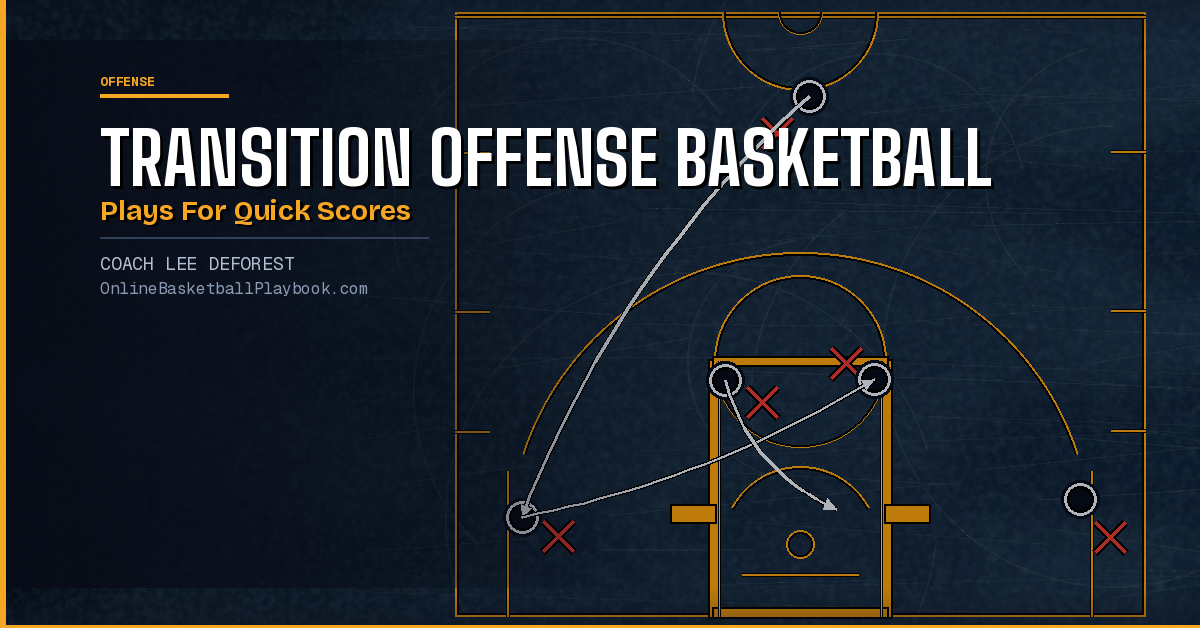
Transition Offense Basketball Plays for Quick Scores
Transition Offense Basketball Plays for Quick Scores