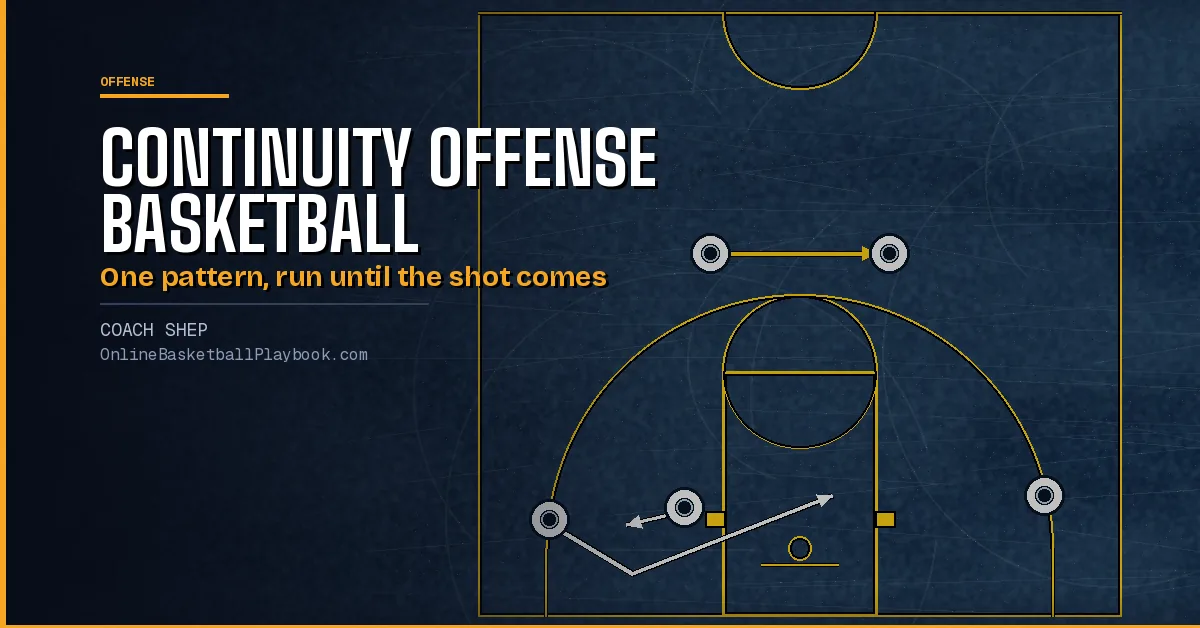
A continuity offense in basketball is a set sequence of passes, cuts and screens that flows from one side of the floor to the other and starts again without a reset. Players learn one pattern and run it until the defense gives up a good shot, with counters for the ways a defense tries to stop it. This continuity offense basketball hub explains what a continuity is, how it differs from motion and set plays, the main continuities and what they cost. The full guides in this section are the flex offense, the swing offense, the Princeton offense and the triangle offense.
What Is a Continuity Offense in Basketball?
One definition calls a patterned offense a specified sequence of movement, screens, cuts and passing with continuity, meaning continuous flow from side to side. It names the flex and the shuffle as the clearest examples. Three features show up in the patterned continuities on this page:
- A pattern that repeats. The same actions run on one side, then the other, and the team ends up back in its starting shape with players in new spots.
- Players rotate through the spots. In the flex the cutter becomes the next screener, so every player passes through every spot. In the shuffle the five spots have role names (first cutter, point, feeder, second cutter and post), and every player learns all five jobs.
- Built-in counters. Each continuity has an answer for a denied pass, so pressure does not stop the pattern.
Continuity is one of three layers coaches use to describe offense, with systems, actions and sets explained on basketball offense. Every offense on the site is listed on the offense hub.
Continuity vs Motion vs Set Plays
The scripted-action view separates the three types this way: set plays script the sequence, continuities repeat a pattern, and motion gives players rules and teaches them to decide. It also lists the pros and cons of each.
| Type | How it works | Strengths | Costs |
|---|---|---|---|
| Continuity | A scripted pattern of consecutive actions that repeats | Consecutive actions are hard to guard, and the pattern is quick to learn | Easier to scout and disrupt, for example by denying the wing entry or trapping the handler, so counters are required. Players can turn robotic |
| Motion | Rules for passing, cutting and screening, read off the defense | Teaches players how to play, hard to scout, improves with time | Reads are hard for young players, it looks ugly at first, and the best players may not get the most shots without defined roles |
| Set plays | A called sequence for one shot | The coach controls shot selection and can draw tough actions for late-game baskets | Many to remember, cannot be overused, and the ball stays with a few players |
The line between continuity and motion is not sharp. Coaches sit at different points between free rules and full structure. One point on that range is a pattern with a bail-out, such as a pattern with a "play!" call that breaks into 4-out motion, or the UCLA high post, which answers each denial with a named counter. Rules-based offenses are covered on motion offense basketball, and a motion offense with assigned screening roles is on blocker-mover offense.
The Main Continuity Offenses
The scripted-action view groups nine offenses as continuities: the flex, shuffle, swing, triangle, Princeton, UCLA, pick and roll, wheel and four corners. A line on each follows, with a link where the site has a full guide.
Flex
On a guard-to-guard pass, a baseline player cuts off a teammate's baseline screen (the flex cut) looking for a layup, and a down screen then frees the screener for a shot or the reversal. The cutter becomes the next screener and the pattern repeats side to side. It is most effective against man-to-man, and its known costs are predictability and trouble with switching. Full guide: flex offense basketball. Every named flex special, counter and pro set that uses a flex screen is drawn on flex basketball plays.

Swing
Bo Ryan's 4-out 1-in continuity from Wisconsin. Each kind of pass triggers one screen: a UCLA screen on the wing entry, a weak-side flare when the ball goes back to the slot, and a flex screen on a slot-to-slot pass. Every player posts up and plays the perimeter. Full guide: swing offense basketball.

Shuffle
Credited to Bruce Drake at Oklahoma in the early 1950s. All five players rotate through five role-named spots. The post screens for the first cutter, who cuts over the top or backdoor, then screens again for the second cutter, and a down screen rotates the roles so the series runs on the other side. Counters cover a denied pass to the point. Its supporters say mismatches happen naturally, any substitute can enter any spot, and the changing roles make it hard to scout.
Triangle
Tied to Tex Winter. Three players form a sideline triangle on the ball side (post, wing and corner) and the other two play a two-man game on the weak side. Nobody calls plays, and players read the defense to choose the next pass, so the triangle is read-based even though the scripted-action view lists it as a continuity. Full guide: triangle offense basketball.

Princeton
Pete Carril's patient offense. Five players who can all pass, dribble, shoot and cut play high on the floor around a passing post, scoring with backdoor cuts against denial, threes against a sag and screen-the-screener actions. Like the triangle it is read-based, and the scripted-action view still groups it with the continuities. One pattern offense from a 2-3 high set is described as resembling the Princeton with a fixed, repeating pattern added. Full guide: Princeton offense, with drills on drills to teach the Princeton offense.
UCLA high post
John Wooden's offense from a 2-3 high set. The wing entry triggers the UCLA cut: the passer basket-cuts off the high post's screen. If the cut is covered, the high post steps out for the reversal. Named counters answer a denied high-post entry, a denied wing pass and a denied guard-to-guard pass. The cut itself is borrowed by other offenses, including the swing. Full guide: UCLA offense and the UCLA cut.
Wheel
A patterned 4-man continuity built on flex-style screens to the ball-side block. As the wing pass is made, the opposite wing cuts off a screen to the ball-side block for a layup look, two players brush shoulders and exchange, and the ball reverses to start the pattern on the other side. It has separate counters for a denied pass to the point and a denied pass to the wing.
Ball-screen continuity
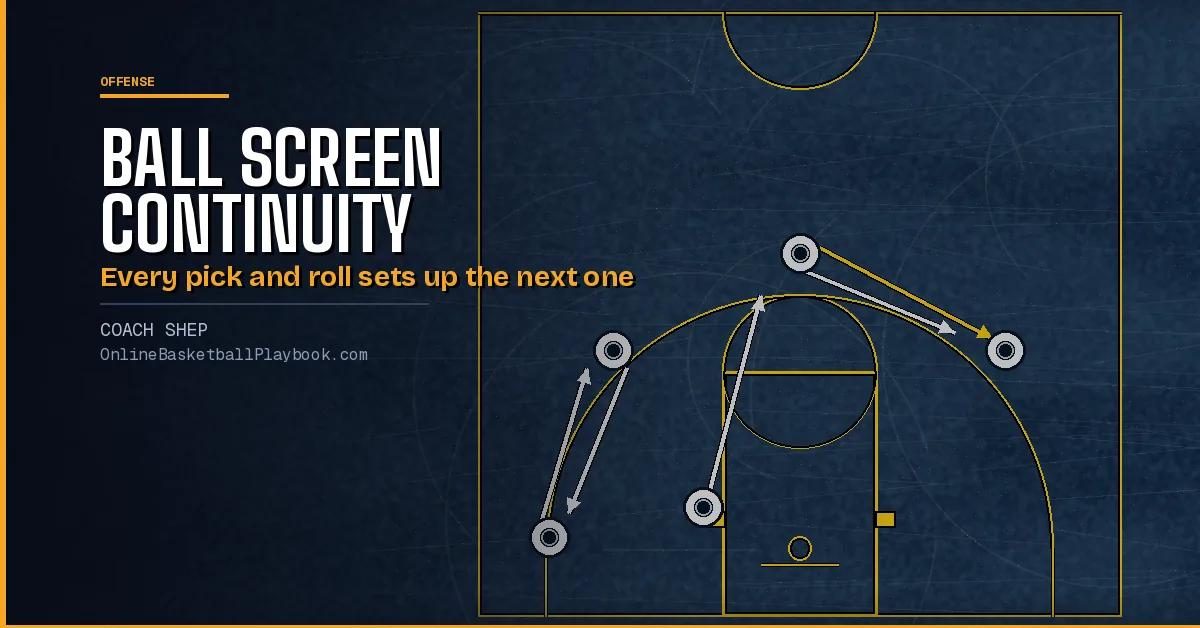
One pick and roll leads into the next by rule. In one 4-out version the guard at the top of the key throws to a wing and follows to set the ball screen, the two weak-side players interchange, the post lifts to the arc, and if nothing opens the same screen runs on the other side. The coaching point in that version is that the screener pivots and opens to the ball on the roll. Drills are on drills to teach ball screen continuity offense, and the defensive side is on how to defend ball screen continuity. Full guide: ball screen continuity offense.

Four corners
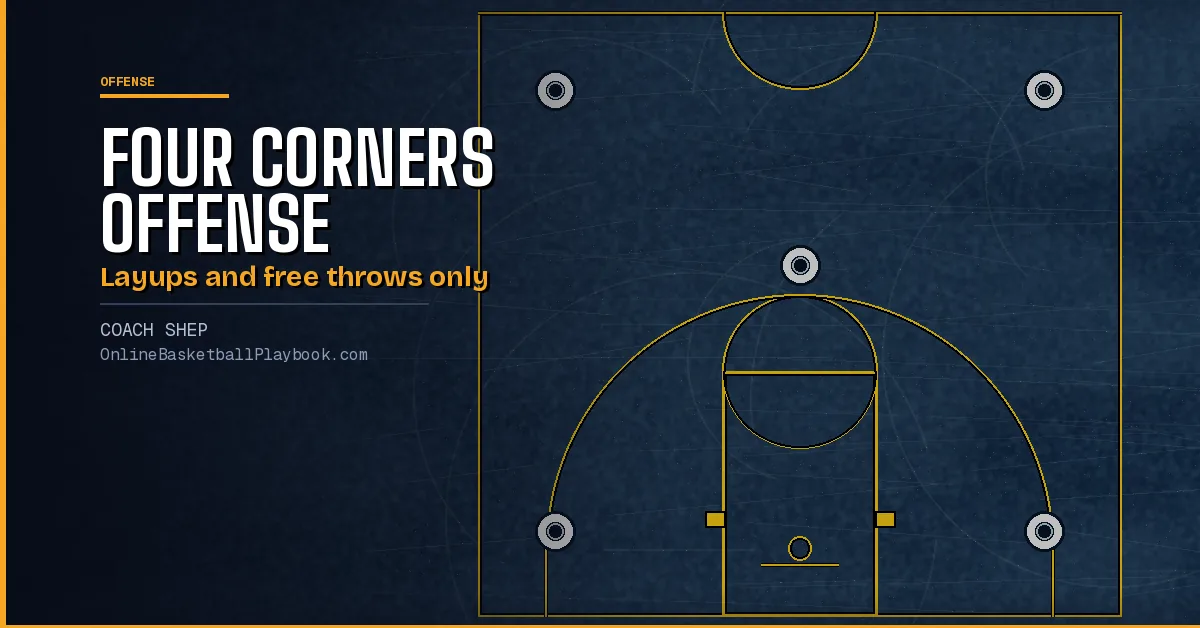
A delay offense with scoring built in, listed with the continuities in the scripted-action view. Full guide: four corners offense, and other ways to protect a late lead are on basketball delay game offense.
What Patterned Continuities Share
The continuities above look different on a whiteboard, but the same habits show up in each.
- A denial counter, often a back cut. The pattern runs until a pass is denied. A counter replaces that pass and the spot is refilled so the pattern resumes. In the flex, wheel and Princeton the denial counter is a back cut and a refill. The swing uses a back cut for a denied wing and a dribble-at for a denied slot, and the shuffle answers a denied point pass through the high post. One exception is an offense whose baseline back cuts fire when the ball reaches the middle post, not off a denial.
- Patience across several reversals. The open shot often comes after two or three reversals in the wheel, and one swing version says that offense is at its most dangerous after several reversals.
- A way back in. In the swing, each called play is built to fall back into the base pattern if it does not produce a shot.
- Interchangeable players. Because positions rotate, defensive switches can leave a big guarding a guard or a guard guarding a post, and several versions count those mismatches as a reason to run a continuity.

The cut reads behind those counters are on cutting in basketball.
Get the next coaching guide in your inbox
One email when a new guide or diagram set goes up. Free.
Strengths, Costs and Where Versions Disagree
Two views weigh continuities differently, and one point they disagree on is scouting.
| Version | Case for a continuity | Case against |
|---|---|---|
| Interchange view | Fits teams without strong inside post players, because players interchange positions and switching creates mismatches | Takes a fair amount of practice time to install, and running set patterns can keep young players from learning to read a defense |
| Scripted-action view | Scripted consecutive actions are hard to guard and quick to learn | Easier to scout and disrupt, so counters are required, and players can turn robotic |
| The shuffle's own case | Hard to scout, because each player's role changes from possession to possession, and substitution is simple | Not stated |
The flex adds one more cost: trouble with a defense that switches everything, which its coaches answer with corner options, read counters and named entries. How defenses attack the Princeton is covered on how to defend the Princeton offense.
Choosing a Continuity
The scripted-action view gives four factors for choosing any offense:
- Age and practice time. Its example: a youth team with one 30-minute practice cannot install the full triangle.
- A philosophy the coach believes in, such as freedom or control, fast or slow, post or three.
- Personnel. Shooters or posts, drivers or players who need screens, and where the best players want the ball.
- The fit with the defense. Its named example is the pack line paired with Mover-Blocker.
For young teams, the same view recommends a 5-out offense with three rules: cut to the basket after every pass, fill toward the ball when a spot opens, and back cut when denied. Its swing version makes the same point for youth teams with little practice time. The 5-out is covered on 5 out offense and its drills on 5 out motion offense drills. For installing a pattern, the wheel version says to drill the bare 4-man pattern until it is automatic before adding the high-post player.
Guides in This Section
- Princeton offense: the Chin set, high-post reads, the backdoor, personnel and install.
- Triangle offense: the sideline triangle, the line of deployment, the wing's reads and the weak-side actions.
- Flex offense: every version of the flex cut, the starting sets, the counters for switching, the drills and the teaching orders.
- Flex basketball plays: the named specials, the read counters and the pro sets built on a flex screen.
- Shuffle offense: five named jobs (first cutter, point, feeder, second cutter, post) that every player rotates through on a shuffle cut off the high post, with counters for denial and fronting.
- Ball screen continuity offense: the 4-out side-to-side continuity, the two-big lift, reload rules, second-screen layers (Spain, Ram, double drag) and answers to hedges, switches and zones.
- UCLA offense: the UCLA cut off the back screen at the elbow, the 2-3 high set, the high-post series and the counters for denial.
- Swing offense: the pass triggers, the full cycle, post entries, counters and set plays.
Want the printable playbook packs?
OBP Pro members get the premium playbook packs: the zone attack, out of bounds and practice plan PDFs, plus each new pack as it is finished. The membership page lists what is in each one. Or draw your own version free in PlayDraw.
See what OBP Pro includesQuestions Coaches Ask
What is a continuity offense in basketball?
A set sequence of passes, cuts and screens that flows from side to side and repeats without a reset, with counters for a denied pass.
What is the difference between a continuity and a motion offense?
A continuity repeats a pattern every player learns. Motion gives players rules and lets them choose the action from what the defense does.
What are examples of continuity offenses?
The flex, the swing, the shuffle, the UCLA high post, the wheel and ball-screen continuities. The scripted-action view also lists the triangle, the Princeton and the four corners.
Is the flex offense a continuity offense?
Yes. The cutter becomes the next screener and the pattern repeats side to side, so every player passes through every spot.
Are continuity offenses good for youth basketball?
The versions split. One says patterns can keep young players from learning to read a defense, and one recommends a three-rule 5-out for youth teams instead.
How do you beat a defense that denies a continuity?
With the built-in counter, which in many continuities is a back cut by the denied player and a refill of the empty spot.
More Guides From This Batch
- Swing Offense Basketball: Rules, Cuts and Counters
- 5 Out Motion Offense Drills: Install Steps and Live Games
- Basketball Rules and Regulations: Official Rules by Level
Back to every Offense page.
Keep Building
Related breakdowns
Ball Screen Continuity Offense: Pick and Roll Rules and Reads
Ball screen continuity offense in full: the 4-out and two-big engines, reload rules, spacing, angles, reads, counters, Spain, Ram, double drag and zone sets.
Four Corners Offense Basketball: Roles, Rules and Versions
Four corners offense basketball: the set, the chaser, the corner and post rules, three versions, when to run it, the shots it hunts and shot clock limits by level.
High Low Offense Basketball: Reads, Counters and Zone Rules
High low offense basketball explained: the two-post shell, the lob and bounce reads, answers to a front, down-screen reads, 1-4 low sets and the hi-lo against zones.