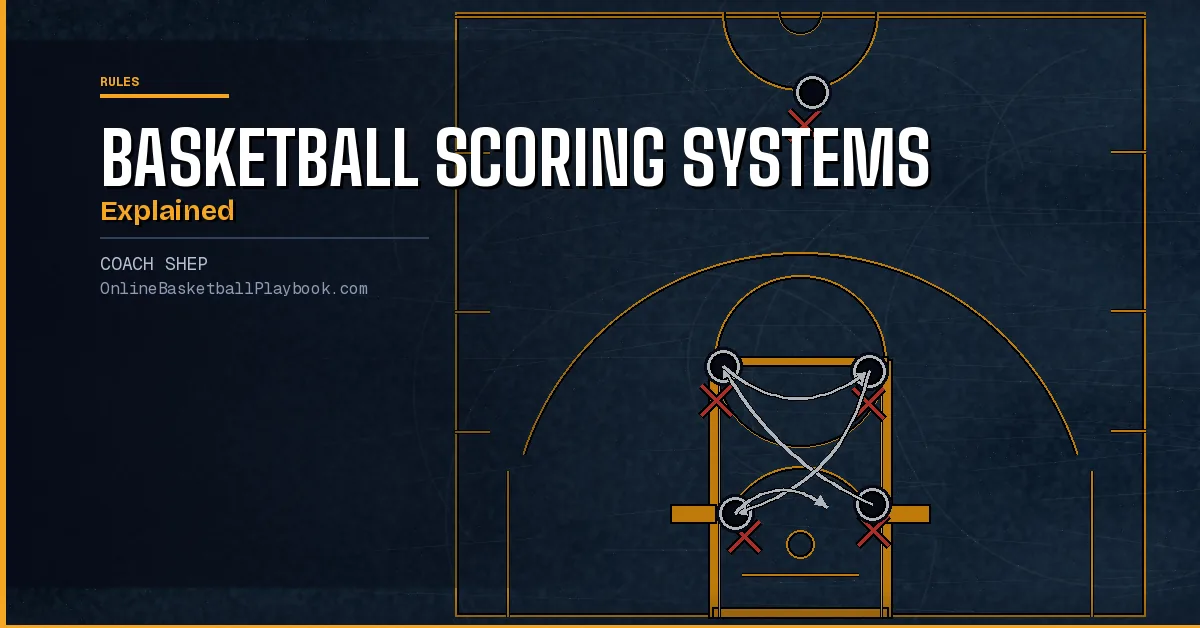
Basketball scoring is more than counting points. Coaches use specific systems to measure offensive efficiency, pace, and shot quality, numbers that tell a clearer story than the final scoreboard ever could.
Basic Scoring Rules and Point Values
Every basketball coach starts with the same foundation: a made layup or mid-range shot is worth 2 points, a shot from beyond the arc is worth 3, and a free throw is worth 1. But understanding when and why those point values matter, and how they compound over 32 or 40 minutes, is where coaching knowledge begins to separate itself from casual fandom.
At the youth and high school level, many coaches focus almost entirely on the scoreboard. Win or lose, that number at the end of the game feels like the whole story. The problem is that a final score tells you almost nothing about how a team produced those points or what they need to fix. A team can win 50–48 on a good night and lose by 20 using the exact same offensive approach the very next game.
The three-point line has reshaped how coaches think about point values. A team shooting 33% from three is scoring 1.0 point per attempt, identical to a team converting half of all two-point shots at 1.0 points per attempt. Understanding this math is the first step toward building a smarter offensive system. When your players know why certain shots are prioritized, they make better decisions in real time.
Free throws are the most underrated category in basic scoring. A team that draws 20 free throw attempts per game and converts at 70% earns 14 points from the line, essentially a free possession every time they get to the stripe. Teaching players to use proper footwork to attack the basket and draw contact is a direct investment in your scoring output, not just player development in the abstract.
Offensive Efficiency: Points Per Possession
Points per possession (PPP) is the single most useful metric a basketball coach can track. Instead of asking "how many points did we score?" it asks "how many points did we produce each time we had the ball?" The difference is enormous. A team that scores 60 points on 80 possessions is far less efficient than a team that scores 55 points on 50 possessions.
To calculate PPP: divide total points scored by total possessions. A possession ends with a made field goal, a made free throw on the final attempt of a trip to the line, a turnover, or a defensive rebound by the other team. Most coaches aim for 1.0 PPP as a baseline, anything above that is elite at the high school level.
When you track PPP by play type (transition, half-court set, post-up, pick-and-roll) you get a coaching roadmap. If your motion offense generates 0.85 PPP but your transition game produces 1.4 PPP, the answer is obvious: find more transition opportunities. Not every team can run and gun, but every coach should know their own numbers before building a game plan.
PPP also reveals the true cost of turnovers. A turnover isn't just a missed possession. It's a potential fast break for the opponent on the other end. Some coaches calculate "turnover-adjusted PPP" that accounts for the expected opponent points generated from each live-ball turnover. It sounds technical, but the practical result is simple: value the ball, and your scoring efficiency improves automatically.
Shot Quality and the Value of Each Attempt
Not all shots are equal, and modern coaching increasingly treats shot selection as a skill that can be developed and measured. The concept of "expected points" assigns a value to each shot location based on historical make rates, and the results challenge a lot of conventional basketball wisdom.
The hierarchy of shot quality, ranked by expected points per attempt, generally looks like this: layups and dunks at the rim (highest), corner threes, above-the-break threes, mid-range jumpers (lowest). The mid-range shot is the statistical villain of modern basketball. It's harder to make than a layup and worth fewer points than a three. That doesn't mean you never take one, but it does mean you should have a specific reason when you do.
For youth and high school coaches, the lesson isn't to eliminate the mid-range, it's to build your offense around the highest-value looks. If your offense consistently generates corner threes and layups, your scoring floor is significantly higher than a team that settles for pull-up mid-range jumpers off isolation plays. Drilling proper shooting form from the spots that actually matter is more efficient than practicing every shot on the floor equally.
Shot quality also includes the concept of "contested vs. uncontested." A wide-open three-pointer and a heavily contested three-pointer are both worth 3 points if they go in, but their expected values are wildly different. Offense that moves the ball and forces rotations, like the 5-out motion offense: is specifically designed to generate uncontested looks by spacing the floor and punishing help defenders.
Pace, Tempo, and How They Affect Scoring
Pace refers to the number of possessions a team uses per game. A fast-paced team might play 75 possessions per 40 minutes. A slow, deliberate team might hold that number under 55. Neither approach is inherently superior, but both have major implications for how you score and how you scout opponents.
A high-pace team scores more points in absolute terms simply because they have more possessions. That makes raw scoring totals misleading. A team averaging 70 points per game at 75 possessions is actually less efficient than a team scoring 62 points on 55 possessions. This is why pace-adjusted statistics became essential at the professional and college levels, and why savvy high school coaches now think the same way.
Tempo is also a strategic weapon. If your opponent has a dominant post player who controls the low block, pushing pace and getting into transition takes them out of their preferred sets. If you're physically outmatched, slowing the game down reduces the number of possessions your opponent can exploit their size advantage. Every coaching decision about tempo should be tied to your personnel and the specific opponent you're facing that week.
Running an effective fast break requires more than just speed. It requires discipline and spacing. The best transition teams make smart decisions about when to push and when to reset. Knowing how to run the fast break systematically means your players aren't just freelancing. They're executing a scoring system at high speed, which dramatically increases efficiency.
Defensive Scoring Systems and Opponent Efficiency
Scoring systems aren't just for offense. Defensive rating (opponent points per 100 possessions) is the mirror metric every serious coach should track. A team that holds opponents to 0.75 PPP is playing elite defense, regardless of what their offense looks like on a given night.
Understanding how your defense limits opponent scoring starts with identifying where they want to attack. Some teams live in the paint. Others are built around the three-point line. Some are pick-and-roll heavy. Your defensive system should be tailored to take away the opponent's most efficient shot attempts, which requires knowing what those attempts are before tip-off.
Zone defenses like the 2-3 zone are specifically designed to limit paint scoring and force opponents into lower-percentage mid-range or perimeter attempts. The tradeoff is corner threes. A well-executed zone can give up a lot of corner looks if the rotations break down. Understanding that tradeoff is part of building a complete defensive scoring system.
Man-to-man defense, by contrast, can be more adaptable to individual matchup advantages but requires better individual defenders who understand help principles. Your defensive scoring system is only as good as your players' willingness to make the right rotational decisions under pressure. Tracking opponent PPP weekly gives you objective feedback on whether your defensive concepts are translating to the court.
Before you can fix your offense or defense, you need a baseline. Start tracking points per possession for your team and your opponents over a three-game sample. The patterns you find will tell you exactly where your system is breaking down and where it is thriving.
Applying Scoring Systems to Practice and Game Planning
The real value of understanding scoring systems is how they reshape your practice design. When you know your team generates 0.6 PPP out of your half-court sets but 1.3 PPP in transition, you don't just note the stat. You reorganize your practice time to develop the habits that generate more transition opportunities.
A well-designed basketball practice plan reflects the scoring priorities you've identified through data. If your team is strong in the paint but weak from the perimeter, your shooting drills should emphasize getting open shots from the areas where your personnel can convert. Drilling five pull-up mid-range shots per player per practice makes little sense if your data shows those shots produce 0.7 PPP and your team has two quality shooters from the corner.
Game planning against specific opponents also becomes sharper when you use scoring systems. Before a game, identify your opponent's top-three shot types by PPP. Your defensive preparation should prioritize limiting those exact looks, even if it concedes higher volume on their weaker shot types. This is not abstract analytics; it is targeted preparation that gives your players a clear job on every possession.
For youth coaches especially, framing scoring systems in simple terms can be a powerful teaching tool. When a player understands that a layup is worth roughly twice as much as a contested mid-range shot, they start to self-correct their shot selection in real time. That kind of basketball understanding is the foundation of long-term basketball IQ development: players who understand the "why" make better decisions without needing to be coached on every possession.
- Track PPP weekly: divide total points by total possessions for both your team and your opponents. This single number reveals more than any scoreboard.
- Prioritize high-value shots: layups, corner threes, and free throws are your most efficient scoring opportunities. Build offensive sets that generate them.
- Know your pace: count possessions in practice and compare to game film. Discrepancies reveal where your team wastes possessions on dead-ball turnovers or poor shot clock management.
- Match tempo to personnel: if your team is small and quick, push pace; if you have a dominant interior player, slow the game down and get them 15–18 touches per game.
- Use defensive rating in film sessions: show players exactly which shot types the opponent scores on. Giving them a visual of the "problem" makes your defensive game plan concrete and memorable.
- Reward shot quality, not just makes: a player who consistently gets to the rim or corners is doing more for your scoring system than a player who takes heavily contested mid-range shots and happens to be hot that night.
Scoring systems ultimately exist to remove guesswork from coaching. They give you an honest picture of where points come from, which habits create them, and which ones silently drain efficiency. The coaches who master these concepts don't necessarily have the most talented rosters. They just deploy their personnel in the situations where they're most likely to succeed, and they do it consistently enough that the math compounds over a season.
Get free play diagrams, drills, and coaching guides delivered weekly.
Draw this play free in the play drawer →
Membership: the full library, playbook packs, and Pro drawing tools →
Keep Building
Related breakdowns
3x3 Basketball Rules: FIBA Scoring, Clock, Check-Ball and Fouls
3x3 basketball rules from the FIBA rulebook: teams, scoring, the 21-point win, the 12-second clock, check-ball, clearing the ball, fouls and penalties.