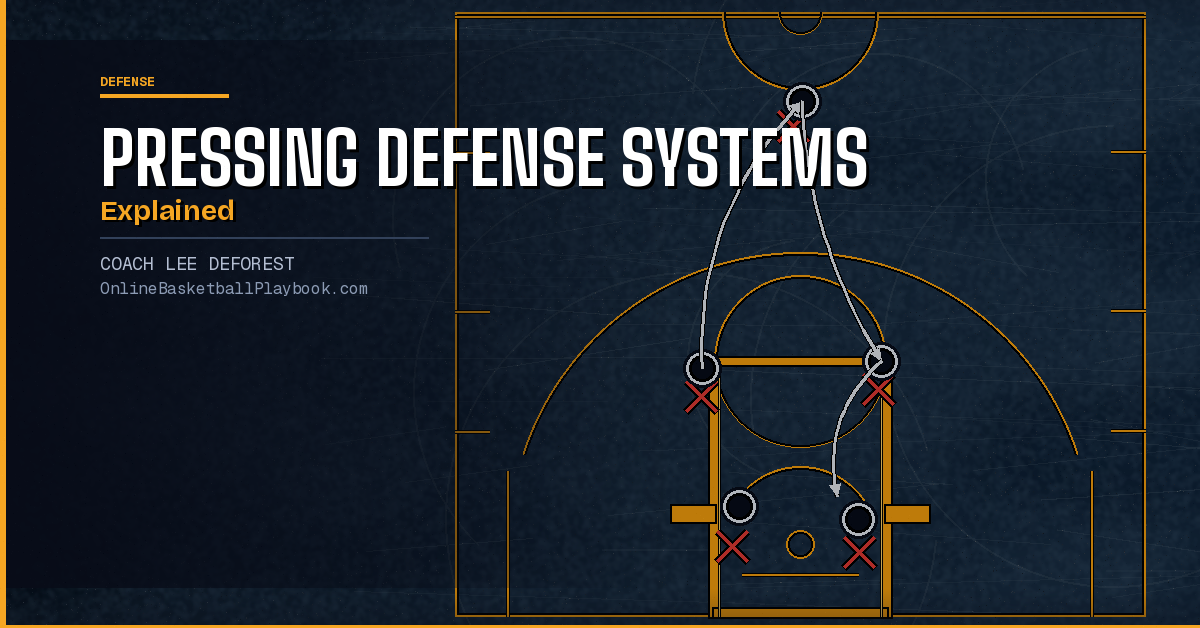

Pressing defenses extend pressure the full length of the floor to force turnovers, disrupt tempo, and put opponents in uncomfortable situations. Understanding the major press families helps coaches choose and install the right system for their roster.
Why Teams Use Pressing Defense
Most coaches think of pressing as a desperation tactic — something you pull out when you're down twelve in the fourth quarter. That framing undersells what pressure defense can actually do. The best pressing programs use it as a primary identity, not an emergency lever. Pressing forces the opponent to play faster than they want to, make decisions they haven't prepared for, and execute under physical and mental stress. When it works, it doesn't just produce turnovers — it changes the entire emotional tone of the game.
The key distinction top coaches make is between turnovers as a goal versus turnovers as a byproduct. Teams that chase turnovers get out of position, gamble, and give up easy baskets. Teams that press with structure — controlling the middle of the floor, dictating pass directions, and trapping in defined areas — create turnovers organically because opponents make errors under consistent pressure. That mindset shift separates good pressing teams from reckless ones.
Pressing also changes what your transition defense looks like. When your players are already moving, communicating, and pressing up the floor, they naturally transition into a structured half-court defense with more purpose. The habits built in pressing — reading the ball flight, declaring quickly, matching up — carry directly into every other defensive possession.
Another underrated benefit is practice value. Teaching a press forces your players to communicate in real time, develop better court vision, and improve their ability to read live situations. Those skills transfer everywhere. A team that learns to press well becomes a better defensive team overall, even in possessions where they don't press at all.
The Major Press Families
Pressing defenses divide into two broad families: zone-based presses and man-based or read presses. Zone presses assign responsibilities by area of the floor rather than by individual matchup. Man-based presses, including the run-and-jump family, start from individual assignments but allow players to switch, trap, and rotate based on reads. Each family has advantages, and the best programs often carry one from each column so they can change the look at halftime.
Within the zone press family, the key variable is the formation number — how many defenders press at the ball versus how many drop into coverage. A 1-2-1-1 puts maximum pressure at the ball with a point defender and a stealer in the middle of the floor, protected by a single basket defender. A 2-2-1 concedes the inbounds pass and traps the receiver with two defenders, using two midfield players and a deep protector. A 1-2-2 sits between those extremes, with a point man and two wing-level defenders who either trap or deny.
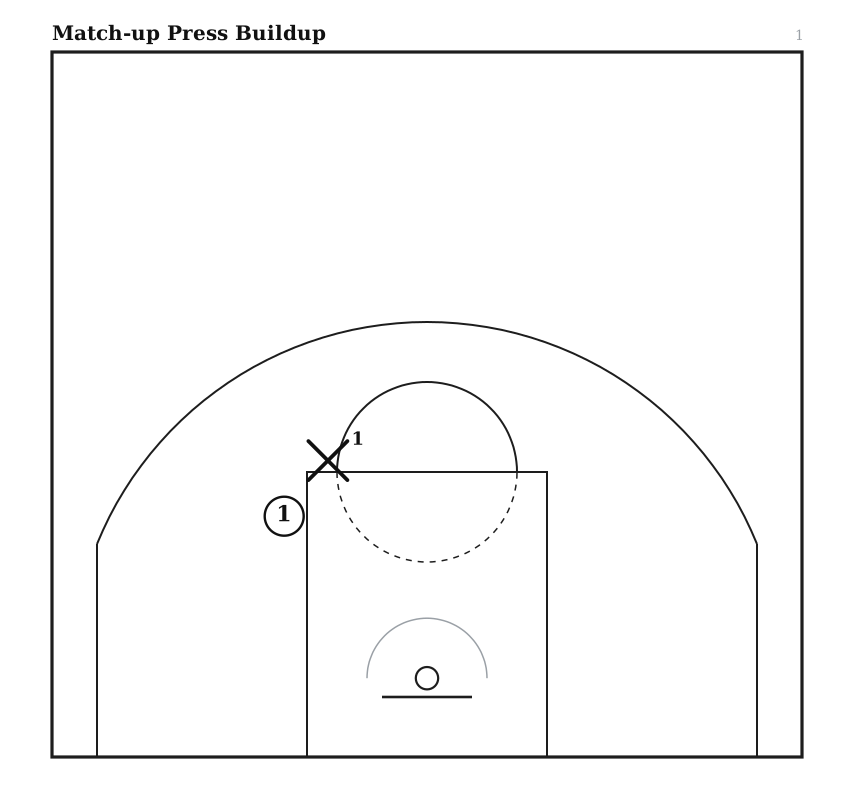
The man-based presses include the classic run-and-jump, where defenders switch on ball handlers who put their head down and dribble, and match-up presses that look like zone from a distance but assign individual responsibilities based on where the offense sets up. Coaches like Tubby Smith have used hybrid systems where the press structure — box (Black) after perimeter makes, diamond (White) after layups — changes based on where the last score happened.
Zone Press Systems: 1-2-1-1, 1-2-2, and 2-2-1
The Georgetown 1-2-1-1 is one of the most aggressive zone press systems in the game. It puts four defenders on or near the ball with only one player protecting the basket. The point defender pressures the inbounder, wing defenders cover the first pass options, a stealer (often the most instinctive defender on the team) plays the passing lanes in the middle, and the fifth player protects the rim. The philosophy is aggressive: you're betting that four defenders can generate a turnover before the ball gets to the stealer or past him.
The 1-2-2 — sometimes called the "Abel" formation — operates on a slightly different logic. It concedes the inbounds pass and dares the receiver to do something with the ball. The point man approaches from an angle designed to funnel the dribbler toward the sideline, while one wing attacks to form a two-man trap. The opposite wing rotates to steal the predictable escape pass. The two back players split responsibility between the middle of the floor and the basket. The genius of the 1-2-2 when it's installed as a program identity, as Wes Miller did at UNC-Greensboro, is that it becomes an entire philosophy: control tempo, dictate ball movement, and drop cleanly into a 2-3 zone when the press doesn't produce a turnover.
"Turnovers are a byproduct, not the measure."
— Basketball Vault
The 2-2-1 is often described as the most conservative of the zone press families. Two defenders apply pressure at the ball on the inbounds pass, two midfield players cut off the advance, and one player protects the basket. It gives up a little early aggression in exchange for better half-court shape when the press is beaten. Many coaches use the 2-2-1 as their base press precisely because it's harder to defeat with a quick vertical pass — the midfield tandem takes away the easy lane, and the press still produces delay and disruption even without a clean trap.
When teaching any zone press, the court-in-thirds concept is essential. Divide the floor into three vertical sections: the inbounds third, the middle third, and the far third. The cardinal rule across all zone presses is that the ball must never travel easily through the middle third. A ball that splits the press through the center of the floor typically produces a layup. Every alignment decision in a zone press is designed to keep the ball on the sideline, where the boundary itself becomes an extra defender and trap angles improve dramatically.
Match-Up and Run-and-Jump Presses
The run-and-jump press operates on a simple but psychologically devastating principle: your defender peels off the ball handler and traps him from behind, while a teammate who was guarding a different player takes over on the ball. From the dribbler's perspective, his defender just disappeared and a new one materialized from nowhere. The instinct is to stop, pick up the dribble, and look — which is exactly the moment the trapping defender arrives. Done well, the run-and-jump generates more confusion than almost any other press because it attacks the dribbler's vision and decision-making rather than simply trying to steal the ball.
The key to a functional run-and-jump is timing and communication. The trapping defender can't leave his man until the primary defender calls the switch and commits to the new assignment. Teams that try to run-and-jump without a clear communication system give up the ball to the open man every time. The switch must happen on the dribbler's blind side, fast enough that he can't react before picking up his dribble. This takes significant practice — it's one reason building it into your basketball practice plan as a dedicated drill segment pays dividends faster than working it in sporadically.
Match-up presses, used by coaches like Tubby Smith, add a wrinkle by varying the press structure based on how the last possession ended. Trapping after a perimeter make (Black/Box) versus trapping after a layup (White/Diamond) sounds like a small adjustment, but it means the offense can never fully predict what alignment they're walking into after a score. The defensive players who execute these presses need excellent basketball IQ — reading the situation quickly, communicating the call, and adjusting their position within two seconds of the score.
Trapping Rules and Ball Containment
Every pressing system relies on trapping principles that are shared across formations. Understanding these principles lets coaches teach the press more efficiently because players can transfer rules from one look to another. The core trapping rules: the trap must be formed in a designated area (not ad hoc), both trappers must arrive at roughly the same time, and the remaining three defenders must rotate immediately to cover the three most dangerous passes.
Trap areas in most systems are the corners of the floor — particularly the half-court sideline corners — and occasionally the deep corner. Trapping in the open floor is risky because the offense has too many angles to pass the ball. Trapping in a corner removes one or two pass options entirely, improving the odds that the ball handler makes a predictable decision. In the Wes Miller 1-2-2, the automatic trap area is roughly six to eight feet on each side of half court along the sideline — a defined zone, not a judgment call.
Ball containment is the discipline that separates effective press traps from gambling ones. Both trappers must stay close enough to the ball handler to prevent an easy dribble escape, but not so close that a single spin move blows past both of them. Their feet should cut off the baseline and the middle simultaneously. The non-trapping defenders must read the ball handler's eyes, not their feet — experienced ball handlers will look away from their intended pass, and defenders who watch feet instead of eyes get faked out of position.
Installing a Press: Practice and Personnel
A press is only as good as the practice reps that build it. Most programs make the mistake of only drilling the press against their own offense, which means they see the same sets and the same tendencies. The most valuable press practice involves drilling the rotations dry — walking through where each player goes on each pass — before adding live resistance. Players need to understand the system's logic, not just memorize positions, so they can adapt when the offense does something unexpected.
Personnel matters enormously. The point man in a zone press — the defender who plays at the top — needs to be your best communicator and your savviest defender, not necessarily your fastest. He dictates the entire shape of the press. If he funnels the ball the wrong direction, every other defender adjusts incorrectly. The wings need athleticism and the ability to sprint on the flight of the pass — they have to cover large amounts of ground and arrive at their spot before the ball gets there. The back two need length, instincts, and the discipline to stay home and not gamble for interceptions that leave the basket exposed.
Conditioning is non-negotiable. A press that runs for 32 minutes requires significantly more from players than a half-court defense does. If your team isn't in excellent basketball conditioning shape, the press becomes a liability in the fourth quarter when the defense breaks down at the moments of highest importance. Programs that make the press a primary identity typically run more and condition more than their opponents — the press isn't a tactic they use, it's a standard their practices are built around.
Before installing a zone press as your primary defense, you need at least one elite communicator at the point, athleticism at the wings to sprint on pass flight, length in the back to protect the basket, and a team that can transition back cleanly when the press is beaten — otherwise you'll give up more than you take.
Defending the Press Break
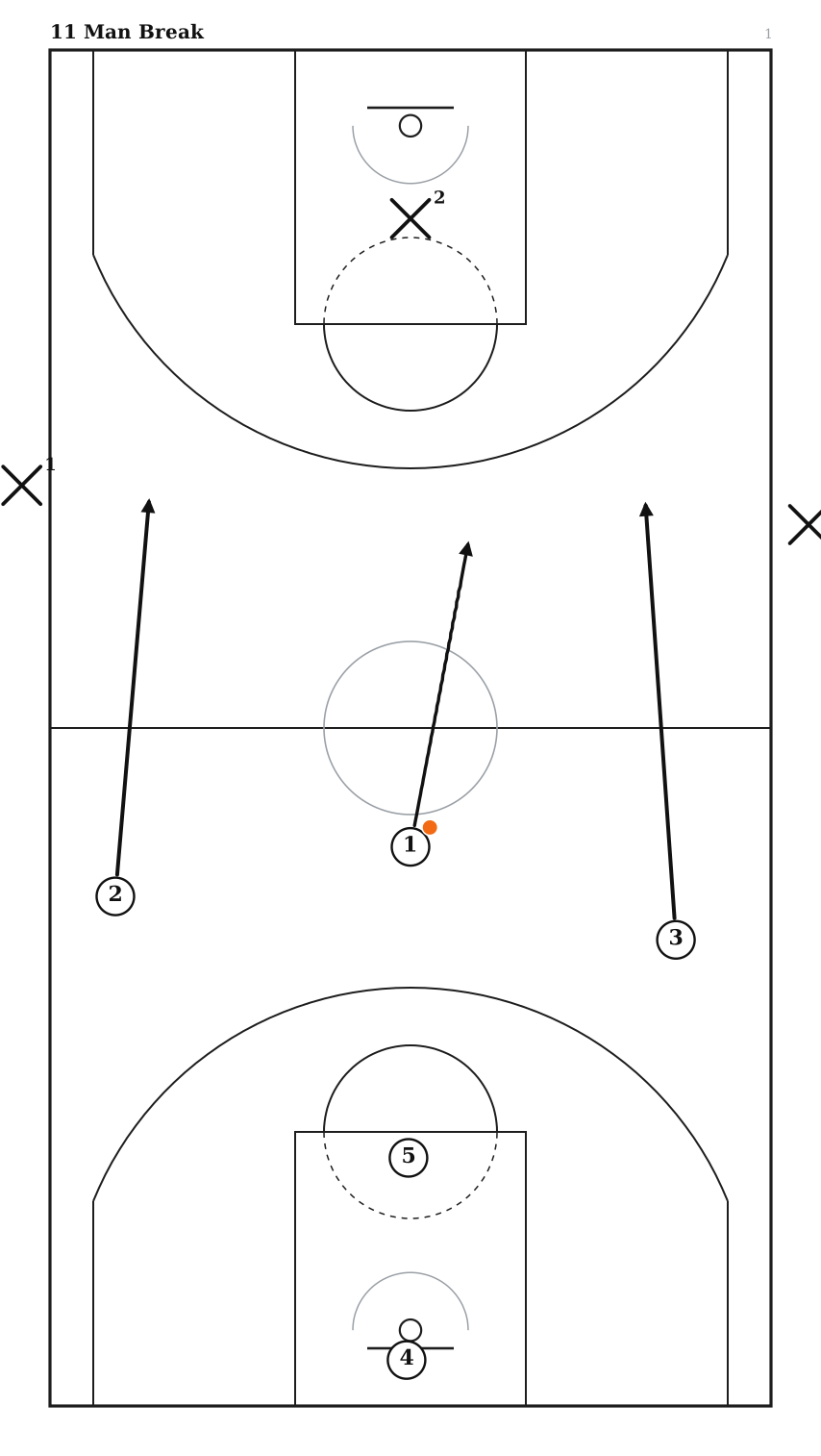
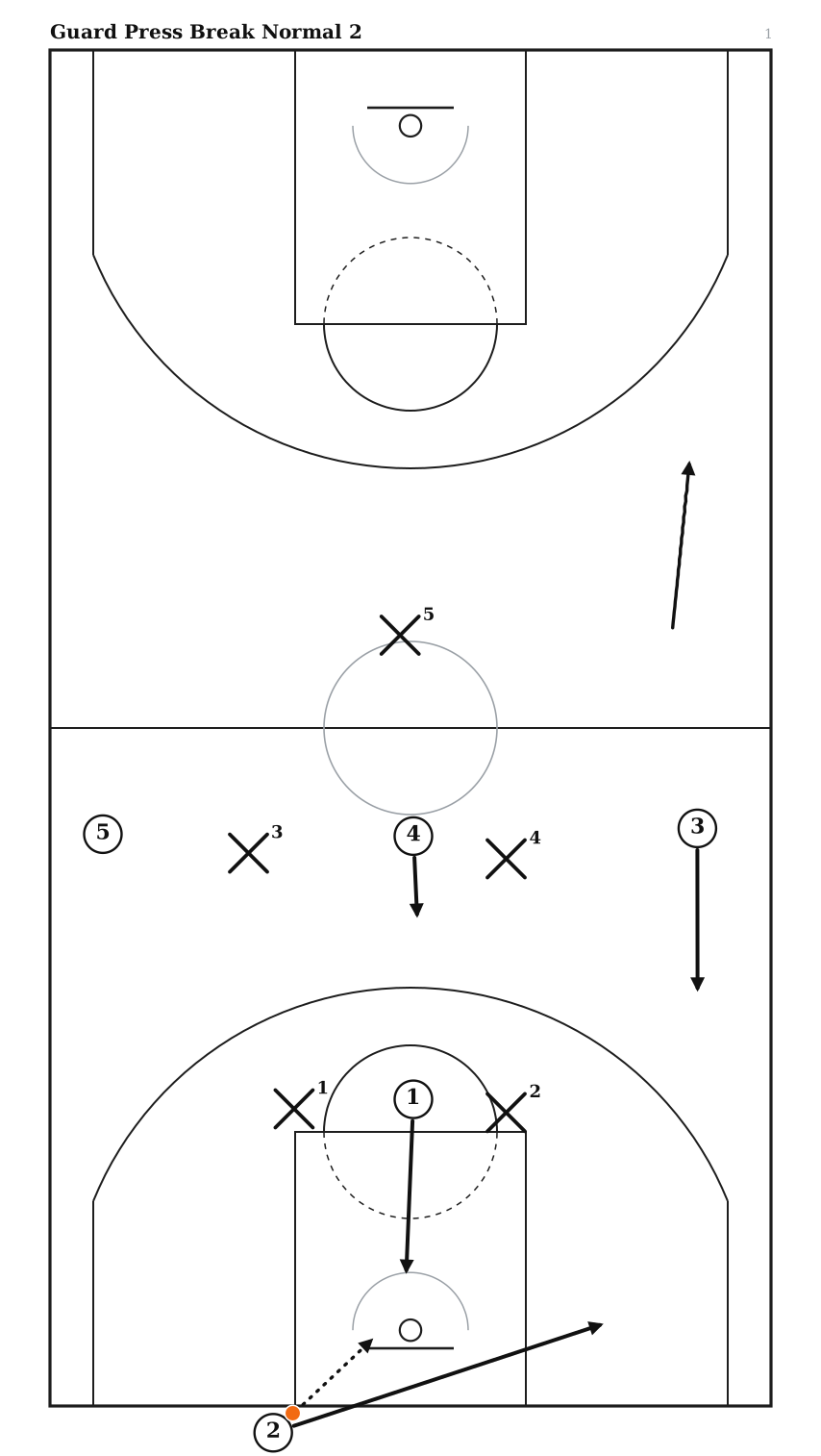
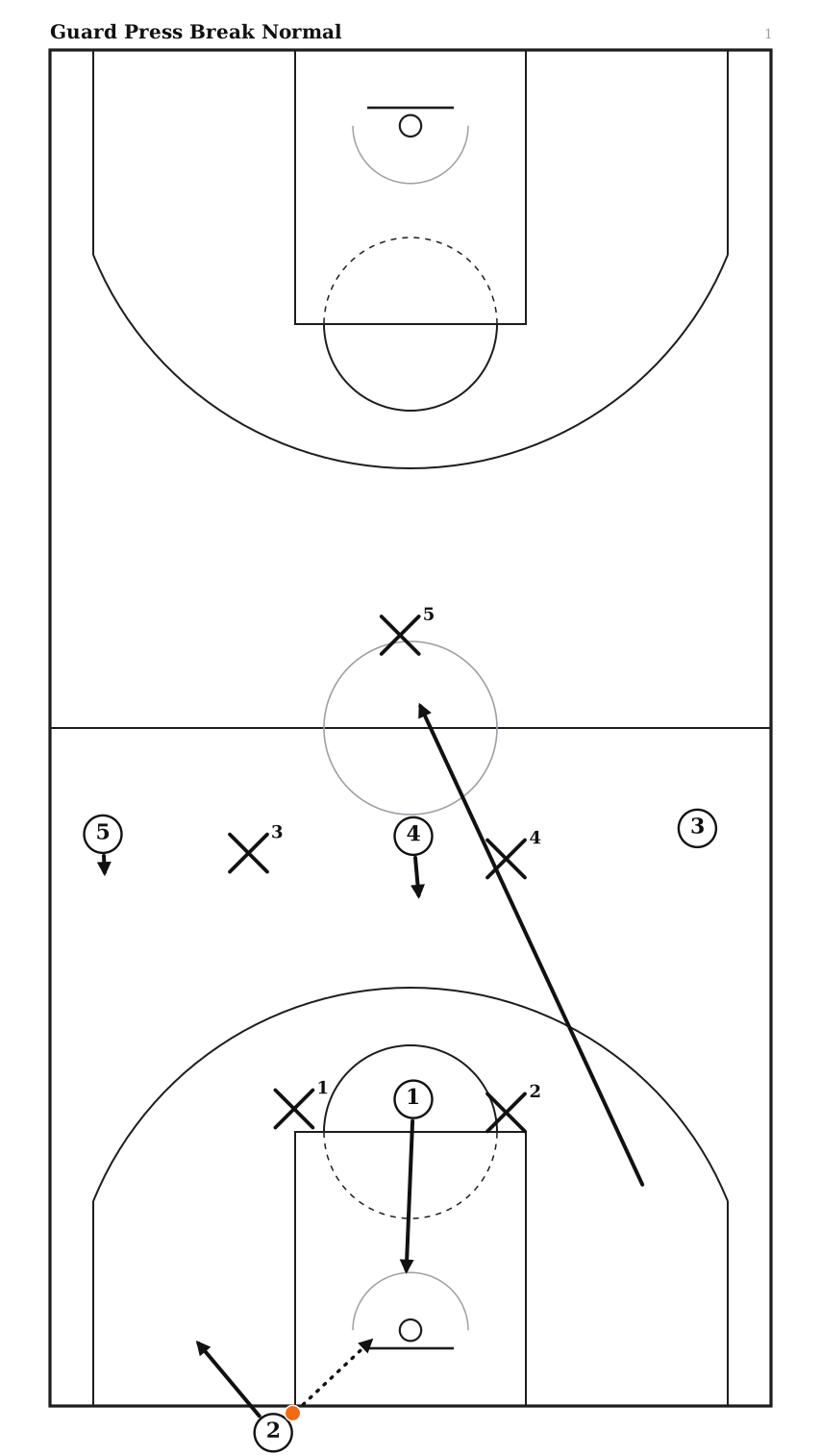
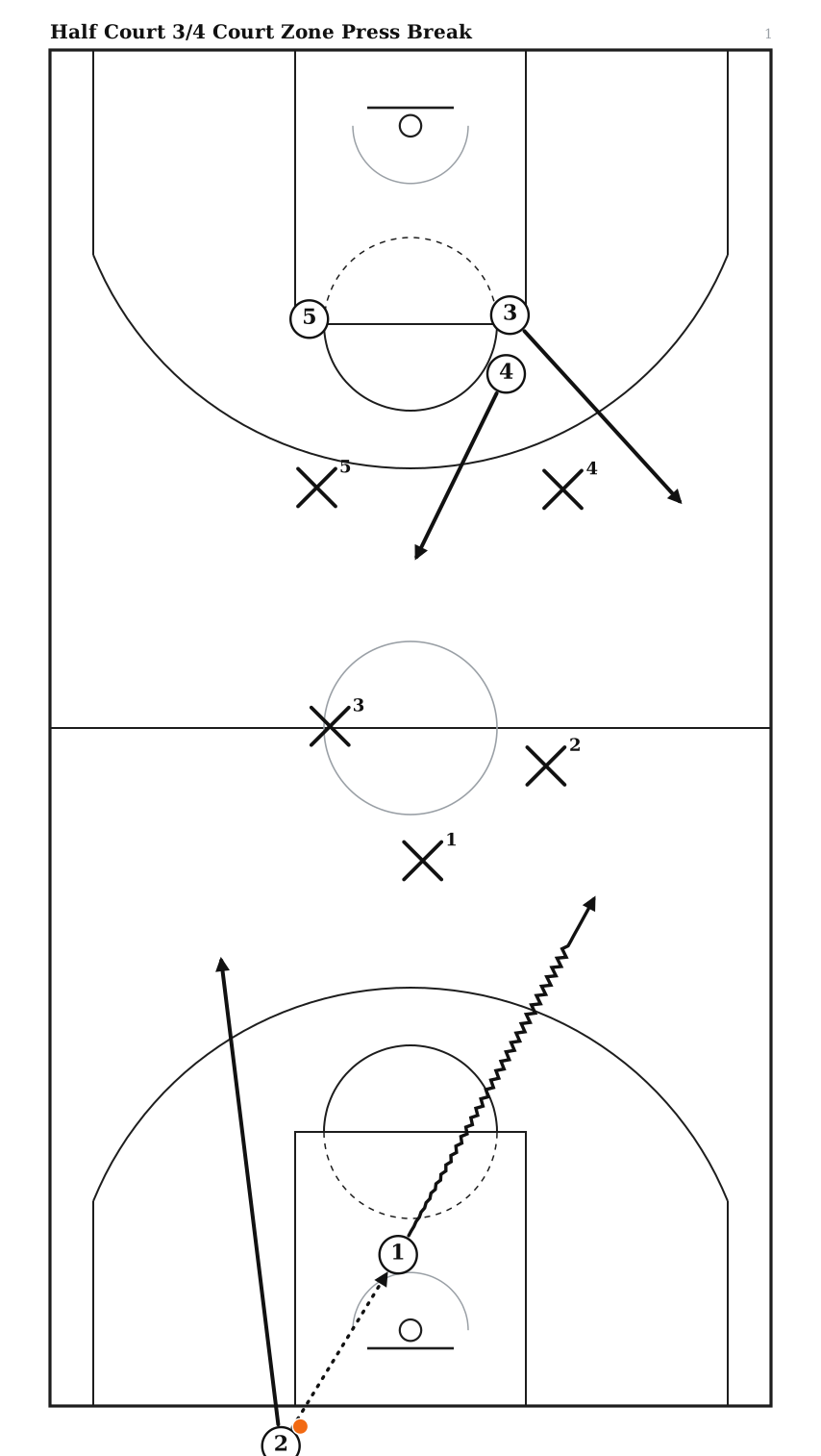
Pressing teams must accept a counterintuitive responsibility: they need to understand press breaks as well as offensive teams do. If your players don't know the most common ways to attack a press, they can't anticipate them. The standard press break uses a point man who catches in the middle, two wings who spread wide, a trailer who fills the high post, and a safety who stays deep. Every variation on this theme is designed to put a defender in conflict — either trap the ball and leave the wings open, or stay home and concede the ball to the middle.
The answer for pressing teams is to take the middle away first, then trap. If the point man in the press never lets the ball get to the center of the floor, the offense is forced to work the sidelines — which is exactly where the trap is waiting. Teams that study the press break from the offensive side become better pressing teams because they understand what the offense is trying to do and can position their defenders to disrupt those intentions at the source.
When the press is beaten cleanly, the discipline to recover and get back into half-court defense matters. Pressing teams that panic and reach after getting beaten create foul trouble and give up and-ones. The rule is simple: if the ball beats the press, sprint back and get into your half-court shell rather than chasing the play from behind. The press exists to produce turnovers and tempo advantages — it cannot also be your last line of defense.
- Court in thirds: Divide the floor — ball out of the middle third is the top rule in every zone press system.
- Declare on the flight: Every player must identify their assignment the moment the pass is in the air, not after it lands.
- Trap areas only: Trap in corners and sideline zones, never in the open floor where the offense has too many angles.
- Point man = communicator first: Sacrifice athleticism for instinct and IQ at the top of the press — he sets everything else.
- Sprint back when beaten: Beaten press = get into your half-court defense immediately; never chase from behind or reach.
- Drop to zone off the press: A 1-2-2 naturally becomes a 2-3 zone — plan the transition so it's a feature, not an accident.
- Condition for 32 minutes: A press you can't run in the fourth quarter is a press you can't use — conditioning is installation.
Get free play diagrams, drills, and coaching guides delivered weekly.
See it drawn up
Related diagrams
Keep Building
Related breakdowns
Continuity Offense Basketball: Systems That Never Stop
Continuity Offense Basketball: Systems That Never Stop