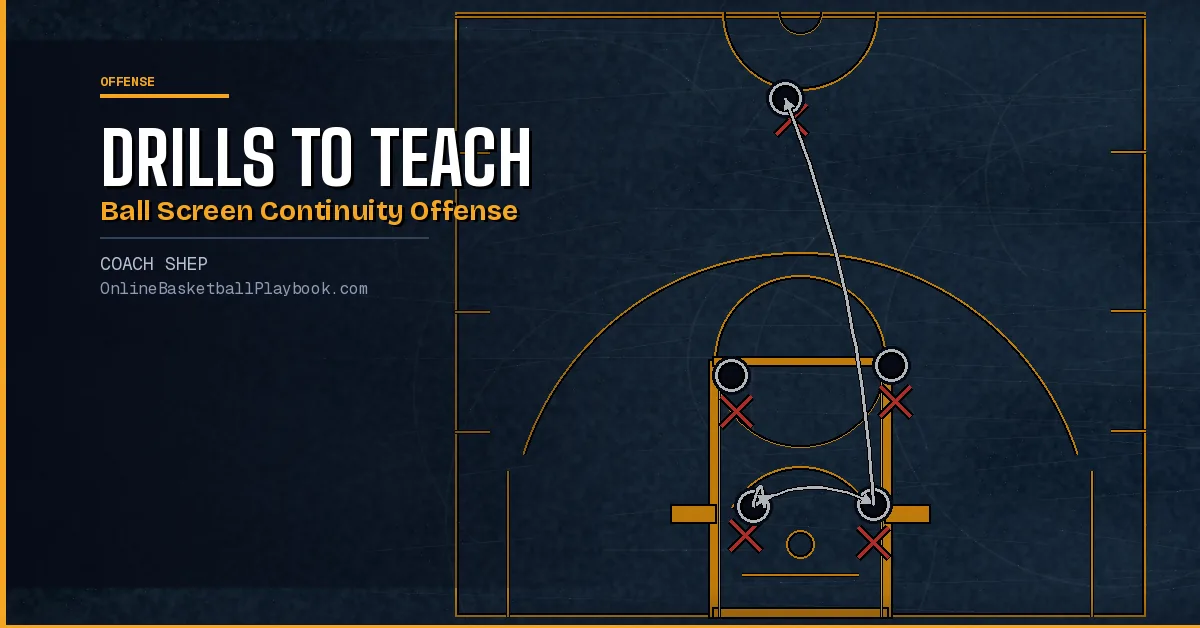
Ball screen continuity only works when players read the defense, not the play. These drills teach the right habits (spacing, roll vs. pop, and off-ball movement), so your offense flows automatically.
Why Continuity Comes Before Plays
Most coaches make the same mistake when installing ball screen offense: they teach the play before they teach the read. Players memorize the diagram, run it once against air, then freeze on the first defensive switch they see. Continuity collapses because nobody knows what comes next.
The fix is simple, but it takes discipline. You build ball screen continuity from the inside out, starting with the reads individual players must make, then linking those reads together into a continuous offense that never stops moving. Think of it less like a play and more like a set of rules your team applies automatically based on what the defense gives them.
This approach comes directly from read-based motion principles. Every ball screen action is really three decisions happening at the same time: the ball-handler reads the coverage, the screener reads the help, and the three off-ball players read where their defenders go. When all five players make correct reads simultaneously, the defense has no answer. When even one player stands and watches, the defense recovers and the possession dies.
The drills in this guide are built around a simple progression. You start with one player and one screen. You add a defender. You add a second action. You finish with live five-on-five where the reads are automatic. Take your time with each step because players need to own the base read before you layer the next one on top.
Drill 1: Screen Angle and Body Position
Before you run a single ball screen in your offense, your players need to set screens correctly. A bad screen angle is the root cause of more ball screen breakdowns than any other mistake. If the screen is set at the wrong angle, the ball-handler has no room to use it. If the screener's feet are too close together, the defender bumps through without slowing down. Get this right first, and everything else becomes easier.
Setup
Start with no defenders. Place a ball-handler at the top of the key and a screener at the elbow on the same side. The ball-handler dribbles toward the screener. The screener's job: set a screen with feet shoulder-width apart, knees bent, arms crossed on the chest, and body angled so the ball-handler can come off either shoulder.
Teaching Points
The screener calls out the screen with a verbal cue ("Ball!" or "Fist!" depending on your terminology) before arriving at the screen position. The ball-handler waits for the screener to be set (both feet planted) before using it. This one habit eliminates most illegal screen calls.
Angle matters more than most coaches emphasize. The screen should be set perpendicular to the path you want the ball-handler to take. For a side ball screen, the screener's body faces the baseline, opening a lane toward the lane line. For a top ball screen, the screener faces the sideline, opening a lane toward the middle. Spend ten minutes on angles alone before adding any reads.
Progression
After five reps with no defense, add a token defender guarding the screener (no live defense on the ball yet). The screener now must hold the screen until the ball-handler clears, then react. This is where you introduce the roll and the pop as finishing moves, which feeds directly into Drill 3.
Drill 2: Ball-Handler Three-Option Reads
The ball-handler in a ball screen offense has three primary options on every action. Your players need to see all three before they can consistently make the right choice. This drill forces them to read rather than predetermine.
The Three Options
Option one: drive off the screen. The ball-handler turns the corner and attacks the lane when the on-ball defender goes under the screen or gets stuck on the screener's body. This is the primary read when the defense hedges soft or switches late.
Option two: pull up off the screen. When the on-ball defender fights over the top and crowds the space, the ball-handler uses the screen as a springboard for a pull-up jumper at the elbow or short corner. The screen creates separation; the pull-up punishes the aggressive coverage.
Option three: pass to the roll or pop. When the defense sends a hard hedge or a double, the ball-handler rejects the initial read and delivers to the screener cutting to the basket (roll) or stepping to open space (pop). This is the most important read to develop. It attacks the help, not the original coverage.
Drill Structure
Run this as a three-read rotation with a single live defender on the ball. The coach or a manager signals the defensive coverage from the sideline (hedge, go under, or switch) so the ball-handler must react rather than plan. Start at half-speed and increase the pace as reads become automatic over multiple practices. Keep reps short: six reads per player, then rotate. Quality over volume.
Drill 3: Roll vs. Pop Decision Drill
The screener's decision (roll to the basket or pop to open space) is the second half of every ball screen read. Most teams drill the ball-handler's options thoroughly and ignore the screener entirely. That is a mistake. An untrained screener holds their position after setting the screen and waits to see what happens. A trained screener reads the defense in real time and attacks the most open path the moment they feel the ball-handler coming off.
Roll Read
The screener rolls when their defender commits to helping on the ball-handler. The read trigger is simple: if the on-ball defender gets hedged hard or if the screener's defender steps up to help, the screener seals their defender with a shoulder, rolls toward the basket, and puts their inside hand up as a target. The roll works when the defense is scrambling to stop the ball. The basket is open because nobody stayed home.
Pop Read
The screener pops when their defender does not commit to help. If the on-ball defender switches cleanly or the screener's defender stays attached, rolling puts the screener into a crowd with no advantage. Instead, the screener steps back to an open area (usually the elbow or the three-point arc at the wing) and presents a catch target for a pull-up or a drive read. The pop works when the defense stays organized. The screener attacks the open space the defense left when it did not help.
Drill Structure
Set up a two-on-two action with one ball-handler and one screener, guarded by two defenders. The defenders alternate their coverage each rep. The coach calls "Go" and both defenders play their assignment, one fighting over the screen and one either helping or staying attached to the screener. The screener must read and react within one second of the ball-handler clearing the screen. No hesitation. Score the drill: one point for a correct roll or pop decision regardless of whether the shot goes in, zero points for the wrong read even if the shot falls. Correct reads are the goal, not buckets.
Run the roll vs. pop drill at the beginning of practice three or four times per week during your ball screen installation phase, not just once and done. Players need distributed repetition across multiple sessions before these reads become automatic in a game. Ten focused reps per player per practice builds far better habits than thirty reps crammed into a single session and then abandoned for two weeks.
Drill 4: Off-Ball Spacing and Movement
The three players not involved in the ball screen action make or break the entire offense. If they stand still and watch, every defensive helper can cheat toward the screen without consequence. If they space correctly and move on cues, the defense is stretched thin and the ball screen attacks five defenders simultaneously instead of two.
Spacing Principles
The three off-ball players maintain spacing by filling the strong-side corner, the weak-side wing, and the weak-side corner after the ball screen is set. Fifteen to eighteen feet between players is the working target. When the ball-handler attacks off the screen, the corner player on the strong side must be ready to catch and shoot. That corner is the first help position the defense abandons, and a shooter waiting there punishes every hedge or rotation.
Movement on Cues
Off-ball players move based on what happens with the ball, not on a timer or a count. The trigger cues are: (1) when the ball-handler turns the corner, the weak-side wing cuts to the opposite elbow. This opens a skip pass lane and forces a second defensive adjustment. (2) When the screener rolls, the strong-side corner clears to the opposite wing to remove their defender from the rotation path. (3) When the ball reverses after a broken-down action, the weak-side corner gets a look as their defender rotates late.
Drill Structure
Run this as a five-on-zero walkthrough first. Call out the cues aloud as they happen so players associate the movement with the trigger, not with a scripted count. "Ball turns corner, weak-side cuts" becomes a verbal habit that players eventually say to each other during games without a prompt from the bench. After three walkthrough sessions, run it five-on-five with live defense and grade off-ball movement separately from the ball screen action itself.
Drill 5: Live Ball Screen Continuity (3-on-3 to 5-on-5)
This is where the drill work becomes offense. The continuity drill links every previous read into one connected action: ball screen, roll or pop decision, off-ball movement, and the second action after the first read is covered. Continuity means the offense never stops when the defense takes away the primary option. Something else is always available.
3-on-3 Continuity
Start with three offensive players and three defenders. The ball-handler initiates a ball screen on one side. After the first action is played out (made basket, turnover, or covered read), the ball reverses and a second ball screen sets on the opposite side. The offense repeats the same three-option read on the new side. Run it until one team scores three possessions. Three-on-three forces every player to be involved in every action and exposes spacing mistakes that five-on-five allows players to hide.
4-on-4 Layer
Add a fourth player on each side when the three-on-three reads are clean. The fourth player occupies the strong-side corner. Now the roll, pop, and corner reads are all live simultaneously. The ball-handler must scan all three options before deciding. This is the most useful teaching format for the ball-handler's progression. More options than three-on-three, fewer distractions than five-on-five.
5-on-5 Live Continuity
Full five-on-five is the final test. Add one rule: every possession must include at least one ball screen action, but no player can call a set play. All reads and cuts happen based on what the defense gives. Track possessions with correct reads separately from points scored. Your team can get a great look and miss the shot, and that is still a successful read. The goal of continuity is not to manufacture layups. It is to generate the best available shot on every possession by putting pressure on every defender simultaneously.
Common Mistakes and How to Fix Them
Even teams that drill correctly make consistent errors when ball screen continuity goes live. Identifying these mistakes early and having a specific correction for each one will save you hours of troubleshooting during the season.
Mistake 1: The Ball-Handler Drifts Into the Screen
This is the most common error at every level. Instead of using a sharp change of direction to set up the screen, the ball-handler wanders gradually toward the screener and arrives at a bad angle. The defender trails easily and the screen is wasted. Fix: require a V-cut or a straight-line change of direction before every screen. The ball-handler must move away from the screen before they use it. No drift allowed.
Mistake 2: The Screener Rolls Too Early
Screeners who roll before the ball-handler clears create a traffic problem in the lane and often draw an offensive foul. The roll starts when the ball-handler's hip clears the screener's body, not when the ball-handler starts to move. Fix: use a two-on-zero drill where the ball-handler calls "Hip!" as they clear, and the screener begins the roll only on that cue. Auditory triggers build the timing better than visual ones.
Mistake 3: Off-Ball Players Standing and Watching
Motion offense principles are clear on this: standing is a team violation, not a personal choice. When off-ball players stop to watch a ball screen develop, their defenders can cheat freely toward the action. The help arrives before the ball-handler has even made a decision. Fix: call "standing" during practice every single time it happens and stop the drill. Make it a teaching moment, not an interruption. Players internalize the standard only when the cost of standing is visible and immediate.
Mistake 4: Ignoring the Roll on the Pass
Ball-handlers who make the right drive read but then forget to look for the rolling screener behind them give up the most efficient shot the action creates. The roll finishes at the basket; ignoring it means passing up a layup for a more contested option. Fix: run a two-ball drill where one ball goes to the driving ball-handler and a second ball goes to the rolling screener simultaneously. The ball-handler must call out "Roll!" before catching to reinforce the awareness, even when they do not need to pass.
Mistake 5: No Second Action After the First Read Is Covered
Continuity collapses when players treat a covered first read as the end of the possession. The ball resets to the top of the key and everyone starts over from scratch, effectively giving the defense a free reset of its own. The second action should begin before the ball stops: the screener who popped looks to re-screen on the opposite side, the off-ball players shift to new spacing positions, and the next ball screen is already being set. Fix: build the second action into every rep of the live continuity drill. No rep ends at a covered first read.
- Teach screen angles before you run a single play: Spend ten minutes on screener body position and foot placement at the start of your ball screen installation week.
- Name every action out loud during drill work: "Roll," "Pop," "Hedge," "Switch" so players build a shared vocabulary they can use to communicate during games without looking at the bench.
- Grade reads separately from makes: A correct roll read on a missed layup is a success. A lucky bucket off a wrong decision is still a wrong decision worth correcting.
- Run 3-on-3 continuity before 5-on-5: Small-sided games expose spacing errors that five players can accidentally hide. Get the reads clean in a smaller format first.
- Call "standing" every single rep: Off-ball movement only becomes a habit when standing is treated as a team error in practice, not a personal style choice coaches let slide until a game.
- Require a V-cut before every screen use: No drifting into ball screens is a non-negotiable standard. Enforce it as early as the first walkthrough session so it does not have to be re-taught later.
Want more basketball coaching strategies, drills, and tools?
Join the Online Basketball Playbook newsletter →
Draw this play free in the play drawer →
Membership: the full library, playbook packs, and Pro drawing tools →
Keep Building
Related breakdowns
Ball Screen Continuity Offense: Pick and Roll Rules and Reads
Ball screen continuity offense in full: the 4-out and two-big engines, reload rules, spacing, angles, reads, counters, Spain, Ram, double drag and zone sets.
Elevator Screen Basketball: How It Works, Plays and Counters
Elevator screen basketball explained: how two screeners close on a cutter, the plays that use it, how to time it legally, and the counters when the defense reads it.
Back Screen Basketball: How to Set, Use and Defend It
Back screen basketball guide: what a back or rip screen is, setting it legally, the cutter's and screener's reads, the UCLA cut, chained actions and defending it.