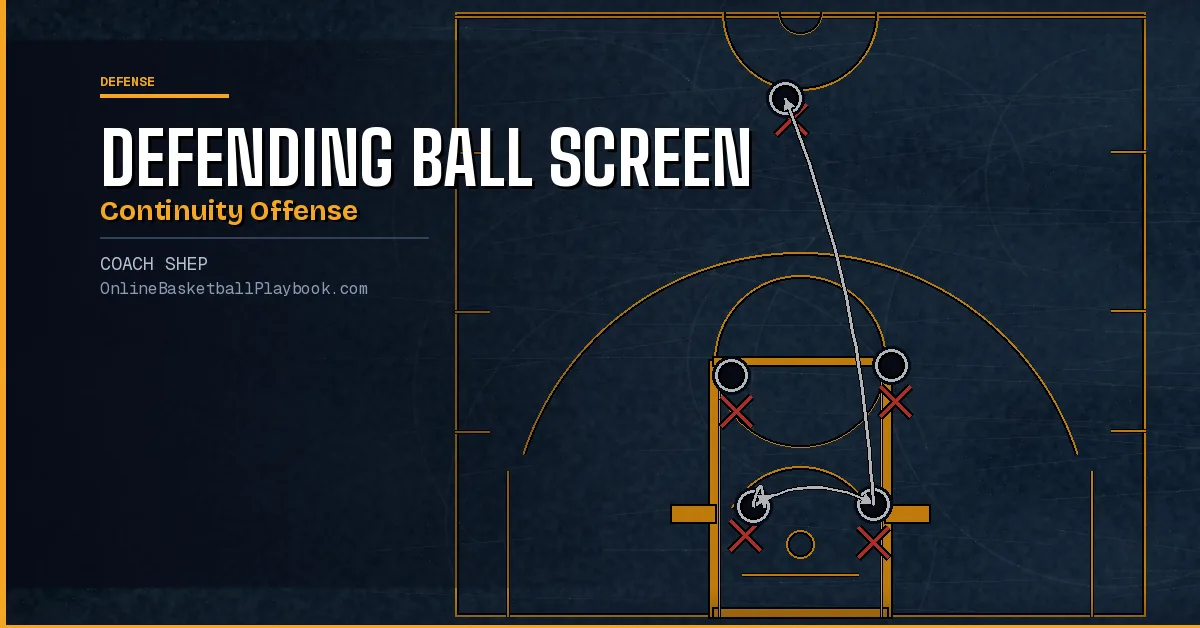
Ball screen continuity offenses grind defenses down through repetition. The same actions cycle over and over until a coverage breaks. Here is how to stop it before it stops you.
What Ball Screen Continuity Offense Actually Is
Before you can defend something, you need to understand its actual structure. Ball screen continuity offense is not a play. It is a system of connected actions that reset themselves automatically. The offense runs ball screens at the top of the key or on the wings, and when the primary action does not produce a shot, the screener and the ball handler flow directly into the next ball screen. This cycles until a coverage is caught sleeping, a mismatch is created, or the clock forces a decision.
The offense is popular at every level because it does not require elite talent to run. Five average athletes who understand the spacing and the timing of the actions can stress even disciplined defenses. The ball screen continuity system is particularly effective because it attacks the communication between the on-ball defender and the screener's defender simultaneously on every possession.
Understanding motion offense in basketball is critical context here. Ball screen continuity is essentially a motion offense with the ball screen as its primary action. Players are reading the defense and choosing options off the screen, not running a scripted play to a scripted conclusion. That means your defenders cannot memorize one stop and apply it all game. They have to make correct reads possession after possession.
What makes it a continuity is the automatic reset. If the ball handler uses the screen and gets nothing, he swings the ball to the wing. The original screener now sets another screen. The corner player moves to the top of the key. The wing fills the corner. The entire offense re-spaces and runs the same action again from a slightly different angle. Defenders who lost an assignment on the first action now have to sprint to recover before the second screen gets set.
Scouting the offense starts with identifying which player sets the most screens, which player is the primary ball handler using them, and whether the team prioritizes the roll or the pop after the screen. Those three answers will drive your entire coverage plan for the game.
Your Coverage Choices Against Ball Screens
There are four primary coverage options against any ball screen, and each has tradeoffs your players need to understand before they step on the floor. You are not choosing the perfect coverage. You are choosing the coverage that takes away what the offense does best.
Go Over the Top
Going over the top means the ball handler's defender fights through the screen on the ball handler's side, staying attached to the dribbler and never going under. This is the correct call against a team whose ball handler is a dangerous shooter off the dribble. It requires high effort from the on-ball defender and demands that the screener's defender either slow the cutter or "ice" the screen to funnel the action baseline or sideline rather than to the middle of the floor.
Go Under the Screen
Going under means the on-ball defender dips below the screen, conceding space to the ball handler. This is only acceptable if the ball handler is not a shooting threat. Against a true shooter, going under hands the offense a free three on every ball screen, a trade no defense can afford to make repeatedly.
Hedge and Recover
Hedging requires the screener's defender to step out hard and stop the ball handler's momentum while the on-ball defender fights over the screen and recovers. A well-executed hedge buys the on-ball defender the time he needs to get back in front of the ball. The danger is the roll: if the screener's defender hedges too far or for too long, the screener rolls to the rim against a flat-footed defender. This is where most defenses give up easy layups in ball screen continuity offense.
Switch
Switching eliminates the advantage of the screen entirely by having both defenders swap assignments the moment contact is made. Switching is fastest to install and easiest to communicate, but it can create size and skill mismatches that the offense will target aggressively. A savvy ball screen continuity team will drive the switch, then immediately set another screen to put the mismatch in an even worse position. Before committing to a switch scheme, evaluate whether your personnel can live with the matchups that result.
Guarding the Roll Man and the Pop
Most defenses spend the majority of their ball screen preparation on the ball handler and almost none on the roll man. That is backwards. The roll man to the rim is the most efficient shot in ball screen continuity offense, and it is where your coverage will break if you do not have clear rules.
When the screener rolls toward the basket after the screen, he is your highest priority. His defender (if hedging) must recover the moment the ball is passed or the dribbler is contained. The weak-side help must be ready to rotate if the roll man catches the ball with a step on his defender. Review the fundamentals of help defense principles with your team, because stopping the roll man is almost always a tag responsibility from a weak-side big rather than a solo job for the screener's defender.
The Tag Rule
A tag defender is the weak-side player responsible for touching the rolling big before he receives the ball. The tag does not mean stealing the ball. It means making physical contact that disrupts the roll man's catch and slows his momentum to the rim. When the tag lands cleanly, the roll man has to re-gather, buying the screener's original defender an extra step to recover. Without a tag rule, the roll catch leads to a dunk or a foul. With a tag rule consistently applied, the roll becomes a contested mid-catch that the offense does not want.
The Pop Situation
Some screeners pop to the perimeter instead of rolling to the rim. The pop is the opposite problem: instead of a threat at the basket, you have a stretch-four or stretch-five pulling your big defender away from the paint. When a screener pops, his defender cannot hedge. Hedging against a pop simply gifts the screener a wide-open three. Against a popping screener, your coverage shifts to a soft drop or a switch, keeping his defender attached to the perimeter threat rather than stopping out to hedge empty space.
Identify in pregame which screeners roll and which pop. A screener who does both is the most dangerous. Your defenders need a rule for how to read his first step after the screen contact. Hips toward the basket means roll. Hips toward the ball means pop. Teach this cue in practice until it is automatic.
Help and Rotation Principles
Ball screen continuity offense is designed to trigger rotations and then attack the gaps those rotations create. If your help system breaks down anywhere in the chain, the offense scores. This is why your rotations need to be drilled as a system, not improvised by individual players mid-possession.
The starting point is strong-side help. The corner defender on the ball side must be positioned to tag the roll man and still recover to his corner shooter if the ball swings. This is an extremely difficult read and it is the one most likely to fail against a well-run ball screen continuity team. The corner defender is being asked to account for two threats at once: the roll man at the rim and the corner shooter on the perimeter.
Work through the shell drill as the foundation of your help and rotation system. The shell drill teaches defenders to hold their position and communicate under pressure, which is exactly what ball screen continuity puts them through on every possession. Four defenders in a shell, with the coach simulating ball screen actions by passing and calling out screeners, forces the habit of early communication before the screen is set.
That principle works directly against your defense when your defenders stand and watch the ball. Off-ball defenders who are watching the ball handler and the screen will miss the skip pass, the cut backdoor, and the weak-side shooter setting up in the corner. Train your defenders to see both the ball and their man simultaneously, which in practice means keeping their vision slightly off the ball and tracking both threats with peripheral awareness.
Rotating on the Skip Pass
Ball screen continuity offenses use the skip pass to reset the offense and attack the opposite side of the floor. A skip after a ball screen often finds a defender out of position on the strong side, and now the ball has moved quickly to the weak side where the defense has not yet rotated. Your weak-side defenders must anticipate the skip by cheating toward the lane rather than pinning themselves to their man on the perimeter. When the skip comes, they close out hard to the ball, following correct closeout technique: Rather than chasing across the entire floor from a bad starting position.
Drills to Install Your Ball Screen Defense
Coverage rules on a whiteboard mean nothing until players have reps making the reads under game speed. Your practice plan needs dedicated ball screen defensive segments at least three times per week during the season.
2-on-2 Ball Screen Coverage
Start every ball screen defensive installation with 2-on-2. Two defenders, two offensive players. One sets a ball screen, the ball handler uses it. No other players involved. The simplicity isolates exactly what you are teaching: the on-ball coverage, the screener's defender coverage, and the communication between them. Run each coverage option (hedge, go over, switch) until both defenders are making the correct read before the screen is set, not after.
3-on-3 With the Tag
Add a third offensive player on the weak side and a third defender. Now the screener's defender must decide between hedging the ball handler and tagging the roll, while the third defender must hold the weak-side shooter. This is the most realistic individual defensive segment for ball screen continuity because it forces the tag communication that gets skipped in 2-on-2 drills.
5-on-5 Continuity Simulation
Have your scout team or assistant coaches walk through the opponent's specific ball screen continuity actions in 5-on-5. Run each action repeatedly until your starters make the correct coverage call and rotation without a coach prompting them. Film this practice segment and show clips the next day. Defenders often do not know they are going under a screen until they see it on video.
Incorporate these drills into your overall basketball practice plan in the first 15 minutes of your defensive segment, before fatigue sets in. Ball screen coverage communication is a mental skill as much as a physical one, and tired defenders revert to individual habits rather than team coverage.
Track your team's ball screen coverage results in practice by charting every roll man catch. If the roll man catches the ball within 10 feet of the basket more than twice in a 5-on-5 segment, your tag rules are not working and need immediate correction before the next game.
In-Game Adjustments When Your Coverage Breaks
Even the best-prepared defense will face a half where its ball screen coverage breaks down. The offense finds a mismatch, your on-ball defender fouls twice in the first four minutes, or their ball handler is simply making every pull-up jumper off the screen. You need a halftime adjustment ready before you need it.
Change the Coverage Angle
If you have been hedging and the roll man is scoring, shift to a switch for a possession or two to take away the roll. If the offense counters the switch by targeting the mismatch with post actions, go back to the hedge but bring weak-side help sooner. The goal is to deny the offense any consistent rhythm. Ball screen continuity offenses depend on finding a coverage that will not adjust, then running the same action against it all game.
Force the Ball Handler Left
Most ball handlers who thrive in continuity offense have a dominant hand they prefer when using screens. Icing the screen (forcing the ball handler baseline or sideline away from the screen) removes the primary option before the screen is even set. Your on-ball defender positions a half-step baseline before the screener arrives, taking away the middle and redirecting the ball handler to the sideline. The screener's defender cheats toward the baseline to be ready for the now-predictable direction of the ball.
Change Defensive Looks Entirely
A 2-3 zone defense presents a completely different set of problems for a ball screen continuity team. Most ball screen continuity offenses are designed to attack man-to-man. Their spacing and timing are built around triggering individual coverage reads. A zone eliminates those reads by replacing them with area responsibilities. Used in short bursts, four or five possessions, a zone can disrupt a team's offensive rhythm enough to slow the continuity down, even if the zone itself is not your primary defensive identity.
Pressure the Point of Initiation
Ball screen continuity cannot run if the ball handler cannot get into position to use the screen. Full-court or half-court pressure applied to the team's primary ball handler can force the offense to initiate from a different player or a different spot on the floor, which in turn forces the screeners into unfamiliar positions and breaks the automatic flow the continuity depends on. Review man-to-man defense principles for your half-court pressure options and identify which of your defenders can front the ball handler and make him initiate from further away from the three-point line than the offense prefers.
Managing Foul Trouble
Ball screen continuity offenses draw fouls by design. The screener sets an illegal screen angle, the ball handler drives into a hedging defender, or the roll man draws contact at the rim. Track your defenders' foul counts carefully and do not hesitate to change a coverage rule for a defender in foul trouble. Asking a player with two first-quarter fouls to hedge aggressively on every ball screen is a recipe for a third foul before halftime. Adjust his coverage to a softer drop and put your clean defender in the primary hedge responsibility.
- Call coverage early: Both defenders must verbally confirm the coverage before the ball handler reaches the screen. Never mid-screen.
- Ice aggressive ball handlers: Redirect the ball handler to the sideline before the screen arrives by positioning half a step baseline.
- Tag every roll: Assign a weak-side defender to physically touch the rolling big on every ball screen action. Make it a non-negotiable habit.
- Close out in balance on skip passes: Anticipate the skip by cheating toward the lane; do not chase across the floor from a wide corner position.
- Chart the roll man in practice: If he catches it inside 10 feet more than twice per session, the tag rules need immediate correction.
- Switch coverage mid-game: If the offense finds your hedge, switch for two possessions; if they attack the mismatch, go back to the hedge with earlier help.
- Use zone as a disruptor: Four to five possessions of 2-3 zone breaks the timing of a continuity offense without committing to a full game of it.
Defending ball screen continuity offense is not about finding one perfect coverage and locking it in. It is about having clear rules, clear communication, and the flexibility to adjust when the offense finds a crack. Teams that stop ball screen continuity offenses do so because every defender on the floor knows his job on every possession and knows how to adjust when the call changes.
The best long-term investment is basketball IQ development for your defenders. Players who understand why a coverage works (not just the mechanics of how to execute it) can make mid-possession adjustments without a timeout. That kind of defensive intelligence is what separates a team that stops ball screen continuity for one game from a team that stops it all season.
Get free play diagrams, drills, and coaching guides delivered weekly.
Draw this play free in the play drawer →
Membership: the full library, playbook packs, and Pro drawing tools →
Keep Building
Related breakdowns
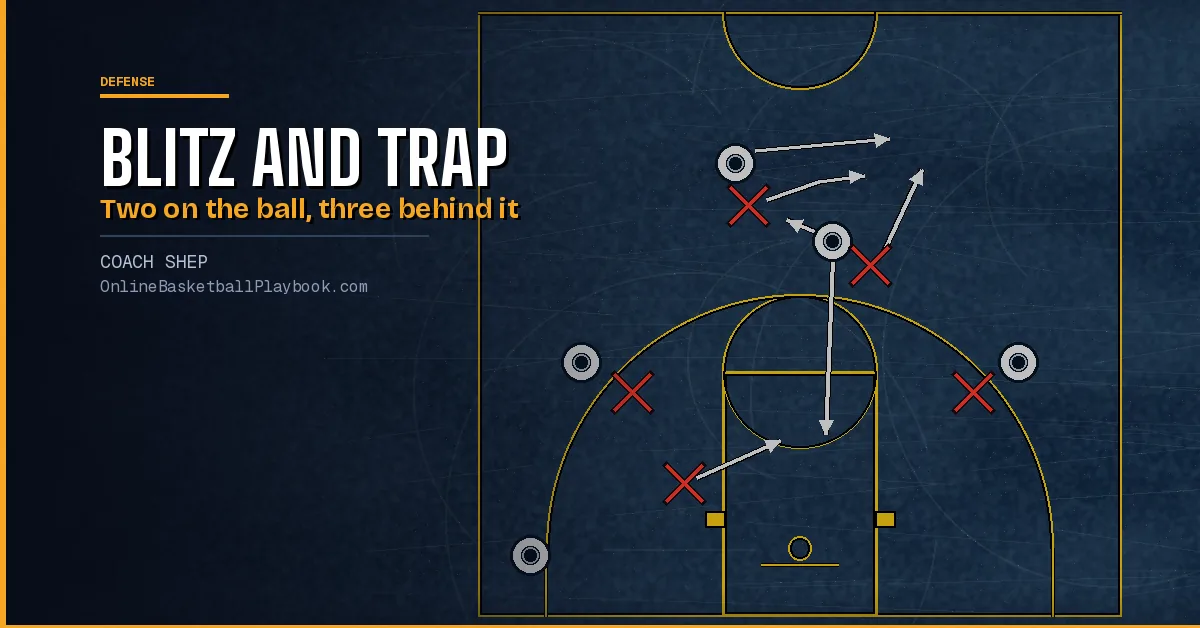
Blitz Pick and Roll Defense: How to Trap a Ball Screen
Blitz pick and roll defense explained: how to trap a ball screen, when the blitz fires, the rotation behind it, the offense's answers and the disguise.
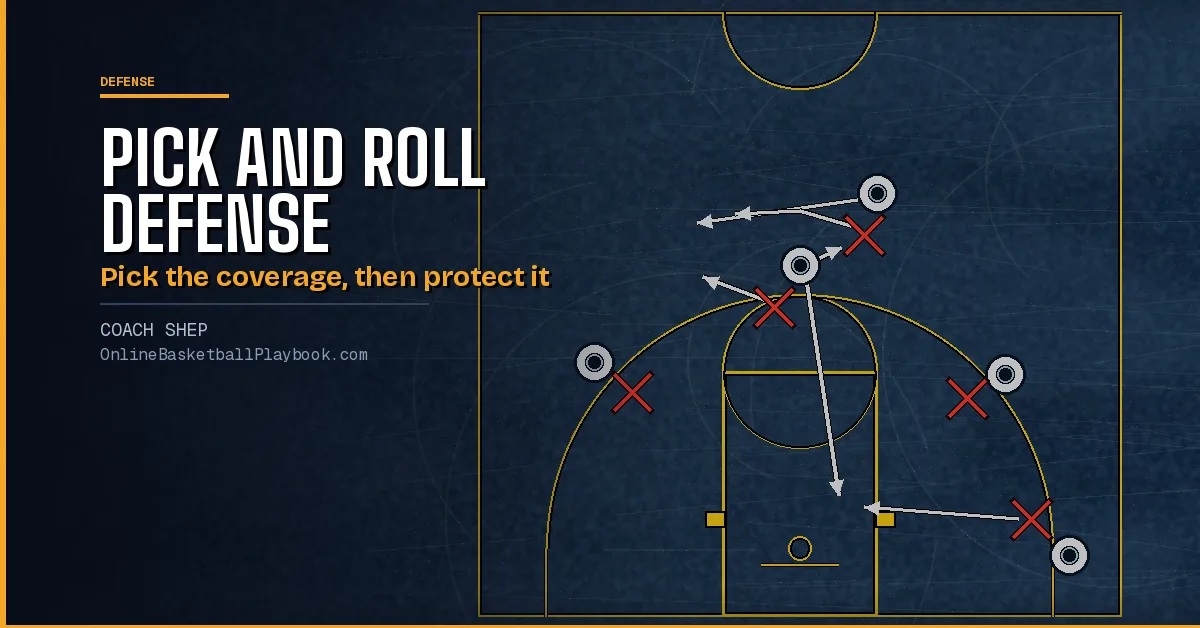
Pick and Roll Defense: Every Ball Screen Coverage Compared
Pick and roll defense compared: drop, show, blitz, switch, ice and under, what each takes away and gives up, the help behind it and how to choose.
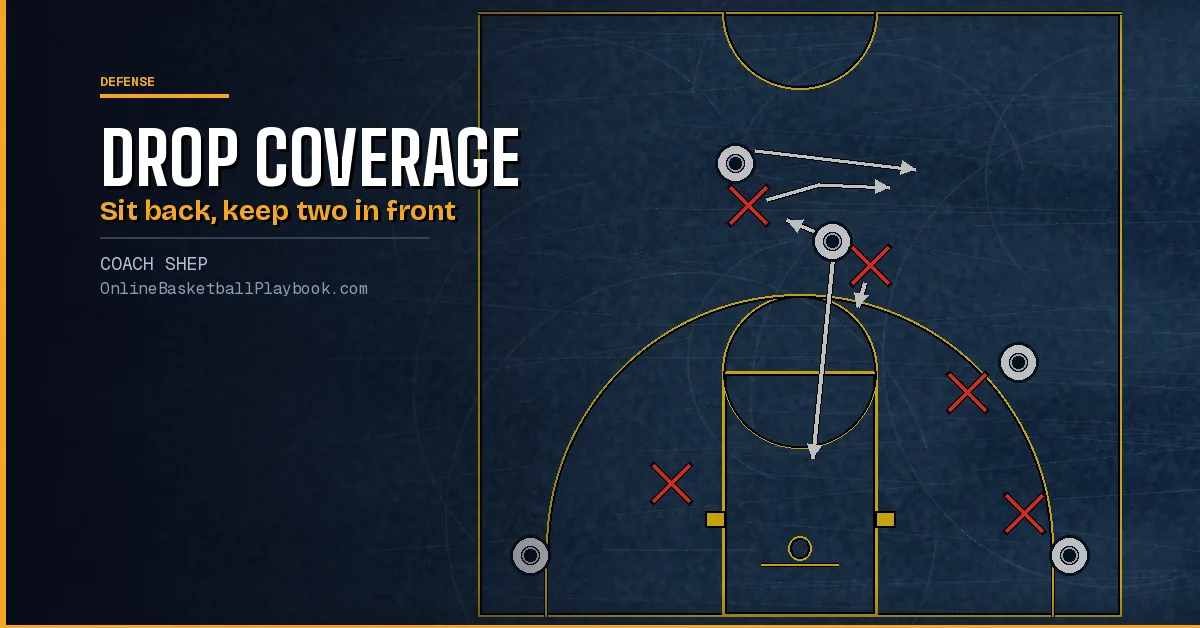
Drop Coverage Basketball: How the Big Plays the Ball Screen
Drop coverage basketball explained: both defenders' jobs, how deep to drop, when to call it, the pop and the pull-up, the help behind it and how to teach it.