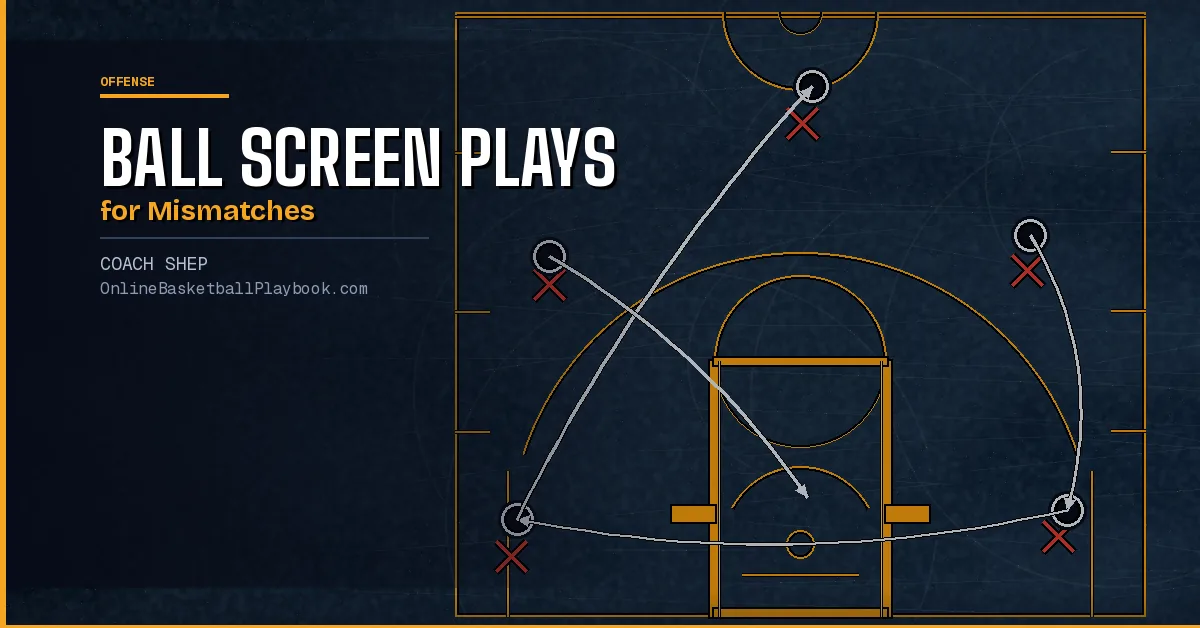
Ball screens are the most reliable mismatch-creation tool in basketball. Run them correctly and you force the defense into impossible choices: hedge and leave shooters open, drop and get attacked, switch and surrender a size advantage.
Why Ball Screens Create Mismatches
A ball screen puts two defenders in conflict at the same time. The on-ball defender must fight through, go under, or get switched, and none of those options are free. The screener's defender must decide to hedge, drop, or switch. That moment of hesitation, half a second of indecision, is exactly what an offense with trained reads can exploit.
Most defenses today pick one base coverage (switch, drop, or hedge) and try to execute it consistently. Smart offenses pick their ball screen locations, screener types, and play designs specifically to make that coverage uncomfortable. A team that hedges hard? Run the slip and the pocket pass. A team that drops? Attack the big in space the moment he sinks. A team that switches? Hunt the mismatch on the low block immediately after the switch happens.
The best ball screen systems are not just pick-and-roll. They are a read-and-react structure where every player on the floor has a job based on what the defense shows. Understanding how defenses defend the pick and roll is as important as knowing how to run the play itself. When your players understand what they are attacking, the reads get faster and the decisions get cleaner.
Ball screens also work at every level of basketball because they do not require exceptional athleticism to execute. A well-set screen at the right angle, combined with a ball-handler who reads the coverage, will stress any defense: youth, high school, or elite college. That universality is why it remains the most commonly run action in organized basketball at every level of the game.
Ball-Handler Reads Off the Screen
The ball-handler's job starts before the screen even makes contact. He needs to read the defensive positioning of both his man and the screener's defender before he uses the screen. That pre-read determines how aggressively he attacks off the catch or dribble hand-off, and which direction he turns the corner.
There are three primary options for the ball-handler coming off a screen: attack the rim, dump the ball to the rolling or posting screener, or hit the popping screener on the perimeter. The right choice is dictated entirely by how the two defenders play the action. If the on-ball defender trails badly, attack the rim. If the screener's defender flies out high to cut off penetration (the hedge or show), turn and find the roll or pop. If both defenders collapse into the paint, kick to the corner or wing shooter who has lifted into space.
One critical element coaches often overlook: the ball-handler must not make his decision prematurely. Committing to the rim before reading where the big is leaves the handler running into a waiting help defender. The best ball-handlers stay on a north-south path and make the last-second read as the screen engages. This is what separates a true ball screen threat from a player who just dribbles off a screen and hopes something opens up.
Footwork matters enormously here. A ball-handler who rounds off the screen instead of using it tightly gives the on-ball defender room to recover. The shoulder-to-hip contact with the screen (getting as close as possible to the screener's body) is what makes the on-ball defender deal with the obstacle. Teaching proper basketball footwork drills that emphasize tight screen usage will pay dividends every time this action is run in a game.
Screener Reads: Slip, Roll, or Pop
The screener is not a stationary prop. He is the second read, and his decision after setting the screen is as important as anything the ball-handler does. Three options define the screener's game: the slip, the roll, and the pop. Each is triggered by what the screener's defender does.
The Slip
When the screener's defender goes high to hedge or jump the ball-handler, the screener slips before full contact. He cuts hard to the basket before the screen is fully set. The ball-handler sees the hedge forming and delivers the pocket pass to a slipping screener who now has a lane to the rim with the defender out of position. The slip is automatic in most systems when a high hedge is the coverage. It is built into the offense as a standard read, not a freelance play.
The Roll
When the screener's defender stays attached or drops toward the paint, the screener sets the screen and rolls hard to the basket. The roll should be a straight-line dive to the rim, not a wide arc. The screener's inside hand should go up as a target the moment he pivots, giving the ball-handler a clear delivery window. The roll is most effective against a switching defense that sends a smaller guard to contain the screener. Now the screener has a size mismatch in the post.
The Pop
The pop is the counter to a defense that crashes hard on the roll. The screener sets, feels the defense commit to the roll, and instead flares out to the three-point line or mid-range area. A screener who can shoot from distance forces the defense to track him back out, which opens the driving lane for the ball-handler. The pop is particularly punishing against teams that send the weakside big to help on the roll, because that big is now chasing the popping screener toward the perimeter instead of protecting the paint.
Spacing and the Corner Lift
Ball screen offense does not live in a vacuum. The three players not directly involved in the screen-and-roll action are responsible for the spacing that makes the two-man game possible. Poor spacing (players standing in the wrong spots, clogging driving lanes, or clustering near the action) turns a good ball screen into a dead end.
The most important spacing concept tied to ball screen offense is the corner lift. The ball-side corner guard (typically the weakest off-ball player) must lift into the vacated wing spot as the ball-handler uses the screen. This lift does two things: it keeps a shooter available for a kick-out if the defense collapses, and it clears the lane so the ball-handler has a clean drive path. If the corner player stands flat in the corner, the driving lane gets crowded and the kick-out option disappears.
This is where running a 5-out motion offense As a base system pays off, players trained in 5-out spacing instinctively maintain floor balance and understand their positioning responsibility when ball screens are run out of that structure. The corner lift is natural when players understand floor geometry.
The weakside players (the two furthest from the ball screen) hold their spots or make subtle relocations to keep the defense honest. Pinning in the wrong spot draws a help defender into the driving lane. Moving too early tips the defense to skip passes. The discipline of staying wide and not over-helping is as important as the on-ball execution of the screen itself.
Countering Every Defensive Coverage
Elite ball screen offenses are not built on one action. They are built on a menu of counters that make any defensive coverage expensive. Defenses have four realistic options against a ball screen, and each one has a built-in answer.
Against the Hard Hedge or Show
The high hedge is designed to stop the ball-handler from turning the corner. The screener's defender jumps out to cut off the driving lane while the on-ball defender recovers around the screen. The answer: throw back to the corner and slice to the rim. As soon as the ball-handler sees the hedge forming, he reverses the ball to the corner shooter while the screener slips. Two quick passes (skip to the corner, hit the cutter) blow up the hedge before the defenders can recover. Against a blitz variant, the same principle applies: get the ball out of the two-on-one situation into open space, find the 4-on-3 advantage with quick ball movement.
Against the Drop
A dropping big invites the ball-handler to attack. When the screener's defender sinks into the paint to protect the rim, the ball-handler should feel no hesitation. The dropped big is now a target in open space. This is no longer a pick-and-roll in the traditional sense; it becomes a one-on-one with a big who is out of his best defensive position. A skilled ball-handler with high basketball IQ recognizes this instantly and attacks the drop coverage with a pull-up or a drive-and-kick the moment the big sinks below the level of the screen.
Against the Switch
The switch is the most common modern coverage and the one with the most exploitable aftermath. Once the switch happens, the offense should immediately hunt the mismatch. If a guard is now on the screener, the screener should seal and post immediately before the defense can rotate or help. The ball-handler's job is to enter the ball quickly into that mismatch before the switching team can recover. If a big is now on the ball-handler, drive at the big's hip and force him to either foul or give up a layup or pull-up.
Against the Ice or Blitz
Some defenses will force the ball-handler away from the screen entirely (ice) or send two defenders at him (blitz/trap). The screen-rescreen counter works well here. After the first screen is denied, the screener sets a second screen at the proper angle to force a different coverage call. Alternatively, the offense can use the wait-with-the-pass concept: the ball-handler holds the ball slightly longer, drawing both defenders toward him, and then delivers a skip pass to the now-open shooter on the opposite side before the defense can close out.
Play Designs That Force Mismatches
Executing ball screen reads is one thing. Designing plays that guarantee the mismatch you want is another. Smart play design starts with personnel. You want the matchup you are hunting before the play even begins.
The Two-Big Read
Running a weakside big "lifted" to the three-point line while the ball-screen runs on the strong side creates a specific mismatch scenario. The screener's first look is always the roll, because the lifted big has dragged his defender up toward the perimeter, emptying the rim area. If the defense hedges the roll, the screener can pop back to the vacated area where the lifted big was. If the help stays low, the lifted big is now an open catch-and-shoot option at the three-point line. This two-big structure (popularized by Brad Stevens at Butler) exploits a defense trying to play the roll and cover the pop at the same time.
The Drag Screen
The drag screen is set in transition, before the defense can set up. As the ball-handler pushes in transition, the trailing big sprints to set a screen at the top of the key. Defenses caught in transition rarely have time to communicate their coverage. The screen arrives before the pick-and-roll defender can even call out his assignment. The drag screen produces open layups and pull-up opportunities at a far higher rate than half-court ball screens because of that communication gap.
The Step-Up Screen
Instead of the screener waiting for the ball-handler to come to him, the step-up screen has the big step toward the ball-handler to set the screen. This changes the angle and catches the on-ball defender in a worse position. The timing is critical. The big steps up as the ball-handler approaches, not before. Done correctly, it eliminates the on-ball defender's ability to fight over the top of the screen because the screen arrives at full speed.
The Nash Re-Screen
When the defense blows up the first screen (a defender fights through early or the angle is wrong), the screener resets and sets a second screen at the correct angle. This forces the defense to re-communicate their coverage in a fraction of a second. Most defenses have a primary call and a secondary call. The re-screen creates confusion about which call applies, and that half-second of confusion is enough for the ball-handler to attack.
Teaching Ball Screen Reads in Practice
Ball screen offense only works if all five players make the right read at the same time. That coordination is not built in games. It is built in practice, through deliberate repetition of specific scenarios.
Start with two-man work. The ball-handler and screener only (no other defenders, no other offensive players). Walk through each coverage response: here is the hedge, here is the slip. Here is the drop, here is the attack. Here is the switch, here is the post entry. Players need to build the read as a muscle memory response before adding full-team complexity.
Then progress to three-man and four-man reads, adding one defender at a time. This shows players how the corner lift changes the defense's angles, how weakside movement affects help coverage, and where to deliver the ball when two defenders collapse on the roll. The full five-on-five ball screen system cannot be installed in one practice. It needs layered, progressive teaching across multiple sessions. A structured basketball practice plan that dedicates 10-15 minutes per session to ball screen reads will build the system correctly without overwhelming players.
Film is essential. Players understand reads much faster when they see a hedge, a slip, and the resulting layup on video before they try to execute it live. Show the coverage. Name it. Show the answer. Watch players execute it in the drill. Debrief with the clip immediately after. That repetition loop (watch, name, execute, review) compresses the learning curve significantly compared to coaching purely by verbal cue during practice.
Finally, reinforce the concept that the ball screen is a system, not a set play. Every player must know every position's responsibility, because defensive rotations and switches will sometimes force a player into an unfamiliar role mid-possession. A point guard who understands how to score off a slip pass (not just how to make one) is a more dangerous player because he reads the defense rather than just running an assignment.
Before installing ball screen offense with your team, assess your personnel. The best ball screen system is the one that matches your screener's ability to shoot the pop and your ball-handler's ability to make the dump-off pass under pressure, not simply the most complex system available.
- High hedge from the screener's defender = automatic slip to the basket; the pocket pass is the primary read
- Drop coverage = attack immediately; the big in a drop is now a 1-on-1 target in open space
- Switch coverage = hunt the mismatch in the post before the defense can rotate or help
- Corner guard must lift into the vacated wing as soon as the ball-handler uses the screen. This is not optional.
- The re-screen is a built-in counter when the first screen is blown up; reset the angle and force a second coverage call
- Teach reads two-man first, then three-man, then full five-on-five. Never skip straight to full-team without building the individual reads first.
Get free play diagrams, drills, and coaching guides delivered weekly.
Draw this play free in the play drawer →
Membership: the full library, playbook packs, and Pro drawing tools →
Keep Building
Related breakdowns
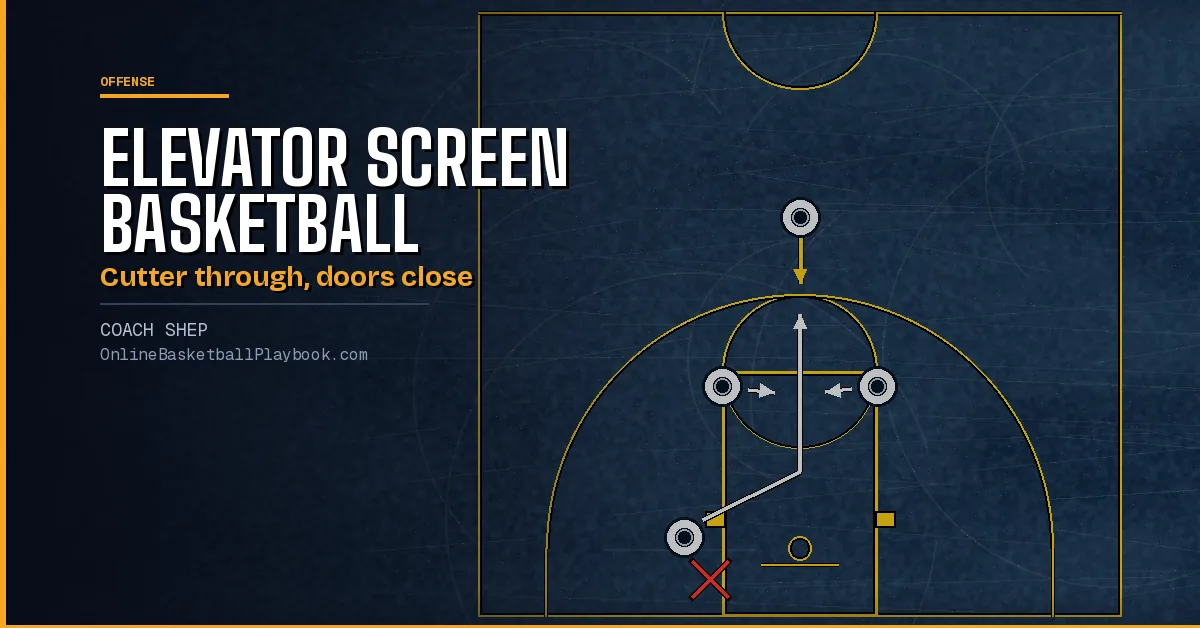
Elevator Screen Basketball: How It Works, Plays and Counters
Elevator screen basketball explained: how two screeners close on a cutter, the plays that use it, how to time it legally, and the counters when the defense reads it.
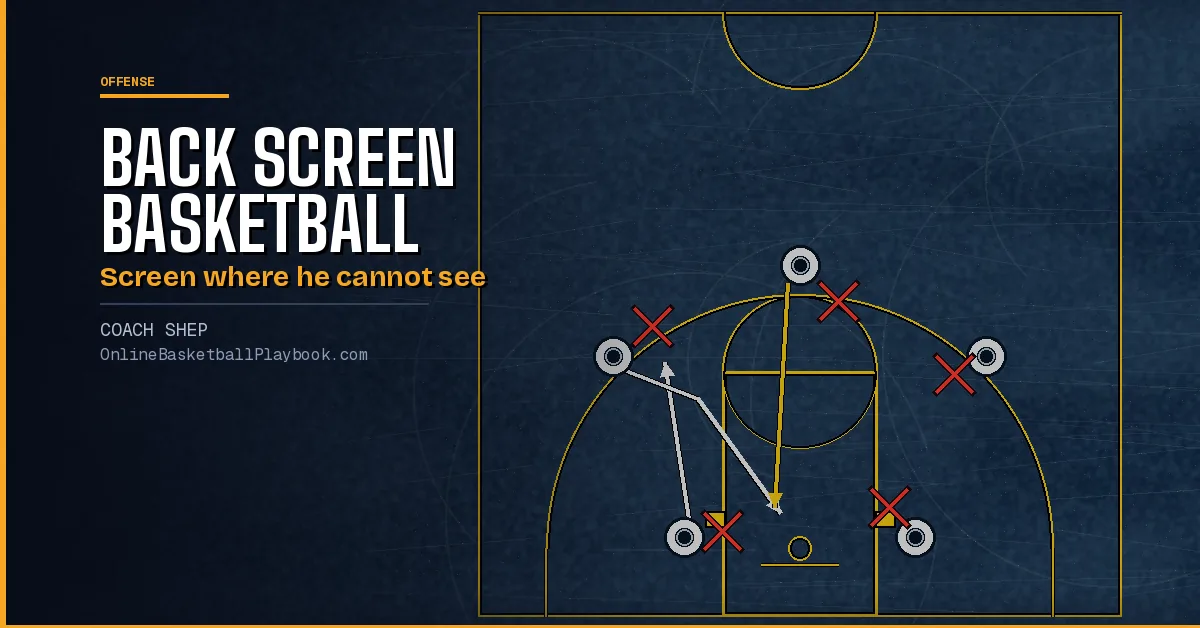
Back Screen Basketball: How to Set, Use and Defend It
Back screen basketball guide: what a back or rip screen is, setting it legally, the cutter's and screener's reads, the UCLA cut, chained actions and defending it.
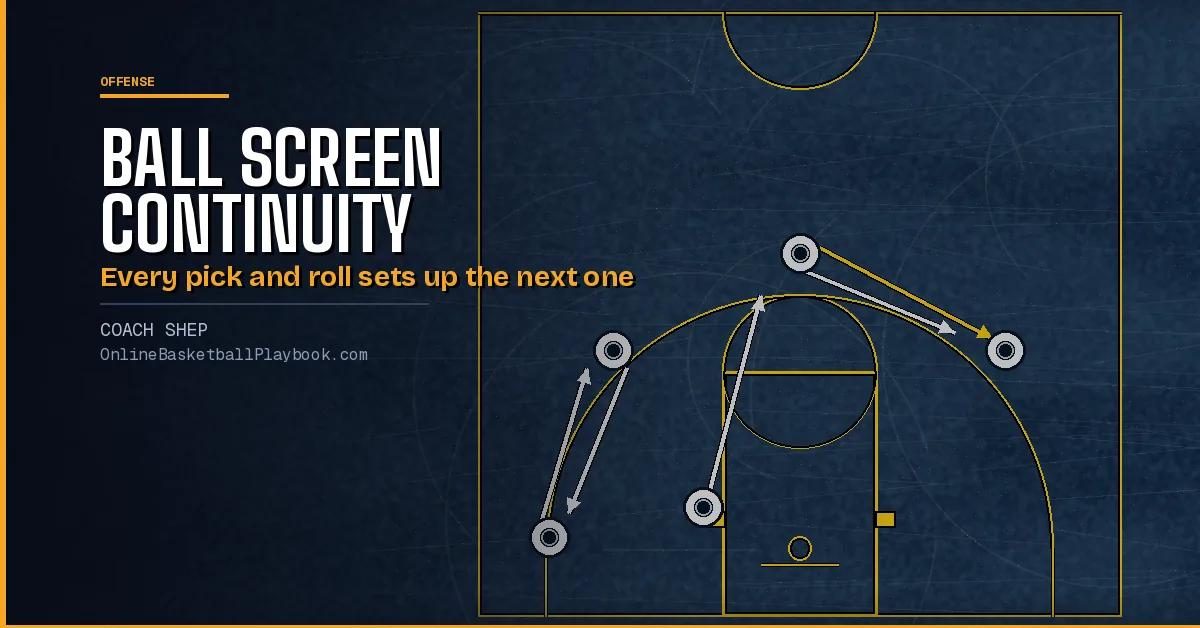
Ball Screen Continuity Offense: Pick and Roll Rules and Reads
Ball screen continuity offense in full: the 4-out and two-big engines, reload rules, spacing, angles, reads, counters, Spain, Ram, double drag and zone sets.