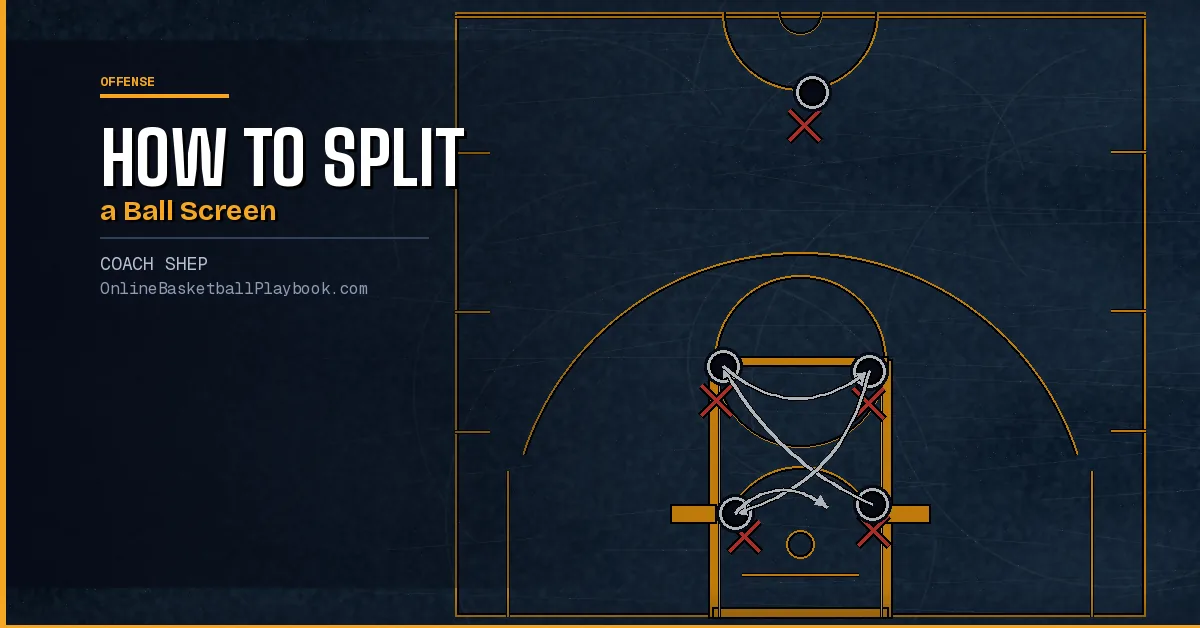
Splitting a ball screen means driving between the screener and the hedge defender to attack the basket directly. When executed with the right read and footwork, it turns a single screen into an immediate two-on-one advantage for your offense.
What It Means to Split a Ball Screen
A ball screen creates a problem for the defense: two offensive players against two defenders, and the defenders cannot both be in the right place at the same time. The split action takes that problem and exploits it immediately, before the defense can recover. Instead of using the screen by going over or under it, the ball-handler threads through the gap between the screener's body and the on-ball defender who showed or hedged. A direct line to the basket.
The split is not a trick play. It is the natural answer when the on-ball defender cheats over the top of the screen too aggressively or when the big hedging forward creeps too far from the screener's body. The moment that gap opens, a ball-handler with the read and the footwork to attack it has a lay-up or an open mid-range pull-up. Understanding this action at a conceptual level will help you teach it, not just run it.
The action also feeds directly into broader motion offense principles: The idea that every defensive coverage generates its own counter, and the offense's job is to identify and execute that counter quickly. Ball-screen reads are one of the most teachable versions of that concept, and the split is the sharpest read of them all.
When to Split vs. When to Use the Screen
The split is not the default. It is one read on a menu of reads, and using it at the wrong moment makes the defense's job easier. You must teach players to read the coverage first and let the coverage dictate the action.
The most common moment to split is against an aggressive switch attempt or a lazy hedge. When the on-ball defender tries to trail tightly over the screen and the big steps out wide to cut off the curl, a gap briefly opens between those two bodies. That gap is the split lane. The ball-handler must already be driving downhill (weight low, first step committed) when that gap appears. A player who reads the coverage, hesitates, then tries to split is a step too late.
The split is also the correct answer against a show-and-recover coverage where the big steps out early before recovering back to the roll man. The moment the big extends, there is space directly between him and the screener's back hip. A downhill drive through that space beats the recovery every time.
Contrast this with a drop coverage, where the big sags back and dares the ball-handler to shoot. In that situation, the split is wrong. There is no gap to attack because the big never came up. Against a drop, the correct read is a pull-up jumper or a direct attack on the sagging big in the lane. Developing basketball IQ in your guards means they recognize these coverages before the screen is even set, not while they are dribbling through chaos.
A blitz or trap is a third coverage where the split is a live option. Specifically, the moment between when the second defender commits to the trap and before he can recover. The ball-handler who can split two committed trappers and get to the basket creates a four-on-three advantage in the back half of the court. However, that play requires exceptional burst and anticipation, and it is a higher-level read. For most teams, the blitz counter is better handled by throwing back to the corner and spacing into secondary reads.
Footwork and Body Mechanics for the Split
The split live or dies in the first two steps. If the ball-handler sets up the screen correctly (coming off a defender's shoulder with weight forward and eyes scanning the coverage), the split becomes a natural extension of that momentum. If the handler ambles into the screen without purpose, there is no angle and no burst available when the gap opens.
The Setup Dribble
The last dribble before the screen is the setup dribble. It determines the angle of attack. The ball-handler should be low, shoulders slightly inside the hip, with the ball pushed out in a directed dribble toward the screen. This creates a natural path that either goes over the screen (if the defender trails) or threads through the gap (if the gap appears). Do not drift away from the screen on the last dribble. That eliminates the split angle entirely.
The Split Step
As the gap opens, the ball-handler plants the outside foot and drives the inside shoulder through the gap. The key coaching cue is "shoulder first, ball protected." The ball must be moved to the hip away from the on-ball defender before the split step is planted. Otherwise the defender recovers with a reach-in foul opportunity or a strip. Work on footwork drills that emphasize this protected-ball concept before adding the live defense element.
Finishing Through Contact
The split produces contact. Because the ball-handler is threading between two bodies, there is almost always a body to finish through. Players must practice jump-stops through contact, one-foot finishes on both sides, and left-hand lay-ups at full speed. A player who can only finish right-handed or who avoids contact will be stopped every time by a recovering big who takes a charge angle. The split without a finish skill set is half a play.
The Screener's Role When the Handler Splits
Most coaching time on the split goes to the ball-handler's mechanics, but the screener's role is just as important. When the handler splits, the screener has an immediate second action, and if he stands still or rolls the wrong direction, the defense recovers quickly.
The screener's read when his partner splits is to open up and seal the on-ball defender. After setting the screen, the screener pivots to face the ball and uses his body to pin the on-ball defender's recovery path. This is not a push or an illegal screen. It is a legal seal created by footwork, pivoting into the defender's path before the defender can close off the split lane.
If the handler beats both defenders cleanly, the screener's next action is to roll to the short corner or the dunker spot. The split will draw a weak-side helper, and that helper's departure creates an open catch-and-finish in the dunker area. This is the "screener reads the help" concept: whatever the defense shows on the split, the screener attacks the opposite.
Against a blitz, the screener who reads his partner going to split should drift to the corner rather than rolling to the rim. Two defenders committing to the split means the corner is wide open, and a simple skip pass turns the split threat into an open three. Understanding how defenses guard the pick and roll from the other side helps your screeners make faster reads. They know what to look for because they understand what the defense is trying to protect.
Spacing Reads: What the Corner and Wings Must Do
A well-executed split is only as effective as the spacing around it. Five-on-five ball-screen offense is not a one-man show, and the three players away from the ball-screen action determine whether the split produces a lay-up, a kick-out three, or a turnover into a crowd.
The Corner Lift
The ball-side corner player has the most critical off-ball job in the split action. When the handler attacks off the screen, the corner must lift into the vacant space created by the collapsing help. If the help defender drops down to stop the split, the corner player lifts to the wing, creating a straight-line kick-out for the driving handler. If the corner player stays flat in the corner, the help defender can sag and take away the split lane without penalty.
This "lift" concept is central to effective spread ball-screen offense. The corner player's job is to read the help defender's feet. Not to wait for a pass, but to move when the help commits. A player who lifts on time gives the driver a release valve. A player who stands still turns the driver into a trapped ball-handler who has to create out of a crowd.
Weak-Side Spacing
The two weak-side players must hold their spacing until a kick-out pass is made. The most common error is weak-side players crashing the lane when they see the split developing. They think they are helping, but they are actually eliminating the space that makes the split dangerous. Weak-side players should space to the three-point line and be ready to shoot if a skip pass comes their way. This is the same spacing principle taught in 5-out motion offense: The spacing is not passive. It is active defensive pressure on the help defenders.
Reading the Second Pass
Advanced teams run the split specifically to generate the second pass. The handler splits, draws two defenders, and immediately looks for the lift pass or the skip. The second pass is taken in rhythm, in a loaded shooting position, with a shorter closeout coming from the help defender. Teaching your players to read this sequence (drive to generate the kick, not to score every time) elevates the entire offense. The split is a means to an end, and the end is an open shot for a shooter who is already in position.
Run the split action in a 3-on-3 shell before adding all five players. Three-on-three isolates the ball-handler read, the screener's counter, and the corner lift. The three moving parts that must be synchronized for the action to work. Once each player understands his role in the smaller setting, adding weak-side spacing in 5-on-5 feels natural rather than crowded.
Teaching the Split in Practice
The split does not develop in a walkthrough. It must be drilled at speed with a live closeout or a live hedge, because the read window is roughly one second and players must train their eyes to identify the coverage and their feet to respond before they consciously process the decision. Here are the most effective ways to build that skill.
Angle Cone Drill
Set up two cones. One representing the screener's body and one representing the on-ball defender's hedge. Have the ball-handler practice the setup dribble, the plant step, and the split between the cones at full speed. The goal is to get the shoulder through the gap and the ball protected to the outside hip before the center foot lands. Run this at three-quarter speed first, then full game speed, then with a late-arriving passive defender added.
Two-on-Two Ball-Screen Read
The two-on-two read drill gives defenders real assignments. One playing on-ball coverage, one playing hedge or drop. The ball-handler must identify which coverage is showing and react correctly: split on a high hedge, use the screen on a drop, throw back on a blitz. Keep the repetitions short and verbal. Have the ball-handler call out the coverage before reacting. That verbal step trains the recognition pattern faster than silent reps. You can build this into a structured practice plan as a seven-minute block after your shooting warmup.
Three-on-Three Corner Lift
Add the corner player and a third defender. Now the ball-handler reads the split, executes it, and immediately finds the corner lift or the dump-off. The corner player reads the help defender. Run it until all three offensive players make the correct read on the same possession. This is where ball-screen offense actually develops. In the shared reads, not in individual mechanics.
Finish Circuit
Pair the split footwork with a finish circuit: left-hand lay-ups, right-hand reverse lay-ups, pull-up floaters at the elbow, and jump-stops through contact with a pad holder. The split produces contact, and players who cannot finish through a body will never fully commit to the action in a game. The finish circuit should be part of every week's individual development work, separate from team ball-screen drills. Consistent player development in these finishing mechanics pays off every time the split action gets to the basket.
- Read the coverage first: identify the hedge or show before the screen arrives, not while you are splitting through it.
- Setup dribble decides the angle: the last dribble before the screen must be directed toward the screen to keep the split lane open.
- Shoulder first, ball protected: drive the inside shoulder through the gap and move the ball to the outside hip before the split step is planted.
- Screener seals and reads help: after the split, the screener pivots to seal the on-ball defender and attacks the opposite of the help. Dunker spot or corner.
- Corner player lifts on help commitment: when the weak-side or corner help defender drops to stop the drive, the corner lifts immediately into the kick-out window.
- Train at speed with live defenders: the split is a one-second read. Drills that teach it at walthrough speed do not transfer to games. Add a real hedge in practice.
- Finish circuit is non-negotiable: the split produces contact every time; players must practice left-hand and reverse finishes before they will commit to the action in games.
Get free play diagrams, drills, and coaching guides delivered weekly.
Draw this play free in the play drawer →
Membership: the full library, playbook packs, and Pro drawing tools →
Keep Building
Related breakdowns
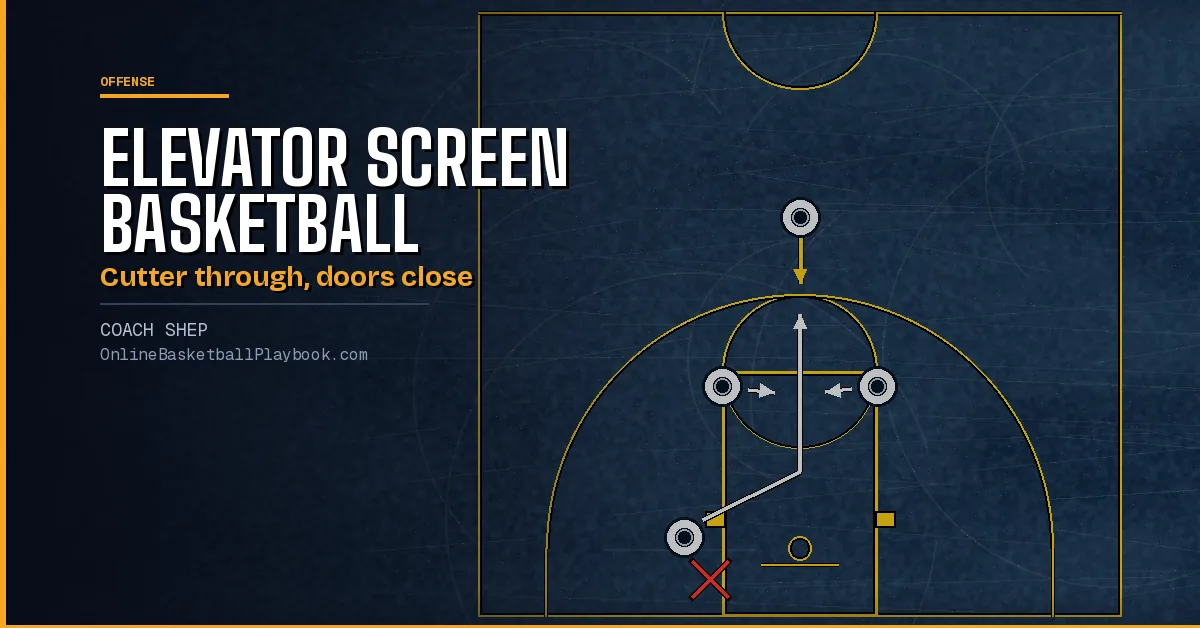
Elevator Screen Basketball: How It Works, Plays and Counters
Elevator screen basketball explained: how two screeners close on a cutter, the plays that use it, how to time it legally, and the counters when the defense reads it.
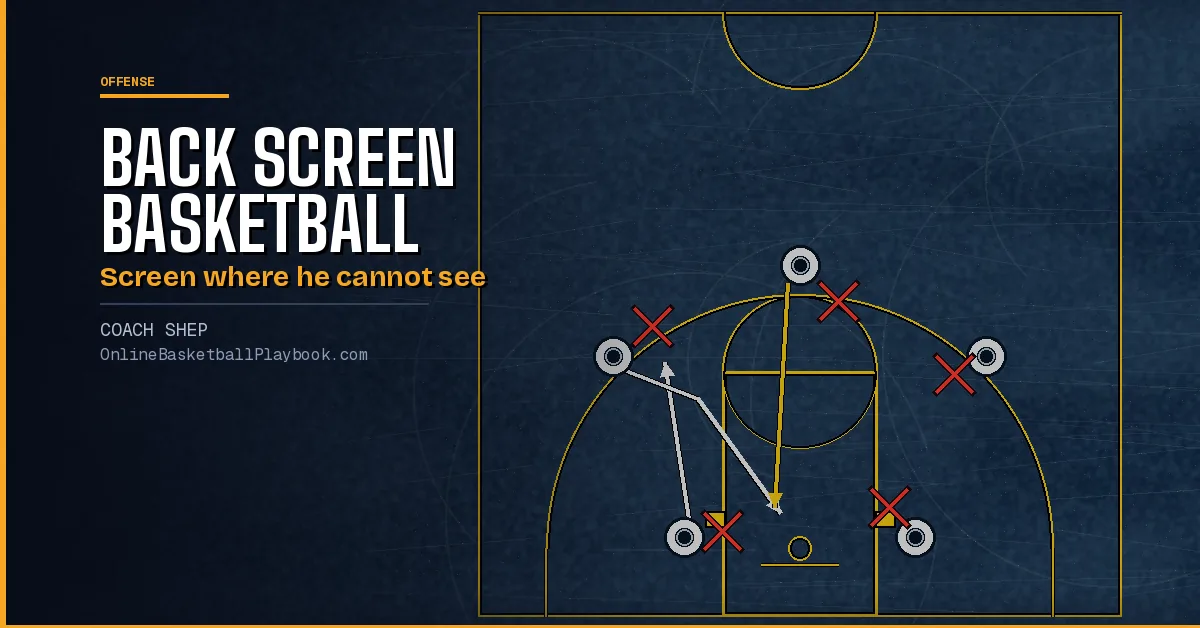
Back Screen Basketball: How to Set, Use and Defend It
Back screen basketball guide: what a back or rip screen is, setting it legally, the cutter's and screener's reads, the UCLA cut, chained actions and defending it.
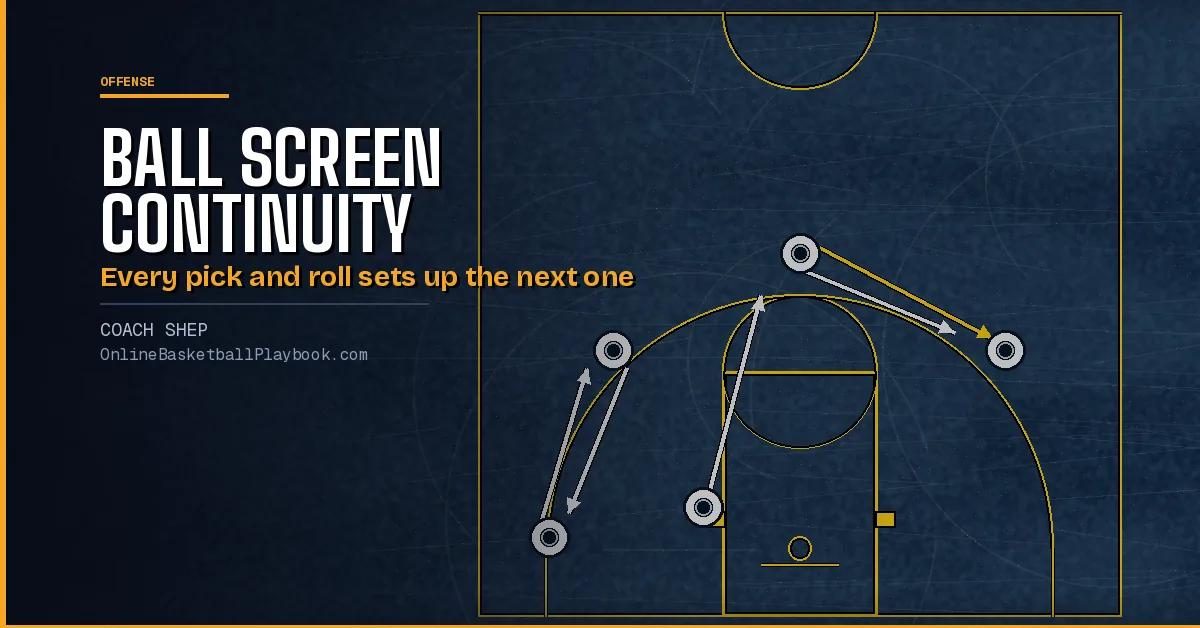
Ball Screen Continuity Offense: Pick and Roll Rules and Reads
Ball screen continuity offense in full: the 4-out and two-big engines, reload rules, spacing, angles, reads, counters, Spain, Ram, double drag and zone sets.