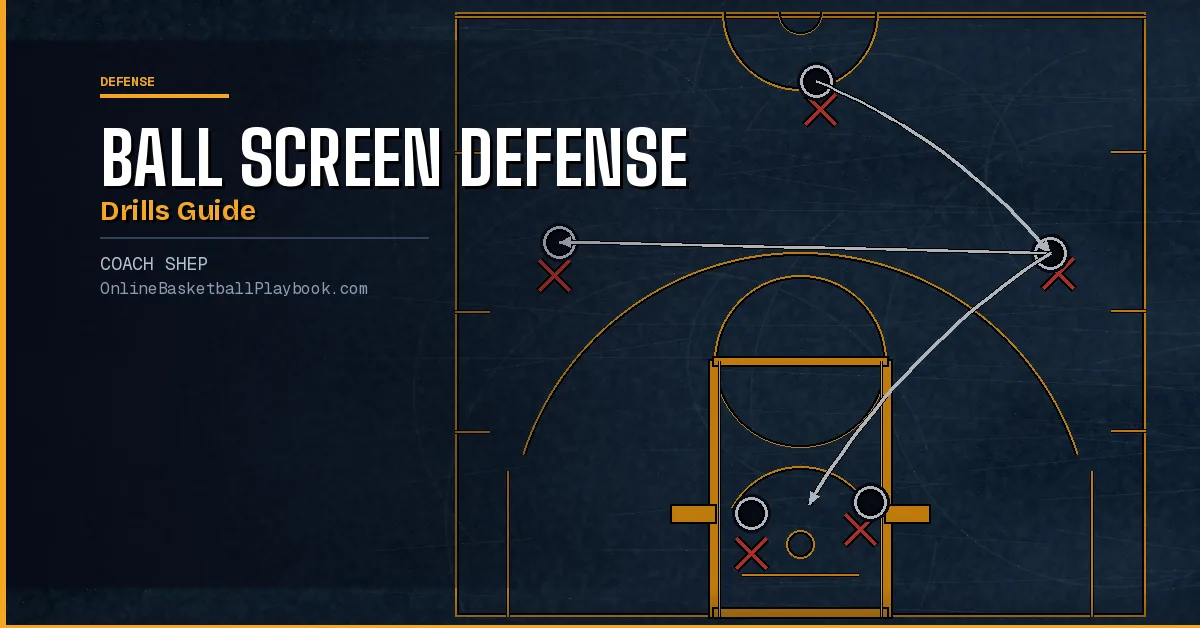
Ball screen defense breaks down in practice before it breaks down in games. These drills build the habits your defenders need, hedge, drop, switch, or blitz, so the right coverage fires automatically when the screen comes.
Why Most Ball Screen Defense Drills Fail
Most coaches spend practice time talking through coverages on a whiteboard and then immediately go live 5-on-5. The problem is that players have not yet built the physical habit for any single coverage. When the screen comes in a live rep, they guess. And guessing in ball screen defense almost always produces an open shot or a driving lane.
Effective ball screen defense requires two defenders to communicate, move simultaneously, and execute a specific technique, all within the one to two seconds it takes a ball-handler to use a screen. That is not something players learn by watching it drawn up. It is something they learn by doing it hundreds of times in controlled, isolated reps before live defense is introduced.
The drills below are structured in a deliberate order: technique first, then coordination between two players, then coordination within a small group, and finally a live competitive rep. Each drill isolates one variable so players can master it before the environment gets more complex. Skip steps and you will be back to the whiteboard after the first game.
One more thing before the reps begin: decide on your primary coverage before you run a single drill. Hedging, dropping, switching, and blitzing each require different footwork and different habits. Trying to teach all four at once is how you end up with four coverages your players execute poorly. Pick the one you want as your base, run the corresponding drill sequence all week, and only add a second coverage once the first one looks automatic.
Teaching the Hedge: 2-on-2 Shell Drill
The hedge, sometimes called a show, is the most common ball screen coverage at the high school and college level. The big steps up and out to slow the ball-handler while the guard fights over the top of the screen. Done correctly, it buys time. Done sloppily, the big is three steps from the paint when the ball is reversed, and the guard is chasing a shifty ball-handler across half the floor.
Start with a stationary walk-through. Place a cone on the elbow as the ball-handler and another on the wing as the screener. Have the big defender practice the hard show step without a live offensive player: load the outside foot, punch the outside hand toward the ball-handler, keep the chest square to the sideline. The goal is to cut off the angle to the rim, not to double the ball. Run this ten times on each side before you add movement.
Next, add a live ball-handler but keep the screener stationary. The guard defender works on getting over the screen: timing the jump step to beat the screen, staying low through the contact, and sprinting back into the ball-handler's path after the big shows. The big defender holds the show for two full counts and then retreats to protect the roll. Run five reps at three-quarter speed, then five at full pace.
Finally, run it 2-on-2 with a live screener who can roll or pop after setting the screen. Now the big has a real decision: hold the show long enough to slow the guard but recover fast enough to pick up the roll. This is the crux of the hedge. Undersell the show and the ball-handler turns the corner; oversell it and the roll is wide open for a lob. Competitive reps with a score are appropriate here. The offense gets a point for an open shot, and the defense gets a point for a turnover or a contested finish.
Drop Coverage: The Funnel-Back Progression
The drop has become the dominant NBA coverage and has filtered down to every level of the game. The big drops into the paint instead of stepping up, giving the guard room to fight over or under the screen while the rim is protected. It is a simpler coverage to execute than the hedge, but it requires a big who understands positioning and a guard who knows when to go under versus over depending on the shooter.
The foundational drill for drop coverage is the funnel-back. Set up with a ball-handler at the top of the key and a screener at the nail. The big defender starts two steps toward the screener-side elbow and drops straight back to the paint as the screen is set. The key teaching point is that the big drops to where the ball is going, not to where the screener is. Most young bigs drop to the screener's roll line and end up a step late when the ball-handler attacks a different angle.
Walk players through the drop path with a cone drill first: one cone at the screener's starting position, one at the rim. The big defender touches the screener-side cone and then sprints to a spot halfway between the rim cone and the ball-handler. That spot is the drop destination. Do this three times without any offense so the big learns the path by feel, then add a live ball-handler who has the choice to pull up at the free-throw line or attack the rim.
For the guard, the drop coverage drill teaches when to go under the screen. If the ball-handler is not a shooting threat, the guard goes under and re-routes back to the ball. If the ball-handler is a shooter, the guard fights over. Split your reps accordingly. Run half your reps against a designated shooter and half against a designated driver so both reads become automatic.
Switch Mechanics: The Mirror and Chase Drill
Switching ball screens is clean when both defenders execute it properly and catastrophic when one of them is late. The most common mistake is the guard calling switch and then physically stopping to watch the screener roll while the big is still retreating, leaving a two-step window where no one is guarding the roller. The mirror and chase drill closes that window.
Set up 2-on-2 with a guard and big on offense. Before the drill begins, the defense calls "Switch" out loud so both know the coverage. The guard defender's job on a switch is to instantly mirror onto the screener the moment the screen is set, not after the ball-handler has turned the corner, but simultaneously with the screen. The big defender's job is to chase the ball-handler and close out hard on any pull-up shot.
Run the mirror and chase drill at three-quarter speed first, counting aloud: "Screen, switch, mirror." The guard steps directly into the screener's roll path while saying "Switch!" and the big peels off to take the ball-handler. After five slow reps, go live. Award a point to the offense for any open roll layup or any mismatch they can exploit for three seconds. Award a point to the defense for a deflection or forced reset.
An important secondary drill for switching teams is the size-mismatch recovery. When a big ends up guarding a guard one-on-one after the switch, the big must close out without fouling and stay between the ball and the rim, no lunging at jab steps, no reaching on shot fakes. Run three-on-three with the offense attacking the switched mismatch for three full seconds before the drill resets. Defenders who can hold ground in a mismatch make switching a viable primary coverage.
Blitz and Recover: 3-on-3 Scramble
The blitz, also called a trap, is the most aggressive ball screen coverage and the one that requires the most from your help defenders. Both the on-ball guard and the big crash the ball-handler simultaneously as they come off the screen, forcing a rushed decision. If the help defenders rotate correctly and pick up the open men, the blitz gets a turnover or a bad shot. If they are late or guess wrong, it is an easy layup for the open roller or a kick-out three for a spacing player.
Start the blitz drill with just three offensive players: ball-handler, screener, and one wing. Your two on-ball defenders blitz the screen; the third defender is responsible for both the roller and the wing. This impossible math is the point, and it forces the third defender to read which player is more dangerous and take away the primary outlet. After a dozen reps, your defenders will understand why communication from the backside help is critical before the blitz is called.
Progress to 3-on-3 with the full scramble: blitz the ball-handler, big picks up the roll, and the third defender rotates to the open wing. Now it is a 3-on-3 drill where the offense has one pass to get into advantage and the defense has one rotation to take it away. Keep score. Competitive 3-on-3 blitz drills are high-intensity and reveal every weakness in your rotation assignments faster than film review will.
The scramble drill also teaches the recovery when the blitz fails. If the ball-handler splits the trap and gets into the paint, defenders cannot panic and foul. They must funnel back and recover to their assigned man. Run three reps where you intentionally allow the split to teach post-blitz recovery positioning. Defenders need to know what to do when the coverage breaks down, not just when it works perfectly.
- Call the coverage before every rep. Defense should never be guessing at the screen.
- Drill footwork in isolation before adding live offensive players
- Use score to create competitive reps in every 2-on-2 and 3-on-3 drill
- Teach recovery positioning when the coverage breaks, not just when it succeeds.
- Rotate your big defenders through guard-coverage reps (switch recovery, mismatch holds)
- Never run more than two coverages in the same practice until both are automatic
Putting It Together with Live Ball Screen Reps
Once each coverage has been drilled in isolation and in small-group settings, it is time for live reps that mirror game conditions. The best structure is a 4-on-4 shell drill with a designated ball screen every two to three passes. One side of the floor runs your primary coverage; the other side runs your secondary. Defenders rotate and every group gets reps against both.
The key constraint in live ball screen reps is that the offense must set a real screen, no ghost screens, no lazy pins. The offense needs to make the defense work for every coverage or the drill loses its training value. Assign a coach or manager to watch screen quality and reset the possession if the screen is not set at the correct angle or with the right body contact.
Finish every practice segment with a full 5-on-5 set where the only offensive action allowed is a ball screen. Remove all other reads from the offense so the defensive reps are concentrated. Five minutes of focused ball screen defense is worth more than thirty minutes of 5-on-5 where ball screens are one of fifteen possible actions.
Track your performance by counting stops versus scores. A stop is any possession that ends without a clean shot at the rim or an open three off ball screen action. Over a week of focused drilling, you should see the stop percentage climb from around fifty percent in the first session to over seventy percent by the fifth. If it does not, go back to the 2-on-2 isolated reps. Something in the individual technique is still breaking down before the team defense can hold.
End each week with a game-simulation segment: five minutes of 5-on-5 where the offense can run any action they want but the ball screen is the expected primary action. Now your defenders are reading an unscripted environment with the habits they drilled all week. That transfer, from the isolated drill to the live game read, is the whole point of the progression.
Draw this play free in the play drawer →
Membership: the full library, playbook packs, and Pro drawing tools →
Keep Building
Related breakdowns
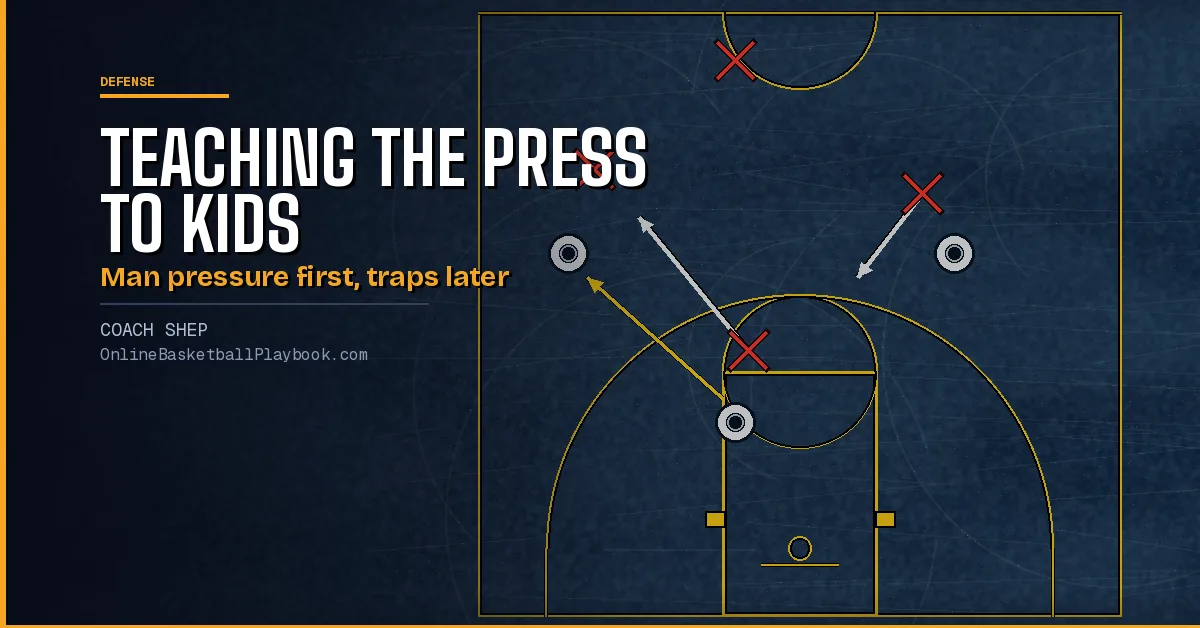
How to Teach a Press to Youth Teams: What to Teach First
How to teach a press to youth teams: check your league's rules, start with man pressure, build it through small games, then add a simple trap or zone press later.
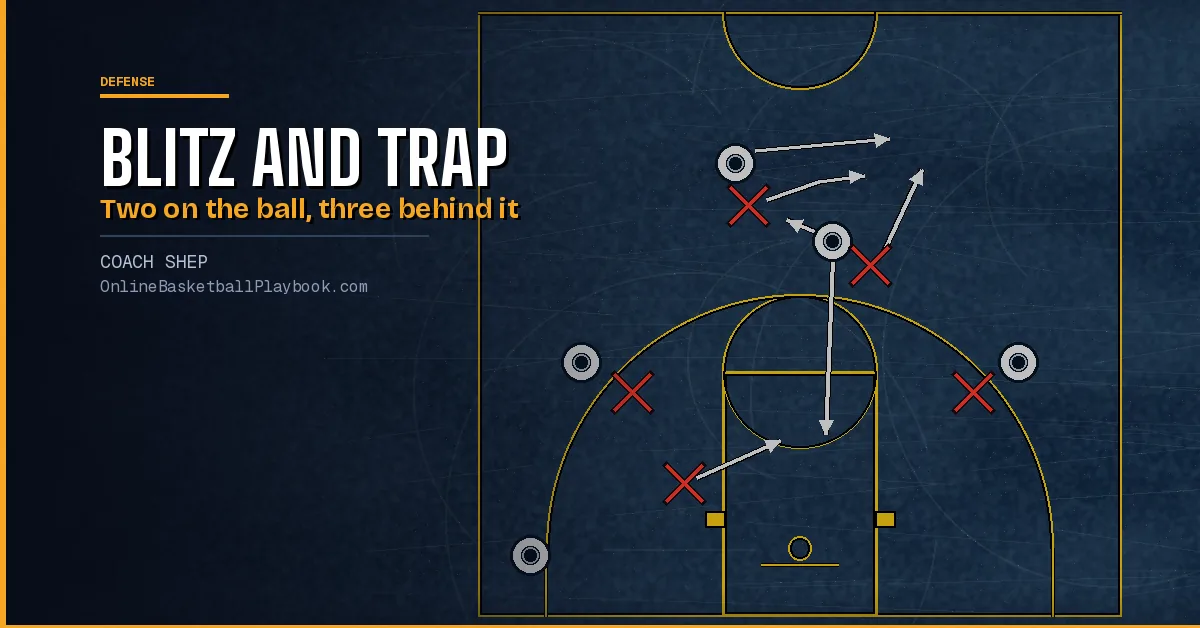
Blitz Pick and Roll Defense: How to Trap a Ball Screen
Blitz pick and roll defense explained: how to trap a ball screen, when the blitz fires, the rotation behind it, the offense's answers and the disguise.
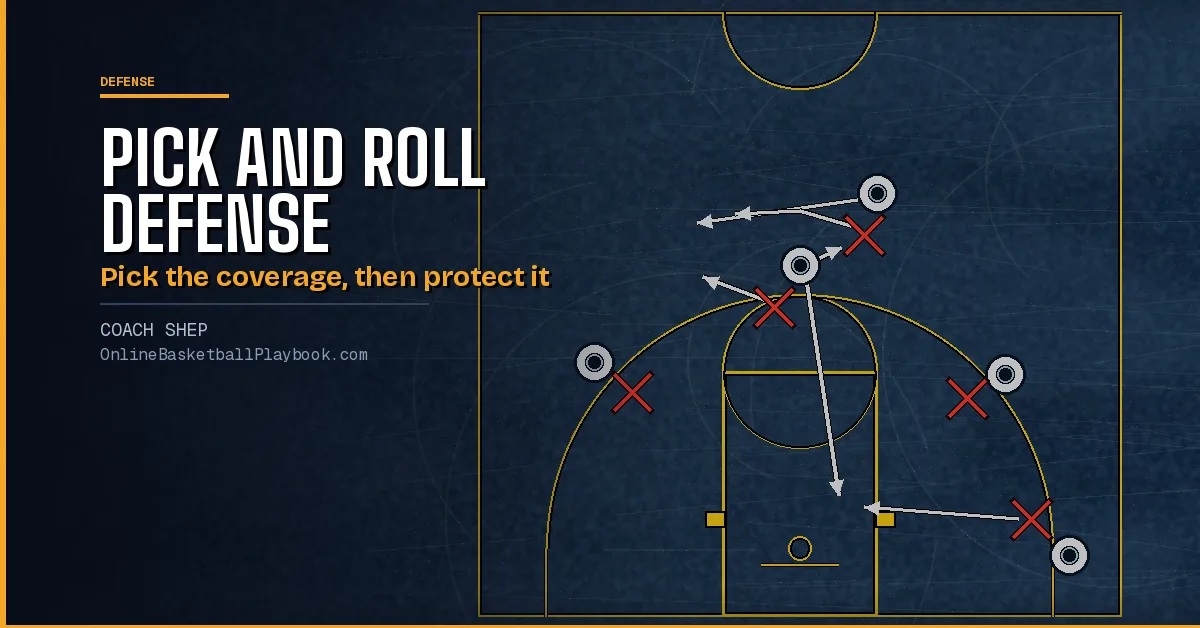
Pick and Roll Defense: Every Ball Screen Coverage Compared
Pick and roll defense compared: drop, show, blitz, switch, ice and under, what each takes away and gives up, the help behind it and how to choose.