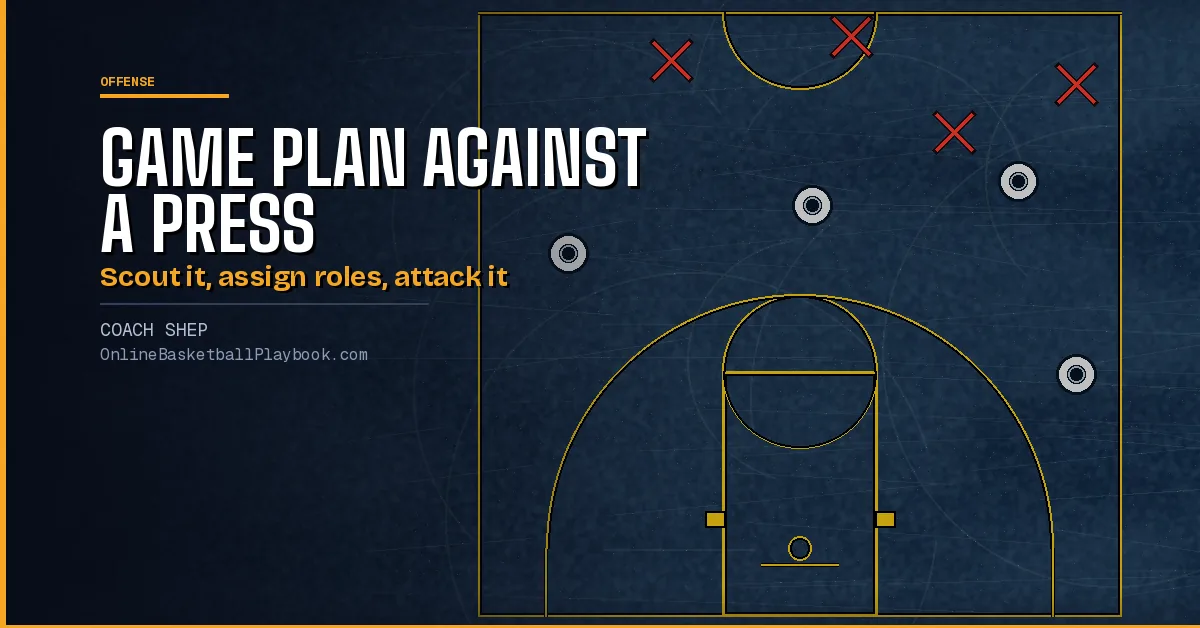
A game plan against a press defense is a written answer to four questions. What press will we see, who has which job against it, which rules hold on every possession, and what do we change when it is working? Teams that only drill a press break in the week before a game answer those questions on the floor, under pressure. A plan answers them in the film room and the practice gym.
The Game Plan Against a Press Defense at a Glance
| Part of the plan | What you decide |
|---|---|
| Scout | The press family, the pickup point, who the trap is aimed at and how it treats a reversal |
| Base break | One alignment every player already knows, so nobody waits for a call |
| Roles | Inbounder, primary handler, reset receiver, deep runner and far-side outlet |
| Rules | Sideline, middle and reverse outlets. Catch and face. Never catch and hold |
| Finish | Attack for a layup and run the secondary break instead of resetting |
| In-game | A second handler, a timeout to regroup and a short list of adjustments |
What the Press Is Trying to Do
Teach your players why the other team presses so they anticipate the pressure instead of reacting to it. Coaches press to speed up a slower team, disrupt a rhythm, force turnovers, keep the ball away from a hot scorer, wear down a thin bench or come from behind. Some coaches measure a press by disruption alone. By that measure the press works when the offense cannot run what it planned and fails when the defense fouls or gives up a layup or an open three.
That definition changes the goal of your break. A turnover-free possession that ends in a rushed shot is still a win for the press. Your plan has to get the ball across half court and into your offense, and it should look for a score on the way.
A press also shows up at different moments. Some teams press after every made basket, some only in short bursts, and some as a comeback tool or as an adjustment after you beat their first press. Ask which one you are facing, because it tells you how many possessions the press break has to carry.
Scout the Press You Will See
Name the defense first and attach the counter second. A scouting report that says "they press" does less for your players than one that says "diamond after made baskets, trap on the first pass to the wing, looks to deny our point guard." Here is what to look for on film.
- The press family. Zone presses such as the 1-2-1-1, 2-2-1, 1-2-2, 2-1-2 and 1-3-1 place defenders in set lines and trap in set spots. A man press puts every defender on a man across the floor and may or may not trap. Match-up presses trap only on a trigger, such as an uncontrolled dribble. Each family asks for a different first read.
- The pickup point. Full court starts at the inbounder. Three-quarter court starts near the free-throw line extended. Half court starts as the ball crosses.
- The inbound. Some presses let the inbound happen and trap after it. Others deny the first pass or deny the return pass to the inbounder. A press that denies the return pass can be aimed at your best ball handler.
- The target. Some teams trap quick guards at once and wait on slower ones until the second dribble. Some face-guard the dominant guard so a weaker guard has to decide. Find out whom yours is aimed at.
- The trap spots. The deep corners and the sideline about halfway up the floor are the classic trap zones, because the boundary line works as an extra defender. Note where they trap and which pass comes next. Pressing staffs chart the inbound sector and the next pass so they can move the trap point during the game, so expect the spot to move.
- The reversal. Press designers often plan for a reversal back to the inbounder and treat it as harmless, because the backcourt count keeps running. Your plan should say when a reversal helps and when it only stalls.
Run the film both ways. Review your own past possessions against pressure to find patterns, such as who drifts into the corner or who picks up the dribble early. Then study the opponent's press tendencies and design the counters from what you saw. Mental preparation belongs in the plan too. Breathing exercises and visualizing a clean break are skills players should practice before they need them in a game.

Pick One Base Break and Name the Roles
The simplest plan gives every player one alignment to use against any press. The 1-4 high is a common choice. Four receivers start high across the floor and the inbounder has a choice of targets. Bringing everyone high removes back-side help, makes denial harder and forces slow post players to defend the full floor. One receiver then breaks deep, and a player who starts high and cuts deep is harder to guard than one parked deep for the whole possession. The alignment works against man and zone pressure, so no player waits for a sideline call when the defense changes.

Some staffs number the break by court length instead of naming the alignment. An "80" is full court, a "60" is three-quarter court and a "40" is half court. The same personnel and spacing carry across all three, and a team that learns one learns the others. Use whichever label your players remember, and use the same one across every team in your program.
Then give every job a name and a player.
- Inbounder. Use the same player every time, inbound fast after a made basket and keep moving along the baseline so a cross-court pass gets shorter. The inbounder faces five against four with five seconds, so teach him to read overplays, fake, throw sharp passes through a pressuring defender and step back in at once.
- Primary handler. This is your best dribbler and passer, and he has to stay calm when he is doubled. Name a second trusted handler too, because a press that hunts your best guard needs an answer.
- Reset receiver. A trailing player behind the ball gives the handler a release valve to reverse out of a trap. Name a guard for the job, because resetting to a big through the inbounder invites trouble.
- Pressure-release post. An athletic post near the midcircle can serve as a pressure release. Some coaches use a mismatch clear-out so the post advances the ball.
- Deep runner. He holds the back defender and gives the passer a long option that turns a broken press into a layup.
- Far-side outlet. He stays spread and ready for the reversal.
Rules Every Player Carries
Roles change by press. The rules stay the same.
- Sideline, middle and reverse. Any time the ball can be trapped, the handler needs three outlets. Two defenders cannot trap the ball and cover all three, so with the spacing right the trapped player stays poised and finds the open teammate.
- Catch, square up and face. Catch with two hands, square the defender in triple threat at once and battle for the first twelve inches so he cannot spin you backward. Catch where you can do something with the ball.
- Never catch and hold. A receiver who stalls becomes the next trap target.
- Forward first, sideways second, backward last. A press wants sideways and backward passes because they slow the advance.
- Pass fakes and straight-line passes. Press defenders play the lanes like free safeties, so fake to move them and keep the pass flat and quick.
- Avoid the danger zones. Corners, inbounding too close to the baseline and carrying the ball across half court into a corner all hand the defense an extra defender.
- Count the defenders. Two on the ball means two teammates are unguarded somewhere behind it. A trap is a chance.
- Play at your own pace. A press is built to speed you into quick long threes. Attack for a layup first and take a good shot or nothing.
- Sprint back. If the break fails and the ball is lost, every player runs back at once.
For the footwork and passing details behind these rules, see the guide to How to Break the Full Court Press and 10 Keys for Beating Pressure Defense.
Get the next coaching guide in your inbox
One email when a new guide or diagram set goes up. Free.
Turn the Broken Press Into a Score
Beating the press is the start of a possession. A team that resets after every break gives the pressing team no penalty for gambling, and a press that carries no penalty stays on. A team that scores off the break gives the other coach a reason to back off.
A trap leaves a numbers advantage behind the ball. The best outcome is a two-on-one against the lone deep defender, and the ball handler who sees it should attack the rim and pass only when the safety commits. A long pass to the deep runner, a swing to the far side or a dribble handoff with the big who popped out can all start it.

Press-break lanes and fast-break lanes match, so one set of habits serves both. If your team already runs a numbered secondary break, run the press break on the same lanes and the players do not learn a second system. Read How to Run the Fast Break and Secondary Break Basketball for the lanes and the reads.
Know the clock as well. Backcourt counts differ by league, so check yours and count aloud in practice. A player who feels the pressure of the ball instead of watching the clock can give away a violation.
When the Press Is Working
Even a prepared team gets pressed into a bad stretch. Decide the responses before the game.
- Change the handler. If the press is face-guarding your primary handler, a second trusted handler can take the first outlet. You can also put the best handler in the middle and throw over the top.
- Shorten the pass. A quick inbound pass near the sideline followed by short, fast passes beats dribbling into a trap. Against a hard man press, a backcourt ball screen or a ball-handling big bringing the ball up are options.
- Pass before the double arrives. Swing passes made before the second defender gets there keep the ball moving until a shot or a driving lane appears. Near half court, a firm high screen and roll for the trapped handler lets the screener roll or pop depending on how the defense reacts.
- Use a timeout to regroup. A timeout is a tool for the press as well as a clock stop. Use it to talk through what is and is not working and to make the adjustments above.
Where Coaches Split on Breaking a Press
- Dribble or pass under the trap. Some coaches allow a dribble only to avoid a trap, score or improve a passing angle, and they teach a pull-back dribble with teammates coming back to the ball. Others drill a half-court break that demands a pass with no dribble at all. Pick one rule and say it the same way every day.
- The sideline. One view calls the sideline dribble the most common press-break mistake, because the sideline is where the press wants the ball. Another view says that beating the first defender up the sideline before the trap arrives breaks a press that depends on trapping there. No version settles it, so practice against the press you will face.
- Reversal. Press designers often plan for a reversal to the inbounder and welcome it. Break guides reverse the ball as soon as the pressure lets up to punish a defense loaded to one side. A reversal that advances the ball attacks the weak side. A reversal that only retreats gives the defense what it wants.
- One break or one per press. Install a single versatile break for every press, or build a named counter for each press on the schedule. A universal break saves practice time, and a named counter gets used for the one or two presses you will actually see.
Put the Plan Into Practice
Install in order. Choose your offense, your defense, whether you will press and then your press break, and build the press break from the roster you have. Teach it whole-part-whole. Show the full break, drill the parts, then put the parts back together. Run the break off every made basket and every free throw in practice, whether or not anyone is pressing.
- Outlet and go. Two players. The inbounder passes, the receiver turns and faces at once, takes two dribbles and pulls up or finishes. It builds the catch, turn, face and go habit.
- Trap and kick. Three defenders trap a handler while two teammates wait in kick-out spots. Rotate after five reps. The handler practices the pull-back dribble, sideline-middle-reverse spacing and the open-man kick.
- 4 on 5 no dribble. Four offensive players against five defenders. The offense wins by completing ten passes or scoring. It teaches ball movement and strength with the ball.
- Partner pressure passing. Groups of three in a monkey-in-the-middle setup. The handler holds triple threat under harassment for three to four seconds, then pivots and passes around the defender.
- Live full court. One team presses the whole possession and the break group has to advance and score.
- One practice, three looks. Run an "80" against a diamond, a "60" against a 2-2-1 and a "40" against a half-court 1-2-2. Show each, run it five on zero down and back, then five on five.
More reps are on Drills to Teach the Press Break and Press Break Basketball Drills. For the zone-specific plan, see Strategies for Coaching Against Zone Press Defenses. The half-court and three-quarter versions are covered in How to Break the Three-Quarter Press.
Questions Coaches Ask About a Game Plan Against a Press
How do you prepare a team for a press defense?
Scout the specific press on film, choose one base break, give every player a role, teach the shared rules and run live reps against two or three press looks. Add a plan for timeouts and a second ball handler before the game.
What is the best press break?
It depends on the roster and the press. A single alignment that works against man and zone pressure, such as the 1-4 high, saves practice time. A named counter for each press on your schedule is the other approach.
Should you call a timeout against a press?
Yes, when the press is working. A timeout is a chance to regroup, talk through what is not working and make adjustments such as a new handler or a shorter first pass.
How do you beat a press with a weak ball handler?
Take the ball out of his hands. Name a second handler, use a ball-handling big or a backcourt ball screen and keep the first passes quick and near the sideline so he is not the one who has to beat the trap.
Why should a broken press become a fast break?
A broken press leaves a numbers advantage behind the ball. Scoring off it gives the pressing team a penalty for gambling. Resetting into the half court gives the defense time to recover.
All offense pages sit under the Offense hub, and the full press-break library starts at Press Break Basketball. To see how the pressing team builds its side, read Full Court Press Defense.
Want the printable playbook packs?
OBP Pro members get the premium playbook packs: the zone attack, out of bounds and practice plan PDFs, plus each new pack as it is finished. The membership page lists what is in each one. Or draw your own version free in PlayDraw.
See what OBP Pro includesMore Coaching Guides
- Strategies for Coaching Against Zone Press Defenses
- Basketball Coaching Leadership: 5 Strategies That Hold Up
- Dribble Drive Motion Offense: Spacing, Reads and Install
- How to Run the Fast Break: Lanes, Reads and Drills
Back to Press Break Basketball and every Offense page.
Keep Building
Related breakdowns
Four Corners Offense Basketball: Roles, Rules and Versions
Four corners offense basketball: the set, the chaser, the corner and post rules, three versions, when to run it, the shots it hunts and shot clock limits by level.
Strategies for Coaching Against Zone Press Defenses
How to coach against zone press defenses: what the 1-2-1-1, 2-2-1, 2-1-2 and 1-3-1 take away, the spacing that beats them, how to break the trap and the drills.
High Low Offense Basketball: Reads, Counters and Zone Rules
High low offense basketball explained: the two-post shell, the lob and bounce reads, answers to a front, down-screen reads, 1-4 low sets and the hi-lo against zones.