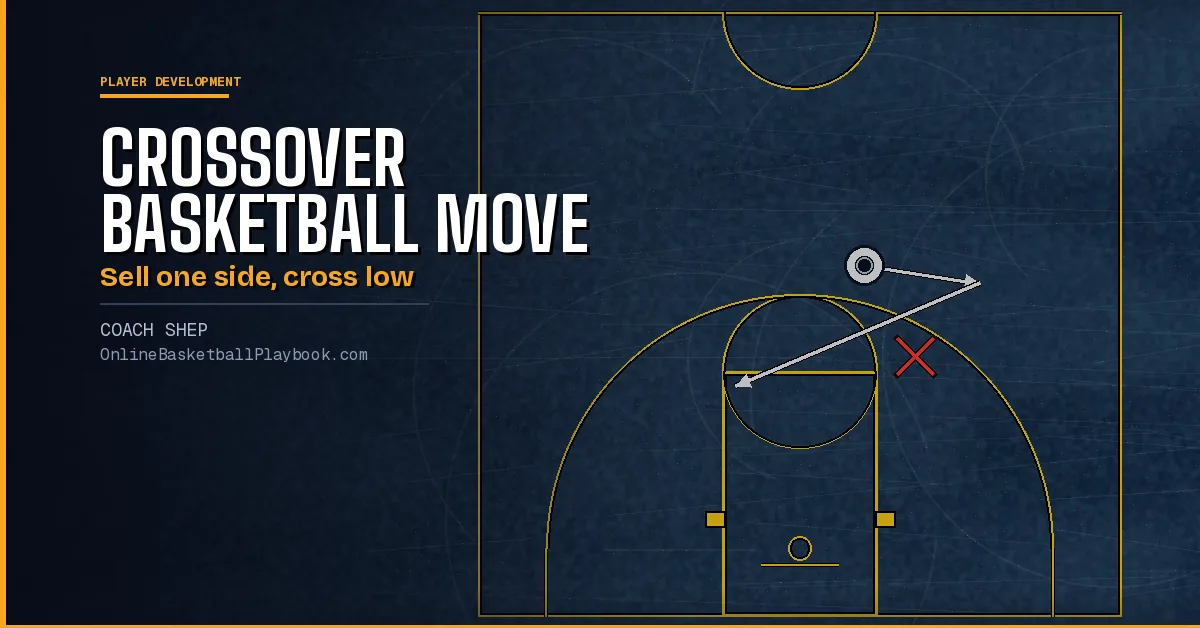
The crossover in basketball moves the ball from one hand to the other to change direction. It works because a fake first pulls the defender one way, and the cross then takes the handler the other way. Crossover basketball is usually the first move players learn, and it stays useful as long as the setup changes. This guide covers the four steps, change of pace, the footwork after the cross, the counters, the read that follows and the drills.
The Crossover at a Glance
| Step | Job |
|---|---|
| Fake | Two or three hard dribbles or a step fake to get the defender moving |
| Hesitate | Pause as the ball returns to the hand so his momentum carries him past |
| Cross | Power dribble low and wide across the body to the other hand |
| Decide | Pull up, drive, or pull a help defender off a teammate |
Crossover Basketball Move: The Four Steps

1. Fake. Make a dribble or step fake one way. Two or three hard dribbles help, because they get the defender's feet moving. Drop the foot and the shoulder toward the fake and keep the eyes there.
2. Hesitate. Pause as the ball comes back to the hand. The defender's momentum carries him slightly past.
3. Cross. Push the ball low and wide across the body to the other hand. Cross it at a slight backward angle. A hand under the ball and a high cross are both errors. Bring the opposite foot forward as the ball crosses so the drive starts right away.
4. Decide. Pull up, attack the driving lane, or pull a help defender off a teammate.
Fake first, and the cross takes care of itself.
Where the Space Comes From
Change of pace does most of the work. Go from slow to fast so the defender cannot settle into a rhythm. To slow down, shorten the stride and keep the upper body forward. To speed up, lengthen the stride and push off the back foot.
The steps after the cross finish the job. A one-two step footwork out of the cross creates the separation for a shot, and the same steps create a driving lane. The hips matter too. After the cross the handler's hips should sit ahead of the defender's hips, along with the ball. Then the handler can get between the defender and the basket.
Change pace first, then cross.

Counters and Variations
A crossover done the same way every time gets scouted. Change the setup and the finish. Use the cross as a counter against a defender who has committed to stopping a straight drive, and save it for that moment.
- In and out. Sell the cross by rolling the hand from the outside of the ball to the top and then the inside. Push the ball back outside and keep going the same way. Use it once defenders begin to jump the real cross.
- Two-step cross. A quick power dribble between the legs sets the defender up one way, and a second quick cross takes the handler back. It forces two changes of direction instead of one.
- Wider cross. A bigger step and a wider ball placement add hesitation. The full breakdown is on Allen Iverson Crossover.
- In and out into a pull-up. Sell the attack with the in and out, then cross and shoot. It gives smaller players space without relying on size. See Tony Parker In and Out Crossover Pull Up.
- Crossover step. A right-handed player going left can use a crossover step instead of a crossover dribble, because the dribble can be stolen.

The crossover step from triple threat. The crossover step changes direction with the feet from triple threat.
- Jab and read. The player jabs and reads the defender. If he holds his ground instead of dropping back, go at his forward foot.
- Swing and cross. With the defender's inside foot forward, swing the ball low and across, cross the jab foot over without first returning it, and drive hard and straight past the defender's inside shoulder.
- Ball before pivot. The ball leaves the hand on the dribble before the pivot foot leaves the floor. The heel may lift, but the toe stays down.
- Front crossover drive. Rip the ball low across the shoe tops, step the free leg across and start the dribble with the opposite hand.
The jab itself is on jab step basketball.

Get the next coaching guide in your inbox
One email when a new guide or diagram set goes up. Free.
The Read After the Cross

The move ends in a decision. If the defender is beaten, drive. If a helper steps over, pass. If neither happens, the space is enough for a pull-up. Teach this read with the move.
Watch the crossover in a 2-on-1. It carries the ball back toward the teammate and collapses the spacing. In that spot attack first and pass second.
See the helper before you decide.
How to Teach It
- Teach why a move is used along with how to do it.
- Start with the base menu, crossover, in and out, hesitation, behind the back, between the legs and spin. Add counters and doubles after players own the base.
- Check three things every rep: change of pace, eyes up and hips ahead of the defender after the cross.
- Ask every player to name a go-to move and a counter, and make sure the counter has a different setup.
- Add live resistance early. Stationary reps do not transfer until a defender is involved. Coaches split here: open with stationary work, or teach the move inside a game after a short introduction.
- Doing too much often never moves the defender, so keep the move menu small for younger players.
Teach the why and the read, and keep the menu small.
Crossover Drills
- Called-move lines. The coach calls a move and blows a whistle. Players perform it at half court and at each wing. Cue: knees bent, stay low, protect the ball.
- Cone drill. Players do the called move two steps from a cone, explode out of it and finish with a layup at both ends.
- Token defender. A full-court drill that pairs each named move with a token defender and a finish at the rim.
- Weak hand. Run every drill with the opposite hand too.
- Move on. If a drill is not landing after about 10 minutes, bring it back next practice.
More work is on Ball Handling Drills, 50 Basketball Dribbling Drills, Hesitation Pull Up Shot and Basketball Drills for Guards.
Rep it with a defender, from both hands.
Questions Coaches Ask About the Crossover
How do you do a crossover in basketball?
Fake one way, hesitate as the ball returns to the hand, push the ball low and wide to the other hand, then decide whether to pull up, drive or pass.
Why is my crossover not working?
Usually the defender never moved. A fake that does not shift his feet gives the cross nothing to beat, and a cross done the same way every time gets scouted.
What is an in and out crossover?
A fake cross where the hand rolls over the ball and the handler keeps going the same way. It punishes a defender who jumps the real cross.
How low should a crossover be?
Low and wide, out of the defender's reach.
At what age should players learn the crossover?
It is a base move, so it belongs in the first menu with the in and out, hesitation, behind the back, between the legs and spin.
All skill pages sit under the Player Development hub and Basketball Dribble Moves. Related pages are Double Dribble in Basketball and Ball Handling Dribbling Workout.
Want the printable playbook packs?
OBP Pro members get the premium playbook packs: the zone attack, out of bounds and practice plan PDFs, plus each new pack as it is finished. The membership page lists what is in each one. Or draw your own version free in PlayDraw.
See what OBP Pro includesMore Skill Guides
Back to Basketball Dribble Moves and every Player Development page.
Keep Building
Related breakdowns
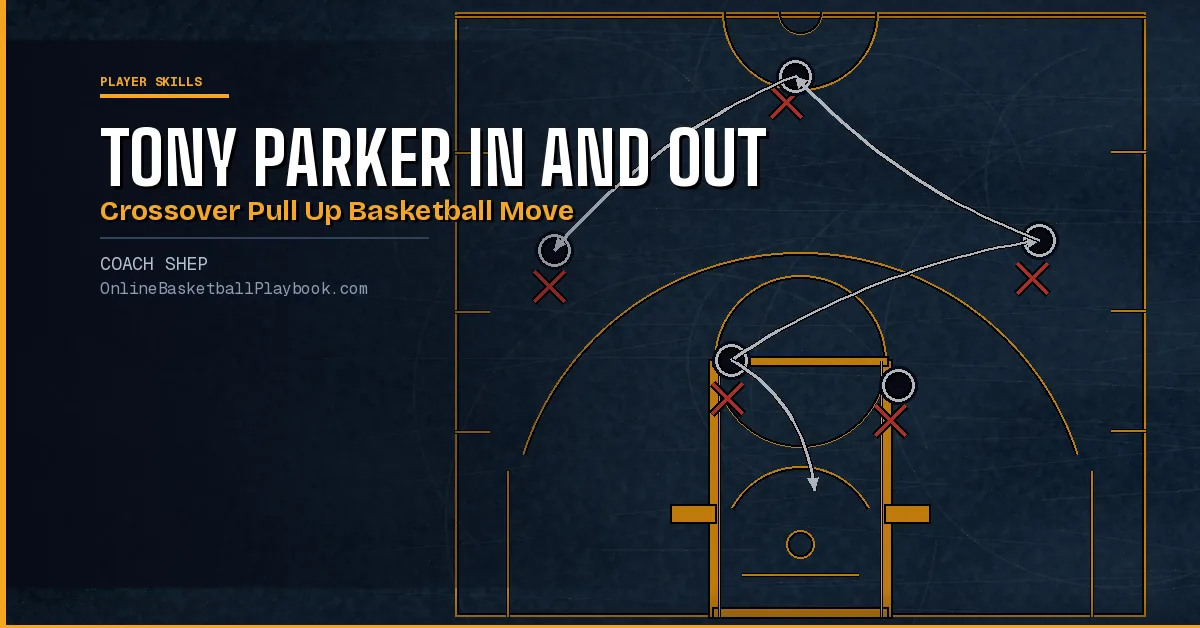
Tony Parker In and Out Crossover Pull Up Basketball Move
Tony Parker In and Out Crossover Pull Up Basketball Move
Allen Iverson's Crossover: The Move That Changed Basketball
Allen Iverson's 1997 crossover on Michael Jordan is still replayed today. Here's the actual footwork, hand speed, and coaching progression behind the move, not just the highlight.
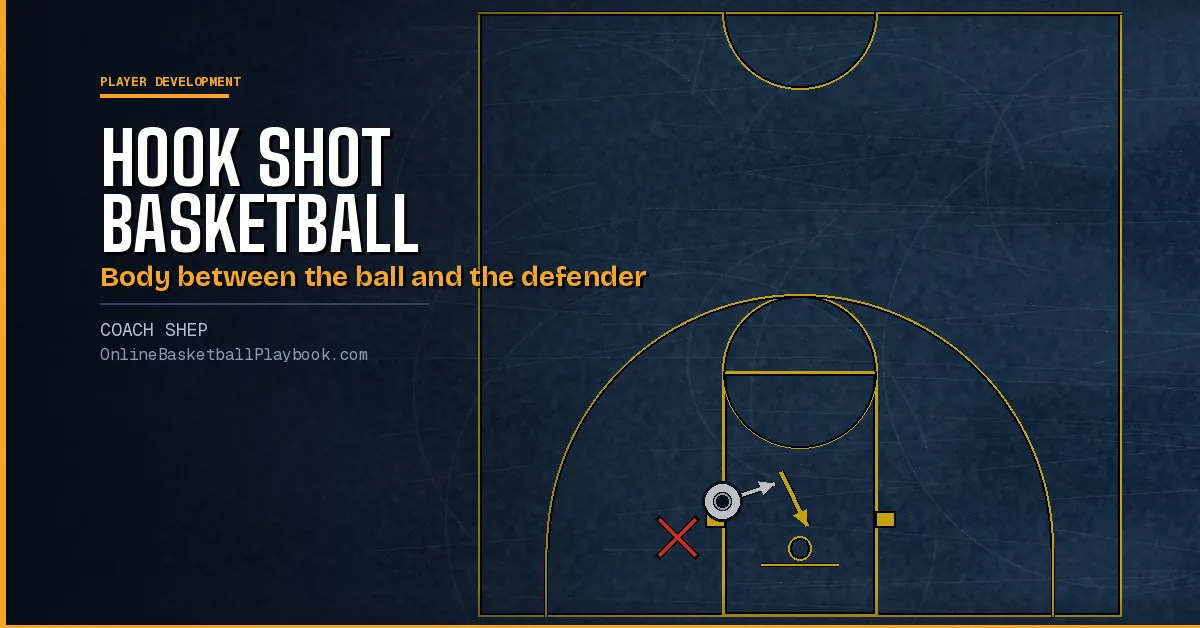
Hook Shot Basketball: How to Do It and How to Teach It
Hook shot basketball for post players and coaches: the classic hook, sky hook and jump hook, the footwork steps, when to use it, the pivot foot rules and drills.