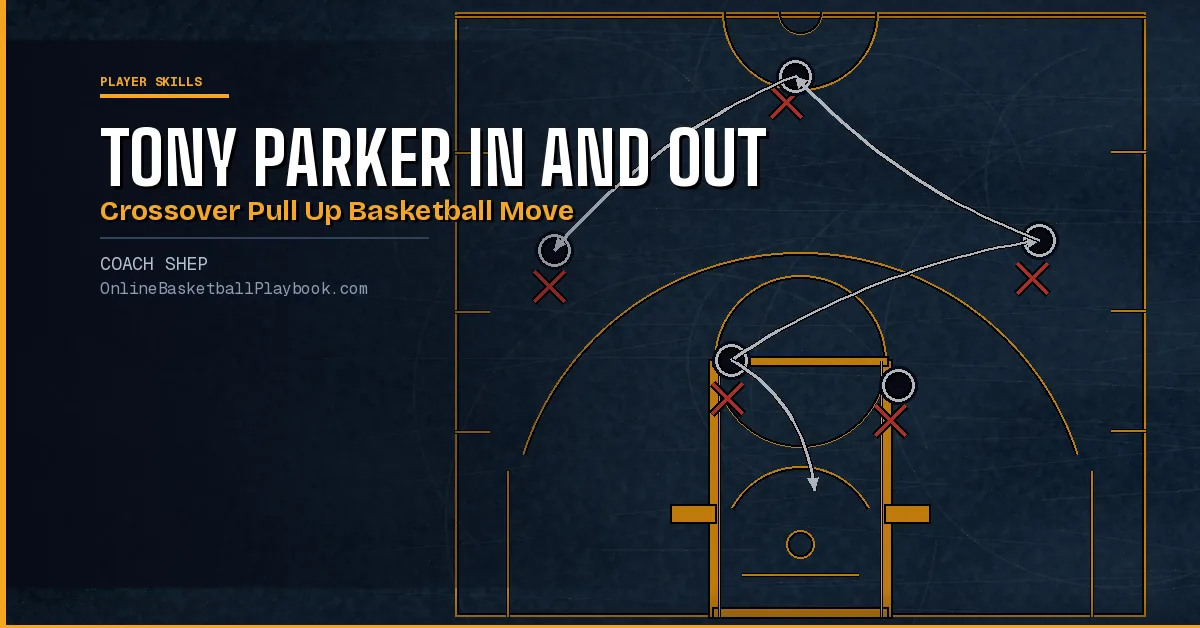
Tony Parker built a Hall of Fame career on one of basketball's most deceptive weapons: the in-and-out crossover into a pull-up jumper. Here is exactly how it works and how to teach it.
What the Move Actually Is
The Tony Parker in-and-out crossover pull-up is a two-part deception sequence. First, the ball handler uses an in-and-out dribble (a move that makes the ball appear to be crossing over to the other hand while actually staying in the same hand) to freeze the defender's feet. Second, the ball handler immediately gathers and elevates into a pull-up jump shot, firing before the defender can recover.
The reason Parker's version became the definitive template is timing. Most players either rush the in-and-out (making it unreadable as a fake) or slow down after it (giving the defender time to close out). Parker did neither. His in-and-out was sharp and exaggerated, his gather was seamless, and his release was quick enough that the defender was still reacting to the fake when the ball was already in the air.
The move lives in the mid-range (typically from the elbow or from the side of the free-throw line) and it is most effective against defenders who are already leaning or who have aggressive closeout habits. Against a flat-footed or completely passive defender, the fake has no value. Parker chose his spots carefully, using the move when the defense was already pressuring him or had a tendency to bite on directional changes.
Understanding what the move is (and what it is not) matters for coaching it correctly. It is not a crossover that ends in a drive. It is not a hesitation that leads to a continued dribble. It is a read-and-react sequence that ends in a shot. The decision to pull up is made before the in-and-out dribble, not after it. That pre-commitment is what gives the move its speed and decisiveness.
The Footwork Breakdown
The footwork on the Parker pull-up is what separates it from a generic jumper off the dribble. Breaking it down into three phases makes it teachable.
Phase One: The Approach Dribble
Parker typically attacked in a straight line or at a slight angle toward the elbow. He was not meandering. He had a destination in mind (a specific spot on the floor) and he drove toward it with purpose. This is the foundation. If a player approaches without a target location, the gather and release will be off-balance and inconsistent.
The dribble during the approach is kept low and close to the body. Parker was not carrying the ball out to one side. He was pushing it forward, running in attack mode, keeping his center of gravity low. This matters because a low, forward dribble generates momentum that the in-and-out can redirect (or appear to redirect) efficiently.
Phase Two: The In-and-Out Dribble
At roughly two strides from the target spot, Parker executes the in-and-out. The ball is pushed forward and to the inside with a pronounced wrist flick, but the palm rotates under the ball and pulls it back to the original hand before the ball leaves control. The key coaching cue here is "show it and take it back." The wrist motion must be exaggerated enough that the defender sees the threat of a crossover. A subtle in-and-out does nothing. The defender's hips won't shift.
The feet during the in-and-out are taking a short, stutter step. This is the "in-and-out" of the footwork: a slight pause that corresponds with the ball fake. The body weight shifts momentarily toward the false-crossover direction, then recenters. Many defenders react to the head and shoulders during this moment, shifting their hips in the direction of the apparent drive.
Phase Three: The Gather and Pull-Up
Immediately after the in-and-out, Parker gathers into his shooting position. Because he pre-committed to the pull-up before initiating the fake, the gather is clean and deliberate. His feet land in a consistent two-foot stop or a quick one-two rhythm (he varied this depending on speed of approach). He was balanced at the gather, with his knees bent and his hips under him. The shot goes up quickly (within one second of the gather) before the defender's feet have reset.
The release itself is a standard pull-up jumper: Parker was not a high-flyer. He released quickly from a medium height, relying on arc and touch rather than altitude. Coaches should not try to redesign a player's shooting mechanics when installing this move. The pull-up release is the player's own shot. The move delivers them to a balanced spot on the floor; the shot takes care of itself.
Reading the Defense to Trigger the Move
The in-and-out crossover pull-up is a counter move. It is not a primary action you run blindly on every possession. Parker was exceptional at reading which defensive posture made the move available, and teaching that read is as important as teaching the footwork.
The Overplaying Defender
The best target for this move is a defender who is cheating toward one side, leaning to cut off a drive or shading hard to take away a dominant hand. When a defender's hips are already angled, the in-and-out fake exaggerates that lean and freezes their recovery. Parker regularly attacked defenders who were giving him a look that suggested "I've taken away your right hand." He would initiate a left-hand approach, use the in-and-out to fake the crossover back to the right, and pull up as the defender over-corrected.
The Hard-Closing Defender
A second trigger is a defender who closes out hard on perimeter catches. When a defender is running at full speed to cut off space, their momentum makes them vulnerable to any directional fake. Parker would catch at the three-point line, take one or two dribbles toward the closeout, use the in-and-out as the defender arrived, and pull up from mid-range as the defender flew by. The move required him to attack the closeout rather than retreat from it, a counter-intuitive read that most players avoid.
When NOT to Use It
Against a defender who is completely still and squared up, the in-and-out has little effect. The fake requires momentum and commitment from the defender to exploit. If the defense is passive and waiting, the correct read is to attack downhill and either score at the rim or find the open teammate. Parker understood this and rarely wasted the in-and-out pull-up on a stationary defender.
How Spacing Makes the Move Work
No individual move functions in isolation. Parker's pull-up worked in part because of how the Spurs structured their spacing, and the same principle applies to every team that wants to install this action. When the floor is spread correctly, defenders cannot help off their own assignments to cut off the ball handler's pull-up lane. This is the direct connection between individual skill and team system.
A five-out spacing arrangement (all five players outside the three-point arc) is the ideal environment for this move. With the paint clear, Parker had an unobstructed path to his pull-up spot and no help-side defenders camped in his landing zone. The spacing concept is simple: "Five players outside the arc pull shot-blockers away from the basket," creating straight-line driving and pull-up lanes that would otherwise be clogged.
When one player in the lineup cannot be guarded as a shooting threat, the defense can sag that player's defender into the lane. That extra body in the paint collapses driving lanes and provides a fifth defender who can step up on any pull-up attempt. This is why the "one-non-shooter collapse rule" matters: before running any isolation pull-up action consistently, every player in the lineup needs to be a credible threat. If they are not, the defense gets a free safety to take away the very move you are trying to run.
Corner spacing is the most important component. If a player is stationed in each corner with the ability to shoot, their defenders must stay attached. That keeps four defenders busy on the perimeter and leaves the ball handler's pull-up lane protected. Parker rarely operated in a crowded floor. The Spurs' attention to spacing was a fundamental part of why his individual actions were so effective.
Drilling It With Your Team
Installing this move with a team requires a progression. Jumping straight to five-on-five is the wrong starting point. Players need to build the individual mechanics before adding defensive pressure, and they need to understand the reads before the reps have competitive consequence.
Drill 1: Stationary In-and-Out Repetition
Start without any dribbling approach. Players stand in their shooting spot, ball in hand. On the coach's signal, they simulate the in-and-out wrist motion, then go up for a shot. The goal here is purely mechanical: the wrist flick, the ball control, the transition into the shooting motion. Ten repetitions per hand per player, each one with emphasis on an exaggerated fake before the shot.
Drill 2: Dribble Approach + In-and-Out + Pull-Up
Players start at the top of the key. They take three to four dribbles toward the elbow, execute the in-and-out at the two-stride mark, gather, and pull up. No defender yet. The coaching emphasis is on the pre-commitment: players decide to pull up before starting the approach. Coaching cue: "You're already pulling up. The in-and-out is just the setup."
Run this from both elbows, from the wing, and from the short corner. Parker used this move from multiple locations. Players need to build comfort from each spot independently.
Drill 3: Live Closeout Defense
Add a defender starting at the rim. The ball handler catches at the three-point line; the defender closes out hard. The ball handler uses the in-and-out as the defender arrives and pulls up. The defender's job is to close out at full speed. This trains the ball handler to attack the closeout rather than retreat from it. Switch roles every five reps.
Drill 4: Guarded Elbow Isolation
One-on-one from the elbow. The defender starts already guarding the ball handler, shading one direction. The ball handler reads the shade, uses the in-and-out to attack the lean, and pulls up. The defender is live. This is the closest simulation to real game use and should come after players have built mechanical consistency in the earlier drills.
When installing this move, resist the urge to use it as a primary ball-handler-isolation action. Teach players to read two cues before triggering it (the defender's hip angle and the defender's approach speed) so that every rep in practice has a decision attached to it, not just a mechanical habit. Players who run the in-and-out without reading the defense first will use it against stationary defenders and wonder why it stops working in games.
- Pre-commit to the pull-up before the approach dribble: the in-and-out is a setup, not a decision point. If players are deciding mid-move, they will be late and off-balance on the gather.
- Exaggerate the wrist flick on the in-and-out: a subtle fake does not freeze defenders' hips. The motion needs to be pronounced enough that the defender's body weight shifts before the ball comes back to the original hand.
- Target the elbow and the wing, not the three-point line: the pull-up is most effective from spots where the defender has already been forced to close ground, typically 15 to 18 feet. Too far out and the pull-up reads as a three, which changes how the defense plays it.
- Clear the paint before running this action: four or five players on the perimeter force their defenders to stay attached, which protects the pull-up lane. One sagging non-shooter collapses everything.
- Attack the closeout, do not retreat: the move is designed for a defender coming at you, not standing still. Teach players that a hard closeout is an invitation, not a reason to hesitate or reset the dribble.
Common Mistakes and How to Fix Them
There are four mistakes that show up consistently when players first learn this move. Each one has a specific fix.
Mistake 1: Telegraphing the Pull-Up
Some players slow down before gathering, which signals to the defender that a pull-up is coming. The fix is to maintain dribble speed through the in-and-out and into the gather. The deceleration, if any, should happen during the gather itself, not before the fake. Drill this by having a coach call out "slow" every time a player decelerates prematurely; the player owes a sprint if they get called three times in a session.
Mistake 2: Under-Executing the In-and-Out Fake
A small, tight in-and-out does not move defenders. Players often minimize the motion because they are worried about losing control of the ball. The fix is to drill the in-and-out in isolation (just the wrist motion, stationary) until the exaggerated version is comfortable and the ball-control anxiety disappears. Once the mechanics are secure at a standstill, re-introduce the dribble approach.
Mistake 3: Poor Gather Position
Players who are still thinking about the footwork sequence during the gather often land with their feet too wide, too narrow, or their body weight forward. The result is an off-balance shot. The fix is deliberate: in drill 2 (approach without defense), emphasize the gather landing position explicitly. Two feet, shoulder-width apart, knees bent, hips under the shoulders. Players should pause at the gather position before going up for the shot until the landing becomes automatic.
Mistake 4: Overusing the Move
Once players feel comfortable with the in-and-out pull-up, many overuse it, running it against defenders who are flat-footed or completely guarding them. Against stationary defenders, there is no lean to exploit and no momentum to freeze. The move stops working and players lose confidence in it. The fix is to drill the read explicitly: in drill 3 and drill 4, require players to verbally identify the defensive cue (closeout or overplay) before executing. No cue, no move.
Parker never ran this action blindly. He used it when the read was there and chose different options when it was not. That discipline (knowing when to use a move and when to put it away) is what separated his mid-range game from players who had the same mechanics but worse results. Teach your players the same discipline and the move becomes a reliable weapon rather than a habit that gets them into trouble.
Over a career that included four championships and a Finals MVP, Parker consistently returned to this pull-up as his go-to scoring action in the half-court. The reason was its reliability. When executed correctly against the right defensive posture, it is nearly unguardable. The ball handler has already decided to shoot, the in-and-out has disrupted the defender's balance, and the pull-up goes up before recovery is possible. That sequence of deception, decision, and execution is something any guard can develop with deliberate practice and the right coaching cues.
Want more basketball coaching strategies and drills?
Join the Online Basketball Playbook newsletter →
Draw this play free in the play drawer →
Membership: the full library, playbook packs, and Pro drawing tools →
Keep Building
Related breakdowns
Crossover Basketball Move: How to Do It and Teach It
How to teach the crossover in basketball: the four steps, change of pace, footwork after the cross, the in and out counter, the read that follows and drills.
Allen Iverson's Crossover: The Move That Changed Basketball
Allen Iverson's 1997 crossover on Michael Jordan is still replayed today. Here's the actual footwork, hand speed, and coaching progression behind the move, not just the highlight.
Basketball Hesitation Dribble: How to Do the Hesi Move
The basketball hesitation dribble step by step: the stop and rock back, selling it, when to use it, its crossover and pull-up counters, the hedge read and drills.