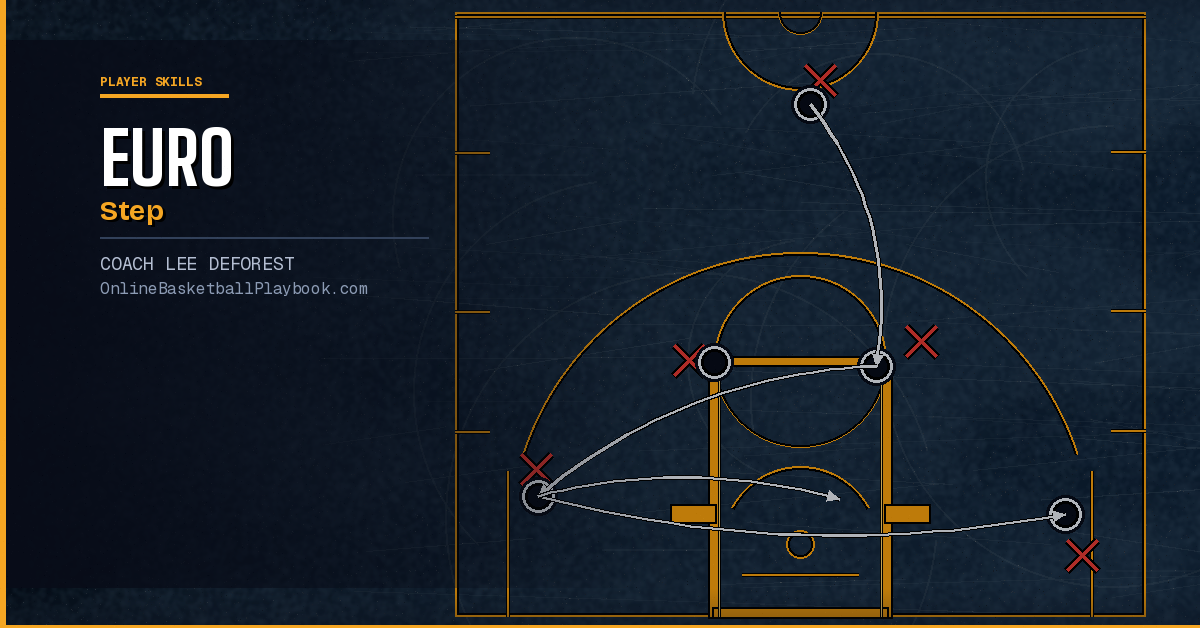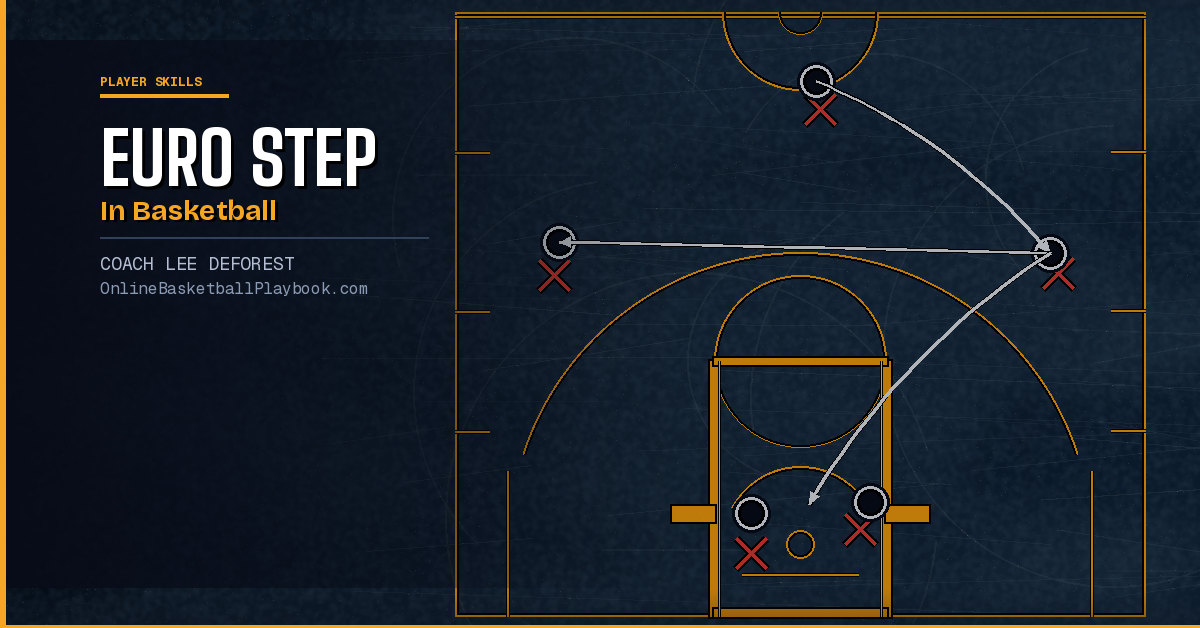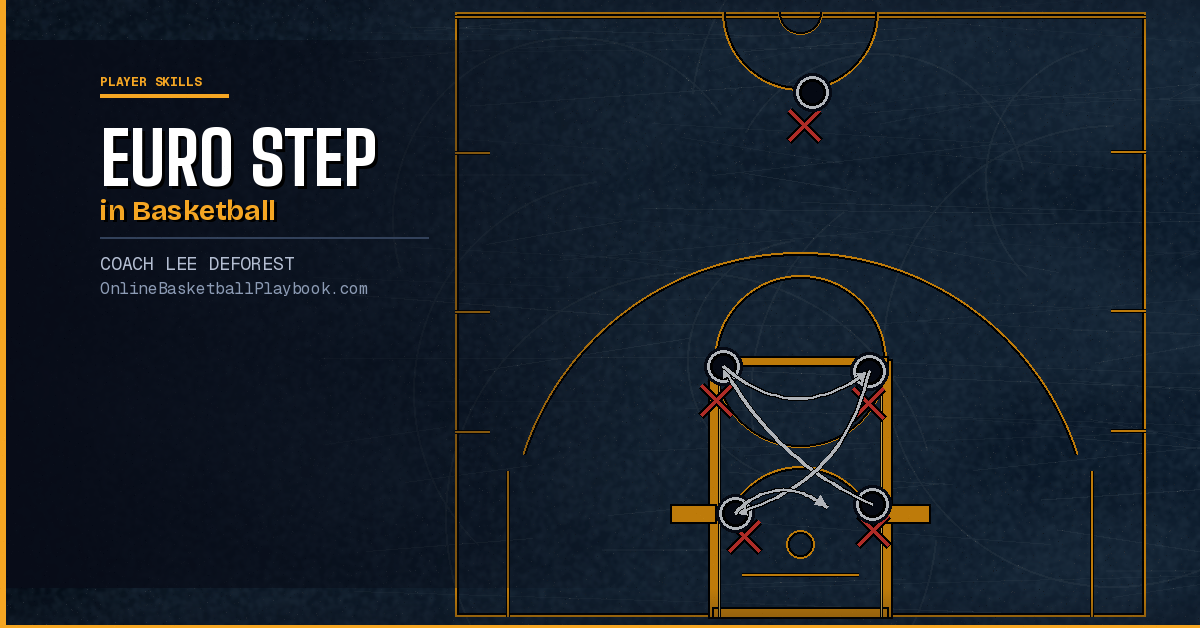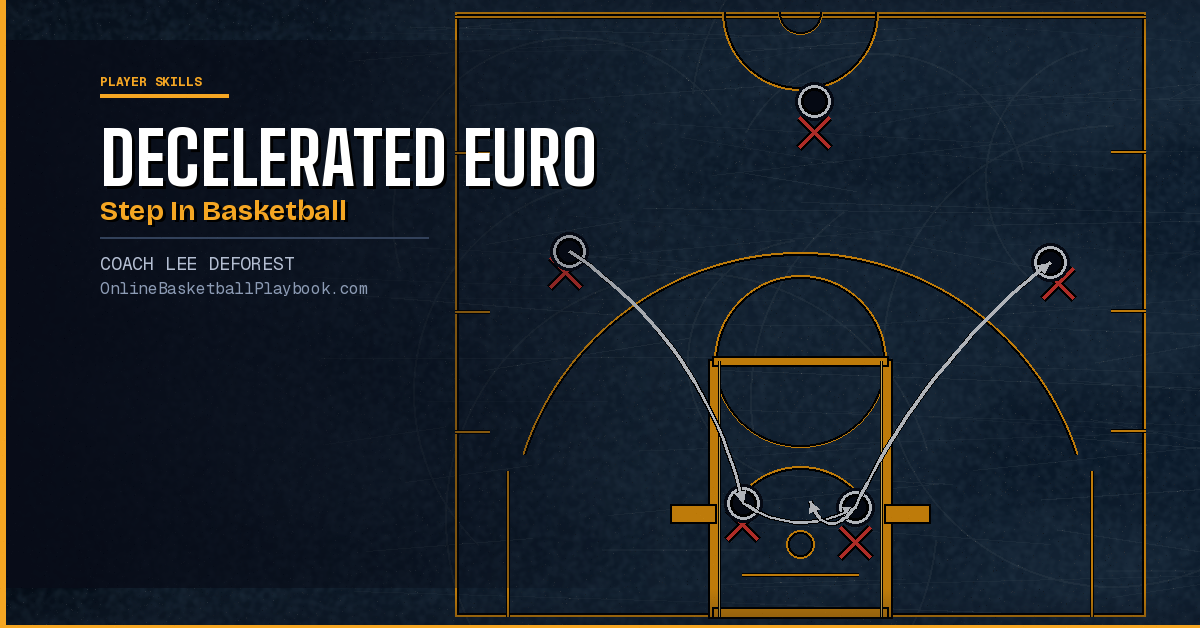

The decelerated Euro step fools help defenders by breaking rhythm before the gather. This guide covers the exact footwork, when to use the move, and the drills that make it automatic.
What the Decelerated Euro Step Actually Is
Most players think of the Euro step as a move you make at top speed — attack the paint hard, gather, plant one foot to the side, and step around the shot-blocker with the other. That description is accurate, but it only covers one version of the move. The decelerated Euro step adds a tempo change before the gather, and that tempo change is what makes the finish so difficult to guard.
The standard, full-speed Euro step works because the ball handler covers a lot of lateral ground in two steps, forcing the help defender to choose a side. The decelerated version works for the opposite reason: the attacker slows down as they approach the paint, the help defender reads "layup" and commits to a position, and then the two-step gather moves in the opposite direction of that commitment. The defender is frozen because they already made their bet.
Think of it as a change-of-pace dribble that runs all the way through the finish. The deceleration is not a mistake or a loss of momentum — it is the move. A defender who has already shuffled toward where they think the ball is going cannot recover in time to contest a finish that goes the other way.
The move belongs to what coaches call a "finish menu" — the set of rim-finishes a guard should own so they can choose based on what the defense gives them. You cannot drill just one layup. Players who only know how to finish at one speed, in one direction, against one look, will get their shot blocked the moment they face organized help defense. The decelerated Euro step adds a dimension that the standard power finish and the straight-line floater do not cover.
The Step-by-Step Footwork Breakdown
This is where most teaching goes wrong. Coaches describe the Euro step as "step left, step right" and leave out every decision that happens before and after those two steps. Here is the full sequence.
Phase 1 — Drive and Approach
Attack the paint with a purpose. Your angle of approach should put you on a collision course with the help defender. If you drive so wide that no one is in your path, the Euro step is not the right read — just finish. The deceleration works because there is a body between you and the basket that the help defender must protect. Drive at them, not around them.
On the final dribble before the gather, push the ball out in front of you lower and harder than your previous dribbles. A low last dribble keeps the ball out of reach of the on-ball defender, shortens your gather, and positions your body to absorb the pace change without lunging forward.
Phase 2 — The Controlled Deceleration
This is the step most teaching skips. Two or three dribbles before the gather, reduce your stride length without changing your body posture. Stay low. Keep your shoulders level. Do not stand up straight as you slow down — that is a giveaway that something is about to change. The defender should see the same body shape they have been seeing the entire drive.
The key is that you slow your feet, not your body position. If your upper body shoots upright, any competent help defender will read the stutter and reset before your gather. Decelerate like you are about to take a normal two-foot jump stop. The sell is that you look like you are gathering to go straight up.
Phase 3 — The Gather and First Step
Pick up the ball. Your first step should be wide — plant it clearly to one side of the defender. Not slightly to the side. Wide enough that your foot is past their foot. That first step picks your direction, and it must be decisive. A narrow first step gives the defender a chance to shuffle and cut you off before your second step lands.
The direction you step on that first plant does not have to be the direction you finish. You are creating a problem for the defender: they must commit to your first step's direction, because if they do not, you will simply finish that way. Their commitment is what the second step exploits.
Phase 4 — The Second Step and Finish
Step away from the defender's commitment. If they slid to their left to cut off your first step, your second step goes right. If they stayed centered, you have two options — finish on the side of your first step or counter back across. The second step is where you layup the ball. Use the hand on the same side as your second-step foot. If you step right on the second step, finish with your right hand. This keeps the ball as far from the help defender's reach as possible while you are still off the ground.
Finish softly. The temptation on a Euro step is to muscle the ball at the rim because you feel the contact coming. Soft touch wins more often. Use the backboard when the angle allows it. Use the far side of the rim. Get the ball up and let the glass do the work.
When to Use It — Reading the Defense
The decelerated Euro step is not a default finish. It is the right read in a specific situation: one help defender is positioned in your direct path to the rim, they are in a set stance rather than moving toward you, and you are close enough to the basket that a two-step gather puts you at the rim.
If the help defender is moving at you with momentum, the deceleration will not freeze them — they are already in motion. In that situation, a direct power finish or a floater over the top is the better read. The Euro step freezes defenders who are stationary or who are shuffling laterally. It does not stop a defender who is running at you on a sprint.
If two defenders are collapsing together, the Euro step can split them if there is enough space between their bodies. If they are stacked one behind the other, go overhead with a floater. The move you choose is always determined by the body position of the help, not by a predetermined plan.
The best trigger for the decelerated version specifically is when the help defender has already committed early — they read your drive and shifted before your gather. That early commitment is a mistake you want to reward. The deceleration stretches the time between when they commit and when you actually gather, which means they have even less time to recover after their early move.
Train the rim-finish family — regular, opposite-hand, power, reverse, floater/runner, Euro step — and choose by the help. Use the rim as a shield; finish through contact.
— Finishing & Footwork Concept, Basketball Vault
Common Mistakes and How to Fix Them
The Euro step fails for predictable reasons. Identifying which mistake a player is making is faster than generic repetition.
Standing Tall on the Deceleration
This is the most common error. The player slows down and simultaneously straightens up, telegraphing the entire move. Any defender watching their hips and shoulders will see the speed change coming. Fix: drill the deceleration in isolation, with a coach watching to ensure the player stays low. The cue is "same shape, slower steps." The body does not rise until the gather is complete.
Narrow First Step
A narrow first step fails to force the defender's commitment. If your foot lands only six inches to the side of the defender's foot, they can stay centered and contest either direction equally. The first step needs to be wide enough to demand a reaction. Cue: "your first foot past their foot." If your foot is not past their foot, you have not created the problem you need them to solve.
Wrong Finishing Hand
Finishing with the inside hand on the second step exposes the ball to the defender's active hand. After the second step plants, the ball should be in the hand on the same side as that foot. Finishing with the outside hand on the first-step side means your arm is crossing your body, which shortens reach and reduces control. Drill hand-foot correspondence explicitly — it is not instinctive early in the learning process.
Using the Move at the Wrong Angle
The Euro step needs room to work. When a player drives too wide to the corner, there is not enough space between the first step and the second step to move laterally past a defender. The move is most effective when attacking from the wing or the slot directly toward the basket, where the path to the rim is short enough for two steps to cover it.
Drills to Build the Move
Drilling the Euro step in isolation — no defense, no consequence — produces players who can demonstrate the move but cannot use it in a game. The drill progressions below build each phase separately before combining them.
Deceleration Isolation Drill
Start at half-court. Dribble toward the basket at full speed. At the three-point line, reduce stride length over two dribbles without changing upper body posture. Gather at the free-throw line extended. A coach or partner watches from the side for any postural change during the deceleration. No defender. No finish yet. The only goal is body shape under a speed change. Run this ten times each direction before adding any other phase.
Cone First-Step Drill
Place a cone at the top of the charge circle. Dribble toward it, decelerate as above, and plant your first step wide enough to clear the cone. If your foot lands before the cone or on the same vertical line, it was too narrow. This builds the habit of a decisive first plant without needing a live defender. Progress to a teammate standing still at the cone once the footwork is clean.
Two-Step Finish Drill (Both Sides)
From the elbow, start with a live dribble. Two dribbles, gather, Euro step to the right with right-hand finish. Then reset and repeat to the left with left-hand finish. No defense. The purpose here is hand-foot correspondence. Each rep, call out which hand finished and which foot was the second step. If they do not match, stop and reset. Build the pairing into automatic memory before adding a defender.
Shadow Euro Step (Stationary Defender)
Add a teammate standing in the paint with their hands up. They do not move — they are there to give the attacker a real body to read. The ball handler decelerates, reads where the defender is standing, and executes the gather and two-step finish. The defender's job is to watch and report: "Your first step was narrow," "You stood up," "Right call, wrong hand." This stage builds real-time reading without the chaos of a moving defender.
Live 1-on-1 Finish
The defender starts in the paint and can shuffle but may not leave their feet until the gather is complete. The ball handler drives from the wing or slot. This constraint forces the attacker to use the deceleration to freeze the defender rather than relying on athleticism to beat a flying body. Once clean at this level, remove the constraint and play it fully live.
Do not introduce the Euro step until your players can already finish a standard layup off a two-foot jump stop from both sides. The jump stop builds the same gather rhythm the Euro step uses. Players who skip this step tend to travel on Euro step attempts because they have never trained a controlled two-step gather. Start with jump-stop layups from the free-throw lane and use them as the physical prerequisite for this move.
Teaching It to Your Players
The Euro step is a finishing move, not a trick play. Treat it the same way you treat any other skill in your finish menu: drill the footwork without defense, build in a stationary read, then progress to a moving defender, then live situations. Shortcuts at any stage produce players who look competent in warmups and fall apart in games.
The deceleration is the hardest part to teach because it runs against instinct. Young players drive toward the basket and speed up as they get closer. The idea of slowing down near a defender feels wrong — it seems like it would make a block more likely, not less. You have to explain the logic before you drill it: you are not slowing down for the defender who is in front of you, you are slowing down so that the help defender who is already committed cannot correct their mistake in time. Once a player understands why the deceleration works, the footwork comes much faster.
Teach the move on both sides from the beginning. Coaches who teach the Euro step right-dominant and then try to add the left side later find that players are much harder to retrain. The footwork patterns are different enough between sides that they need to be built simultaneously. Drill right-side and left-side finishes in equal repetitions from the first session.
Finally, pair the Euro step with its counters. A defender who has been Euro-stepped once will begin to anticipate the lateral step after the deceleration. That anticipation opens up the straight finish — stop the deceleration, gather, and go straight over them. Every move drilled without its counters is a move that will get taken away. Teach the counter in the same session you introduce the primary move, even if just as a concept. The deceleration that leads to a straight power finish is just as valuable as the one that leads to the step-around.
Progress your players through the full finish menu over the course of a season. The decelerated Euro step sits alongside the regular layup, the opposite-hand finish, the power layup, the reverse, and the floater. None of them replaces the others. A complete guard owns all of them and chooses based on what the defense offers. That is the standard worth building toward.
- Body shape is the sell: stay low and level during the deceleration — the upper body must not rise or the defender reads the move before your gather.
- First step past their foot: the plant must be wide enough to force the help defender's commitment; a narrow first step lets them stay centered and contest both directions.
- Match hand to second-step foot: if the right foot is your second step, finish with the right hand — this keeps the ball extended away from the defender's reach.
- Drill both sides from day one: right-dominant only training creates a left-side gap that is much harder to close after habits are set; equal reps from the start is the shortcut.
- Always teach the counter: pair the Euro step with a straight power finish off the same deceleration so players have a second answer when the defense adjusts.
Want more basketball coaching strategies and drills?
See it drawn up
Related diagrams
Keep Building
Related breakdowns