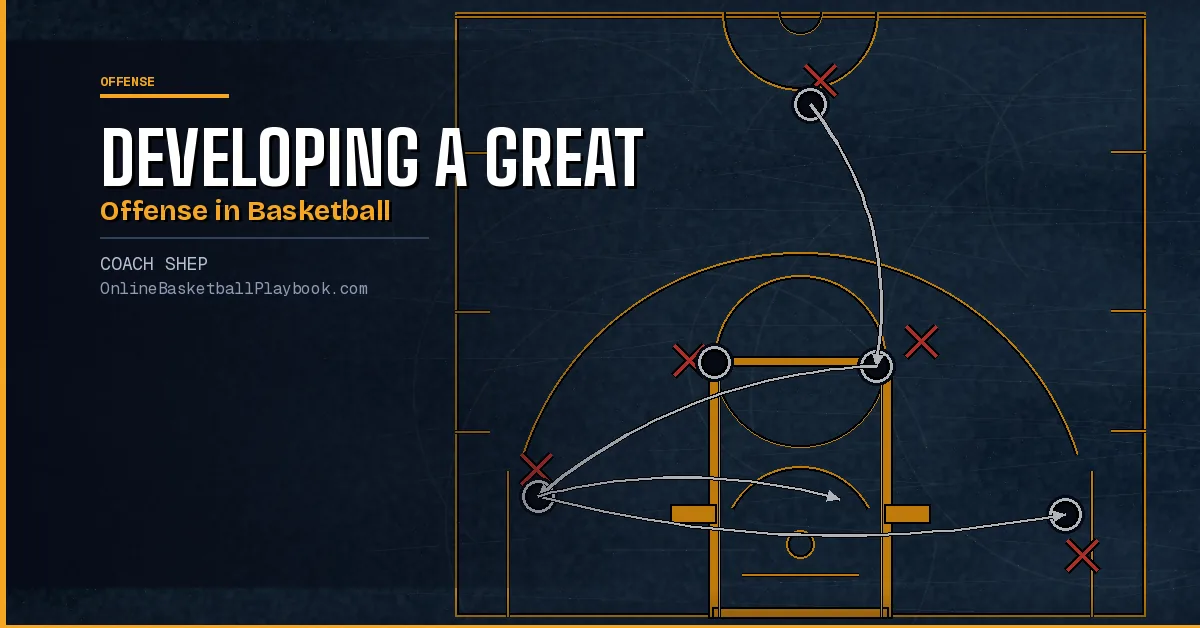
A great basketball offense is built on reads, spacing, and movement, not memorized plays. Here are the principles coaches at every level use to develop offenses that are hard to scout and easy to play.
Read, Don't Call: The Foundation of Motion Offense
The best offensive systems in basketball share one trait. Options emerge from how the defense plays, not from what the coach calls. This is the essence of motion offense: players read the defense and make decisions based on what they see, rather than running scripted sequences they memorized in practice.
Coaches who build great offenses teach their players to "learn to play, not run plays." The goal is an offense that is functionally unscoutable, because no two possessions are scripted the same way. When defenders key off an alignment or a play call, there is nothing to key off. The read changes every time a defender makes a choice.
This approach requires a shift in how you teach. Instead of drawing up plays for every situation, you teach rules. Rules for what to do after a pass. Rules for how to use a screen. Rules for when the backdoor is open. Once players internalize those rules, the offense runs itself, and it keeps running even when a substitute comes off the bench because the logic is the same for every player in every position.
The mental model that unlocks this for players is simple: watch the defense, take what it gives you. Every defensive mistake is a scoring opportunity. If a defender turns their head, cut. If they sag off, shoot. If they overplay, go backdoor. The offense does not dictate these opportunities. The defense does. Your job as a player is to recognize them, and your job as a coach is to train players to recognize them faster.
Pass and Move: Why Standing Kills Your Offense
Every effective motion offense runs on one non-negotiable rule: after every pass, a player must move. A pass is not a moment to rest. It is a trigger. The moment the ball leaves your hands, you have three choices: basket cut, set a screen, or receive a screen. Standing still is not one of them.
Standing players do two damaging things to an offense. First, they make the defense's job easy. Defenders do not have to work when nobody is moving. They can watch the ball, anticipate passing lanes, and collapse on the dribbler without worrying about off-ball threats. Second, they crowd the floor. Good spacing requires constant work. When players stop moving, spacing collapses, and with it, all the driving and passing lanes your offense depends on.
The "pass and move" principle is not complicated to teach, but it is surprisingly hard to install. Players default to watching the ball after they pass. Film sessions are one of the best tools for correcting this. When a player sees themselves standing while the play develops elsewhere, it registers in a way that verbal instruction often does not.
Some coaches track standing as a formal error in film review, the same way they would track a turnover. That standard communicates the priority clearly. Movement is not a preference. It is a team discipline. When one player stands, the offense slows for everyone.
The off-ball player who cuts at exactly the right moment (when the ball-handler's defender turns their head) is the engine of any motion system. That cut does not need to lead directly to a basket to be effective. It clears a lane, pulls a helper out of position, or creates the spacing that gives the ball-handler a window. Every cut has a purpose even when it does not touch the ball.
Spacing Principles That Create Open Shots
Spacing is not the result of a good offense. It is the cause of one. The gaps between players determine which reads are available. When spacing collapses, the driving lanes close, the passing angles get harder, and the defense can help without giving up anything.
The standard reference point in motion offense is 15 to 18 feet between perimeter players. That gap is wide enough that a defender helping on a drive cannot recover to their own man in time to contest a catch-and-shoot. It is the spacing that makes the kick-out pass dangerous. Shrink the gap below that threshold and suddenly the defense can cover two threats at once.
Spacing is not a static configuration. It is constant work. Movement maintains spacing rather than preserving it. When a player cuts through, someone fills the vacated spot. When a screen is set on one side, players on the opposite side adjust their positioning to keep the floor balanced. The discipline of filling spots (especially the five spots in a 5-out system) is what keeps the spacing consistent possession after possession.
One principle that does not get enough attention at the youth and high school level: the most dangerous moment for a defender is the instant a player catches the ball. That player is more open at the catch than they will be at any other point. Catching balanced, with eyes on the rim and a genuine threat to shoot, drive, or pass, is what forces the defense to commit. A player who catches and immediately puts the ball on the floor with no read gives that advantage away. Catch ready to attack. That is the spacing principle in its simplest form.
"Spacing is offense, offense is spacing." This is not a slogan but a structural truth. Every read your offense wants to make depends on defenders being spread out enough that helping costs them something. When your spacing is tight, your offense is predictable. When it is wide and maintained through constant movement, every pass becomes a decision point for the defense.
Ball Movement Beats Player Movement
One of the most counterintuitive insights from elite motion-offense coaches is this: a team of five players standing still but passing quickly can be harder to guard than a team of five players constantly moving with one player holding the ball.
The reason is simple. Defenders must adapt to where the ball is. A quick pass finds a late defender before they can recover. Complex player movement with a stationary ball gives the defense time to adjust. When a player holds the ball above their head or stands without any attacking threat, the defense surrenders nothing. All initiative shifts back to the defense.
This does not mean player movement is unimportant. Off-ball cuts and screens are still the engine of motion offense. But when a player is holding the ball, that ball needs to move fast and with purpose. Dribbling without a reason (neither to penetrate nor to improve a passing angle) gives the defense a rest. The guideline from Ettore Messina and Aito García Reneses is direct: dribble only to penetrate, or to move the ball, maximum two bounces in the same spot.
Ball reversal is a pressure mechanic, not a reset. Swinging the ball from one side of the floor to the other forces every defender to change sides simultaneously. If the reversal is quick enough, someone is always late. In systems like the Princeton offense, every ball reversal is also a trigger for the next read: the dead corner, a stagger screen, or a back cut. Reversal is used offensively, not just to restart the possession.
The practical coaching application is to time your passes. If a player regularly holds the ball for two or three seconds between passes, the defense has time to adjust. If passes come in one second or less, the defense is always reacting. Ball speed is a weapon even when nothing looks spectacular on film.
Run timed passing drills in practice where holding the ball for more than one second is a turnover. It sounds extreme, but it trains the habit of passing quickly and moving immediately. Two behaviors that do not develop on their own and that separate sharp motion offenses from slow ones at every level of the game.
How to Install Motion Offense Step by Step
The most common mistake coaches make when installing motion offense is layering too many options too soon. Players need to own one action before they can choose between two. Introducing the full read tree before the base rhythm is automatic results in hesitant, passive players who are thinking too hard to play.
The correct progression starts with the simplest version of the offense at 5-on-0. No defense, no pressure. Players walk through the pass-and-cut action, experience the spacing, and understand what they are supposed to feel. The 5-on-0 drill is not about getting reps of a play. It is about installing a rhythm. What does it feel like to catch, look at the rim, and make a decision? What does it feel like to pass and immediately move with a purpose?
After the base rhythm is automatic, add one read. Not three. One. The most common first layer is the basket cut. Pass and cut hard. If the cut is covered, fill the spot and reset. Run that until it is fast and instinctive. Then add the screen option as an alternative to the basket cut. Then add the backdoor as a response to defensive overplay. Each layer builds on the last rather than overwhelming the player with choices they cannot process in real time.
Naming the actions matters more than most coaches expect. When there is a word for a recurring situation (a "flare," a "slip," a "rip"), players can communicate and correct each other without waiting for the coach to intervene. Named actions turn individual reads into team vocabulary. They make the offense teachable in a way that free description alone does not achieve.
The install finishes when players can make reads against live defense without hesitation. That standard (automatic decisions under pressure) is the goal, and it takes more time than most coaches budget for it. Rushing to 5-on-5 before the base reads are solid is the most common reason motion offenses stall in their first season.
The Princeton System: Reads Over Play Calls
The Princeton system is one of the clearest examples of how a named-set catalog can operate as read-based offense rather than scripted play calling. The six sets (Chin, 5 Out, Low, Point/OUA, Twirl, X) are entry points into the same underlying read logic, not six different plays that require separate memorization.
The key insight from the system's design is that any of the six sets can be triggered by a read rather than a call. A player does not need a coach to yell "Chin" from the sideline. If the defense gives the right look on a dribble-up, the offense flows into Chin automatically. The sets are teaching handles, not play signals.
Ball reversal in the Princeton system is treated as a pressure mechanic. When the ball swings, defenders must change sides, and the reads on the far side (particularly in the Point series with hi-low duck-in options) expose whoever is switching late. Reversal is an offensive weapon, not a shot-clock management tool.
The three wing options form a universal decision tree that every player needs to know: if the post is open, go Low; if the pass to the top of the key is available, go Point or OUA; if neither option is there, dribble up and reset to Chin. Those three reads cover almost every situation a wing player will face without requiring a play call. When every player on the floor knows those three reads, the offense survives pressure, broken plays, and substitutions without missing a beat.
The backdoor is always live in the Princeton system. Patience is the currency. The offense waits for a defender to turn their head or overplay before cutting. Rushing kills the reads. A player who cuts before the defender commits gives up the advantage the offense is designed to create. The discipline of waiting (sometimes uncomfortably long) for the right moment to cut is what separates teams that run the Princeton system well from those that run a rushed, improvised version of it.
- Film standing as an error. Track every pass-and-stand the same way you track a turnover. When players see themselves standing in film, the habit changes faster than any number of verbal reminders during practice.
- Install one option at a time. Run 5-on-0 until the base pass-and-cut rhythm is automatic before adding screens or backdoor options. Layering reads too early creates hesitant players who think instead of play.
- Name every recurring action. Teach players the words (flare, slip, rip, strong) as each action is introduced. Named actions create team vocabulary that speeds up communication and makes reads coachable under live-game pressure.
- Treat ball reversal as an attack. Every swing pass should be fast and purposeful. Drill quick reversal so that the moment a defender commits on one side, the ball is already moving to exploit the late recovery on the other.
- Teach the three wing options as a universal rule. Post open equals Low. Pass to the top of the key available equals Point. Neither available equals dribble up to Chin. These three reads keep the continuity alive in every situation without a play call from the bench.
- Use shot-quality math with players. Layups, then threes, then midrange, in that order. Show players the points-per-possession numbers for each shot type. It is the most persuasive tool you have for changing shot selection without simply telling players what to do.
Want more basketball coaching strategies, drills, and tools?
Join the Online Basketball Playbook newsletter →
Draw this play free in the play drawer →
Membership: the full library, playbook packs, and Pro drawing tools →
Keep Building
Related breakdowns
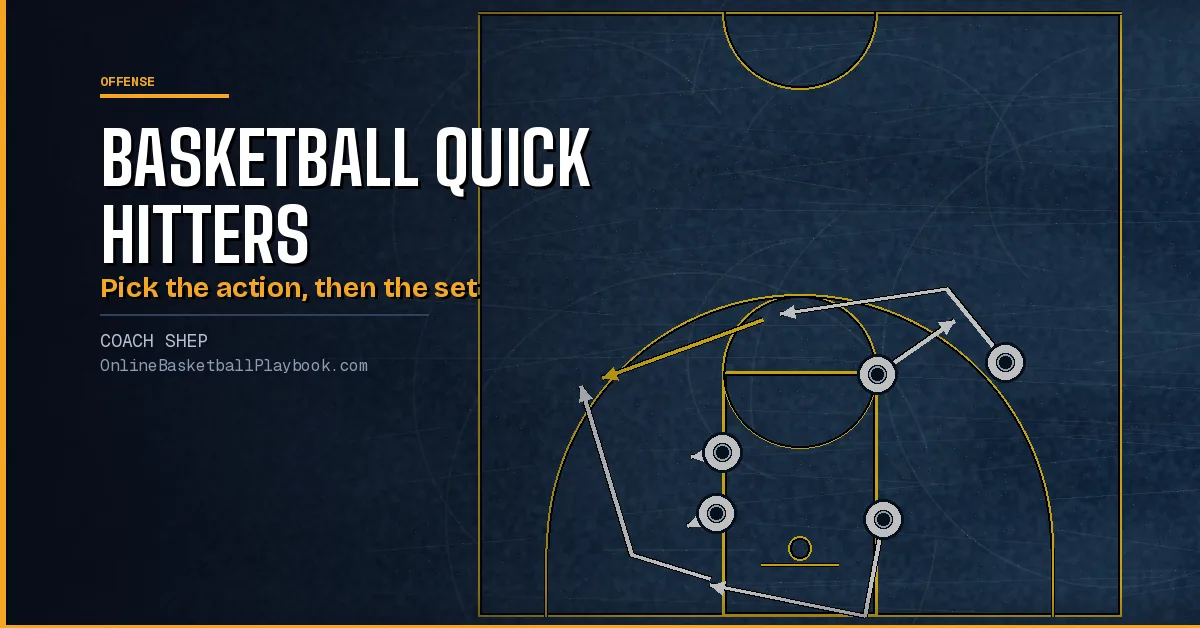
Basketball Quick Hitters: 25 Sets by Action and Formation
Basketball quick hitters sorted by the action you want, catch-and-shoot to post feed, with each set's formation, diagrams, the read and the counter.
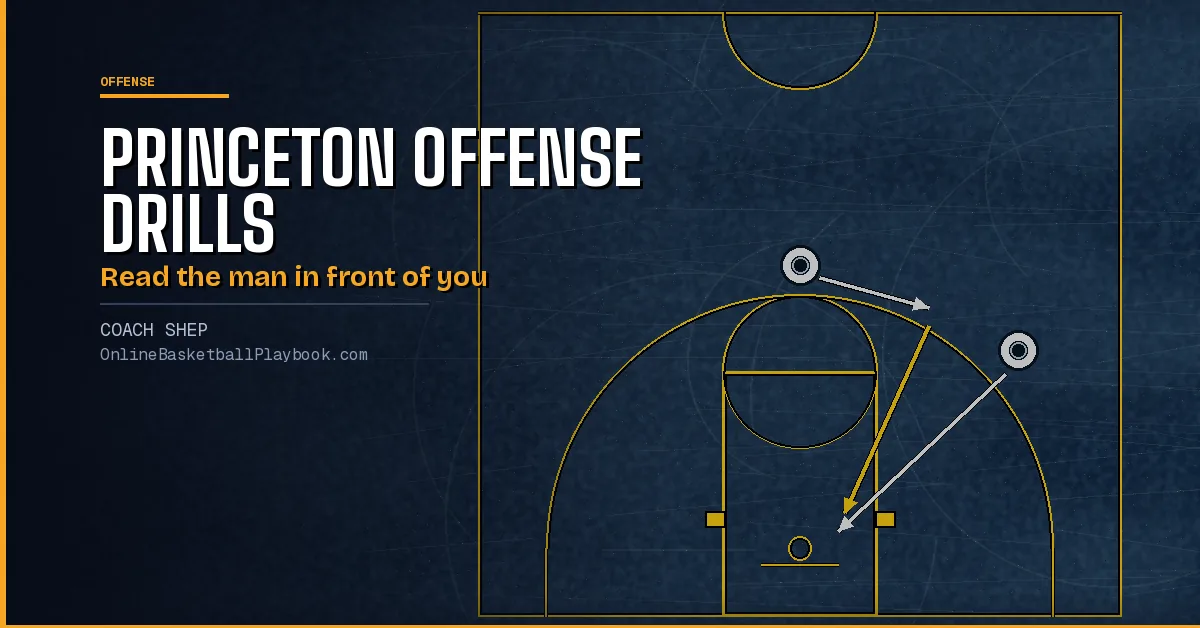
Princeton Offense Drills: Breakdowns, Shooting and Live Reps
Princeton offense drills that teach the reads: spacing, backdoor and hand-off breakdowns, 3-0 Chin and wave drills, Point shooting, a drive drill and an install.
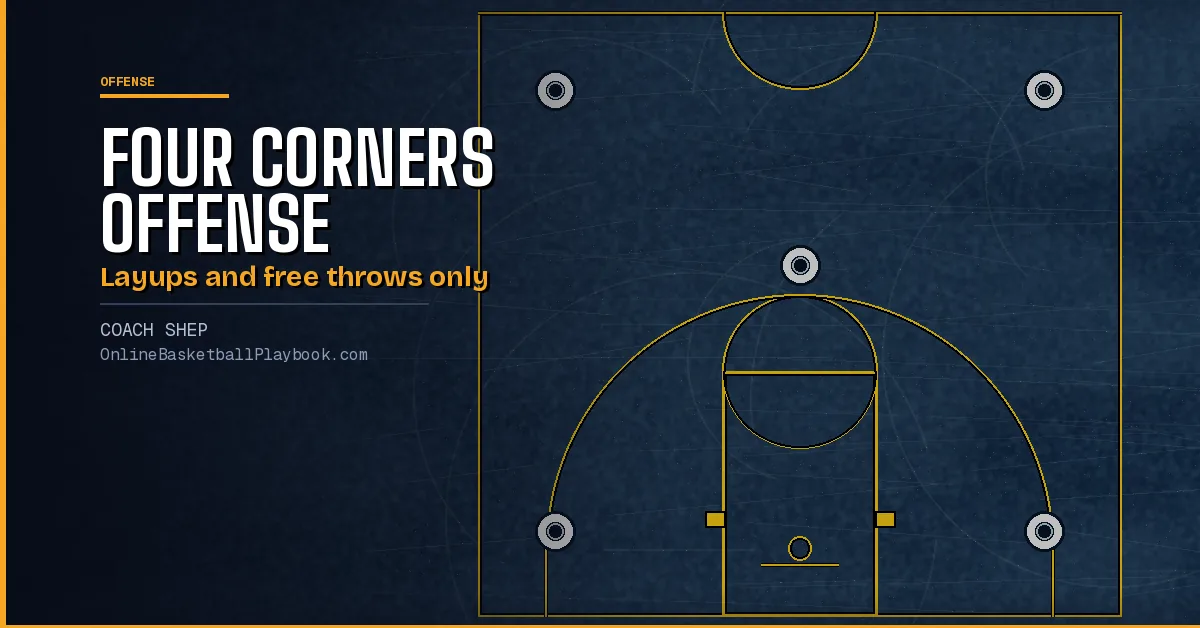
Four Corners Offense Basketball: Roles, Rules and Versions
Four corners offense basketball: the set, the chaser, the corner and post rules, three versions, when to run it, the shots it hunts and shot clock limits by level.