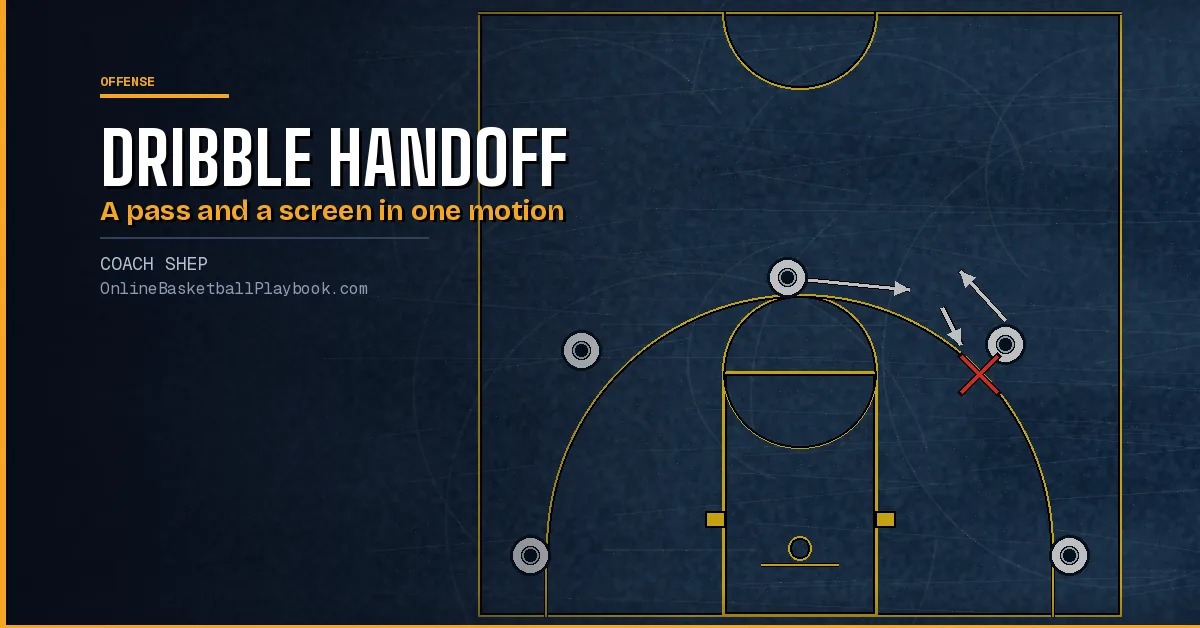
A dribble handoff is a two-player action. One player dribbles at a teammate, hands him the ball from almost no distance, and becomes a screener on the receiver's defender in the same motion. That makes the DHO a pass, a screen and a change in the point of attack at once, and its reads mirror a ball screen.
Coaches use it to beat a denied wing without a risky pass, to get a guard going downhill on the catch, to force a switch, to start a system, and as the fallback when a set's first reads die.
This page covers the types of handoff, how the giver delivers it, the reads for the receiver and the giver, the counters, how defenses guard it and where coaches split. It sits under the basketball screens hub in the offense section.
What a Dribble Handoff Does

The handoff has four jobs: create motion, attack downhill off the catch, force a switch into a mismatch, and free a player who is being face-guarded. Teams usually run it outside the paint to keep the floor spread. Jay Wright uses a one-dribble handoff whenever the defense will not guard a big on the perimeter. In Princeton teaching it is a pressure release, and in dribble-drive it is the listed fix for too much pressure.
Because the giver's body screens the receiver's defender as the ball changes hands, the same coverages and reads that apply to pick and roll apply here.
Types of Handoff
- Dribble handoff. The giver dribbles straight at the receiver's defender and hands off on the move or after a stop. This is the base action.
- The post handoff. A post who has caught the ball at the elbow or the nail hands it to a cutter. The Princeton point series hands off from the high post on its Away, Over and Under options, and a 1-4 high set passes into the high post and cuts back for the handoff.
- The pitch. In the shooting handoff the giver calls "exchange" and hands or pitches the ball while turning to put a butt screen on the receiver's defender.
- The Euro handoff. The cutter attacks the dribbler's defender, the dribbler jump-stops and pivots back, and the ball changes hands shoulder to shoulder.
- Zoom. A down screen into a handoff. The big dribbles at a guard coming off a down screen, hands off and rolls.
- Pistol and 21. The point guard dribbles at the wing, or passes and follows for a return handoff, with a post ready to flare or ball screen.
- The weave. The handoff passes around three players so the defense has to switch every one until a switch fails.
- Get. In Horns the guard sprints for a handoff from the elbow big. Other systems use the word for other jobs, such as the big denying that handoff and dribbling at the wing instead, or a ball screen or a hand-back to the initiator, so write the job next to the name.
- Hand-back. The receiver returns the ball to the passer at once.

The down screen at the front of zoom is covered on down screen basketball. Pick the types your players can read.
How the Giver Delivers It
The shared rule: the giver stays under control and dribbles straight at the defender he is screening, then makes a short, clean handoff. The details differ:
- Two hard dribbles and a jump stop. Jay Wright teaches two hard dribbles and a jump stop.
- One dribble. Jay Wright's one-dribble handoff.
- Two dribbles, then screen. Jay Wright's two-dribble handoff takes two dribbles at the cutter, then screens.
- Deliver on the move. Zoom has no count, and the big delivers on the move.
- No jump stop. The receiver takes it off the bounce.
- Lay it out on a plate. Jay Wright lays the ball out "on a plate."
- Hands top and bottom. The receiver takes the sides.
- Hand or pitch it while turning. Hand or pitch the ball while turning into the butt screen.
Two errors show up most. A giver who keeps moving into the defender after the give is setting a moving screen. Too much space between the two players lets a defender jump the lane, and a rushed handoff turns the ball over.
Whatever the count, stay under control and make the give short and clean.
Dribble Handoff Reads for the Receiver
The receiver sets his man up before the catch and closes the gap so no hand can get in. The receiver's single rule: come get it as fast as you can, because speed is what makes the defense hedge and help. Then he reads his own defender.
Defender chases over: turn the corner. Drive hard to the rim. If the weak-side post defender helps, drop it to the big.

Defender goes under: shoot it or re-screen it.
- Shoot it. A pull-up, a three or a step-back.
- Re-screen it. The giver turns and sets the screen again so the receiver can attack the other way, or a big comes to set a ball screen.

Defense switches: punish the mismatch or slip. The screener rolls or posts the smaller defender, or slips to the rim.
Receiver overplayed: back cut. The denied receiver goes backdoor for a bounce pass. Jay Wright makes it an automatic lob instead, thrown right over the defender's head and caught before the cutter reaches the rim.

The Princeton read: tight or loose. In the Princeton low-post series the wing takes two dribbles toward the elbow player. Tight means back cut for a one-hand bounce pass. Loose means take the handoff. Details are on the Princeton offense page.
Read your own defender and answer him the same way every time.
Get the next coaching guide in your inbox
One email when a new guide or diagram set goes up. Free.
Reads for the Giver
Screen with the turn, then roll, pop or space. After the exchange the giver rolls in some sets, pops in others, and spaces at once in the rest. To roll, the big forward-pivots out of the handoff, finds the ball and sprints to the rim, called a restricted roll.
Read the receiver, not the defense. In zoom the giver watches the cutter. If the guard takes the handoff, the big pops or rolls. If the guard back cuts, the big comes off for his own handoff or rolls.
Keep it when the defense cheats. A defense that jumps the handoff early gets a fake handoff and a quick attack. In a box set the giver fakes, keeps the ball and runs a pick and roll with the other big.

Counters
| Defense does | Answer |
|---|---|
| Chases over | Turn the corner and drive |
| Goes under | Shoot it |
| Goes under | Re-screen, or a big ball screens |
| Switches | Post the mismatch, roll or slip |
| Overplays the receiver | Back cut for a bounce pass |
| Overplays the receiver | Automatic lob (Jay Wright) |
| Overplays the receiver | Giver comes off for his own handoff (zoom) |
| Cheats early | Fake the handoff and attack, or keep it and ball screen |
| Weak-side post helps | Drop it to the big |
Learn one answer for each defense and rep it.
How Defenses Guard the Handoff
There are three coverages, each with its price. Switch is the simplest and creates a mismatch. Go under against a non-shooter and give up an open jump shot. Go over against a shooter and give up a driving lane.
- Switch everything. Flip Saunders' 1-2-2 matchup zone switches every handoff with no chasing. Ben Howland goes over the top on ball screens but switches the handoff.
- The "through" call. In a drop-or-slide coverage the man guarding the ball can drop off or slide through on a "through" call, and a switch is allowed only if it stops the ball aggressively.
- Blitz. Jay Wright's Villanova blitzes ball screens and handoffs when its calculated-risk triggers appear.
- Trail, under or trap. Frank Martin notes the handoff isolates the best handler with the best big and forces the defense to choose trail, under or trap.
The defense of every ball screen coverage these come from is on pick and roll defense, and switching technique is on how to coach effective defensive switching. Pick your coverage before the game and know what it costs.
Where It Lives in Each System
- Princeton. The Chin series starts with a handoff exchange on both wings. Chin is named for Pete Carril's players rubbing their chin to call it.
- 5 out. A player who is dribbled at reads handoff or back cut, and the handoff is taught last, after the cutting. See 5 out motion offense.
- Triangle. The two-man game from the pinch post runs through a handoff. See the triangle offense.
- Beilein two-guard. A Chin entry is the handoff, with the same footprint as the backdoor entries so the defense cannot tell which is coming.
- Ball-screen chains. Brad Stevens' Butler reverse action chains two handoffs into a ball screen, and several continuities hand off before every ball screen.
In motion offense the handoff is one of the passer's options once the cutting habit is owned. Fit the handoff to the system you already run.
Where Coaches Split
Under: shoot or re-screen.
- Shoot the under. Several read trees do.
- Re-screen it. One re-screen rule is that under means re-screen with no double unders.
Overplay: back cut or lob.
- Throw the lob. Jay Wright makes the lob automatic.
- Back cut for a bounce pass.
- Giver comes for his own handoff.
What the rest of the floor does.
- Freeze. A Villanova motion has players away from a handoff stop cutting and relocate.
- Exchange. A Princeton continuity has the weak-side wings exchange in time with the handoff.
- Read and cut. In BYU's Pistol the weak side spots up or cuts backdoor if overplayed.
When to install it.
- Hold it back early. Players will want to use it all the time.
- Teach it after the cutting. Teach screens and the handoff only after the cutting rhythm is owned.
Decide your weak-side rule and your install order before you run it.
Drills
The zoom progression builds the reads in steps:
- Handoff reads. 1 on 1 with a chair standing in for the screener.
- Screener reads. 1 on 1.
- Timing. 2 on 2.
- Live zoom. 2 on 2.
- Add a help defender. 3 on 3 with a spot-up help defender.
A bad read made quickly beats indecision. The Princeton 2 on 0 handoff drill trains three options: shoot, drive, or reverse pivot and hit the back cut. More off-ball screening drills are on drills to teach off-ball screens. Rep the read until it is quick.
Questions Coaches Ask
What is a DHO in basketball?
A dribble handoff: one player dribbles at a teammate, hands him the ball from almost no distance, and screens the receiver's defender as the ball changes hands.
Is a dribble handoff a screen?
It works like one. The giver's body screens the receiver's defender, so the reads and the defensive coverages mirror a ball screen.
What is the counter to a dribble handoff that is overplayed?
The receiver cuts backdoor for a bounce pass, or in Jay Wright's offense the giver throws an automatic lob over the defender.
What is a zoom action?
A down screen into a dribble handoff. The big dribbles at a guard coming off a down screen, hands off and rolls to the rim.
How do you defend a dribble handoff?
Switch it, go under against a non-shooter, go over against a shooter, or blitz it. Each choice gives something up: a mismatch, a jump shot or a driving lane.
Want the printable playbook packs?
OBP Pro members get the premium playbook packs: the zone attack, out of bounds and practice plan PDFs, plus each new pack as it is finished. The membership page lists what is in each one. Or draw your own version free in PlayDraw.
See what OBP Pro includesMore Core Coaching Guides
- What Is Spacing in Basketball? Distances, Gaps and Alignments
- Pick and Roll Defense: Every Ball Screen Coverage Compared
- Lock Left Defense: Force Direction, Rules and Help Rotations
- Pressure Defense Basketball: The SOS Man-to-Man System
Back to Basketball Screens and every Offense page.
Keep Building
Related breakdowns
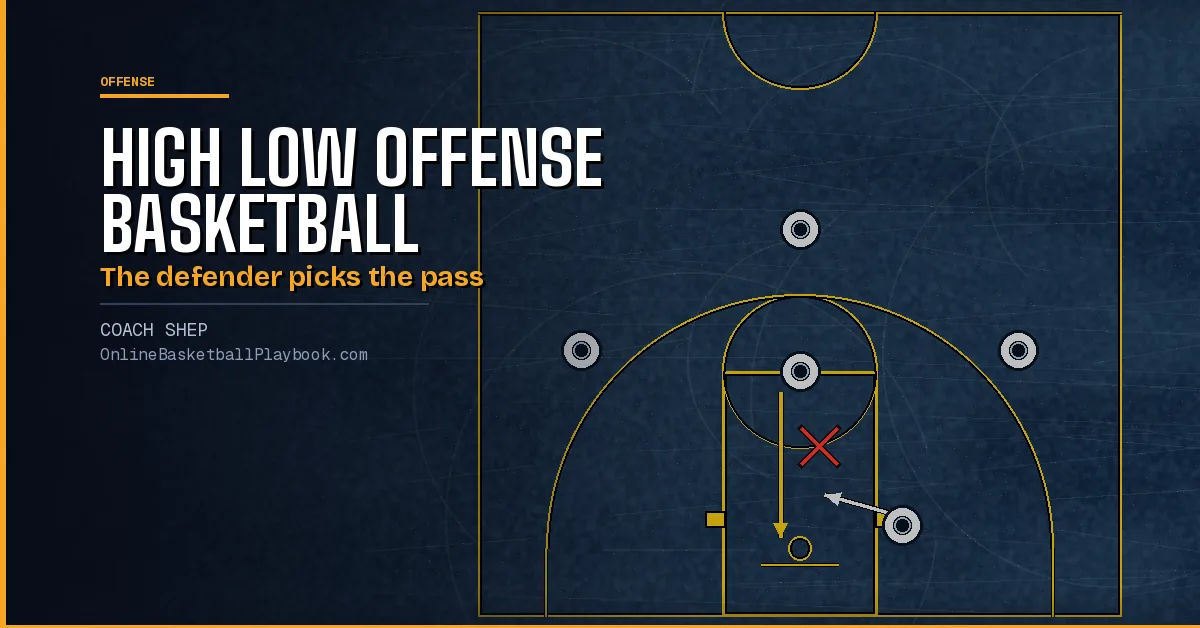
High Low Offense Basketball: Reads, Counters and Zone Rules
High low offense basketball explained: the two-post shell, the lob and bounce reads, answers to a front, down-screen reads, 1-4 low sets and the hi-lo against zones.
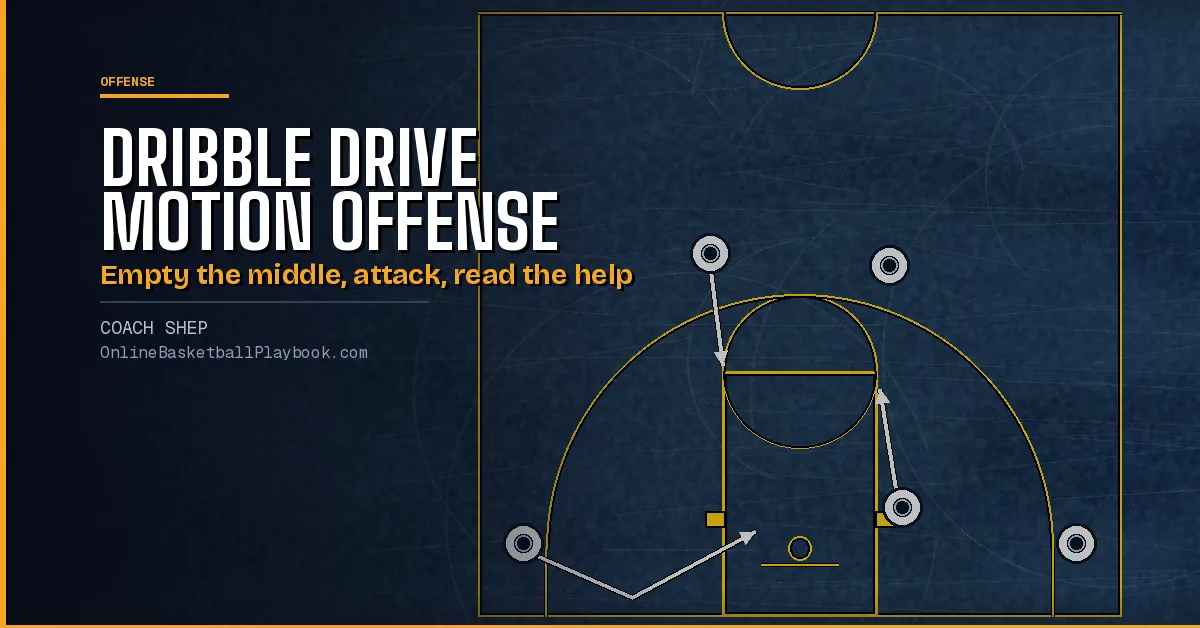
Dribble Drive Motion Offense: Spacing, Reads and Install
The dribble drive motion offense explained: 4-out 1-in spacing, the Drop, Drag and Rack zones, the read off a drive, shot diet, weak spots and the install.
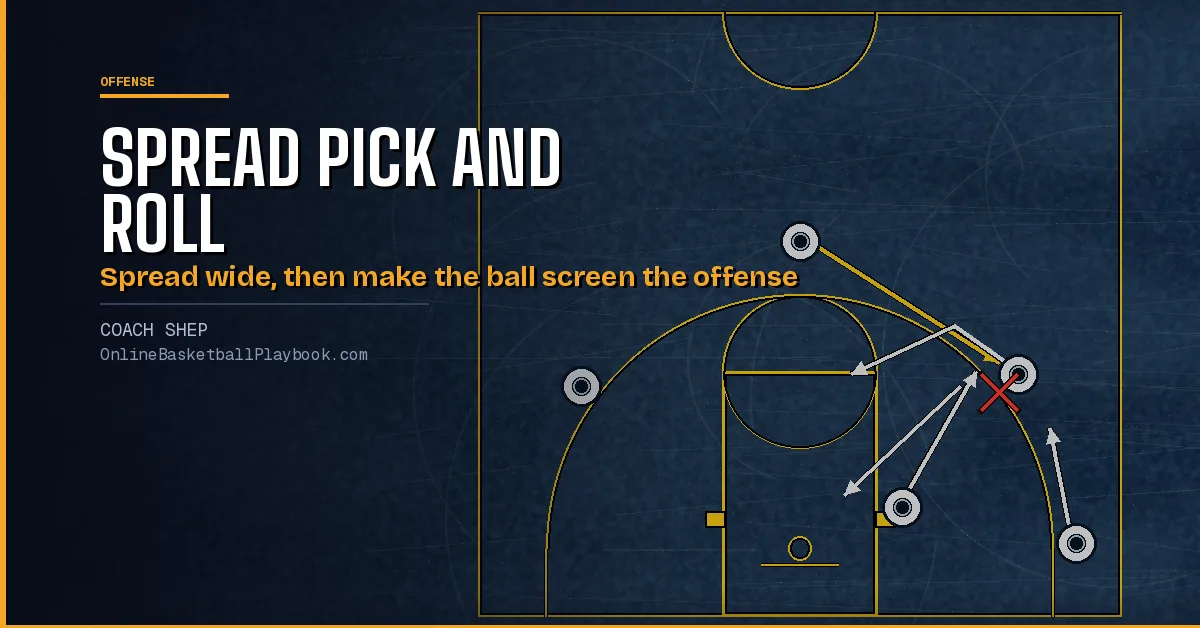
Spread Pick and Roll Offense: Flat Screens, Reads and Counters
Billy Donovan's spread pick and roll offense step by step: the trail pass, the angled wing screen, the second side, the flat screen and the counters.