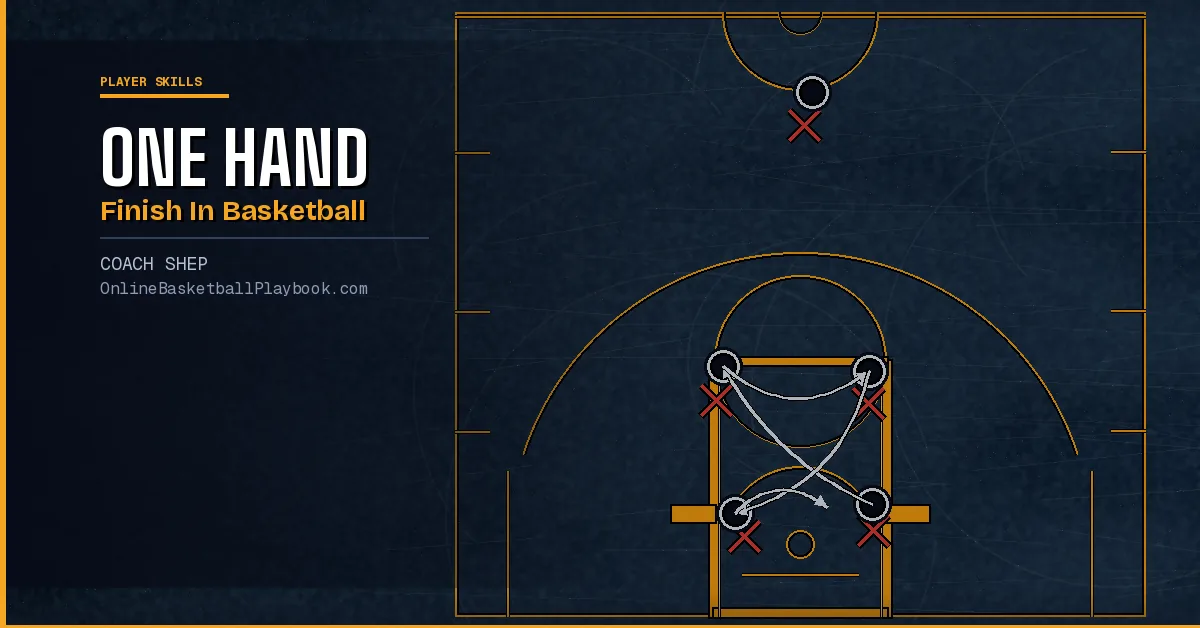
The one hand finish separates players who score at the rim from those who get blocked or miss easy layups. Here is how to build it from the ground up. Footwork first, then the full finish menu.
Why the One Hand Finish Matters
Walk into any gym and watch the first fifteen minutes of open run. You will see the same scene every time: a guard gets past his defender, drives to the rim, and then the play falls apart. He gathers with the wrong foot, floats into traffic, extends two-handed into a waiting shot-blocker, or converts a good drive into a missed layup because his footwork collapsed under him the moment his speed had to stop.
The one hand finish solves all three of those problems at once. It extends the ball away from defenders, allows the shooter to use the rim as a shield, and puts the ball on a soft arc that absorbs contact. Two-handed layups are teachable and good for beginners, but as players face longer, more athletic defenders they become progressively harder to execute cleanly. A well-drilled one hand finish (especially when combined with proper gather footwork) is simply harder to block and easier to control.
Beyond the block-avoidance factor, the one hand finish forces players to develop the body control and balance that make every other offensive skill better. A player who can gather, jump off the correct foot, and extend a controlled one-hand lay through contact has built the physical base that transfers directly to floaters, reverses, and Euro steps. You are not teaching one shot. You are building the platform for the entire rim-finish family.
Coaches at every level underestimate how much practice this skill requires. Players do not develop a reliable one hand finish from layup lines at the start of practice. They develop it through deliberate, game-speed repetition with both hands on both sides, against resistance, until the mechanics are automatic enough to survive a closeout, a scramble defense, or a foul-and-finish situation.
The Footwork Foundation
No finish is reliable without the footwork that sets it up. Before players take a single finish rep, they need the two-part gather, and that gather starts much earlier in the drive than most coaches think.
The Jump Stop as the Base
According to one footwork framework, the jump stop is the foundation of all ball-handler movement. The cue is direct: kill your dribble, take a small two-foot simultaneous landing, and preserve the right to designate either foot as the pivot. In finishing terms, this matters because it gives the driver one clear moment of body control before committing to the final two steps into the layup. Players who skip this discipline gather at full speed with no control, and their finishes suffer for it.
One skills coach, whose three-move curriculum is one of the clearest teaching systems, enforces a jump-stop-only layup rule for the first two to three weeks of every season. His reasoning: it forces players to deal with help defense rather than floating through it. When you can only gather off a jump stop, you have to recognize the helper, decide to finish or kick, and commit. That decision-making happens before the gather, and it is a skill in its own right.
The Two-Step Gather for One Hand Finishes
Once players have the jump stop internalized, the traditional two-step gather (inside foot, outside foot) for a one hand layup becomes easier to teach because players already understand body control at the rim. The key points for the gather are consistent across coaching resources:
- Last dribble low and hard. The final dribble before the gather should be the lowest and hardest of the approach. This gives the player maximum momentum control on the gather step.
- Inside foot first. For a right-hand finish on the right side, the left foot (inside) hits the floor first, then the right foot (outside) powers the jump. This is the standard two-step that maximizes extension and keeps the body between the ball and the defender.
- Opposite foot for off-hand and reverse finishes. A left-hand finish on the left side, or a reverse layup coming from the right side of the basket, requires the mirror footwork. Drill both equally from day one.
- Eyes on the top corner of the box, not the rim. Aiming at the top corner of the backboard square gives players a consistent target and promotes the soft-arc release that makes one hand finishes forgiving on contact.
Using the Rim as a Shield
A one hand finish only works when players understand the geometry. The rim and the backboard are not just targets. They are physical protection. A right-hand layup from the right side should be released high enough and close enough to the basket that the rim itself stands between the ball and any left-side shot-blocker. This means finishing up and through, not casting the ball toward the board from outside the restricted area. Teaching players to be aggressive to the rim before releasing is the difference between a contested make and a blocked ball.
Building Your Finish Menu
The guidance is explicit: "A finish menu, not one layup." Players who only know the standard right-hand layup on the right side are predictable. Defenders at higher levels take that away within the first few possessions. A true finisher has reads, not habits.
The core finish menu includes five options, and players should be able to execute each one on both sides:
Regular Layup
The baseline of the menu. Inside foot, outside foot, jump, extend, release off the glass. The finish most players learn first and practice the least after youth basketball. At higher levels it requires a tight, high gather to avoid the weak-side help blocker.
Power Layup
Two-foot gather, strong jump, two-hand control finish or dominant-hand finish with the body square to the backboard. Used when the driver is fighting through contact or when a defender is trying to undercut the gather. The power layup sacrifices some extension for balance and strength. This is the finish to use when the defense collapses hard and a foul is likely.
Reverse Layup
Coming from one side of the basket, swinging under the rim to finish from the opposite side. The rim shields the ball from the primary defender, and the backboard becomes the tool. According to one guard drill battery, the reverse should be finished off the correct foot for the new side, not a floating, uncontrolled spin. Players who learn to reverse cleanly become very difficult to block because the defense has to chase to a new angle.
Floater / Runner
The mid-range one hand finish off one or two dribbles that is released before the player reaches the restricted area. The floater is the answer to a rim-protecting center or a weak-side helper who has time to meet you at the basket. That system drills it off the correct foot. The release comes at the peak of a controlled one-foot jump, with the ball launched high enough to clear the outstretched hand of a taller defender. A flat floater is easy to block; a high-arc floater is nearly impossible.
Euro Step
Two directional steps after the gather (inside foot in one direction, outside foot sharply cutting to the other) that carries the driver past a positioned defender without a foul. The Euro step is not a travel because both steps are legal gather steps. It is, however, a skill that requires spatial awareness and practice. Players who learn the Euro step add a finish that sidesteps the defender's timing entirely rather than going over or around them.
Drills to Own the One Hand Finish
Drills develop the one hand finish only when they are run at game speed, with both hands, on both sides. Slow-motion layup lines build muscle memory for slow-motion layups. Here are the drill categories that actually transfer.
Mikan Drill
The Mikan drill is the foundational finishing drill for a reason. Alternating short bank shots from tight angles on each side of the basket, taken off the correct foot each time, builds the automatic footwork and soft touch that one hand finishes require. The drill sources include a Mikan three-man weave variation with jump-hook additions, a useful progression for more advanced players who need to apply the footwork in motion.
Form Layup Lines: Both Hands, Slow to Fast
Start the season with form layup lines that emphasize the gather footwork. Walk through the two-step gather on each side before adding a dribble, then add a dribble, then go to half-speed, then full speed. The progression matters. Most coaches skip directly to full speed and then wonder why the footwork breaks down under pressure. Walk before you run, literally.
Finish vs. Resistance
A stationary manager or coach standing in the paint with a pad forces the driver to protect the ball, use the correct gather foot, and extend through contact. This is the simplest drill that bridges the gap between form layup lines and game-condition finishes. Run it at three-quarter speed initially, then push toward full speed. The player cannot float; they have to commit to the correct footwork or the contact knocks them off balance.
Three-Option Finish Reads
Every move in this framework is drilled with its counters. The same applies to finishes. A drill that presents three possible defensive positions, no help (standard finish), strong-side help (reverse or Euro), or rim protector (floater), trains players to read and select rather than defaulting to one finish every time. The coach signals the defensive alignment as the driver approaches, and the player executes the corresponding finish. Two to three reps at each option per turn, game speed, both sides.
Run the three-option finish read drill before live scrimmage, not after. Players who have just practiced reading and selecting will carry that decision-making pattern into the scrimmage immediately. Running the drill at the end of practice means the pattern competes with fatigue rather than reinforcing into live play.
Teaching Progressions by Age and Level
That framework is particularly clear on this point: players who try to learn eight moves learn zero moves. The same logic applies to the finish menu. Start narrow and expand only after the foundation is owned.
Youth and Beginner (Ages 8–12)
One finish: the right-hand layup on the right side off the correct two-step gather. Left-hand layup on the left side. That is the entire menu for this level. The goal is automatic footwork (inside foot, outside foot, jump, extend) with eyes on the correct target. Do not introduce the reverse, floater, or Euro step until the standard two-step gather is consistent at game speed on both sides.
The jump-stop-only layup rule is especially useful here. Young players gather chaotically because they are still developing body control. The jump-stop rule imposes a moment of control that teaches balance at the rim and, as a side effect, forces them to slow down just enough to make the correct decision before committing.
Middle School and JV (Ages 12–16)
Add the power layup as the second option, because players at this level are beginning to face physical defenders who initiate contact. Add the reverse layup as the third option once both standard finishes are reliable. Begin drilling the floater as a conceptual finish, not for game use yet, but so the mechanics are in the muscle memory when they need it.
High School Varsity and Above
The full menu is available and all five finishes should be drilled regularly. At this level the emphasis shifts from mechanics to reads. Players who have the mechanics but default to the same finish every time are still one-dimensional. The training priority is the three-option finish read drill and live-play reps where the defense is assigned to take away one finish per possession. The player has to find the answer.
Common Mistakes and How to Fix Them
After years of coaching and watching players at multiple levels develop (or fail to develop) their rim-finishing, the same errors appear repeatedly. These are the most common ones and the direct fixes.
Wrong Gather Foot
What it looks like: The player gathers off the outside foot on the standard layup side, which kills extension and forces a two-handed release or a flat-angle finish. Fix: Mark the floor with tape at the gather spot and require the player to identify their gather foot out loud before each rep. The verbal cue makes the decision conscious until it becomes automatic.
Releasing Too Early
What it looks like: The player extends and releases the ball while still rising, before reaching peak jump height. The shot is flat, the arc is low, and it is easily blocked. Fix: Cue "up and through." The release should happen at or just after the peak of the jump, with the arm fully extended. The ball should be going up when it leaves the hand, not already on its way down.
No Counter Move
What it looks like: The player has one finish that they use regardless of the defensive alignment. When that finish is taken away, they force it anyway or pull up confused. Fix: Add the three-option finish read drill to practice. One rep at a time is not enough because the player needs enough repetitions that the read becomes automatic before they are in a game situation with no time to think.
Drifting on the Float
What it looks like: The player drifts laterally across the lane during the floater, releasing from an uncontrolled angle. Fix: The floater should be released off a one-foot jump that is mostly vertical. Forward momentum carries the player slightly toward the basket, but lateral drift is a balance problem, not a technique choice. Work on the gather footwork for the floater as a separate drill before integrating it with the full approach.
Two-Handing Under Pressure
What it looks like: The player practices the one hand finish in drills but reverts to a two-handed layup the moment a defender is in the paint. Fix: Add resistance to practice at game speed. If the player never practices the one hand finish with a body in front of them, the two-handed instinct is the one that survives into games. Resistance drills are not optional for players who revert under pressure because they are the specific cure.
- Jump-stop rule early in the season: Enforce jump-stop-only layups for the first two to three weeks to build body control and force players to recognize help defense before committing to a finish.
- Both hands, both sides, every rep: Never run a finishing drill on one side only. Every standard layup rep on the right earns a mirror rep on the left. Players who neglect the off hand are predictable by November.
- Drill the finish that the defense takes away: In practice, assign defenders to deny the player's preferred finish for an entire possession. The player earns two points for converting the correct counter finish, one point for any make, and zero for forcing their go-to against the denial.
- Cue "up and through" on every release: The most transferable single cue for players who release flat or early. Stick it on the wall of the gym if needed. The finish lives or dies on the release point, and that cue addresses it directly without overloading the player with mechanics during reps.
Want more basketball coaching strategies and drills?
Join the Online Basketball Playbook newsletter →
Draw this play free in the play drawer →
Membership: the full library, playbook packs, and Pro drawing tools →
Keep Building
Related breakdowns
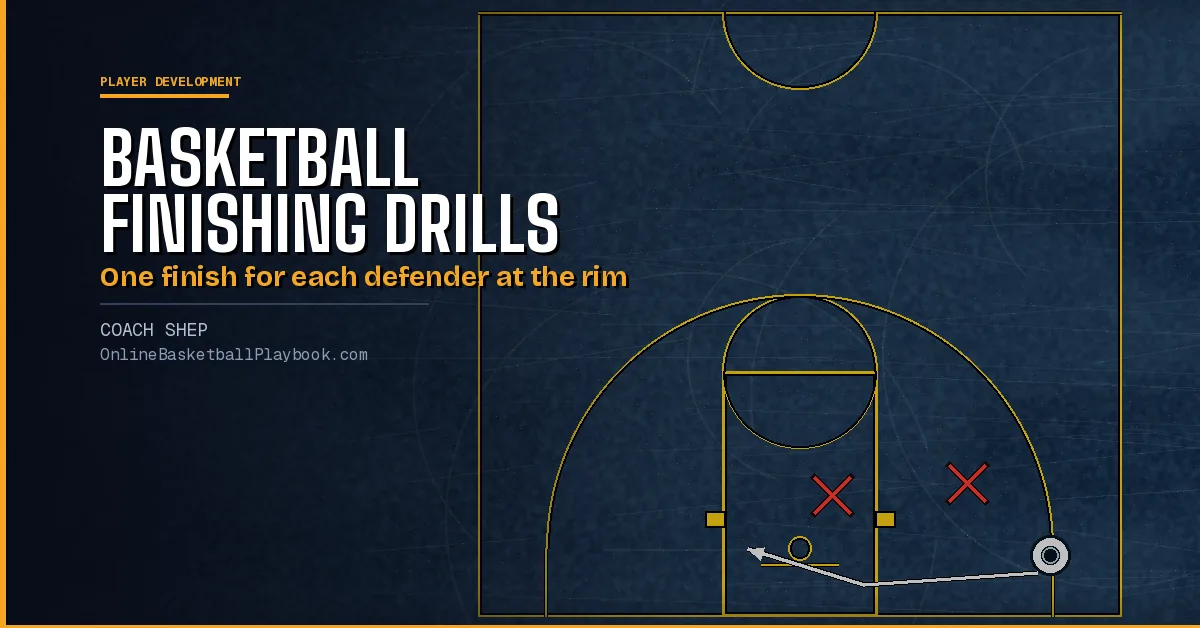
Basketball Finishing Drills: Read the Defender, Then Finish
Basketball finishing drills matched to the defender at the rim, from inside-hand and reverse finishes to the pro hop, contact drills and live progressions.
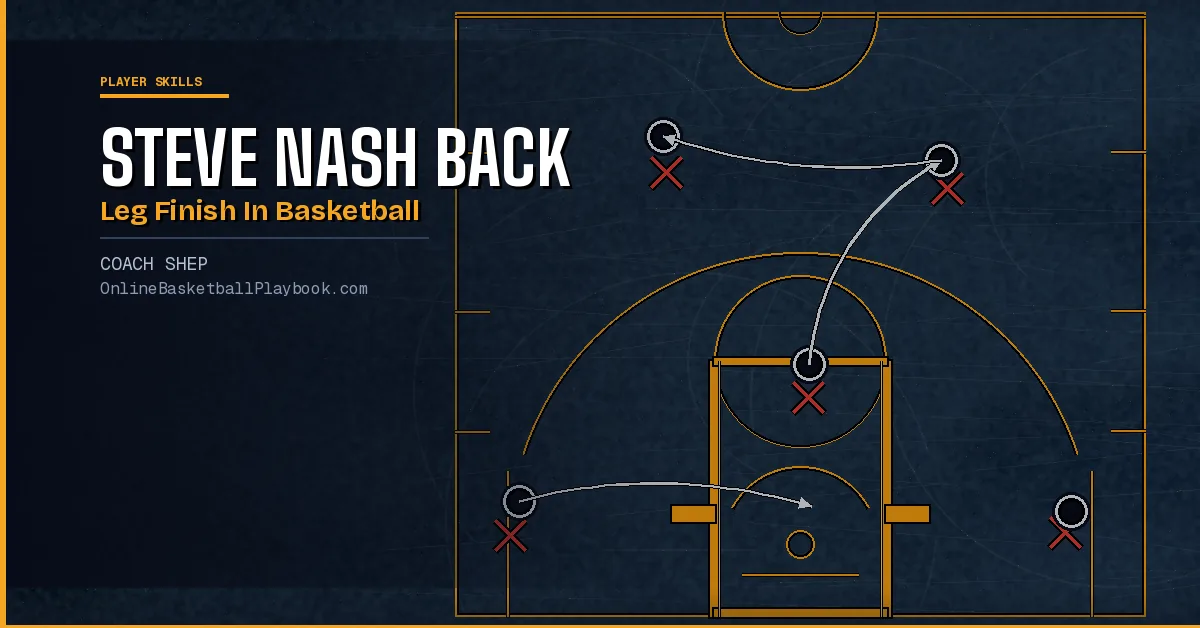
How to Do a Steve Nash Back Leg Finish in Basketball
How to Do a Steve Nash Back Leg Finish in Basketball
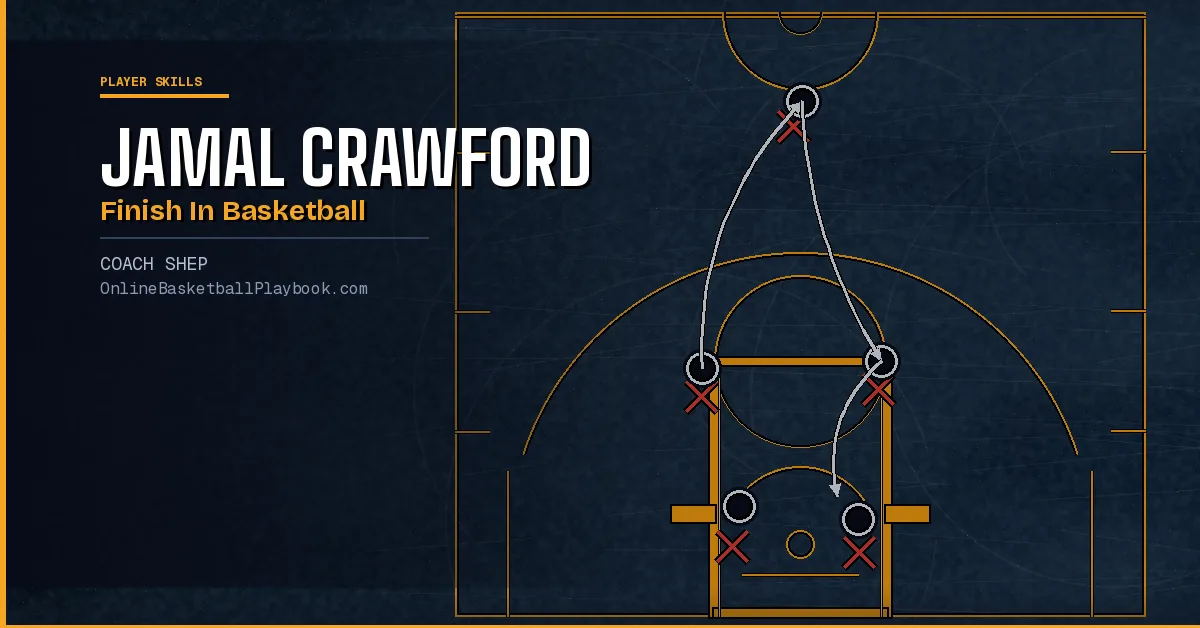
How to Do a Jamal Crawford Finish in Basketball
How to Do a Jamal Crawford Finish in Basketball