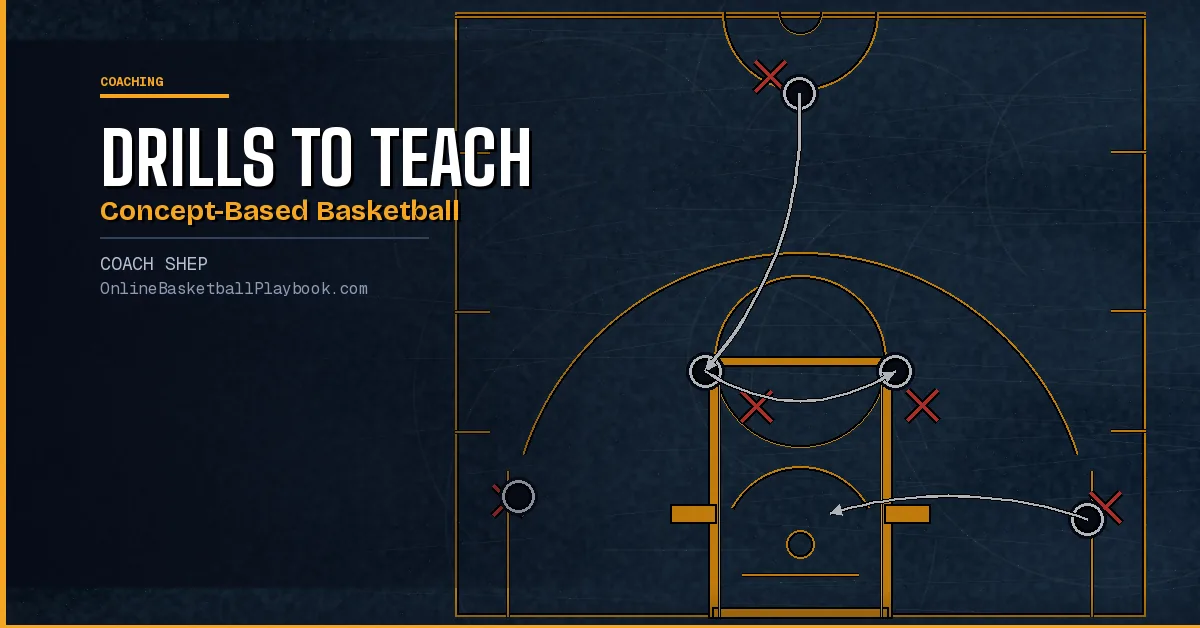
Concept-based offenses fail when coaches skip straight to 5-on-5. The fix is breakdown drills that isolate one read at a time, small-sided, constrained, and scored, so players own the decision before they face a full defense.
One Read at a Time: The Core Principle
The single biggest mistake coaches make with concept-based offenses (motion, dribble-drive, 5-out, Princeton) is trying to teach the whole system before players understand any one part of it. You run through a 5-on-5 possession, the read breaks down at step two, and you stop play to explain what went wrong at step four. Nothing sticks because the players never isolated the moment where the decision was made.
Breakdown drills solve this by doing the opposite. Each drill has one read in it. The court setup, the defender's position, or a rule enforced by the coach creates a situation where only one correct action exists, or at most two, so the player must choose. When a player makes that read cleanly fifty times in a week, the decision is no longer a thought process. It becomes automatic. That is when you can start connecting reads into chains.
The framework comes from the part-whole method: drill one skill or decision in isolation, validate that it is owned, then add the next piece. One decision-drill library phrases it this way: start with one defender and one clean read, then add the second defender who changes the read, then connect two or three actions so players keep playing after the first option is covered. This is the ladder every concept-based offense should climb before it ever runs a live 5-on-5.
The drills covered here are not random. They map onto specific reads that appear in concept-based systems: drive-and-kick, backdoor cuts, ball-screen responses, spacing corrections, and transition decisions. Run them in the right order and your offense installs itself.
Constraint-Based Drills That Coach the Decision
The most powerful tool in concept-based drill design is the constraint, a rule that forces behavior without a coach having to stop play and lecture. When the rule is built into the drill, the game teaches the player.
The Blood series from the Memphis offense is the cleanest example. Blood 4 runs with a single rule: a mid-range pull-up is a turnover. The ball is live, the defense is live, but any player who settles for a mid-range jumper loses possession for his team. The constraint trains the shot diet (attack the rim or kick to a shooter) without a single word from the coach. The drill coaches itself.
Other constraints that work across offensive systems:
- Dribble limits. Assign each player one or two dribbles maximum. This forces pass-and-cut reads and eliminates the habit of dribbling to think.
- Validate with a free throw. After scoring in a drill, the scoring player must make a free throw before the point counts. This adds pressure to the finish and teaches composure under fatigue.
- No paint / paint game. Two opposite constraints, same idea. "No paint" requires players to shoot only from the perimeter, forcing ball movement and spacing reads. "Paint game" requires every possession to involve a drive, training players to attack the rim before kicking out.
- Restart instead of taking a challenged shot. Borrowed from Rick Pitino's 42-minute offensive workout: if a player catches a shot fake and takes the contested shot anyway, the possession restarts. Players learn to play the read, not the impulse.
The constraint should be tied directly to the concept you are installing. If your offense is built on attacking closeouts, the constraint should punish catch-and-hold. If your system depends on spacing, the constraint should punish players who collapse it. Design the rule to make the wrong action hurt and the right action reward itself.
Advantage Small-Sided Games
Advantage small-sided games, often called SSGs, are the live-action version of the breakdown drill. Instead of removing the defense entirely, you engineer an advantage from the start and let the players play through it with real decision-making pressure.
The key idea, developed by Alex Sarama's CLA (Constraint-Led Approach) work, is that the coach controls the size of the advantage, not the play itself. The ball position, the defender's release point, and the starting gap all set up a specific read without calling a play. When the ball is on the outside hip of the ball-handler, the baseline drive is open. When it is on the inside hip, the middle is open. The coach changes the hip position to change the read. Players read and react. They are not executing instructions.
Examples of Advantage SSGs
Two Side 3-on-2. Three offensive players on one side of the court versus two defenders. The offense has a spacing advantage from the start. The read is simple: attack the gap, and when the defense collapses, find the open man. This is the drive-and-kick chain (what Sarama calls the Dominoes effect) in its most isolated form.
Loop the Loop 2-on-2. Two players versus two defenders in a half-court setting, with a rule that the ball must change sides at least once before a shot attempt. The rule forces the skip pass read and eliminates iso ball.
1-on-1 with a Decision Built In. The defender must hi-five a cone before they can guard the ball-handler. The distance between the cone and the ball-handler is the size of the advantage. A short distance means a tight contest. The ball-handler must attack immediately. A long distance means time and space. The ball-handler must read what the defense gives, not what they prefer.
Guided Defense. The coach tells the defender to trail, cut off, or play neutral for three consecutive repetitions. The offensive player knows the defense is varying but does not know which option is coming on any given rep. This creates "repetition without repetition". The same drill structure with a different read every time. It trains the player to see the defense first, then decide.
The principle across all of these is that the game creates the teaching moment, not the whistle. Players get real reps with real decisions at practice speed. The coach can add a defender, tighten the advantage, or change the constraint to increase the difficulty as the read becomes automatic.
Shooting and Finishing Batteries
Concept-based offenses generate open shots and drive angles. If your players cannot finish those opportunities, the reads are worthless. The shooting and finishing battery builds the physical skill the reads depend on.
The core principle from the Krause/Meyer skill development work: "game shots at game spots at game speed." Form work comes first (footwork, balance, lock-and-lock), but every rep in the battery should replicate a shot or finish the offense will actually produce. There is no drill for a shot that your system never generates.
Shooting Battery Structure
The Olympic shooting drill runs from five spots on the arc. Two balls in motion, players catching in a squared stance and shooting before their feet reset. The constraint: make a free throw after each made basket to validate the score. This builds conditioning alongside shooting mechanics and trains players to finish when their heart rate is elevated.
The Five-Spot shooting drill rotates through every spot a concept offense creates shots from: the corners, the wings, and the top of the key. Players catch off a pass that simulates a skip, a kick-out, or a swing (not a set-up throw from a stationary rebounder). The catch and the footwork are part of the rep.
The Livsey simultaneous shooting battery solves the large-squad problem. When you have fifteen or more players, traditional lines waste time and kill conditioning. The Livsey approach runs multiple drills at the same time across multiple baskets: Backpedal, Pepper, Crack Back, and J-J Touch all running at once. Every player gets a game-speed catch-and-shoot rep every thirty seconds instead of every three minutes.
Finishing Progression
Drive-and-kick is only as good as the finish at the other end. Walberg's layup sequence is the foundation: both hands, both sides, straight layup, reverse layup, crossover finish, hesitation finish. All at game speed, all before team reads are introduced. Add the jump-stop power layup as a dedicated rep because this is the finish that concept-based drives generate most often when the defense rotates to help.
X-Layups run two lines at opposite elbows, both cutting to the basket simultaneously. The drill trains the finish through traffic and builds the habit of locating a cutter when driving. The opposite player becomes a visual cue for the kick-out read.
Crack Back simulates the pull-up or catch-and-shoot that appears at the end of a drive-and-kick chain: the player sprints to a touch point, cracks back toward the passer, and catches the ball on the inside shoulder while moving into the shot. It is a finishing drill and a spacing drill at the same time.
Transition and Outnumbered Games
Concept-based offenses attack in transition. The reads in your half-court system are the same reads that appear at the end of a push: spacing, cut-or-pass decisions, drive-and-kick chains. Teaching transition is teaching your offense at full speed.
The 11-Man Continuous 3-on-2 is the foundational transition drill. Three offensive players push against two defenders. When a score or stop occurs, the rebounder outlets the ball and joins the attack going the other way with two of the remaining players. The third offensive player drops back to defend. The drill never stops. Players get outnumbered reads, outlet decisions, and finishing reps in a continuous flow that also conditions.
Texas drills (22, 33, 44) train the transition read at different numbers. Two-on-two teaches the ball-handler to attack the gap and dish when help comes. Three-on-three adds the skip pass read. Four-on-four is nearly full-court offense but with the spacing decisions required by the transition advantage. Each format isolates one layer of the transition read before the next layer is added.
The Duke 21 drill adds a recovery element that concept offenses need: the scorer sprints back to touch half-court, then turns and defends. The offensive player who just scored must now be the first line of transition defense. This trains the offensive players to sprint back (a discipline that is hard to install any other way) while conditioning the team to finish through fatigue.
Popovich's 3 Ways scrimmage brings the structure of a drill to 5-on-5 transition: one point for scoring, one point for a stop, play to ten, throw to the coach after each down-and-back and restart. The coach controls tempo and can re-teach after every repetition. Players cannot coast through possessions. The scoring makes every transition decision matter.
Progressive Installation: Part to Whole
The part-whole installation method is how concept-based offenses get put into a team without running sets. Each drill teaches one layer. The layers connect until the system runs itself.
Weber's 5-out motion installation is the clearest model. Start with 5-on-0 walk-throughs where the only objective is spacing, with every player finding their spot after every pass. Add the drive-and-kick option. Add the backdoor read. Add the ball-screen option. Each addition is first drilled in a 2-on-1 or 3-on-2 setting before it appears in the 5-on-0 flow. By the time the team runs 5-on-5, every player has already owned each read in isolation.
That decision drill ladder follows the same logic. Start with 1-on-1: one defender, one read, one clean decision. Then 2-on-1: a second defender changes the initial read, so the player must play through the first option to the second. Then 3-on-2: now two connected reads must both be made correctly before a shot appears. Each step up the ladder adds one layer of complexity to a read the player already owns.
The Sarama advantage SSG framework connects to this ladder. Early in the installation, the coach engineers a large advantage. The defender is far from the ball, and the read is obvious. As the player's competence grows, the coach tightens the advantage. The distance closes, the timing window shrinks, and the read becomes harder. The drill matches the player's skill level instead of overwhelming or underworking them.
The final step before live 5-on-5 is a constrained scrimmage, not a free-form run. The Popovich 3 Ways format works here. The same rules from the breakdown drills carry over: specific shot diet constraints, scoring that rewards correct decisions, and coach-controlled restarts that allow re-teaching without stopping the competitive energy of the game.
Start every practice week with at least two breakdown drills before you run any 5-on-5 live. Pick one drill that targets the read your team got wrong in the last game, and one drill that builds toward a read you have not fully installed yet. Rotate the second drill each week so the installation keeps moving forward without abandoning what was already earned.
Scoring the Drill: How to Coach Without Stopping Play
Scored drills teach without stopping. When every action in the drill has a point value attached to it, the scoreboard becomes the coach. Players self-correct because losing points hurts more than a whistle.
The Alabama (Oats) scoring model is the benchmark: a correct shot attempt earns three points, an offensive rebound earns two, a basket off a kick-out earns one, and a turnover costs two. The negative value on the turnover is intentional. It must outweigh the reward for shooting to train players to value the ball. Teams playing under this scoring model naturally improve their assist-to-turnover ratio because the drill's math demands it.
The "444" drill applies the same model to transition: four-on-two continuous, with positive points for charge-drawing, offensive rebounds, and scores, and negative points for turnovers. The losers run the point difference. When players know the run is coming, they make better decisions. The conditioning is built into the consequence instead of added as punishment after the fact.
The Karl/Stotts 101-drill encyclopedia makes the point clearly in the post game format: the 1-on-1 post drill awards plus-two for a made basket, plus-one for drawing a defensive foul, minus-one for an offensive foul, plus-one for a post entry assist, minus-one for a turnover, and plus-one for an offensive rebound. Six different outcomes, each with a value. The scoring is the coaching. The coach never has to say "stop taking offensive fouls" because the score says it every possession.
Hubie Brown's rule, "every drill ends with a make," adds a finishing discipline to any scored format. No matter how the drill is structured, the final rep must end with a made basket. If the player misses, they shoot again. This trains the completion habit and conditions the mind to finish under pressure, not just execute the drill's middle steps.
For youth teams, the scoring does not have to involve points subtracted. Track makes, jump-stops, or completed passes for positive points only. The competition matters more than the complexity. Turn any drill into a team race (first group to twenty points wins), and the drill develops focus and hustle alongside the skill. Coach Mac's approach of borrowing from childhood games (sharks-and-minnows for dribbling, knockout for shooting pressure) works on the same principle: competition sharpens the skill without the players realizing they are doing drill work.
- One read per drill. Every drill you run should have a single correct decision built into its structure. If players can make two or three different choices and all are considered correct, you are not drilling a read. You are scrimmaging.
- Constrain the diet, not the play. Use rules (mid-range = turnover, dribble cap, validate with a free throw) to coach shot selection and ball movement without stopping play and lecturing.
- Control the advantage. In small-sided games, adjust the size of the offensive advantage (distance of the defender's release, ball-hip position, cone placement) to match the drill's difficulty to the players' current skill level.
- Score the decisions you want. Build a point system that puts a negative value on turnovers and a positive value on hockey assists, offensive rebounds, and correct shot selection, not just made baskets.
- Install in order. Never move to 5-on-5 until the part drills own the individual read. Drill 1-on-1 reads before 2-on-2, drill 2-on-2 before 3-on-3, drill 3-on-3 before you put all five players on the floor together.
- Every drill ends with a make. Apply Hubie Brown's rule to everything you run. The completion habit carries into games when the environment is loud and the clock is short.
Want more basketball coaching strategies, drills, and tools?
Join the Online Basketball Playbook newsletter →
Draw this play free in the play drawer →
Membership: the full library, playbook packs, and Pro drawing tools →
Keep Building
Related breakdowns
Fun Basketball Games for Practice: Scored Games for Any Team
Fun basketball games for practice at any level: shooting games, defense-only scoring, rebounding contests and passing games, with scoring rules and records.
Basketball Conditioning Drills for Teams: Runs, Games and Tests
Basketball conditioning drills in three styles, timed runs, conditioning inside skill drills and scored games, with the tests and yearly plans coaches use.