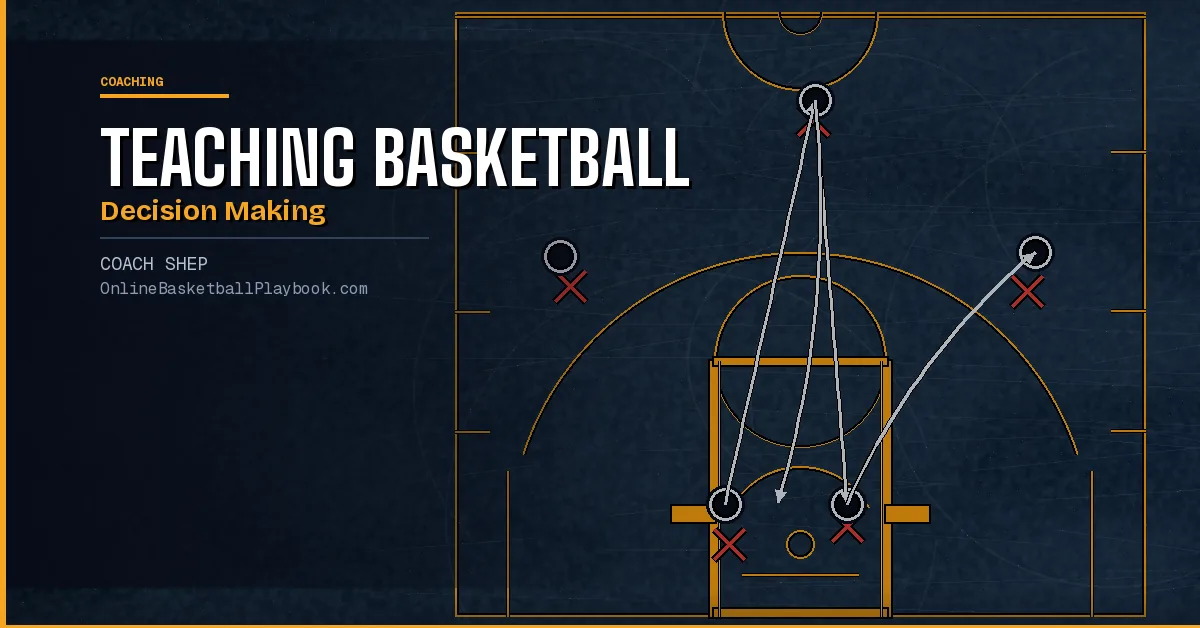
Basketball IQ is not a personality trait. It is a trainable skill. The players who read the game fastest got there because someone designed reps that forced real decisions, not scripted routes.
Why Reads Beat Routes
Most youth and high school basketball is taught through routes. The point guard dribbles to the elbow, the wing cuts baseline, the big sets a screen at the block. Players know where to go. What they do not know is what to do when the defense takes it away because they were never taught to read the defense in the first place. They were taught geography.
Read-based teaching flips that entirely. Instead of giving players a path, you give them a problem. You manufacture a specific advantage situation (two offensive players against one defender, for example) and you make them solve it. The advantage creates the decision. Players are not executing a play; they are reading the defense and choosing. That is a fundamentally different cognitive process, and it transfers to games in a way that scripted routes simply do not.
The premise behind this approach is straightforward: decisions are a trainable skill, and you train them by manufacturing the situation, limiting the options, and playing it live at game pace. The reads-not-routes philosophy sits underneath every successful read offense (motion offense, pace-and-space, drive-and-space) and it is what separates a team that can play through any defense from a team that stalls the moment the scout report gets in their opponent's hands.
The Advantage Ladder: Your Core Teaching Tool
The most effective way to manufacture decisions is through graded advantage drills. You start with a built-in numbers edge and make players solve it. Then you add a defender. Then another. The read gets harder at each step, but it stays game-real throughout.
The standard ladder runs: 2v1 → 3v2 → 4v3 → 4v2-plus-2 → 5v3. Each step adds a defender without adding a script. Players are still reading and reacting, they are just doing it against more resistance.
Why this works
The advantage situation does something a scripted drill cannot: it creates a consequence. In a 2v1, the ball handler must decide whether to drive the help defender or hit the open player on the kick. That is a real decision with a real right answer that changes based on what the defender does. The player must read, process, and choose every single rep. Run that 40 times in a practice and you have built 40 genuine decision reps, not 40 repetitions of a memorized sequence.
There is also a defensive dividend. An advantage drill is simultaneously an offensive decision drill and a defensive help-and-recover drill. The help defender is learning when to commit and when to stall, when to shade the paint and when to deny the wing. The communicating defender is building a habit of calling the action and rotating. Both ends are training at once, which is why advantage drills are one of the most efficient uses of practice time available to a coach.
Constraints: How to Isolate a Read
Advantage drills are the frame. Constraints are the coaching tool that focuses them. A constraint limits what is legal until the specific decision you are teaching becomes automatic.
The clearest example: in decision-shooting, the rule is catch-and-shoot or catch-and-pass only. No fakes, no dribble. The third player, however, is allowed to penetrate. That single constraint isolates one specific read. When the third player gets the ball on the kick, they must immediately read the defense and decide: is the defense collapsed? Shoot. Are they closing out hard? Drive. The constraint removes every other option so the read you are coaching that day is the only decision in the room.
Other constraints work the same way. "One dribble max" forces kick reads. "Must penetrate" forces the ball handler to read help before settling. "No dribble off the catch" forces off-ball players to catch in a shooting position and read the close-out on reception rather than after three dribbles of re-gathering.
The key is that constraints are not permanent. You use them to over-rep one specific decision until it is automatic, then you remove the constraint and let players play free. If the drill is still constrained six weeks in, you have not taught the read. You have built a new route with extra steps. The goal is for the constraint to become unnecessary because the read has been internalized.
Quin Snyder's systematic situational training gives this a name and a process: identify the situation, attack it systematically at the right number progression, teach it to its finest points (foot angles, timing cues, verbal calls) and then hold players accountable. But accountability only comes after players have enough reps to build habits. Accountability before reps builds anxiety, not ownership.
Pick one constraint per drill session and stick to it for the entire block. Mixing constraints mid-rep is the fastest way to blur the read you are trying to build. Players need enough identical situations to develop a pattern recognition response before you change the problem on them.
The 1v0 to Game Progression
Advantage drills and constraints are most effective inside a clear installation sequence. The standard progression runs: 1v0 → 1vC → controlled advantage → game.
1v0: No defense
Introduce the skill without a defender. Show the footwork, the spacing, the catch position, the body angle at reception. This is about shape and habit, not decision-making yet. Players need to own the physical execution before you add a defender and demand they read at the same time.
1vC: Coach guides the read
Add a coach who actively signals the read in real time. The coach plays a passive defender and cues the player: "I'm going under, shoot." "I'm showing, drive." The player is making a real decision, but the coach is narrating the key cue so the player learns what to look for. This is the bridge between knowing the action and reading the action.
Controlled advantage
Remove the coaching narration and let the advantage situation create the decision naturally: 2v1, 2v2 with a help constraint, 3v2. The player must now see and react without a prompt. The advantage is still built in, but the decision is genuinely live.
Game situation
Run the same read inside a full possession: 4v4, 5v5, or a scout team shell that presents the same defensive look. The player now has to recognize the situation in context, within the flow of an offense, without the numbers edge as a prompt. This is the transfer test. If the read lives here, it has been taught.
Don Meyer's four-stage learning model frames what this progression is building toward: unconscious-incompetent (the player does not know what to read) → conscious-incompetent (they know the read exists but can't execute it) → conscious-competent (they run the read correctly but need to think through it) → unconscious-competent (the read fires on reflex, no checklist). The 1v0-to-game progression is the path from stage one to stage four. Every coach's job is to move players up that ladder as fast as repetition allows.
Teaching by Age and Level
The reads-not-routes philosophy scales by age, but the implementation looks very different at 10 years old versus 17.
Youth (ages 8–12)
Decision-making teaching at this age starts with conversation, not live constraints. Let the play finish, then ask: "What did you see?" before correcting anything. That question teaches self-evaluation and respects the player's reading ability at an age when two-choice binaries are the ceiling. Shoot or pass, drive right or left. Do not overload a 10-year-old with a full read tree. One fork at a time.
Developmental high school
Shift to structured advantage drills. The 2v1 → 3v2 progression works here. Add constraint-based reps (catch-and-shoot-or-pass only, no dribble) to isolate the specific read you are building. The conversation of youth coaching gives way to designed situations that force the player to read and react without a question being asked afterward.
Advanced high school and college
Ettore Messina's principle applies here: "Decide while catching." At this level, the read must happen during reception, not after the catch. Players use peripheral vision to track the close-out before the ball arrives, so the decision is already made when their hands touch it. Full read-tree menus (eight ball-handler options on every ball screen, six screener reads, eight cutter reads) become the vocabulary. The goal is sub-second, automatic reads. What took a high school player a half-beat of processing time must now happen before their feet hit the floor.
Building a Weekly Decision-Making Practice Plan
The most practical version of this philosophy is a weekly advantage ladder built into your practice schedule as a permanent block, not a special unit, not a preseason-only emphasis, but a standing structure that scales with your team's development.
A functional week might look like this: Monday opens with 2v1 decision-shooting to wake up the reads and establish the constraint for the week. Wednesday scales to 3v2 with the same constraint, adding a help defender so the read gets harder. Friday runs 4v3 or 4v2-plus-2, where the offensive advantage is tighter and the defense has real recovery options. The reads are the same all week, only the resistance changes.
One decision-making drill book structures this as a menu: 1v1 reads (pindown, gap-stunt closeout, veer finish, downed ball screen), 2v1 and 2v2 advantage reads (corner stunt, short roll, pick-and-pop, baseline drive), and 3v2 and 3v3 connected reads (fronted-post lob, post doubles, hit-and-get ball screen, pinch post, combination screens). The coaching value is the sequence: isolate the read, add the help defender, then connect actions so the player is reading the second defender without stopping the possession. By the time you reach 3v3 connected reads, players are processing two or three reads in a single possession, which is exactly what a live game demands.
A practical version of this ladder runs: 1v1 gap-stunt closeout → 2v1 ball-screen corner-stunt → 2v2 short roll → 3v3 post double → 3v3 hit-and-get ball screen. Same reads. More bodies. More help. The reads become automatic because they are repeated in the same situations at game pace, with real defenders, across the entire season.
Meyer's teaching principle applies to all of it: "See the picture, sell the picture, then everybody paints the picture." Before players can read on reflex, they need to understand why the read exists. Show them the defensive rotation that makes the kick the right play. Show them the help defender's weight shift that tells them to drive instead of pass. Players who understand the why behind a read execute it far more consistently than players following a command. Sell the picture first. Then get out of the way and let them play.
- Start with the advantage, not the action. Build your drill around a numbers edge (2v1, 3v2) so the defense creates the decision, not a script that tells the player where to go regardless of what the defense does.
- Name one constraint per block and stick to it. Catch-and-shoot-or-pass, one dribble max, must penetrate. Pick the constraint that isolates today's read and run it consistently so players build pattern recognition, not confusion.
- Follow the 1v0-to-game sequence for every new action. Introduce the footwork and body angles with no defense, add a coach guiding the read, scale to a controlled advantage, then run it in game situation, and never skip a step because the team looks ready early.
- Hold accountability after reps, not before. Players build habits through repetition; accountability before they have enough reps builds anxiety instead of ownership. Get the reps in first, then hold the standard.
- Let the play finish before coaching youth players. Ask "What did you see?" after the possession ends, not during. That one question teaches self-evaluation and builds the reading habit at the age when it matters most for long-term development.
Want more basketball coaching strategies and drills?
Join the Online Basketball Playbook newsletter →
Draw this play free in the play drawer →
Membership: the full library, playbook packs, and Pro drawing tools →
Keep Building
Related breakdowns
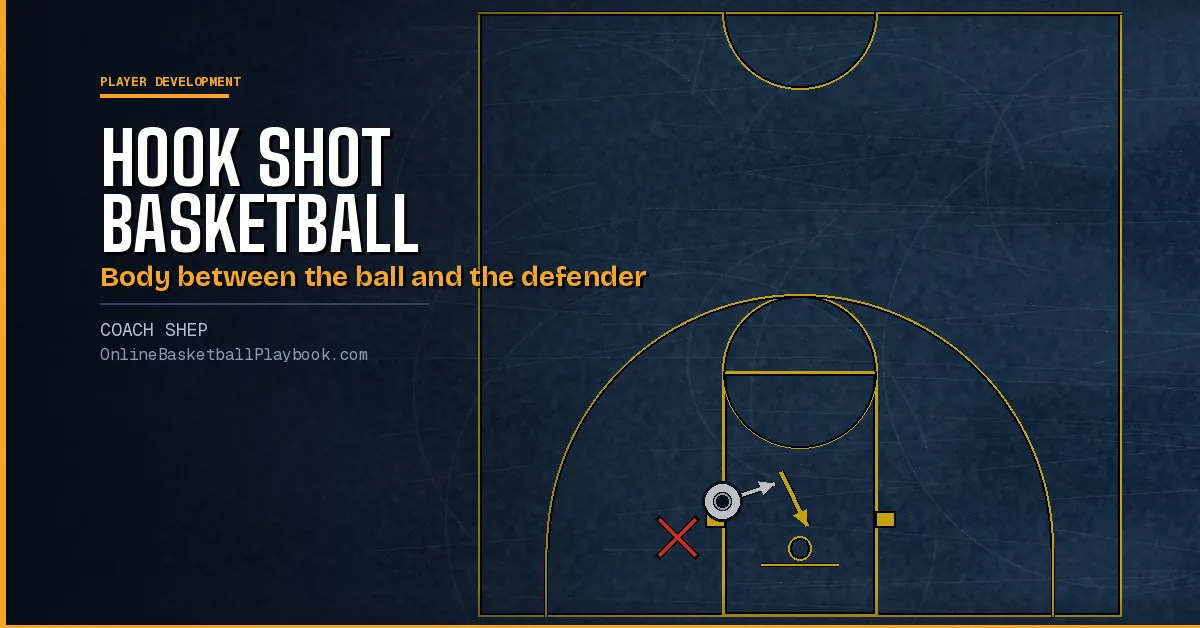
Hook Shot Basketball: How to Do It and How to Teach It
Hook shot basketball for post players and coaches: the classic hook, sky hook and jump hook, the footwork steps, when to use it, the pivot foot rules and drills.
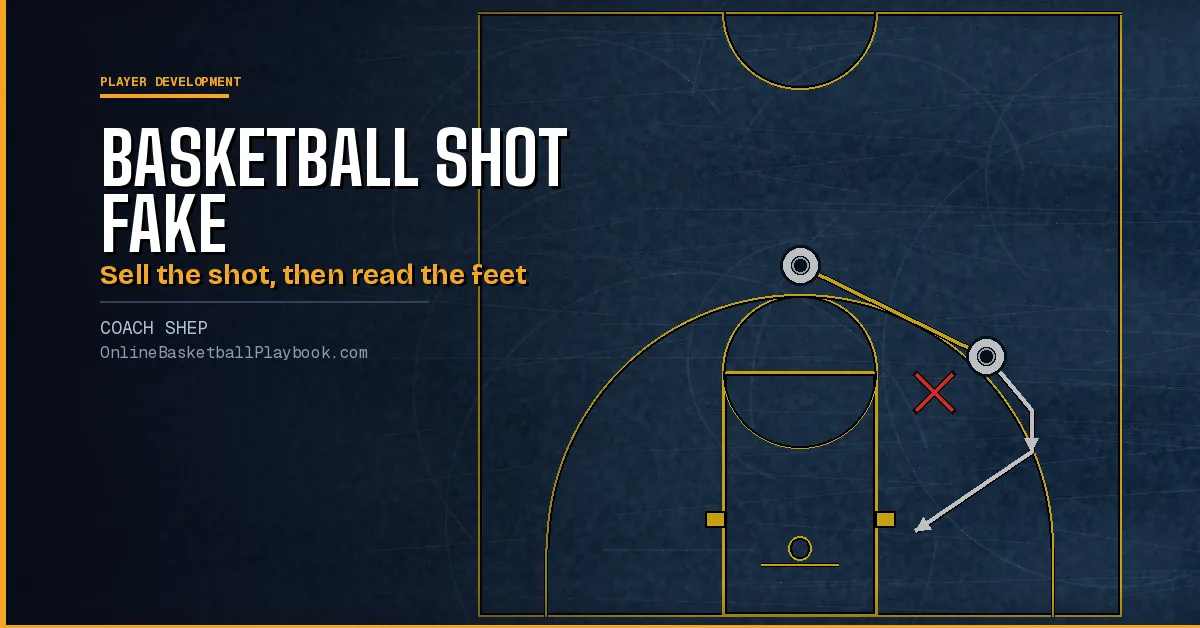
Basketball Shot Fake (Pump Fake): How to Do It and Teach It
The basketball shot fake, also called the pump fake, works when it looks like the real shot. The mechanics, the pivot foot footwork, the read and the drills.
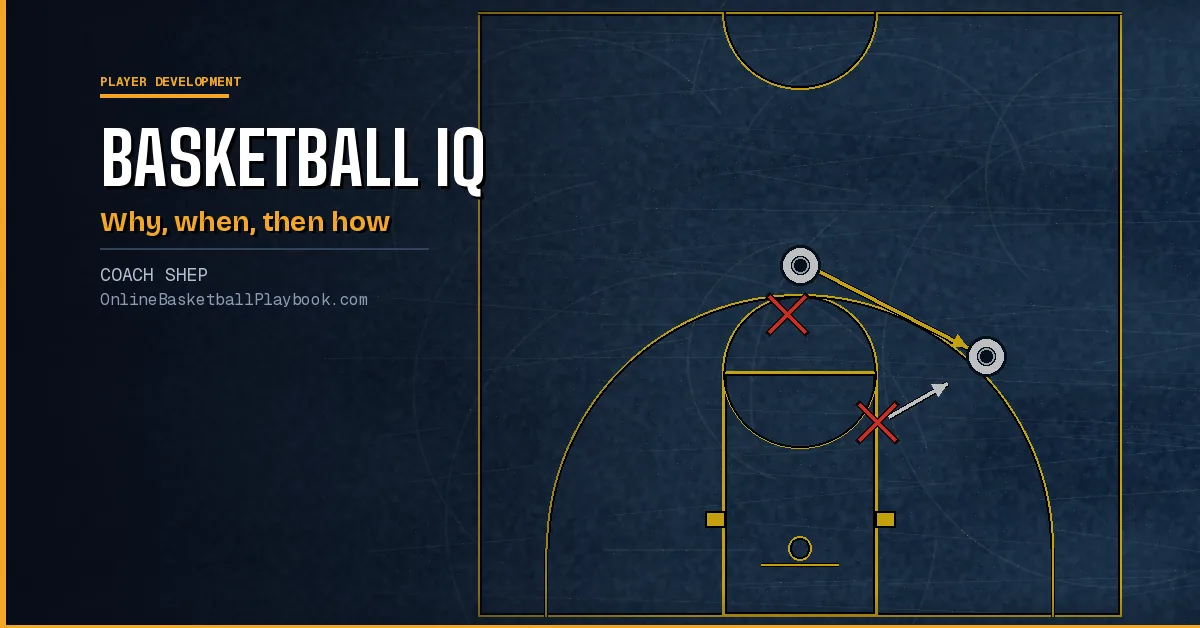
Basketball IQ: What It Is and How to Teach It
Basketball IQ is knowing why and when, not just how: the reads players learn, thinking ahead, rebounding and shot reads, game state, and how coaches teach it.