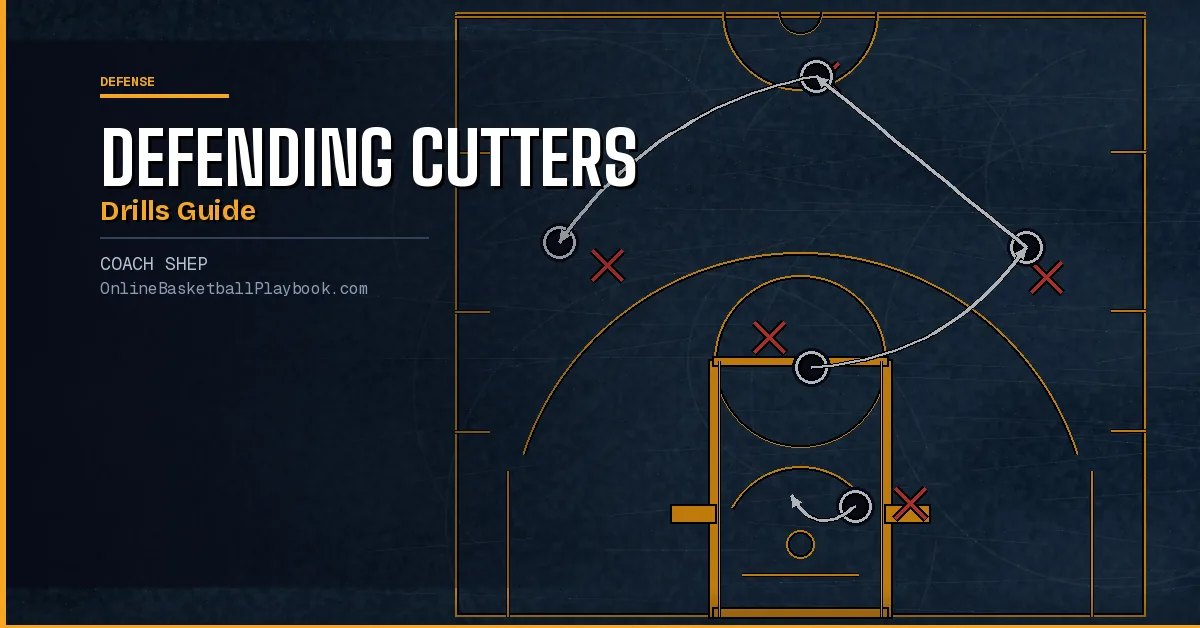
Cutter defense breaks down fast without the right reps. These five drills teach players to jump to the ball, front live cuts, and stay in position before the cutter ever gets moving, stopping the problem at the source.
Why Cutters Beat You (And Why It's Not a Reaction Problem)
Most coaches attack cutter defense as a reaction problem. They tell players to watch their man, keep their head on a swivel, or communicate louder. Those are reasonable cues, but they treat the symptom instead of the cause. Cutters beat defenders because defenders are in the wrong place before the cut starts, not because they were slow to react once it was already happening.
The root problem is that off-ball defenders drift too far from the lane. When the ball is on one side of the floor, the weak-side defender floats toward the corner or the three-point line instead of maintaining a position that allows him to front any flash to the ball. By the time the cutter moves, there is too much distance to close. The defender has to chase, lunge, or foul, none of which are acceptable outcomes.
That quote reframes the entire problem. Cutter defense is a positioning discipline, not an athleticism discipline. The drills in this guide are built around that idea. They force players to move on every pass, while the ball is in the air, so they are already repositioned before any cutter gets started. Train the positioning habit first. The reaction speed follows naturally. The technique for each cut is on how to defend cutters.
Before running any of these drills, establish one non-negotiable standard with your players: every pass triggers movement. Not the catch, the pass. A defender who moves on the catch is always one step late. A defender who moves while the ball is in the air is already where he needs to be. Build that into every rep from the very first drill and carry it all the way through to live play.
Drill 1: Jump to the Ball on Every Pass
This is the foundational drill. Run it before anything else, because every other drill in this guide depends on the habit it builds. The purpose is simple: train defenders to move on every single pass while the ball is in the air.
Setup
Use half the court. Place four offensive players at the four perimeter spots, two wings, two corners. One defender is assigned to guard the weak-side wing. A coach or manager starts with the ball at the top of the key.
How It Runs
The coach passes around the perimeter in any order. The offensive players catch and pass, no dribbling, no cutting yet. The defender's only job is to jump to the ball on every single pass. When the ball moves right, the defender closes toward the lane and toward the ball. When the ball reverses left, the defender repositions immediately. Every pass triggers a jump step, two quick, active feet toward the new ball position while the ball is still in the air.
The drill runs for 60 to 90 seconds per rep. The coach passes quickly to give the defender no rest. The focus is footwork: two feet moving on every pass, not sliding after the catch, not watching the pass and then moving. During the catch is already too late.
Coaching Points
Watch for three common errors. First, defenders who watch the ball and then move. They are one step behind before anything happens. Second, defenders who take one big jump instead of two active steps. The jump should be quick, not dramatic. Third, defenders who drift wide instead of toward the lane. The jump goes toward the ball and toward the basket simultaneously, not just sideways. Correct all three in real time. This drill is repetitive by design. The habit only forms through volume.
Add a verbal cue: yell "pass!" every time you throw. Defenders learn to move on the sound, which mirrors game speed. Within a few reps, they start anticipating the pass instead of reacting to it.
Drill 2: Front the Cutter 1-on-1
Once players understand how to jump to the ball, teach them what to do when the offensive player they are guarding decides to cut. Fronting the cutter is the single most important individual skill in off-ball defense, and it has to be drilled in isolation before players can apply it in team settings.
Setup
One offensive player starts on the weak-side block or elbow. One defender guards him in a standard off-ball position, inside position, seeing both man and ball. A passer stands at the top of the key or the wing with the ball. No live passing yet, the passer holds the ball.
How It Runs
On the coach's signal, the offensive player makes a hard cut toward the ball: a flash cut across the lane, a cut to the mid-post, or a cut toward the elbow. The defender's job is to get chest-to-chest: step directly into the cutter's path and front him. Not beside him, not chasing from behind, physically between the cutter and the ball.
The defender holds the front position until the offensive player stops cutting. Once the cut is resolved, the defender opens back up to see both man and ball. The passer does not throw during the first phase of this drill. The focus is purely on the defender's ability to identify the cut early, move into position before the cutter gets there, and maintain the front without fouling.
After players understand the basic movement, add a live pass. The passer now throws to the cutter if the defender is out of position. The goal is zero clean catches. When the defender fronts correctly, the pass cannot be made. When the defender is late, the cutter catches and the rep is stopped immediately for correction.
Progressions
Run cuts from all four positions: weak-side block to ball-side, elbow flash, backdoor from the wing, and point-to-basket. Each direction creates a slightly different movement pattern for the defender. Drill each direction separately before mixing them. Players should be able to defend all four cuts without thinking. The positioning becomes automatic through repetition.
Drill 3: Defending the Flash from the Weak Side
The flash cut from the weak side is the most common cutter threat in modern basketball. When the ball is on one side of the floor, a weak-side forward or post player flashes across the lane to the ball-side mid-post or elbow. If the defender is not already in position inside the lane, the cutter gets a clean catch at the elbow with no help nearby.
Setup
Place the ball on one wing. Put an offensive player on the opposite block, the weak-side post. The defender guards that player in a standard off-ball position with inside position and vision to both man and ball. A second offensive player is on the strong-side block for misdirection.
How It Runs
On the pass from the top of the key to the wing, the defender executes his jump-to-the-ball step immediately. The weak-side offensive player then flashes hard to the ball-side mid-post. Because the defender already moved toward the ball on the pass, he is now inside the cutter's path. He steps chest-to-chest and fronts the flash.
The wing passer attempts to throw to the flashing player. If the defender is in position, the pass is deflected or impossible to complete. The drill runs live. The cutter tries to make the front difficult by using body contact and changing speed. The defender must maintain position without fouling and without turning completely away from the ball longer than necessary.
The key coaching point here is timing. The defender's jump to the ball on the wing pass is what makes fronting the flash possible. Defenders who skip that jump step (who stand still when the ball moves to the wing) cannot get inside position in time. They end up chasing from behind, which is a losing battle. Run this drill until the jump-to-ball habit and the front-the-flash habit become one automatic sequence.
Drill 4: Backdoor Cut Recognition
The backdoor cut is the cutter's counter to over-aggressive denial. When a defender denies too hard (leaning into the receiver with full denial), the offensive player behind him cuts backdoor and the defender has no angle to recover. This drill teaches players to recognize the trigger for a backdoor cut and adjust their positioning before the cut happens.
Setup
Ball at the top of the key. One offensive player on the ball-side wing. Defender guards the wing in a denial position. Coach signals the offensive player secretly to either hold, V-cut back to the wing, or cut backdoor.
How It Runs
The defender is in denial, front foot up, arm in the passing lane. When the offensive player V-cuts to get the ball, the defender stays in denial and the pass is made or denied. When the offensive player cuts backdoor, the defender must recognize the cue (the offensive player's first step going baseline instead of toward the ball) and immediately open his hips toward the basket, dropping into a help position to cut off the backdoor lane.
The recognition cue is the offensive player's first step. If the step goes toward the ball, stay in denial. If the step goes baseline, open up. Defenders who wait for the full cut are always too late. The read has to happen on the first step, not after the cutter is already moving at full speed toward the basket.
Progress the drill by having the passer attempt the backdoor pass on every backdoor cut. The defender's repositioning must be fast enough to either deflect the pass or establish position under the basket before the catch. Over several sessions, players learn to make the read automatically because they have seen the trigger hundreds of times in isolation before facing it live.
Drill 5: Live Cutter Shell (Putting It All Together)
The shell drill is the standard tool for teaching team defensive concepts, and the cutter shell is its most important variation. This drill combines everything from the previous four (jump to the ball, front the cutter, defend the flash, recognize the backdoor) into one live, multi-player environment that mirrors real game conditions.
Setup
Four offensive players at four perimeter spots. Four defenders guarding them in standard shell positions: inside position, vision to both man and ball, positioned to jump to the ball on every pass. A coach manages the ball and gives direction to the offense.
How It Runs
The offense passes around the perimeter. Every defender jumps to the ball on every pass. At random intervals, the coach signals one offensive player to make a live cut: flash, backdoor, post flash, or point-to-basket. The defending player must front the cut. The remaining three defenders rotate to provide help and coverage while their teammate is engaged with the cutter.
The live shell exposes two problems that isolation drills cannot catch. First, defenders who jump to the ball correctly in a 1-on-1 drill but stop doing it when they have to track multiple players and cutters simultaneously. Second, help defenders who watch the cutter and forget to maintain their own positioning. Run the drill at moderate speed first, then increase tempo as players build the habits. The goal is not winning. It is executing the positioning system correctly on every single rep, regardless of what the offense does.
Score the drill by counting correct reps, not stops. A correct rep is one where every defender was in the right position before the cutter moved. If any defender was out of position when the cut started (even if the cut was ultimately defended) the rep does not count. High standards on what counts as a correct rep accelerate learning faster than any other coaching decision in this drill.
Coaching Cues and Common Mistakes
These five drills cover the mechanics, but the verbal environment matters just as much. The right cues in the right moment speed up learning significantly. The wrong cues (or too many at once) slow it down. Keep your coaching language tight and consistent across every drill session.
Cues That Work
Use short, action-based phrases: "Pass, move," "Front him," "Ball side," and "Open up" cover 90% of what needs to be said. Avoid explanations during live reps. Stop the drill for teaching. Use cues during play. Players cannot process paragraphs at game speed.
The Three Most Common Mistakes
First: moving on the catch instead of the pass. This is the most common error and the hardest to fix because defenders have usually spent years moving on the catch. Use the verbal "pass!" cue in Drill 1 specifically to retrain this timing. Second: chasing the cutter from behind instead of stepping into his path. This usually means the defender was in the wrong position before the cut. Fix the position, not the chase. Third: fronting the cutter and losing awareness of the ball. Defenders who front a cutter should still be reading the passer with peripheral vision. Their back is briefly toward the ball, but their head is not fully down. They are tracking the pass out of the corner of their eye.
- Move on the pass, not the catch. Every single rep, without exception.
- Jump toward the ball AND toward the lane simultaneously on every pass.
- Front the cutter chest-to-chest, not beside him, not chasing from behind.
- Read the offensive player's first step: toward ball = stay in denial. Toward baseline = open up.
- Hold the front until the cutter stops moving, then immediately reopen to see man and ball.
- Score your shell drill by correct positioning reps, not just defensive stops.
Building cutter defense into your program takes three to four weeks of consistent drill work before it shows up reliably in games. The first week is about teaching the concepts and establishing the vocabulary. The second week is about individual mechanics, Drills 1 through 4. The third week introduces the live shell. The fourth week mixes cutter defense into your full defensive system so players can execute it without having to think about it consciously. After that, maintenance reps keep the habits sharp throughout the season.
The payoff is significant. A team that consistently jumps to the ball on every pass and fronts every live cut will eliminate the easiest baskets in any opponent's offense. Basket cuts, flash cuts, and backdoor layups are low-difficulty, high-value plays for the offense. They require no shot creation and no individual skill. Stopping them requires only discipline and positioning. That is entirely coachable, and these drills are where that discipline gets built.
Get new defensive drills and breakdowns delivered every week.
Join the Newsletter →Draw this play free in the play drawer →
Membership: the full library, playbook packs, and Pro drawing tools →
Keep Building
Related breakdowns
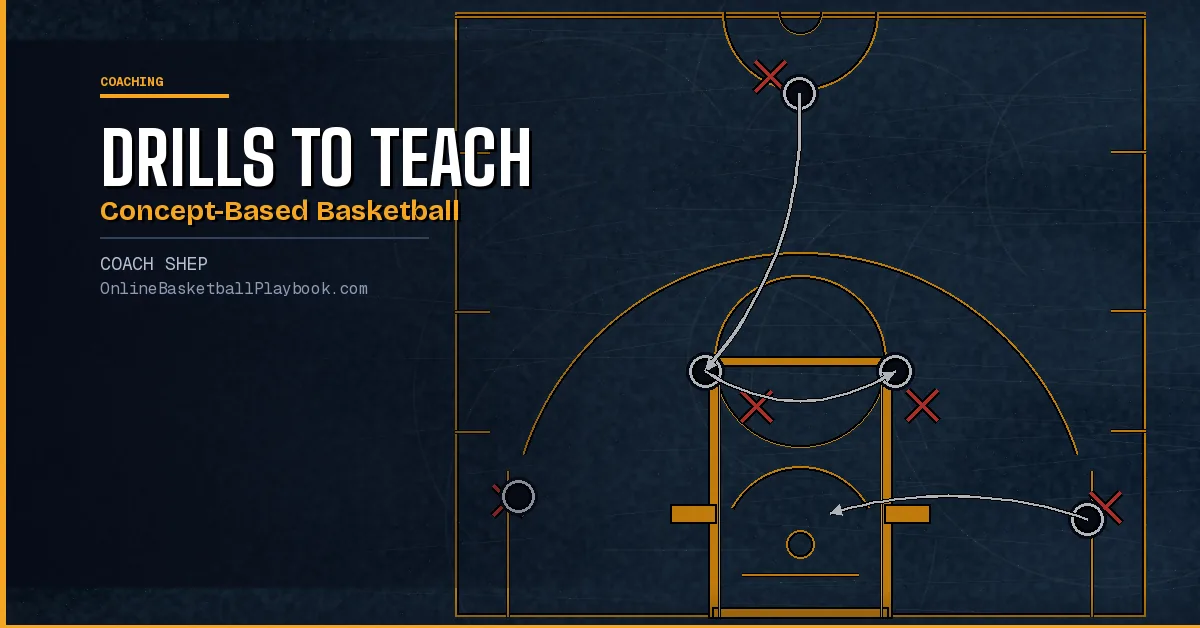
Drills to Teach Concept-Based Basketball
Drills to Teach Concept-Based Basketball
Fun Basketball Games for Practice: Scored Games for Any Team
Fun basketball games for practice at any level: shooting games, defense-only scoring, rebounding contests and passing games, with scoring rules and records.
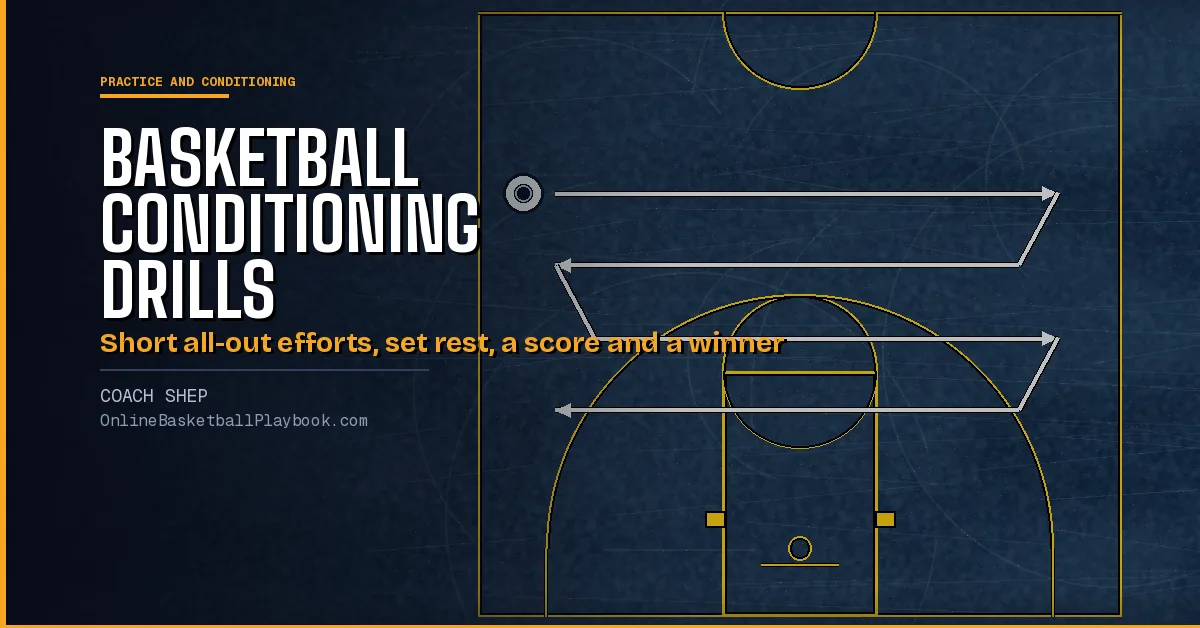
Basketball Conditioning Drills for Teams: Runs, Games and Tests
Basketball conditioning drills in three styles, timed runs, conditioning inside skill drills and scored games, with the tests and yearly plans coaches use.