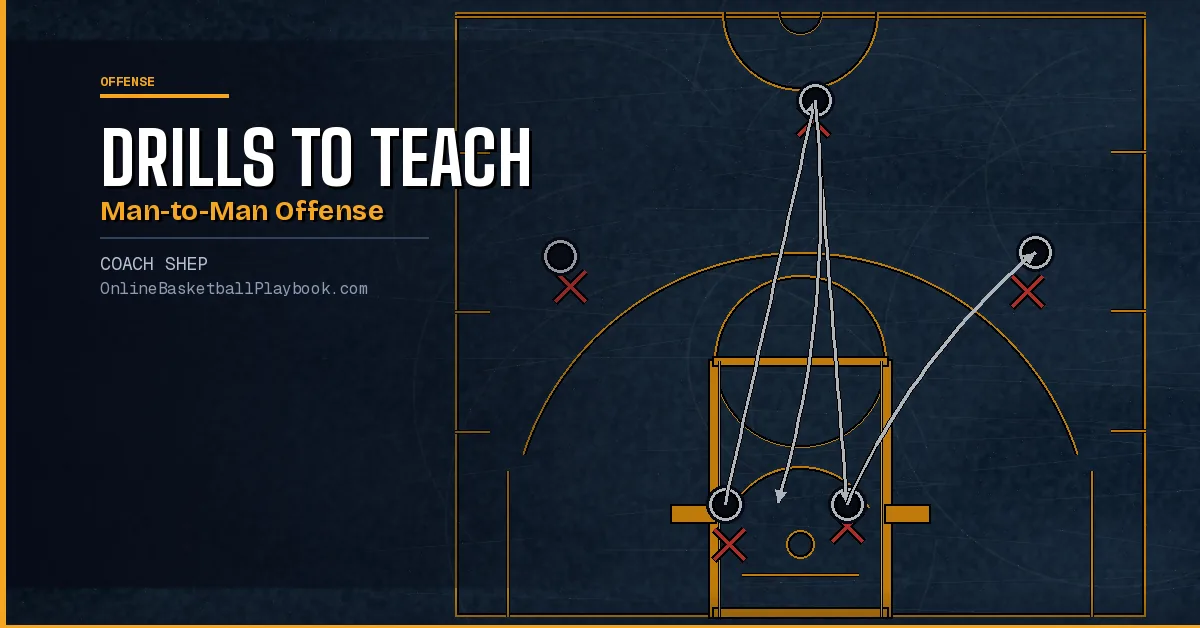
Man-to-man offense is not a set play. It is a trained read. These drills build the spacing, cutting, and decision-making skills your players need to consistently attack and score against man coverage.
Why Offense Starts with Understanding the Defense
Every effective man-to-man offense is built on one principle: force the defense to choose. Your players need to understand what a man defender is trying to do before they can consistently beat it. The defender is trying to stay on the ball-you-man line (the connecting line between himself, his player, and the ball) while preventing penetrating passes and protecting the middle of the floor.
When your players understand that every off-ball defender is sagging toward the lane to help, they can use that sag against the defense. When they understand that on-ball pressure is meant to funnel them away from the middle, they can counter with cuts, reversal passes, and back-door action.
This is why the best man offense drills are not pure offensive drills. They are offensive drills run against live defense because the reads only become real when there is a defender to read.
Teaching spacing in the air, without a defender to react to, builds habits that fall apart in games. The drills below are designed to give players real decisions and to train the habit of reading before acting, every time.
When your offense internalizes that the defense is forcing extra passes and extra dribbles, your players stop fighting the pressure and start using it. They learn to be patient, find the open read, and attack only when the defense has committed to a mistake.
1-on-1 Drills That Build the Foundation
Man offense begins with individual skill. These three 1-on-1 drills build the reads and footwork your players will use in every larger drill down the road.
Wing 1-on-1 (Full Live)
Start the ball at the top of the key with a passer. The offensive player catches on the wing against a live defender. The offensive player has three reads: attack off the catch, use a shot fake to draw the closeout, or pass back and cut back-door if the defender overplays the return pass. The key coaching point is this: do not let the offensive player default to the dribble. Make the first read a catch-and-decide read, not a catch-and-go read. This one discipline (pause, read, then act) is the single biggest difference between players who score in man offense and players who just stay busy.
Elbow 1-on-1 with a Live Denial
Place the ball at the top of the key. The offensive player works from the elbow, one pass away. The defender plays a live denial, with a body part in the passing lane and his chest angled toward the receiver. The offensive player's job is to use a V-cut or an L-cut to get open, receive the pass, and attack the basket in two dribbles or fewer. If the denial is complete and the pass is unavailable, the offensive player reads it and runs a back-door cut immediately. This drill trains the fundamental skill of man offense: get open or go back-door. There is no third option.
Post 1-on-1 from the Low Block
Post players need the same individual read-and-react training as perimeter players. This drill places the ball at the wing with the offensive post player on the low block and a defender behind him. The post player works to establish position using a reverse pivot or a seal. Once the ball is entered, the defender plays live. The post player has two moves. The drop step toward the baseline and the face-up. Coaches should require the post player to read which side the defender is on before catching, not after. Call out the defender's position as the pass is in the air and watch how quickly your post players learn to pre-read rather than react.
2-on-2 Drills for Pass-and-Cut Execution
Two-on-two drills are where the core action of man offense lives: the pass, the cut, and the read. These drills force players to communicate, read each other, and execute the two fundamental decisions of the Princeton-style man offense: give-and-go or give-and-screen away.
2-on-2 Pass-and-Cut (Give and Go)
Two offensive players, two defenders, half court. Whenever a pass is made, the passer makes a hard cut to the basket. The catcher reads the cutter. Is the defender chasing the cut? If yes, catch and feed the cutter. If the defender has jumped to the ball, the cutter clears to the weak side and the ball handler attacks the closeout. This is the simplest, most direct action in man offense and it never stops working at any level. Run this drill before every practice until the give-and-go cut is automatic.
2-on-2 Handoff and Read
One player drives with the ball toward a teammate who sets up as a handoff option. The ball handler reads the defender on the handoff man: if that defender goes under the handoff, the receiver attacks immediately; if the defender goes over, the ball handler keeps it and drives the gap. This drill simulates the dribble-handoff action used in nearly every modern man offense and forces defenders to communicate their coverage, which breaks down quickly under even mild pressure.
2-on-2 with the Screener's Read
This drill adds the screen-and-roll or screen-and-pop read. One player sets a ball screen. After the screen, the screener rolls to the basket or pops to the three-point line based on what the defense gives. The ball handler reads the coverage: hedge, switch, drop, or fight over, and attacks accordingly. This drill cannot be rushed. Take time to name the defensive coverage and have the ball handler identify it out loud before making the decision. Players who can name the coverage can beat the coverage.
3-on-3 Drills for Reading Help-Side
Three-on-three is the most important game-like format for teaching man offense. It introduces the third player, the one who creates the skip pass opportunity, the baseline cut threat, and the weak-side rebound angle. Most possessions in a man-to-man offense are ultimately decided by what the weak-side player does after the initial action.
3-on-3 Shell Read
Arrange three offensive players in a triangle: one at the top of the key, one at the wing, and one on the weak-side block. Three defenders take positions matching the ball-you-man principle, the weak-side defender sagging into the lane. Run a series of passes and reads. When the ball goes to the wing, the cutter from the top of the key must read the weak-side defender: is he helping? If yes, the weak-side player flashes to the elbow for the skip. If the weak-side defender has committed to the cutter, the weak-side player dives to the short corner. The scoring rule for this drill: you can only score off a pass. No isolation finishes. This forces players to make the extra pass that man offense depends on.
3-on-3 Continuous (No Resets)
Run 3-on-3 with no stoppages. The moment the defense secures a stop or a rebound, they become the offense and attack the other end immediately. The offensive players who gave up the ball sprint back to become the defense. This continuous format teaches transition discipline but more importantly it teaches man-offense players to stay connected after a failed action. The reset, the reversal pass, the next cut. These are the habits that separate teams that score in spurts from teams that generate open looks consistently.
Run your 3-on-3 drills with a possession rule: the offense must make at least three passes before they can shoot. This single constraint eliminates the instinct to iso on the first catch and forces players to move the defense before attacking. You will see more open layups in the first week of this rule than you saw in the month before it.
5-on-5 Flow Drills to Put It All Together
The goal of 5-on-5 flow work is not to run a set play. It is to train the offense to flow from one read to the next without stopping. Man-to-man offense is a series of connected decisions, and flow drills train the connection.
5-on-5 Layered Reads
A layered motion offense ties every action to the ball. Every pass triggers a cut. Every dribble penetration triggers a fill and a kick-out read. Every post touch triggers weak-side movement. You do not need to adopt the full system to benefit from running the first three or four layers as a flow drill. Spend two weeks teaching the pass-and-cut layer and the dribble-penetration layer in 5-on-5, with no set plays, just the rules. Most coaches are surprised by how well their players score when they stop calling plays and start training reads.
5-on-5 Half-Court Continuous
Run 5-on-5 half court with two rules: no shot in the first seven seconds of a possession, and no individual can score twice in a row. The time constraint forces ball movement. The individual constraint forces unselfish decision-making. After three weeks of this drill, you will have a team that shares the ball by habit, not by instruction. The defense will be forced to communicate because no single defender is being hunted, and that communication breakdown is exactly where man-offense scores.
Scramble 5-on-5 (Tag-Up Drill)
Start with the offense in an intentionally scrambled configuration, no one is in their natural spot. The coach calls "go" and both teams must establish their man-to-man connections and play live. For the offense, this trains the ability to read spacing in real time and create actions from whatever configuration the game presents. For the defense, it trains the tag-up matchup concept: guard whoever was defending you, re-sort to natural matchups only once both teams are set. Running this drill twice per week produces teams that do not panic on broken plays, and that poise shows up late in close games.
The Teaching Progression Coaches Should Follow
The drills above only work if they are taught in the right order. Skipping the 1-on-1 foundation to run 5-on-5 flow produces players who make random decisions, not trained reads. Follow this progression and compress or expand each phase based on your team's age and experience level.
Phase 1: Individual reads (weeks 1–2). Run all three 1-on-1 drills daily. The goal is not scoring; it is decision identification. Require players to call out their read before they execute it. "I see the defender cheating over, I'm going back-door." Verbalization accelerates the development of automatic reads faster than repetition alone.
Phase 2: Two-man combinations (weeks 3–4). Move to the 2-on-2 drills. Add the rule that every drill ends with the defense naming what coverage they played and the offense naming what they read. This creates a shared vocabulary that makes 5-on-5 coaching dramatically faster. When a player makes a wrong read in a game, you say "that was a hedge. What was the right call?" and they know the answer because they have been naming it in practice for four weeks.
Phase 3: Three-man flow (weeks 5–6). Run both 3-on-3 drills for the majority of your offensive practice time. This is where man offense actually lives, three players connecting reads, with the weak-side player as the deciding variable. Do not rush to 5-on-5 until players consistently make the weak-side read in 3-on-3.
Phase 4: Full five-out flow (weeks 7+). Introduce 5-on-5 flow drills. Keep the possession rules in place. Add a scout-team concept in weeks 8–9: have the defense play a specific man-to-man coverage (pressure, pack, switch-heavy) and ask the offense to identify the coverage and adjust their reads accordingly. This is the final piece, reading the defense as a unit, not as a collection of individual matchups.
The teaching progression takes time. Teams that try to rush it produce offenses that look great in walk-throughs and fall apart against live defense. Teams that trust the progression produce players who can score against any man-to-man look because the reads are trained, not memorized.
- Require players to verbalize their read before executing it: "I see help-side sagging, I'm attacking the gap." This turns instinct into habit and makes coaching corrections specific and fast.
- Run every 1-on-1 and 2-on-2 drill with a live defender, not a dummy defender. Man-offense reads only develop against real pressure.
- Use the three-pass rule (must make three passes before shooting) in every 3-on-3 session to break the isolation habit and train connected ball movement.
- Name defensive coverages in practice, hedge, drop, switch, ice, so players can identify them by name in games and communicate adjustments without a timeout.
- End every 5-on-5 session with a possession review: one possession per team, offense and defense each name one right read and one wrong read. This builds film-room thinking without a film room.
- Progress from 1-on-1 to 2-on-2 to 3-on-3 to 5-on-5 in order, spending at least two weeks at each stage before adding the next layer. Rushing this progression is the most common reason man offenses stall at the varsity level.
Want more basketball coaching strategies, drills, and tools?
Join the Online Basketball Playbook newsletter →
Draw this play free in the play drawer →
Membership: the full library, playbook packs, and Pro drawing tools →
Keep Building
Related breakdowns
How to Teach a Press to Youth Teams: What to Teach First
How to teach a press to youth teams: check your league's rules, start with man pressure, build it through small games, then add a simple trap or zone press later.