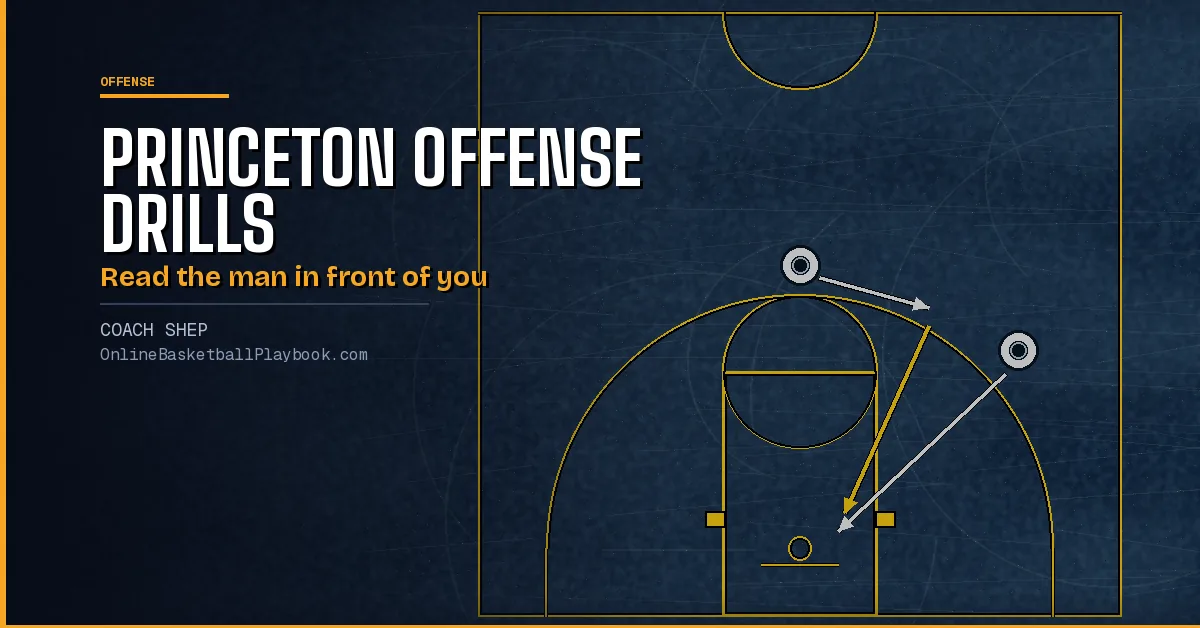
Princeton offense drills break Pete Carril's read-based system into parts a team can repeat: the backdoor against denial, the dribble at a teammate, the hand-off, the flare off the post, the Point cuts and the shots each action produces. Carril's own rules are short: when closely guarded, go back door, and watch the person in front of you. The drills below exist to make those reads automatic. This guide covers spacing drills, backdoor and hand-off breakdowns, the 3-0 drills for Chin, the 5 Out backscreen and wave cuts, two shooting drills built on Point, a 2-on-2 drive drill, a ten-practice install, and the coaches who skip drills and teach everything 5 on 5. The offense itself is on Princeton offense.
Breakdowns or 5 on 5
Breakdowns. Several installs build the offense through 2-0 and 3-0 drills, a cut or a pass or a screen repeated in a continuous rotation. A one-minute version runs each drill for one minute, uses as many baskets as possible and works best with at least six players per basket. A stop-at-the-point version runs each action at full speed up to the new teaching point, then stops.
Game speed. In the game-speed version the team ran no drills. Everything was done at game speed, 5 on 5. If a 2-on-2 was used, players had to picture the other three teammates and the game situation so they did not simply perfect the drill. It also avoided naming cuts with numbers or terms, describing actions in plain words and making players read the defender in front of them.
Carril himself sits between the two in one account: he scrimmaged heavily in the first week to learn his personnel, then built the low-post, high-post or Chin game around what that team had.
Princeton Offense Drills for Spacing
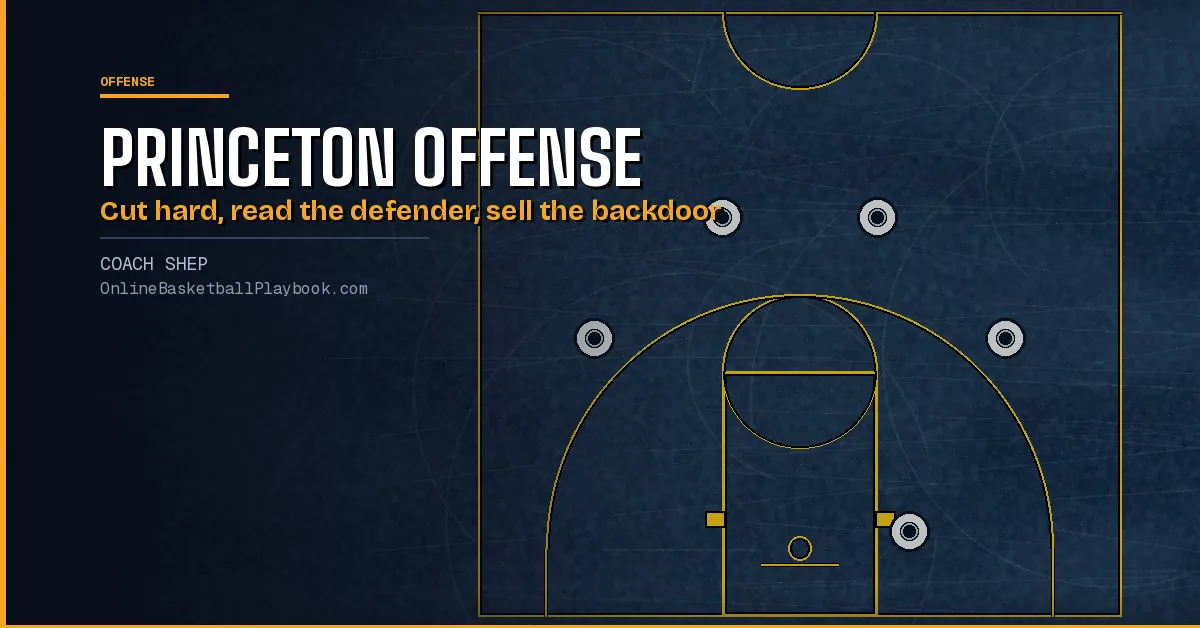
The five-spot alignment puts the post on the ball-side block, the forwards a step higher than the free-throw line extended, and the guards at the elbow extended, 3 to 4 feet above the arc. Spacing numbers differ by version: a wide version wants 15 to 18 feet between players, and a high version keeps everyone above the free-throw line at 12 to 15 feet.

A ten-practice install starts here. Practice 1 freezes play whenever one defender can guard two offensive players. Its progression is five-spot spacing without defense, then pass-cut-replace drills, then 4 on 0 spacing into 4 on 4 possessions with no dribble. Spacing drills for any offense are on basketball spacing drills.
Backdoor Drills
2-on-2 denial read
The same install teaches the backdoor read in its third practice as "if the defender denies, cut behind." The drills are a 2-on-2 denial read and a passer who holds the ball until the cutter's top foot wins, with the defense switching between deny and sag looks so the cutter has to read which one he got.

Dribble-at backdoor
Two breakdown drills run the same backdoor from different spots. 1 dribbles hard at 2, and 2 fakes high and cuts backdoor for the layup. It runs from both sides. The pass is a bounce pass that leads the cutter to the basket, and the cut goes in a straight line to the basket. In several Princeton versions, a dribble at a teammate is the signal for him to cut backdoor.

3-0 Top Backdoor
Two wings, plus one player at the top of the key. A wing dribbles at the player at the top of the key, who cuts backdoor for the layup. The shooter rebounds and passes to the wing who stayed put, the passer fills the top of the key and the shooter fills the empty spot, so the drill keeps turning over.
More cutting drills are on cutting in basketball, and the defensive side of the backdoor is on how to stop the Princeton offense.
Dribble Hand-Off Drills
Hand-off with three options. The breakdown set follows the backdoor drills with a hand-off. 1 dribbles at 2, and he must dribble directly at 2's defender, then hands off. After the hand-off 2 has three options: shoot off the hand-off, drive straight to the basket, or take the ball, dribble hard and pass back to 1 cutting backdoor. On that third option 2 dribbles hard, jump stops, reverse pivots and passes to 1 on the backdoor. The first option runs from several spots on the floor.

3-0 Wing Hand-off or Backdoor. Two wings and a player under the basket. The player under the basket passes to a wing and cuts to the top of the key for the return pass, then dribbles opposite, and the wing on that side either cuts backdoor for the layup or comes off for the hand-off and the jump shot. Its coaching points are waiting to cut, a one-hand bounce pass and different finishes around the rim.
5 Out hand-off stages. A shooting drill from the 5 Out set works the backdoor on the dribble at, with the cutter stepping his left foot to 10 o'clock and his right to 2 o'clock to set up the defender, then cutting backdoor. A second stage reverses the steps and comes behind for a dribble hand-off while the 5 turns to pin the defender. A third stage sends the cutter across the lane for a drift screen at the elbow. Hand-off technique is on drills to teach ball screen offense.
Get the next coaching guide in your inbox
One email when a new guide or diagram set goes up. Free.
3-0 Drills: Chin, 5 Out and Wave
The 3-0 drills turn each action into a continuous three-player rotation in which the shooter rebounds and fills a spot, so players repeat the cut, pass or screen many times.
- 3-0 Chin Cuts. Fixed rotation rules: the guard always rebounds and kicks back to the top of the key, the strong-side wing rotates up to the top of the key after passing, and the weak-side wing stays put and becomes the strong-side wing. The guard flares off the post screen and has five options on the catch: the flare jump shot, flare and drive, flare and kick out, flare and backdoor, and flare and give-and-go cut.
- 3-0 5 Out Backscreen. The wing and corner spots are filled as in the 5 Out play. 2 cuts backdoor and reverse pivots to post up, and 3 fills the empty spot. Four options: the backdoor layup by 2, a jump shot by 3 filling behind, a reverse-pivot post-up by 2, and a backscreen by 2 for 1 to get the post back inside, ending in a jump shot by the screener or a reverse post by the post player.
- 3-0 Wave Cuts. The guard always rebounds, the weak-side wing always rotates up to fill the top of the key, and the high post steps up for a ball screen and fades to the same-side wing. After the guard kicks out, fills the high post and screens away, there are six options: pop back and shoot, pop back and drive, kick out, skip to the wing, a double cut, and the post screen with a pull-up jumper. In the double cut, if the pop back is denied after the screen, the player goes hard backdoor. If the guard refuses the screen and attacks the lane line, he rebounds and becomes the new post, and the action changes sides.
Chin itself differs by version. In a backscreen-and-flare version the post backscreens for a wing to the rim and then flares for another player, and the coaching point is that the cutter does not leave until the ball leaves the passer's hands. A Carril-based version has the post flash and hold the high post while the guards shuffle cut off his outside shoulder. Check which Chin your team runs before you pick the drill. The flare itself is on flare screen basketball.
Shooting Drills Built on Point
In the Point series the passer hits the high post at the elbow and his cut (over, away or under) tells everyone what comes next. Two shooting drills give the shots that series produces. All players work both the post and guard spots.
- Point Over the Top. The point passes to the elbow, cuts over the top as if setting a screen, pops and catches the return pass from the elbow. He can shoot the three or rip and drive baseline for the layup. The 5 rebounds and rotates to the point, and the 1 rotates to the post line. Stage two adds the 5 setting a ball screen for the 1, who takes the layup or the pull-up or drops it to the 5 on the roll.
- Point Screen Away. Same set. The point passes to the elbow, screens away and pops behind the arc, and the 5 hits him. He shoots the three, or shot-fakes and drives. Stage two adds the same ball screen from the 5.
Both run from the other elbow too. A longer sequence starts with the point to elbow pass and practices the under cut, the pop, the pick and roll jumper, the pick and roll drop, the shot on the kick-out, the post going the other way, a second backdoor, the over cut, and the slip with a kick-out on the over cut. On the slip, the screener reads a switch and slips the screen, which swaps the roles of 1 and 2, and any earlier action can then run with the roles switched. The coach first tells players which action to run and works toward them calling their own cuts.
Two pure shooting drills come from the Princeton tree:
| Version | The drill |
|---|---|
| Spot threes, one minute a spot | Four minutes after conditioning, two groups, all threes, one minute at each spot (top of the key, corner, wing), with a goal of 80 makes. The passer calls the receiver's name, hits the hand target, and the shooter squares up and holds the follow-through. |
| Pass-and-cut threes, two lines | Two lines at the free-throw line extended for four minutes, one line passing and the other cutting to the free-throw line for the shot, then changing spots to the top of the key and the corner. A four-spot version asks for 80 makes, 20 from each spot, and the team runs if it falls short. |
Both make targets are reported secondhand. More shooting work is on basketball shooting off screens.
Live Reps and Scrimmages
The 2-on-2 drive drill. One Princeton-tree team credited about 70 percent of its backdoor cuts, by one report, to a drive drill. It runs 2 on 2 from a 5-out set. The driver attacks and the cutter chooses quickly: go backdoor, come around for a hand-off, or come around for a spot-up shot. The driver does not know which, so the defense cannot know either.

No whistle. The same team practiced without a whistle so players got used to hearing the coach talk, an idea credited to Carril.
A scoring scrimmage. The ten-practice install ends with a scrimmage that rewards habits: two points for a backdoor layup off denial, one point for a correct skip against help, and one point for a high-post touch that creates a quality shot.
Dummy offense. This version opens possessions with 10 to 12 seconds of movement in which the center cuts to the hash, catches, and both guards cut through off the forwards' rub screens and come back, so the defense guards nothing first. If the defense gets lazy during it, the offense cuts backdoor for a layup. The exception is a late-game deficit that needs a quick score.
Decision-making drills for any offense are on teaching basketball decision making.
A Ten-Practice Install
One plan spreads a Princeton install over ten practices with one rule: no new set goes in until the players can explain which defensive move triggers the read they already have.
| Practice | Main layer |
|---|---|
| 1 | Spacing and terminology |
| 2 | Passing angles and pass-cut-fill |
| 3 | The backdoor read |
| 4 | Chin entry |
| 5 | Chin continuation |
| 6 | Point action |
| 7 | Low action |
| 8 | Counters |
| 9 | Special situations |
| 10 | Controlled scrimmage |
Chin goes in first because, the plan says, it covers spacing, passing to the high post and the threat of the backdoor at the same time, and its checkpoint is that no player stands after passing. Point is a companion to Chin with over, under and away reads, and players have to say which read the defender gave them. Low changes the angle and involves the post, who should be a passer and decision maker, with a live 4 on 4 that requires a post touch. Counters come last, and each answers one defensive look. Against a switch: slip, re-screen or seal the mismatch. Against denial: the backdoor and a weak-side fill. Against sagging help: catch and shoot or reverse the ball quickly. Practice 9 covers late clock, zone, pressure and after-timeout plays. One estimate puts it at two to three years before the full offense is a consistent weapon. Other installs are compared on drills to teach motion offense.
Want the printable playbook packs?
OBP Pro members get the premium playbook packs: the zone attack, out of bounds and practice plan PDFs, plus each new pack as it is finished. The membership page lists what is in each one. Or draw your own version free in PlayDraw.
See what OBP Pro includesQuestions Coaches Ask
What drills teach the Princeton offense?
Backdoor drills off denial and off the dribble at, dribble hand-off drills, 3-0 drills for Chin, the 5 Out backscreen and wave cuts, shooting drills off the Point action, and a 2-on-2 drive drill where the cutter picks backdoor, hand-off or spot-up.
How do you teach the backdoor cut in the Princeton offense?
Start with a 2-on-2 denial read where the passer waits until the cutter wins, then a dribble-at drill with a straight cut and a bounce pass that leads the cutter to the rim.
How long does it take to install the Princeton offense?
One plan installs a playable package in ten practices, one layer at a time. One estimate puts it at two to three years before the full offense is a consistent weapon.
Do Princeton teams run drills?
Some do and some do not. Several installs build it from 2-0 and 3-0 breakdowns, while a game-speed version ran everything 5 on 5.
How many players do Princeton breakdown drills need?
The 3-0 drills use three players at a time. The one-minute version runs each drill for one minute at as many baskets as possible, with at least six players per basket.
More Guides From This Batch
- How to Beat Man to Man Defense in Basketball: Reads and Drills
- Baseline Out of Bounds Plays: Sets vs Man, Zone and for Youth
- High Low Offense Basketball: Reads, Counters and Zone Rules
- Four Corners Offense Basketball: Roles, Rules and Versions
Back to Princeton Offense and every Offense page.
Keep Building
Related breakdowns
Princeton Offense: Cuts, Reads and Sets
How the Princeton offense works: the Chin set, backdoor cuts, the high-post reads, the players it needs, how to install it and what defenses do to stop it.
Transition Offense Drills: Outlet, 2-on-1 and Live Ladder
Transition offense drills that train a rule for every numbers situation: the outlet, lane filling, 2-on-1, 3-on-2, the 2-on-1 to 5-on-5 ladder and the numbered break
Princeton Offense vs Motion Offense: Compared by Principle
Princeton offense vs motion offense, side by side: spacing, the post's job, cuts and screens, reads, the dribble, called sets, personnel, shots and the install.