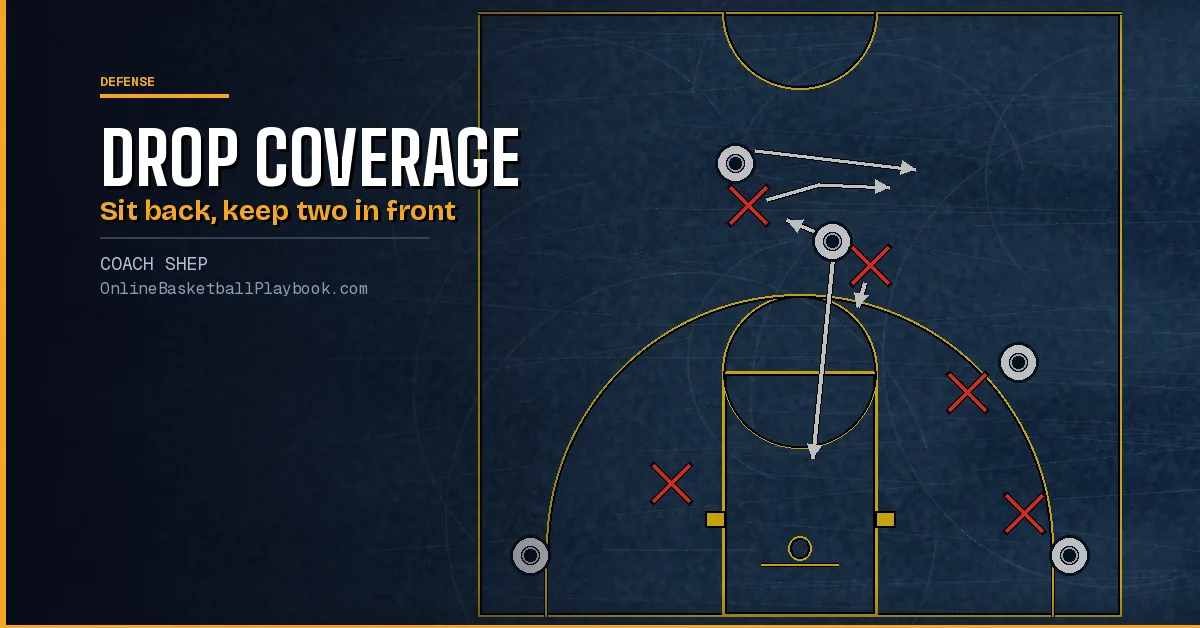
Drop coverage in basketball is a ball screen defense in which the screener's defender sits back toward the paint while the on-ball defender chases over the screen. The big guards the rim and the roller. The guard chases the handler, takes away the jump shot behind the screen, then gets back in front so the big can return to his own man.
This page goes deeper than the coverage summary on the pick and roll defense hub: each defender's job, how deep to drop, when to call it, what beats it, the protection behind it and how to teach it. The offense's answers to a drop are on pick and roll reads.
Drop Coverage in Basketball: What It Is
In drop coverage the screener's defender drops to a level in the paint as the screen is used. He has two jobs: stop an easy shot near the rim, and keep the roller in front of him so the lob is gone. The guard chases over the screen so the handler cannot stop and shoot behind it, then sprints back in front of him. Once the guard is back, the big can recover to the roller.
The open look it leaves is a pull-up or floater in front of the big. The deep drop gives that shot up on purpose to stop the drive. Keep the drop as a secondary call behind a base coverage, and have the on-ball defender call "I'm back" when he has caught up. Keep the two jobs separate and the coverage holds.

The Two Defenders' Jobs
The screener's defender
- Call it first. The first step is the screen call, early and with the side: "Screen left" or "Screen right." Make the call before the screen is set, so the on-ball defender's feet can move before contact.
- Heels to the arc. Put the big's heels on the three-point line as the handler comes off the screen.
- Keep two men in front. He stops an easy shot at the rim and keeps the roller in front of him to take away the lob.
- No dribble around him. Ban the handler from dribbling around the big in both coverages, and call that dribble the killer.
The on-ball defender
- Over the top. He goes over the screen to take away the stop-and-pop jumper behind it.
- Never get rejected. If the handler turns away from the screen and drives the other way, drop coverage breaks down. Make the reject the on-ball defender's fault, so his foot angle must still contain a reject while he waits for the screen.
- Pressure the pass to the roller. The on-ball defender traces the roller's passing lane while he chases, then recovers in step with the big.
- Get back in front. The coverage only works once he has caught up. The big cannot leave the handler until then.
Going over the screen takes footwork. The over and under choices are compared on how to go under a ball screen, and the handler's split of a two-man show is on how to split a ball screen. Know your job and say it out loud.
How Deep to Drop
The depth is a dial. Set it by the scouting report on both the handler and the screener, then drill it in practice. The common settings:
| Setting | Where the big sits | Note |
|---|---|---|
| Drop at the arc | Heels on the three-point line | Called when the ball is caught high or the handler has separation |
| Drop to a level in the paint | Back toward the paint, ball and roller in front | The depth is set by the scouting report |
| Deep drop | At the free-throw line or lower | The pull-up, given up on purpose to stop the drive |

The star handler is the limit. An NBA coach says you cannot play a player like Luka Doncic in drop, and his package doubles stars to get the ball out of their hands instead (see blitz and trap ball screens). Set the depth before the game and drill it.
When to Call Drop Coverage
Call drop by the matchup, the screen and the corner.
- By the screener and the handler. Drop works best against a big who scores well on the roll and against guards who like to drive, since the dropping defender takes away both the lob and the driving lane.
- By how the screen arrives. Pick the coverage on each screen by how it arrives:
- The ball is caught high, or the handler already has separation from his defender before the screen: drop.
- Both defenders are attached at the arc as the screen lands: show (they call it the dance, see hedge basketball).
- A drag screen in transition, or a screener who pops, before the help is set: an early call, covered below.
- By the corner. Let the ball-side corner decide. With the corner filled, the corner defender calls "corner filled" and the coverage is drop. With the corner empty, it blitzes. The read keeps the defense from being spread out.
Make the call before the screen arrives.

What Beats Drop Coverage
The poor matchups for drop coverage:
- A screener who can pick and pop. The dropped big is left with a long closeout to a shooter.
- A handler with a strong mid-range or floater game. That is the shot the drop gives him.
- The Spain pick and roll. A back screen on the drop defender frees the roller for a lob.
- A reject. If the on-ball defender lets the handler turn down the screen, the coverage is broken.

The answers to the pop. The pick and pop is the drop's biggest problem, and the answers differ:
- Switch if the screener's defender can guard on the perimeter.
- Hedge and recover if he is less athletic.
- Zone if he cannot guard in space at all.
- The early call. Push the handler and go under one man against a popping screener. This is much better than a show there, because a late switch is very hard if the offense holds and the handler drives.
- Stunt at the popper. An NBA team stunts at the popping big, with three named stunts.
The shooting big who can roll or flare. The low man stops the roll, but gets back to his own man if the 5 flares, or the defense gives up the corner three. Scout the screener before you pick the depth.
The Protection Behind the Drop
Coverage, protection, recovery. Split every pick and roll into three phases: the two defenders on the ball, the three behind them, and the closeouts and rotations after the pass. Name the phase that broke before you change the scheme.
- Pull the weak link first. In game, first pull the on-ball defender who cannot do the job.
- Ask three questions. Did the team execute what it practiced, execute it well enough, and execute it hard enough?
- Change the coverage last. Only if all three are yes, change the coverage.
Who owns the roll. Someone off the ball has the roller on every possession. Teach one name for that job, the low man.
- Call "low man." After the coverage call, everyone calls "low man."
- Own the roll. The low man owns the roll and the short roll on drop, switch and blitz alike.
- Move with the pass. On every pass, everyone moves in the direction of the pass and sprints to the ball.
Other systems name the roll owner differently, so write the job next to the name. A last-man system names a last man for the deep roll and an X-out for the hardest passing lane, a new last man on every pass, with each player calling his teammate's job, not his own.
Over-helping is as dangerous as under-helping, so the helper leaves as soon as the roller's own man recovers. Systems that split the roll by depth put the top big on a short roll toward the foul line and a low tag man on a long roll to the rim.
Tag height is a choice. NBA teams tag the rolling big from a low weak-side player or from a high weak-side player above the free-throw line, and both are valid, so pick one and name it. The full help system is on help defense principles, and rotation teaching is on how to coach defensive rotations.
Drag Screens and the Early Call
A drag screen comes in transition, before the three protectors are set, so a half-court drop has no help behind it. The early call keeps the play strictly two on two: the on-ball defender pushes the handler, keeps pressure on until the last moment, then goes under one man.
Ettore Messina's drag screen drill picks up the handler early and far from the three-point line, so the defender can go under with a small show from the screener's defender and an "Under" call. A late pickup at the line removes the under against a shooter.
Messina usually switches the side pick and roll in transition. More of his drills are on Ettore Messina pick and roll defense drills, and the transition side is on transition defense. Decide the drag-screen answer before the game.
Get the next coaching guide in your inbox
One email when a new guide or diagram set goes up. Free.
Teaching Drop Coverage
Start with it. Install drop first, then switch, then blitz by day 3, and rep at three-quarter speed with full talk and full detail.
Two on two, then add help. Build the coverage up:
- No help. A 2-on-2 with no help at all, so the two defenders must make the coverage work alone.
- Add the corner. A 2-on-2 with the corner empty, then a 3-on-3 that adds a corner player and a tag man.
- Climb the ladder. A ladder from 1-on-1 at the danger spots to 2-on-2 ball screens, 3-on-3, shell 4-on-4, shell 5-on-5, and 5-on-5 against the ball screen.
More set-ups are on drills to teach ball screen defense.
One vocabulary. Teach one language for every coverage, loud and continual, and test whether the players use the staff's words with each other. The call comes first, from the screener's defender, with the side. Rep the calls until nobody has to think about them.
Questions Coaches Ask About Drop Coverage
What is drop coverage in basketball?
A pick and roll defense in which the screener's defender drops toward the paint to protect the rim and keep the roller in front, while the on-ball defender chases over the screen and sprints back in front of the handler.
What is the difference between drop and hedge?
In a drop the big sits back and keeps the ball and roller in front of him. In a hedge he steps up into the handler's path to slow him, then recovers to the screener. The hedge is on hedge basketball.
What does drop coverage give up?
The pull-up or floater in front of the big, the pop by a shooting screener, and the lob off a Spain back screen. A reject breaks it too.
How deep should the big drop?
It depends on the handler and the screener. Depth ranges from heels on the three-point line to a deep drop at the free-throw line or lower that gives up the pull-up to stop the drive.
Should the guard go over or under in drop coverage?
Over the top, so the handler cannot stop and shoot behind the screen. Going under is a separate call, usually for a handler who is not a shooter.
Want the printable playbook packs?
OBP Pro members get the premium playbook packs: the zone attack, out of bounds and practice plan PDFs, plus each new pack as it is finished. The membership page lists what is in each one. Or draw your own version free in PlayDraw.
See what OBP Pro includesMore Coaching Guides From This Batch
- Hedge Basketball: Hard Hedge, Flat Hedge and the Recovery
- Switching Defense Basketball: How to Switch Ball Screens
- Ice Basketball Defense: Push the Side Pick and Roll Down
- Blitz Pick and Roll Defense: How to Trap a Ball Screen
Back to Pick and Roll Defense and every Defense page.
Keep Building
Related breakdowns
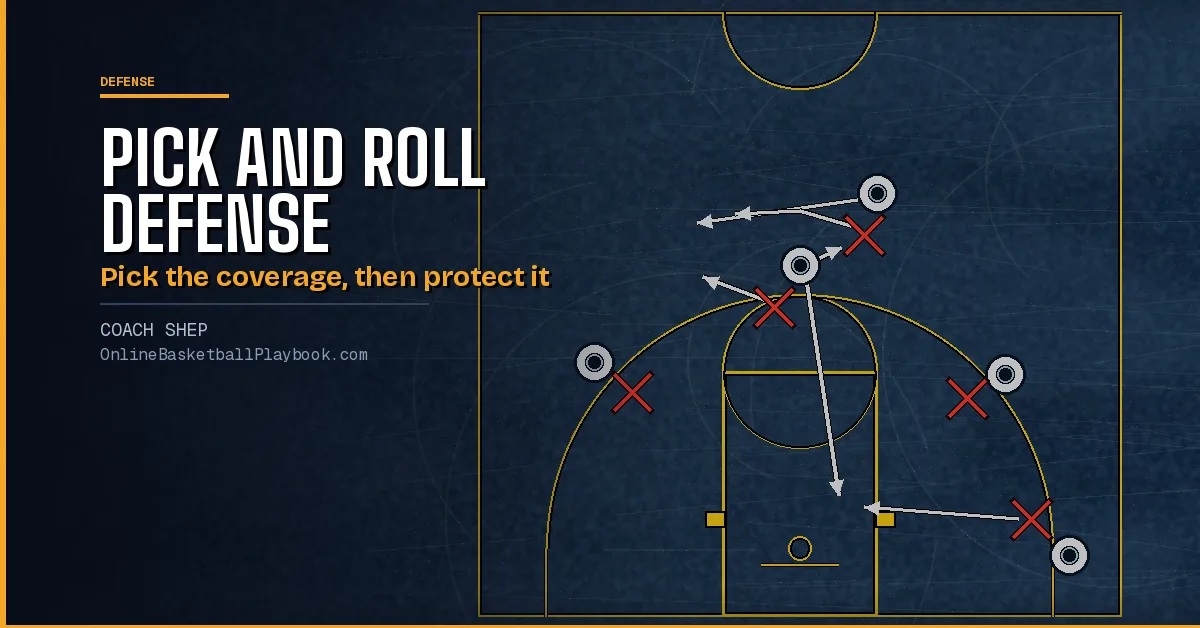
Pick and Roll Defense: Every Ball Screen Coverage Compared
Pick and roll defense compared: drop, show, blitz, switch, ice and under, what each takes away and gives up, the help behind it and how to choose.
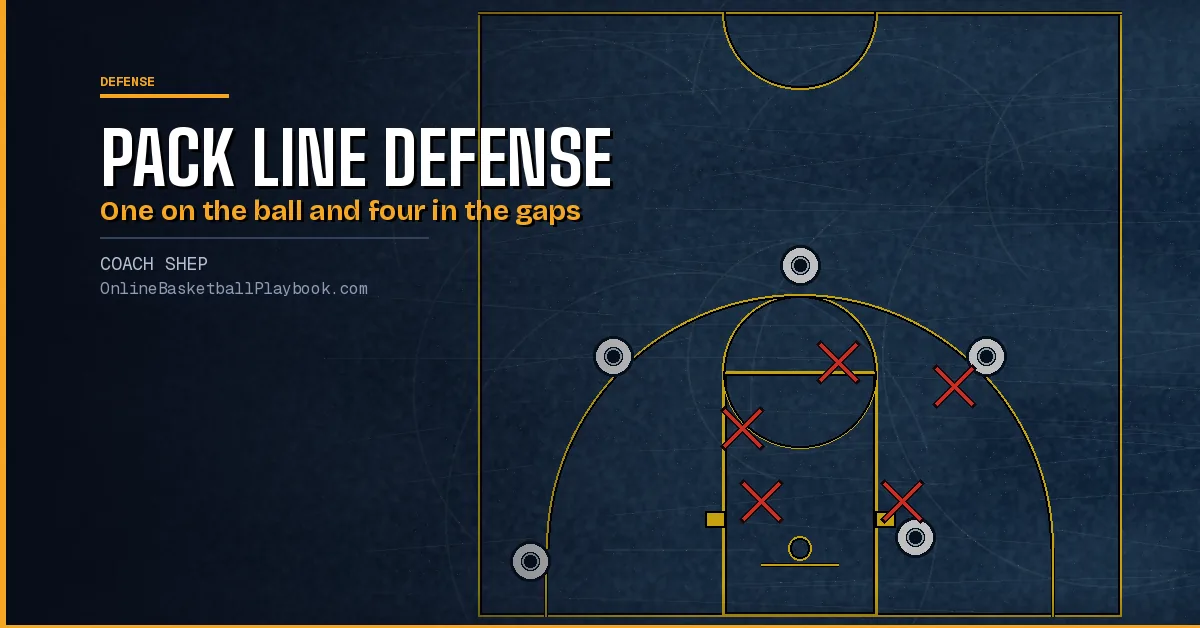
Pack Line Defense: Rules, Post Coverage and How to Install It
Pack line defense as coaches run it: where the line sits, on-ball and gap rules, post doubles, screens, dead balls, the costs and an install order.
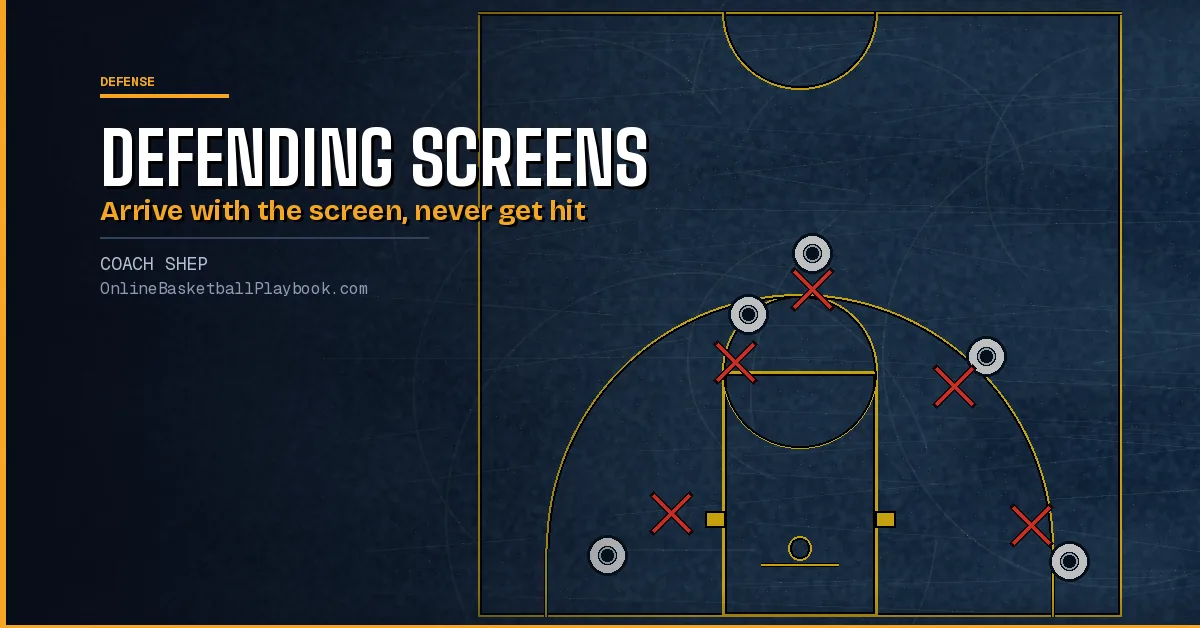
Defending Screens in Basketball: 5 Keys for Every Coverage
Defending screens in basketball comes down to five keys that hold under any coverage, for ball and off-ball screens, with the mistakes that cost baskets and drills.