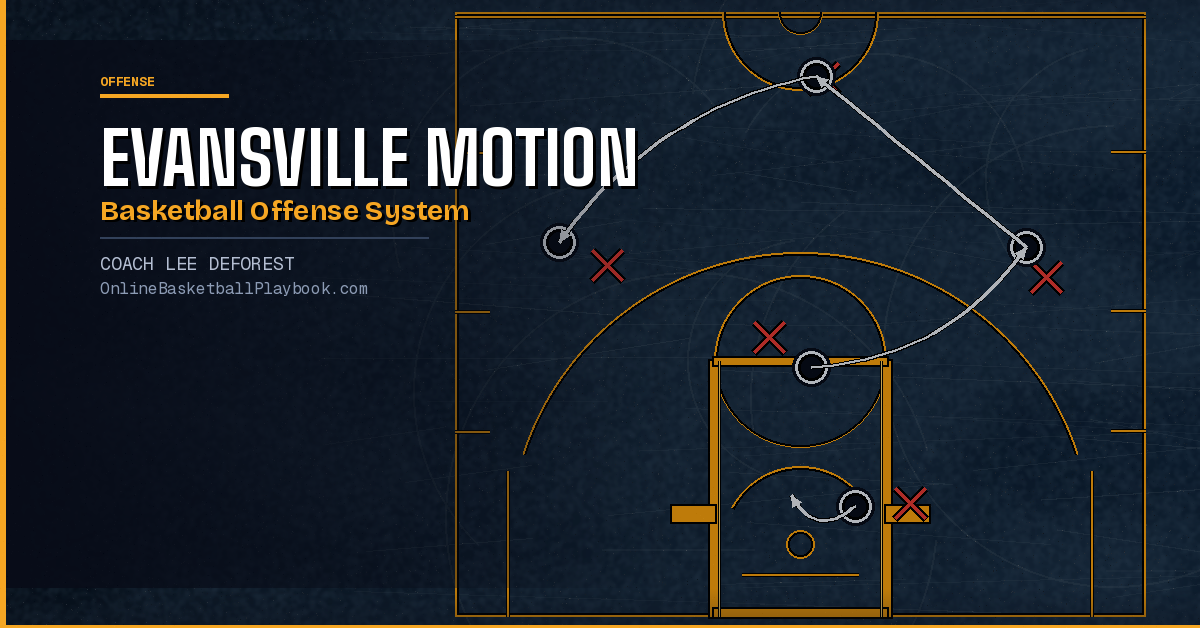

The Evansville motion offense is a read-and-react system built on spacing, ball movement, and purposeful cutting. Every pass triggers a decision. Players learn to play the game, not just run plays.
What Is the Evansville Motion Offense?
The Evansville motion offense belongs to the broader family of read-and-react systems that have defined modern college basketball. Rather than giving players a scripted sequence to execute on every trip down the floor, the motion system hands them a set of rules and teaches them to make decisions based on what the defense gives up. The name references the structured motion frameworks popularized at the mid-major level, where coaches without elite recruiting resources needed a system that could make five average athletes play like a cohesive unit.
At its core, the Evansville motion system operates from a simple premise: standing still is a mistake. Every player who does not have the ball is responsible for doing something useful — setting a screen, cutting to the basket, or relocating to maintain spacing. This constant movement puts pressure on defenses that want to help and recover, because by the time a help defender rotates, the motion has already created a new open look somewhere else on the floor.
What separates the Evansville approach from a generic continuity offense is the emphasis on reads. The offense does not tell a player where to cut — it teaches the player to read the defender and then cut. If the defender is in the passing lane, the offensive player goes backdoor. If the defender is sagging, the offensive player fills and catches ready to shoot. These are not improvised decisions made under pressure; they are trained responses that become automatic through repetition.
Core Principles That Drive the System
Six foundational principles govern every possession in the Evansville motion offense. Understanding these rules is the difference between players who execute the offense and players who truly play within it.
Read, Don't Call
The defining characteristic of any read-based motion system is that options are not play calls — they just happen based on what the defense does. A coach watching from the bench may see a backdoor cut materialize, but no one called that play. The offensive player read an overplaying defender and went backdoor. This is the concept behind "learn to play, not run plays." When a defense scouts your team and cannot find a pattern because your players are reading and reacting rather than running set sequences, you have achieved one of the fundamental goals of motion offense: becoming unscoutable.
Pass-and-Move is Non-Negotiable
Every pass in the Evansville motion system is followed by a move. Not sometimes — every time. The three options after passing are a basket cut, a screen, or a move to receive a screen. Standing after a pass is treated as a team violation because it collapses spacing and allows defenders to relax and watch the ball. Coaches who install this system need to track standing as an error on film just like they would track a turnover or a missed box-out.
Fake Before You Move
Effective off-ball movement in motion offense starts before the cut. A player who telegraphs a backdoor cut by casually drifting toward the baseline is easy to defend. A player who takes two hard steps toward the ball, pauses to let the defender commit, and then cuts backdoor is nearly impossible to guard. The fake is the setup. Off-ball players must think of their movement in two phases: the fake that occupies the defender, and the cut that exploits the defender's reaction.
Catch Ready to Attack
The most open a player will ever be on any given possession is the instant they catch the ball. The defender who is late rotating, still recovering from helping, or caught watching the pass is vulnerable in that single moment. Motion offense players must catch every pass balanced, with eyes on the rim, ready to shoot, drive, or pass. Catching and then gathering to look at the basket surrenders the advantage. Every player — even those who are not shooters — must catch in a position where the defense has to respect the shot.
Spacing Rules and Floor Balance
Spacing is not a passive outcome of the motion offense — it is an active responsibility that every player shares on every possession. The standard spacing principle in the Evansville system calls for 15 to 18 foot gaps between offensive players around the perimeter. These gaps are not set at the start of a possession and then maintained automatically; they must be actively regenerated every time a player cuts, screens, or moves.
When a player cuts through the lane on a basket cut and the defense rotates to help, a gap opens on the weak side. Another offensive player must immediately fill that gap. If no one fills it, the defense can compress, help without consequence, and take away the penetration angles the motion offense depends on. This fill discipline is what separates teams that run motion from teams that play motion.
The dead corner is a structural concept in motion offense that coaches often underteach. On every ball reversal, the weak-side wing — the position the defense has vacated to help on the strong side — becomes a live scoring opportunity. Teaching players to see the dead corner on every reversal turns a routine swing pass into a live threat. The player in the dead corner is open not because of clever design but because defensive help rotations have left someone uncovered. Motion offense is built to exploit exactly that situation.
Perimeter spacing also protects the interior. When the five offensive players maintain proper gaps, no single help defender can guard two of them. If any player collapses to the paint and bunches with a teammate, a single defender can play both of them. Spacing forces the defense to make a genuine choice every time the ball moves.
The Pass-and-Cut Engine
The most fundamental action in the Evansville motion offense is the pass-and-cut, and the most important cut is the one that comes immediately after the pass. When a player passes to a teammate and then makes a hard basket cut, they force the defense to make an immediate decision: follow the cutter and potentially give up the pass back, or stay home and let the cutter go through untouched.
Reading the Defender on Every Cut
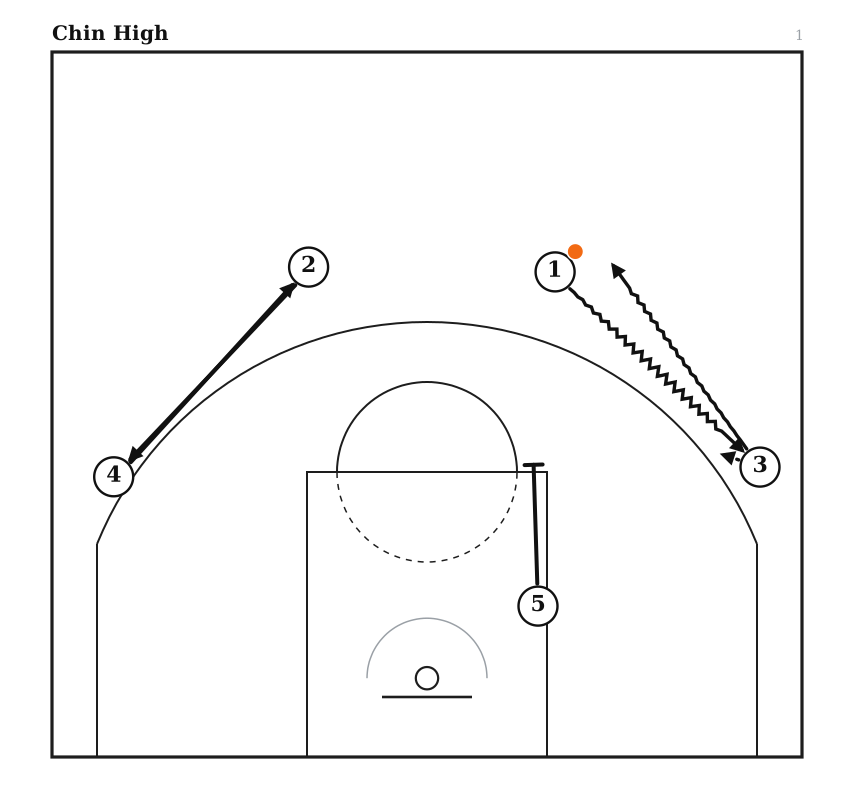
The quality of a cut is determined before the cut begins. As a player prepares to cut, they must locate their defender. If the defender is in help position — sagging toward the lane, watching the ball, or standing between them and the basket — the offensive player blasts toward the ball to fill the open space. If the defender is in denial, pressuring the passing lane, the offensive player goes backdoor immediately. This two-option read — fill or backdoor — is the foundational decision in the entire motion system. Every other cut is a variation on this same logic.
The Seven Cut
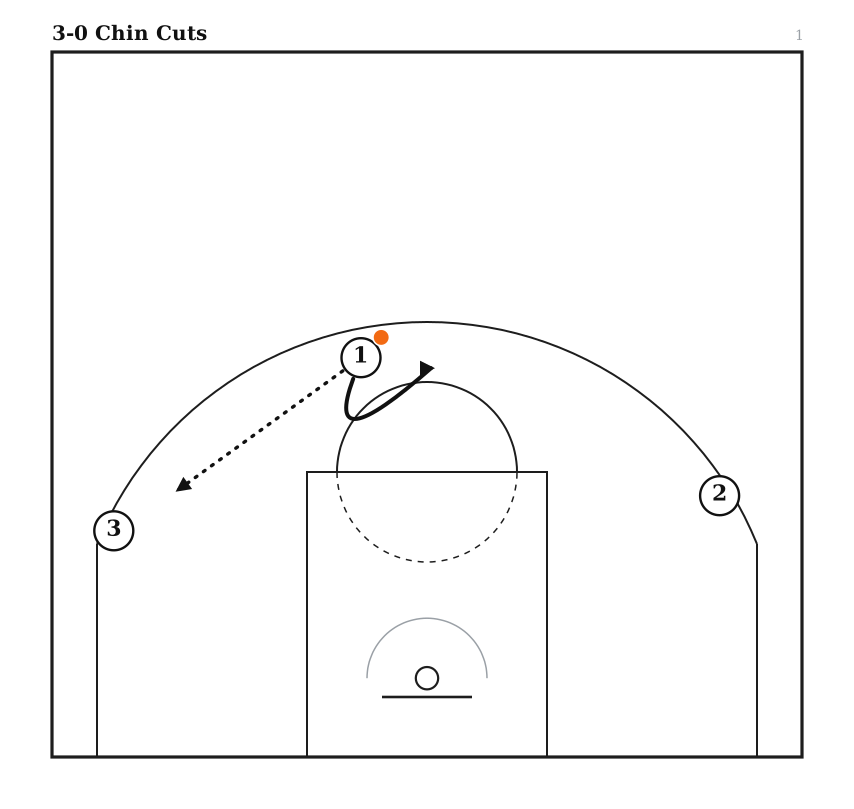
One of the most effective cuts in motion offense is the seven cut, named for its shape. The offensive player takes approximately two deliberate steps in one direction, pivots sharply on the inside foot, gets across the defender's face, and cuts hard to the basket. The pivot is the critical moment. A tentative pivot gives the defender time to recover; a hard, low pivot executed with conviction puts the cutter's shoulder across the defender's chest and makes them impossible to stop legally. The seven cut requires no screen and no help from a teammate — just a player who understands timing and can execute footwork under pressure.
Backdoor as a Pressure Mechanic
In a well-coached motion offense, the backdoor cut is not a bail-out option — it is a built-in pressure tool. Any time a defender overplays the passing lane, the backdoor trigger activates. The passer must be trained to anticipate this: when their teammate plants and cuts backdoor, the pass goes immediately, not after hesitation. A delayed backdoor pass is a turnover. Coaches need to drill the passer's reaction as much as they drill the cutter's footwork, because the two actions must arrive together for the cut to work.
Ball Movement Over Player Movement
One of the least intuitive principles in motion offense is the idea that ball movement matters more than player movement. Five players moving constantly but holding the ball too long accomplish very little. The ball outruns any player on the floor, and a quick pass finds a late defender faster than complex off-ball movement with a stationary ball. When a player catches the ball and holds it while teammates cut around them, defenders can ball-watch and help without cost. But when the ball moves immediately off the catch, defenders must adapt to the ball's location — and adaptation takes time that the offense can exploit.
This principle reshapes how coaches should evaluate possessions. A possession where five players moved constantly but the ball took eight seconds to move from the wing to the corner was not a good possession — it was five athletes working hard while giving the defense time to recover and set. A possession where the ball moved four times in four seconds, even with limited player movement, may have generated a higher-quality shot. Ball speed is the primary threat in motion offense; player movement exists to maintain spacing and create cutting angles, not to substitute for passing.
Motion teaches kids how to play, not just how to run plays — the reads survive any substitution, and the offense never collapses when one player comes off the bench.
— Motion Offense Principles, Basketball Vault
Ball reversal is another dimension of ball movement that the Evansville system uses as an offensive weapon rather than just a reset mechanism. When the ball swings from one side of the floor to the other, defenders who were helping on the strong side must sprint back to their assignments on the weak side. That sprint takes roughly one full second. A good ball reversal combined with an immediate attack by the receiver on the weak side exploits that recovery window before defenders can reestablish position. Ball reversal is a pressure mechanic — not a reset.
How to Install the Offense
The most common mistake coaches make when installing motion offense is adding too many options too quickly. A player who has four different things to do after a pass will freeze and do nothing. The installation principle for the Evansville system is to choose one option, get your players to execute that option automatically, and only then add a second option. This is slower than handing out a playbook and running through it in practice, but it produces players who actually own the reads rather than players who know the names of the actions without understanding them.
Phase One: 5-on-0 Pass-and-Cut
The first installation phase runs entirely without defense. Five players on the floor, one ball, and the only rule is that every pass must be followed by a basket cut. No screens, no back cuts, no flares. Just pass and cut, every time, until the rhythm is automatic. Coaches can run this for ten minutes every day for a week before introducing a second action. Players who own the base rhythm will integrate screens and reads much faster than players who learned six actions in the first practice.
Phase Two: Adding the Backdoor Read
Once pass-and-cut is automatic, introduce the defensive read. Put defenders on the floor and let them make reads. When a defender denies, the offensive player goes backdoor. When a defender sags, the offensive player fills and catches ready to shoot. These two options — fill or backdoor — are the entire motion offense in simplified form. Everything else is a variation on this same read applied to different situations and different personnel alignments.
Phase Three: Screens and Named Actions
The final installation layer introduces screens and gives them names. Giving names to recurring actions — flare screen, back screen, down screen — is not the same as calling plays. The names exist so that players can communicate faster on the floor and coaches can correct reads more precisely in film sessions. When a player calls out "flare" as they come off a screen, teammates can anticipate the next action and position themselves accordingly. Named actions make the motion coachable without making it scripted.
When you first install the pass-and-cut base, resist the urge to add screens in week one. Run pass-and-cut 5-on-0 for at least three consecutive practices before putting a defender on the floor. Players who feel the rhythm of purposeful movement before they face any defensive pressure build the habit faster and execute under game conditions with far less hesitation. The investment in a slow install pays off in January when your team runs the offense against a zone, a press, and two different man coverages without needing a timeout to reset.
What Defenses See and How to Counter
The Evansville motion offense creates a specific set of defensive problems that most teams are not structured to solve simultaneously. Understanding what defenses see — and what counters the motion offense has built in — helps coaches anticipate problems before they appear in games.
Defenses that try to deny the motion offense aggressively leave themselves vulnerable to backdoor cuts. A team that presses all five passing lanes will give up a layup every time an offensive player recognizes the overplay and cuts. This is not luck — it is the motion system doing exactly what it was designed to do. The backdoor cut is the built-in answer to aggressive denial, and it works automatically when players have been trained to read their defender rather than run a set path.
Defenses that choose to sag and pack the paint take away the basket cuts but open up the perimeter. The motion offense counters this by teaching players to shoot when the defender is giving them the shot. One of the core principles of the system is that when a penetration or ball reversal results in an open catch, the receiver must shoot if the defender is sagging. Re-penetrating or re-dribbling when the shot is available surrenders the advantage that the motion created. Defenses that sag must be punished from the perimeter, and teams that have installed the motion with proper shooting discipline will do exactly that.
Switching defenses disrupt the motion's screen-and-cut actions by taking away the mismatches screens are designed to create. The built-in counter is the slip: when a screener reads that the defense is switching, they slip the screen early and cut to the basket before the switch can complete. The switch counter happens automatically when screeners are trained to read the defense rather than set the screen regardless of what the defender does. A screener who always sets the screen will never generate a slip — a screener who reads first and screens second will create slip layups all season against switching teams.
- Track standing as a turnover on film: Every time a player stands after passing, circle it on film and address it by name in the film session. Treat it with the same urgency as a live-ball turnover because it has the same effect — it gives the defense a free advantage.
- Demand catch-ready posture on every touch: Before receiving any pass, players must be balanced with eyes on the rim. Drill this in non-competitive passing circuits until it is automatic. A player who catches and then looks at the basket has already wasted the best moment of the possession.
- Use ball reversal as an attack trigger, not a reset: Every time the ball swings side to side, the receiver on the weak side should attack before the defense finishes rotating. Practice reversal-and-attack as a specific drill, not just as part of 5-on-5.
- Name the recurring actions early in installation: Introduce one name per week — flare, back screen, slip — as you teach each action. Players communicate faster and correct each other on the floor when they share a vocabulary for what they are doing.
- Build the backdoor read before adding any screen package: A team that cannot execute a backdoor cut off a denial read is not ready for screens. The backdoor is the motion's first pressure mechanic — get it automatic before adding complexity.
- Drill the passer's reaction, not just the cutter's footwork: Backdoor cuts fail when the pass is late. The passer must anticipate the cut and release the ball as the cutter plants and turns. Run 2-on-1 denial drills where the passer's timing is the focus, not the cutter's technique.
Want more basketball coaching strategies, drills, and tools?
See it drawn up
Related diagrams
Keep Building
Related breakdowns